- LOGIN
- MemberShip
- 2026-09-17 19:49:42
- Drug expenditures surge due to the use of high-priced drugs
- by Lee, Tak-Sun | translator Alice Kang | 2025-01-17 05:53:57
Drug expenditures have risen significantly in 2023 due to the rising cost of high-priced anticancer drugs and rare disease treatments.
Due to the aging population increasing the expenditures spent on treating chronic diseases, an urgent need has arisen to come up with a measure to reduce drug expenditures.
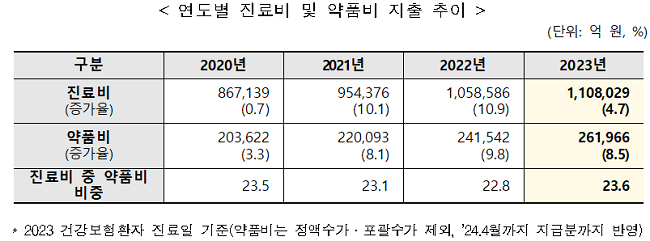
According to the National Health Insurance Service (NHIS, President: Ki-suk Jung), the total drug expenditure in 2023 was KRW 26.196 trillion, an 8.5% increase from the previous year (KRW 24.1542 trillion).
This is twice as high as the 4.7% year-on-year increase in total medical expenses (KRW 110.8029 trillion) in 2023.
The proportion of drug expenses in medical expenses also increased by 0.8 percentage points year-on-year to 23.6%, which indicates that the increase in drug expenditures has exceeded the critical level.
As of 2022, the proportion of drug expenditures in Korea's current health expenditures was 18.0%, 3.8 percentage points higher than the OECD average of 14.2%, and ranked 7th among OECD countries.
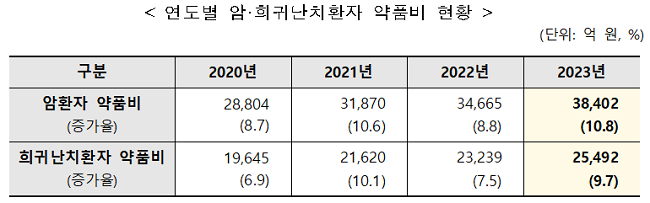
Under the Comprehensive National Health Insurance Plan, the government has been expanding health insurance reimbursement coverage for cancer and rare diseases with high drug costs and promoting drug reimbursement for essential drugs needed for treatment in comprehensive consideration of the social and clinical needs, cost-effectiveness, public acceptance, and financial condition.
In 2022, 22 drugs, including the acute lymphocytic leukemia drug Kymriah, were covered, and the scope of use was expanded for 7 drugs, including immuno-oncology drugs such as Keytruda.
In 2023, 24 drugs, including the spinal muscular atrophy drug Evrysdi, were covered, and the scope of use was expanded for 8 drugs, including those for severe atopic dermatitis.
By age group, patients in their 60s accounted for the highest proportion (25.2%) of drug expenses at KRW 6.6 trillion, followed by those in their 70s (KRW 5.2 trillion), 50s (KRW 4.4 trillion), then 80s (KRW 3.1 trillion).
Those aged 60 and over accounted for 58.1% of all drug expenses.
By type of medical institution, pharmacies accounted for the highest amount of KRW 18 trillion (68.9%), followed by tertiary hospitals (KRW 3.8 trillion), general hospitals (KRW 2.2 trillion), and general clinics (KRW 1.1 trillion).
By efficacy group, arteriosclerosis drugs (hyperlipidemia drugs) accounted for the largest expenditure of KRW 2.849 trillion, followed by anticancer drugs (KRW 2.7336 trillion), blood pressure lowering drugs (KRW 2 trillion), peptic ulcer drugs (KRW 1.3904 trillion), then diabetes combination drugs (KRW 1.3667 trillion).
Due to the aging population and westernized dietary habits, hyperlipidemia drugs have taken the top spot in recent years, followed by drugs for chronic diseases (hypertension, diabetes, and hyperlipidemia).
By ingredient group, the top-ranked drug was the combination of ezetimibe + rosuvastatin for hyperlipidemia, an atherosclerosis drug, posting KRW 605.8 billion.
This was followed by choline alfoscerate (brain function enhancer, KRW 563 billion) > atorvastatin (hyperlipidemia drug, KRW 558.7 billion) > clopidogrel (antithrombotic drug, KRW 417.9 billion) > rosuvastatin (hyperlipidemia drug, KRW 337.7 billion).
The second-ranked drug, choline alfoscerate, has seen a 104.3% increase in spending over the past 5 years (KRW 275.6 billion in 2018 → KRW 563 billion in 2023).
The drug is undergoing clinical reevaluation by the Ministry of Food and Drug Safety to prove its therapeutic effectiveness through clinical trials, and for proper prescription management of the drug, HIRA has recommended institutions refrain from prescribing it for diseases other than dementia as a screened item from 2022, but expenditures on the ingredient have not decreased.
“Drug expenditures are steadily increasing due to the inclusion of new drugs such as high-priced anti-cancer drugs and gene therapies in the reimbursement list and expansion of reimbursement standards, as well as the increase in chronic diseases caused by the aging population,” said an NHIS official.
”We will continue to increase coverage so that people can use the drugs they need for medical treatment on time, but will expand the analysis of drugs that are misused or unnecessarily prescribed to prepare management measures to protect health insurance finances while promoting public health.”
-

- 0
댓글 운영방식은
댓글은 실명게재와 익명게재 방식이 있으며, 실명은 이름과 아이디가 노출됩니다. 익명은 필명으로 등록 가능하며, 대댓글은 익명으로 등록 가능합니다.
댓글 노출방식은
댓글 명예자문위원(팜-코니언-필기모양 아이콘)으로 위촉된 데일리팜 회원의 댓글은 ‘게시판형 보기’와 ’펼쳐보기형’ 리스트에서 항상 최상단에 노출됩니다. 새로운 댓글을 올리는 일반회원은 ‘게시판형’과 ‘펼쳐보기형’ 모두 팜코니언 회원이 쓴 댓글의 하단에 실시간 노출됩니다.
댓글의 삭제 기준은
다음의 경우 사전 통보없이 삭제하고 아이디 이용정지 또는 영구 가입제한이 될 수도 있습니다.
-
저작권·인격권 등 타인의 권리를 침해하는 경우
상용 프로그램의 등록과 게재, 배포를 안내하는 게시물
타인 또는 제3자의 저작권 및 기타 권리를 침해한 내용을 담은 게시물
-
근거 없는 비방·명예를 훼손하는 게시물
특정 이용자 및 개인에 대한 인신 공격적인 내용의 글 및 직접적인 욕설이 사용된 경우
특정 지역 및 종교간의 감정대립을 조장하는 내용
사실 확인이 안된 소문을 유포 시키는 경우
욕설과 비어, 속어를 담은 내용
정당법 및 공직선거법, 관계 법령에 저촉되는 경우(선관위 요청 시 즉시 삭제)
특정 지역이나 단체를 비하하는 경우
특정인의 명예를 훼손하여 해당인이 삭제를 요청하는 경우
특정인의 개인정보(주민등록번호, 전화, 상세주소 등)를 무단으로 게시하는 경우
타인의 ID 혹은 닉네임을 도용하는 경우
-
게시판 특성상 제한되는 내용
서비스 주제와 맞지 않는 내용의 글을 게재한 경우
동일 내용의 연속 게재 및 여러 기사에 중복 게재한 경우
부분적으로 변경하여 반복 게재하는 경우도 포함
제목과 관련 없는 내용의 게시물, 제목과 본문이 무관한 경우
돈벌기 및 직·간접 상업적 목적의 내용이 포함된 게시물
게시물 읽기 유도 등을 위해 내용과 무관한 제목을 사용한 경우
-
수사기관 등의 공식적인 요청이 있는 경우
-
기타사항
각 서비스의 필요성에 따라 미리 공지한 경우
기타 법률에 저촉되는 정보 게재를 목적으로 할 경우
기타 원만한 운영을 위해 운영자가 필요하다고 판단되는 내용
-
사실 관계 확인 후 삭제
저작권자로부터 허락받지 않은 내용을 무단 게재, 복제, 배포하는 경우
타인의 초상권을 침해하거나 개인정보를 유출하는 경우
당사에 제공한 이용자의 정보가 허위인 경우 (타인의 ID, 비밀번호 도용 등)
※이상의 내용중 일부 사항에 적용될 경우 이용약관 및 관련 법률에 의해 제재를 받으실 수도 있으며, 민·형사상 처벌을 받을 수도 있습니다.
※위에 명시되지 않은 내용이더라도 불법적인 내용으로 판단되거나 데일리팜 서비스에 바람직하지 않다고 판단되는 경우는 선 조치 이후 본 관리 기준을 수정 공시하겠습니다.
※기타 문의 사항은 데일리팜 운영자에게 연락주십시오. 메일 주소는 dailypharm@dailypharm.com입니다.


-
- "Leclaza, the best first-line option…expanded reimb will increase accessibility"
- PALOMA-2 recorded an objective response rate (ORR) of 90 and the 3-year overall survival (OS) rate of 70%…mOS has not yet been reached