- LOGIN
- MemberShip
- 2026-09-18 20:33:38
- Active treatment needed for childhood·adolescent obesity
- by Eo, Yun-Ho | translator Alice Kang | 2025-09-15 06:03:07

In particular, the rising prevalence of childhood obesity and the limited treatment options have raised the need for improved treatment environments.
Globally, obesity has become the most common nutritional disorder among children, leading to physical problems such as growth hormone deficiency, precocious puberty, and polycystic ovary syndrome, as well as psychosocial issues including low self-esteem, depression, and anxiety.
Since children and adolescents are continuously growing in height and weight, obesity is diagnosed using body mass index (BMI) percentiles based on sex and age.
According to the Korean Society for the Study of Obesity’s Clinical Practice Guidelines (2022, 8th edition), children aged two years and older should be assessed using the 2017 growth chart: BMI at or above the 85th percentile is considered overweight, and at or above the 95th percentile is considered obese.
◆Childhood and adolescent obesity is on a continuous rise...Korea is also at risk The problem is the sharp increase in the childhood and adolescent obesity population.
According to a pooled analysis by the World Health Organization (WHO) and Imperial College London, the number of obese children and adolescents has increased by more than tenfold over the past 40 years.
By analyzing BMI and obesity prevalence trends from height and weight measurements in populations aged 5 and older across 200 countries between 1975 and 2016, the prevalence of childhood obesity rose from less than 1% in 1975 to 6% among girls and 8% among boys in 2016.
This indicates a steady global rise in both the number and proportion of children affected by obesity, with particularly sharp increases in regions such as the Middle East and North Africa, South Asia, East Asia, and high-income English-speaking countries.
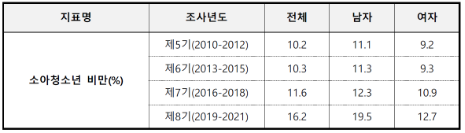
According to the “2021 National Health Statistics” published by the Korea Disease Control and Prevention Agency, obesity prevalence among boys aged 6–18 increased to 19.5% in the 8th survey period from 11.1% in the 5th (a 1.76-fold increase), while among girls it rose to 12.7% from 9.2%, which is a 1.38-fold increase.
Also, a sample survey of elementary, middle, and high school students released by the Ministry of Education in April showed that 29.3% of students fell into the overweight or obese category last year—which is roughly one in three.
◆Academic community aligns with clinical guidelines...recommends drug therapy Given this situation, clinical guidelines for childhood and adolescent obesity are also evolving.
Notably, the necessity for more direct treatment approaches, including previously conservative drug therapy, is increasingly being raised.
According to the guidelines released on January 9, 2023, by the American Academy of Pediatrics (AAP) for the evaluation and treatment of childhood obesity, pharmacological therapy is recommended for children aged two and older, and surgical interventions are permitted from age 13 onward—emphasizing active intervention from the early stages of diagnosis.
The recommended medications include Saxenda (liraglutide), Wegovy (semaglutide), Xenical (orlistat), and Qsymia (phentermine/topiramate).
This has sparked debate by overturning the tendency to prioritize traditional dietary and behavioral therapies in children and adolescents, but it also underscores the urgent need for obesity management in severely obese children and adolescents.
Korea has also recognized the need for pharmacotherapy.
In 2022, the Korean Society for the Study of Obesity recommended considering drug therapy under the supervision of experienced specialists if intensive diet, exercise, and behavioral therapy fail to control ongoing weight gain and obesity-related comorbidities in children Furthermore, the first guidelines on childhood obesity that was published in Asia, which was in 2019, covered the ▲definition and diagnosis of overweight and obesity in children, ▲treatment principles of pediatric obesity, ▲behavioral therapy (including diet, exercise, lifestyle, and mental health), ▲pharmacological treatment, and ▲surgical treatment.
For each area, they established recommendations and their respective levels of evidence (Level A–D).
Professor Hye-Woon Jung of Kyung Hee University Hospital’s Department of Pediatrics said, “Lifestyle intervention is important for severely obese children and adolescents, but it may not be enough.
In such cases, active pharmacological treatment should be considered.
Although some medications are approved for severe pediatric obesity, treatment options remain limited in Korea.”
-

- 0
댓글 운영방식은
댓글은 실명게재와 익명게재 방식이 있으며, 실명은 이름과 아이디가 노출됩니다. 익명은 필명으로 등록 가능하며, 대댓글은 익명으로 등록 가능합니다.
댓글 노출방식은
댓글 명예자문위원(팜-코니언-필기모양 아이콘)으로 위촉된 데일리팜 회원의 댓글은 ‘게시판형 보기’와 ’펼쳐보기형’ 리스트에서 항상 최상단에 노출됩니다. 새로운 댓글을 올리는 일반회원은 ‘게시판형’과 ‘펼쳐보기형’ 모두 팜코니언 회원이 쓴 댓글의 하단에 실시간 노출됩니다.
댓글의 삭제 기준은
다음의 경우 사전 통보없이 삭제하고 아이디 이용정지 또는 영구 가입제한이 될 수도 있습니다.
-
저작권·인격권 등 타인의 권리를 침해하는 경우
상용 프로그램의 등록과 게재, 배포를 안내하는 게시물
타인 또는 제3자의 저작권 및 기타 권리를 침해한 내용을 담은 게시물
-
근거 없는 비방·명예를 훼손하는 게시물
특정 이용자 및 개인에 대한 인신 공격적인 내용의 글 및 직접적인 욕설이 사용된 경우
특정 지역 및 종교간의 감정대립을 조장하는 내용
사실 확인이 안된 소문을 유포 시키는 경우
욕설과 비어, 속어를 담은 내용
정당법 및 공직선거법, 관계 법령에 저촉되는 경우(선관위 요청 시 즉시 삭제)
특정 지역이나 단체를 비하하는 경우
특정인의 명예를 훼손하여 해당인이 삭제를 요청하는 경우
특정인의 개인정보(주민등록번호, 전화, 상세주소 등)를 무단으로 게시하는 경우
타인의 ID 혹은 닉네임을 도용하는 경우
-
게시판 특성상 제한되는 내용
서비스 주제와 맞지 않는 내용의 글을 게재한 경우
동일 내용의 연속 게재 및 여러 기사에 중복 게재한 경우
부분적으로 변경하여 반복 게재하는 경우도 포함
제목과 관련 없는 내용의 게시물, 제목과 본문이 무관한 경우
돈벌기 및 직·간접 상업적 목적의 내용이 포함된 게시물
게시물 읽기 유도 등을 위해 내용과 무관한 제목을 사용한 경우
-
수사기관 등의 공식적인 요청이 있는 경우
-
기타사항
각 서비스의 필요성에 따라 미리 공지한 경우
기타 법률에 저촉되는 정보 게재를 목적으로 할 경우
기타 원만한 운영을 위해 운영자가 필요하다고 판단되는 내용
-
사실 관계 확인 후 삭제
저작권자로부터 허락받지 않은 내용을 무단 게재, 복제, 배포하는 경우
타인의 초상권을 침해하거나 개인정보를 유출하는 경우
당사에 제공한 이용자의 정보가 허위인 경우 (타인의 ID, 비밀번호 도용 등)
※이상의 내용중 일부 사항에 적용될 경우 이용약관 및 관련 법률에 의해 제재를 받으실 수도 있으며, 민·형사상 처벌을 받을 수도 있습니다.
※위에 명시되지 않은 내용이더라도 불법적인 내용으로 판단되거나 데일리팜 서비스에 바람직하지 않다고 판단되는 경우는 선 조치 이후 본 관리 기준을 수정 공시하겠습니다.
※기타 문의 사항은 데일리팜 운영자에게 연락주십시오. 메일 주소는 dailypharm@dailypharm.com입니다.