- LOGIN
- MemberShip
- 2026-09-18 20:07:31
- Denmark's non-profit foundation's virtuous governance cycle
- by | translator Alice Kang | 2025-07-18 06:35:16

August Krogh paid just $1 to introduce insulin production technology from the University of Toronto in Canada.
At the time, he made two promises to the University of Toronto research team: to make insulin available to all patients at an affordable price and to use insulin for public healthcare rather than for commercial gain.
And Leo Pharma delivered on this promise.
Despite the uncertain profitability of insulin production, Leo Pharma participated in its production, laying the groundwork for the first commercialization of insulin in Northern Europe.
Following this, Dr.
Krogh established the non-profit organization Nordic Insulin Laboratory to ensure a stable supply of insulin.
The two brother researchers who worked with him at the laboratory later spun off to form Novo Insulin Research Institute.
The two organizations merged in 1989, giving rise to today's Novo Nordisk.
Denmark's public-interest-driven medical philosophy did not end as a single generation’s promise.
The spirit was carried forward through the corporate governance structure of foundation ownership.
Major Danish pharmaceutical companies such as Novo Nordisk, Leo Pharma, and Lundbeck all have a structure in which a non-profit foundation serves as the top shareholder.
These foundations support the long-term stability of the companies and return profits to society and science, thereby putting into practice the public values emphasized by Dr.
Krogh even today.
'Foundation is the largest shareholder'...
A sustainable management model created by society, institutions, and culture According to industry sources on the 15th, Denmark has the most structured ‘foundation-owned model’ in Europe.
Approximately 1,300 companies in Denmark are operated as foundations.
According to research by Børsting and Thomsen (2017), foundation-owned companies account for approximately 70% of the total market capitalization of the stock market in Denmark, demonstrating the overwhelming influence of foundation-owned companies.
Pharmaceutical companies such as Novo Nordisk, Leo Pharma, and Lundbeck, as well as toy company Lego, beer company Carlsberg, and shipping company Maersk, all adopt a governance structure where a foundation is the majority shareholder.
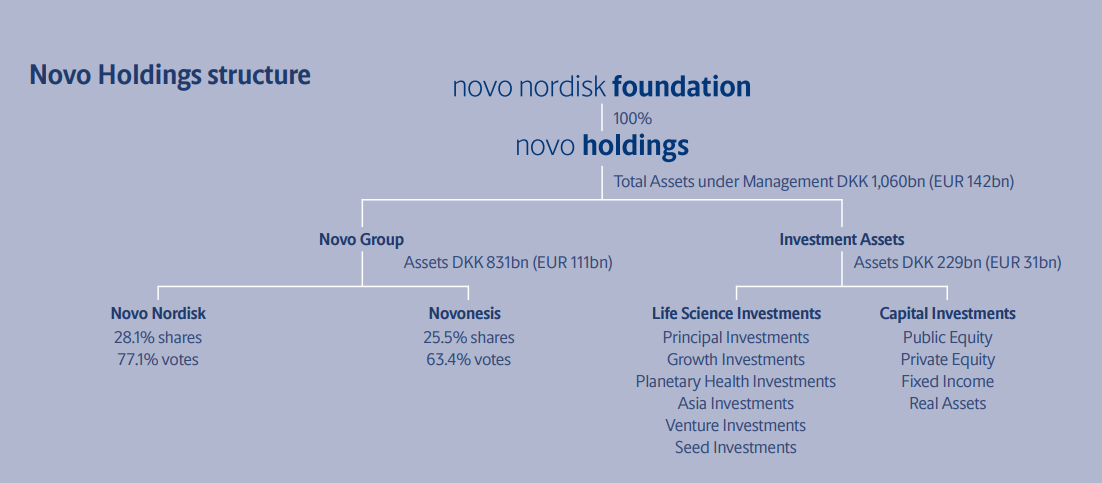
Novo Nordisk's governance structure is organized as a “foundation → holding company → operating company” structure.
At the top is the non-profit public interest foundation Novo Nordisk Foundation, established with the goal of realizing corporate social responsibility and public value.
Rather than directly managing the company, it owns Novo Holdings, a holding company and professional investment firm, as a 100% subsidiary.
Novo Holdings, in turn, holds shares in major pharmaceutical companies such as Novo Nordisk and Novozymes.
This structure effectively allows the foundation to control Novo Nordisk through Novo Holdings.
Novo Holdings holds approximately 28% of Novo Nordisk's shares.
Although the surface ownership ratio is relatively low, Novo Holdings secures approximately 77% of the total voting rights of Novo Nordisk through a dual-class share structure, enabling it to maintain stable management control.
Under the dual-class share structure, the number of voting rights varies depending on the type of shares.
The shares held by Novo Holdings are designed to allow the exercise of more voting rights per share than ordinary shares.
The Lundbeck Foundation is the largest shareholder, holding approximately 70% of Lundbeck's shares.
Another pharmaceutical company, Leo Pharma, is approximately 80% owned by the Leo Foundation.
The remaining shares of Leo Pharma are held by private equity fund Nordic Capital.
Leo Pharma plans to go public as early as next year, with the Leo Foundation maintaining a majority stake even after the IPO.
Denmark's foundation-based governance structure is different from Germany's family ownership and South Korea's holding company-based structures, as it is based on social values.
In this structure, the foundation functions as the core entity that designs the company's direction and strategy, going beyond the role of the largest shareholder.
The foundation prioritizes long-term research and development and the realization of social value, rather than being swayed by short-term profits.
The foundation reinvests profits from dividends received from the company and its own investment activities into public welfare projects.
The establishment of a foundation-based governance structure in Denmark is not simply due to the philosophy of founders or historical coincidence.
It is a structural product of the interplay between social, economic, institutional, and cultural factors.
Many Danish companies began as family businesses, but instead of passing on shares to their children, founders often chose to transfer them to public interest foundations.
For example, the founder of Novo Nordisk, Dr.
Krogh, did not pass on shares to his family even after the Nordic Insulin Laboratory grew into a corporation, instead transferring ownership to a public foundation.
Leo Pharma, a company founded by a pharmacist who accumulated capital to grow the business, also passed on shares to a foundation rather than to his children, continuing the founding philosophy.
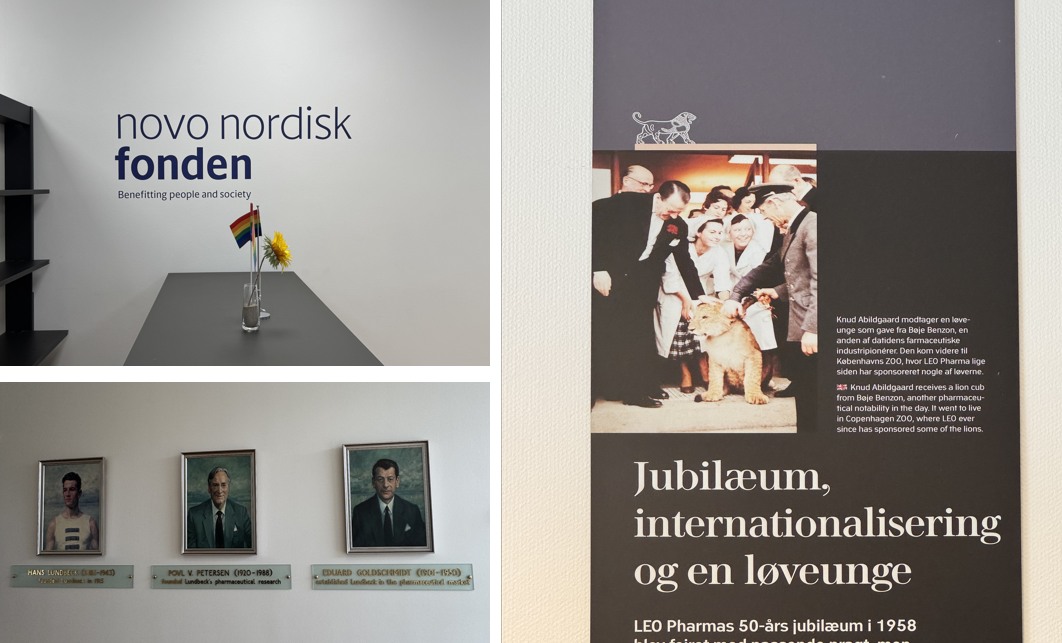
In Denmark, external capital inevitably held significant influence, leading to the natural adoption of foundation-based governance structures.
Since foundations function as a means of defending corporate control, even if external parties attempt to suddenly acquire a large amount of shares or engage in hostile mergers and acquisitions (M&A), they cannot effectively seize control of management.
Government policy support also played a crucial role in the establishment of a foundation-based governance structure.
Under Danish law, companies owned by foundations are eligible for corporate tax exemptions if they distribute a certain percentage of their annual net profits for public welfare purposes.
For example, if a foundation allocates more than 4% of its annual revenue to social welfare, it is exempt from taxation.
This enables foundations to actively disburse subsidies and research funds.
The legal framework enabling foundations to stably own companies is another core factor enabling public interest-centered management.
Denmark restricts the easy sale of shares owned by foundations.
This is to ensure that foundations are not swayed by short-term market fluctuations or external pressures, and can execute long-term corporate strategies in line with the founder's philosophy and public interest objectives.
In other words, policy support has provided a foundation for the founders' philosophy to be institutionalized and sustainably implemented, rather than remaining a one-time legacy.
Long-term perspective rather than short-term performance...
Foundation-based governance proves with results The most distinctive feature of the Danish foundation-based governance structure is the clear separation of ownership and management and the simplicity of the structure itself.
For example, the Novo Nordisk Foundation's board of directors consists of 11 members, including Chairman Lars Rebien Sørensen.
Three of the board members are employee representatives.
Employee representatives are elected by Novo Nordisk or Novonesis employees for a four-year term.
It is also noteworthy that there are no issues of dual listing within the governance structure.
In the Novo Nordisk model, the foundation controls the listed operating company through a non-listed holding company, creating a single stakeholder structure that minimizes the potential for conflicts of interest and external interference.
This distinguishes it from the domestic model, where the holding company and operating company are listed separately, leading to recurring issues such as conflicts of interest between the holding company and subsidiary shareholders and allegations of profit diversion from subsidiaries.
Jun-beom Cheon, Vice Chairman of the Korean Corporate Governance Forum (Attorney), explained, “The fact that the foundation holds 100% of the holding company's shares means that the holding company is unlisted.
This structure allows for the continuous pursuit of business under the same interests without duplicate listings of the operating company.” Ultimately, the core is the “single governance structure without duplicate listings” formed around the foundation.
This structure provides a foundation for companies to consistently execute long-term strategies without being overly concerned about short-term results.
As they are relatively free from the short-term profit demands of external investors or shareholders, they can focus on tasks such as long-term research and development (R&D) or the realization of public value.
Also, the foundation can demonstrate high flexibility in terms of equity ownership and investment methods.
It can secure a majority stake to deeply engage in management or, conversely, hold a minority stake while focusing on long-term support and public interest objectives.
Since the timing of investment exit is not strictly predetermined, it follows a distinctly different trajectory from private equity funds that pursue short-term exits based on the premise of achieving a certain level of returns.
The most notable product of foundation-based governance is “Wegovy.” Thanks to an environment that enabled sustained R&D, Novo Nordisk has grown into the world's leading GLP-1 antidiabetic and obesity treatment company.
Lundbeck and Leo Pharma are no exceptions.
Thanks to their stable foundation-based governance structures, these companies have been able to maintain consistent strategies over the long term, even in low-profit or market-uncertain fields such as mental health treatments and rare/chronic skin disease therapies, despite incurring losses.
Lan Ding, Vice President of Lundbeck, stated, “We have pursued a strategy focused solely on a specific disease group, neurological disorders, similar to Lundbeck.
If a company has a structure where the foundation holds 70% of the shares, like Lundbeck, it can prioritize long-term value over short-term results.”
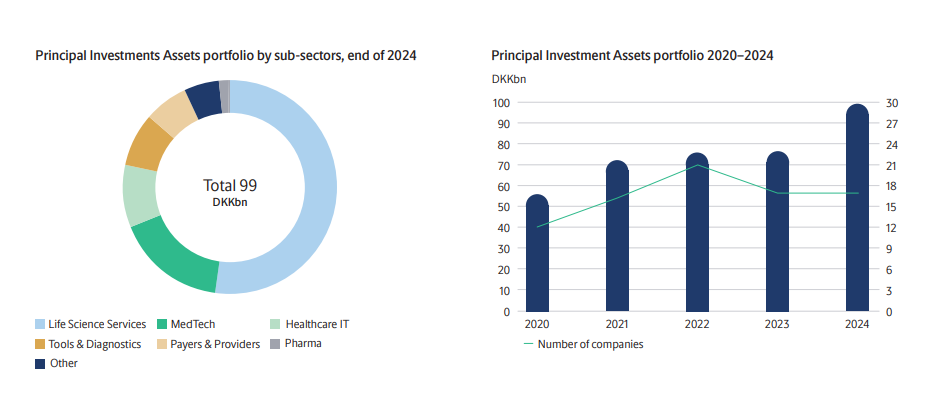
Last year, Novo Holdings earned 8 billion euros (approximately KRW 13 trillion), doubling its sales from the previous year.
The portfolio return rate jumped from 9.4% in 2023 to 18% last year.
This is the result of Novo Holdings' strategic investments based on its expertise in life sciences and its ability to connect ecosystems.
Denmark Foundation returns profits to society...
Attracting global talent through investment in basic sciences The Danish pharmaceutical company's foundation also plays the role of an investor in the national medical and basic science ecosystem.
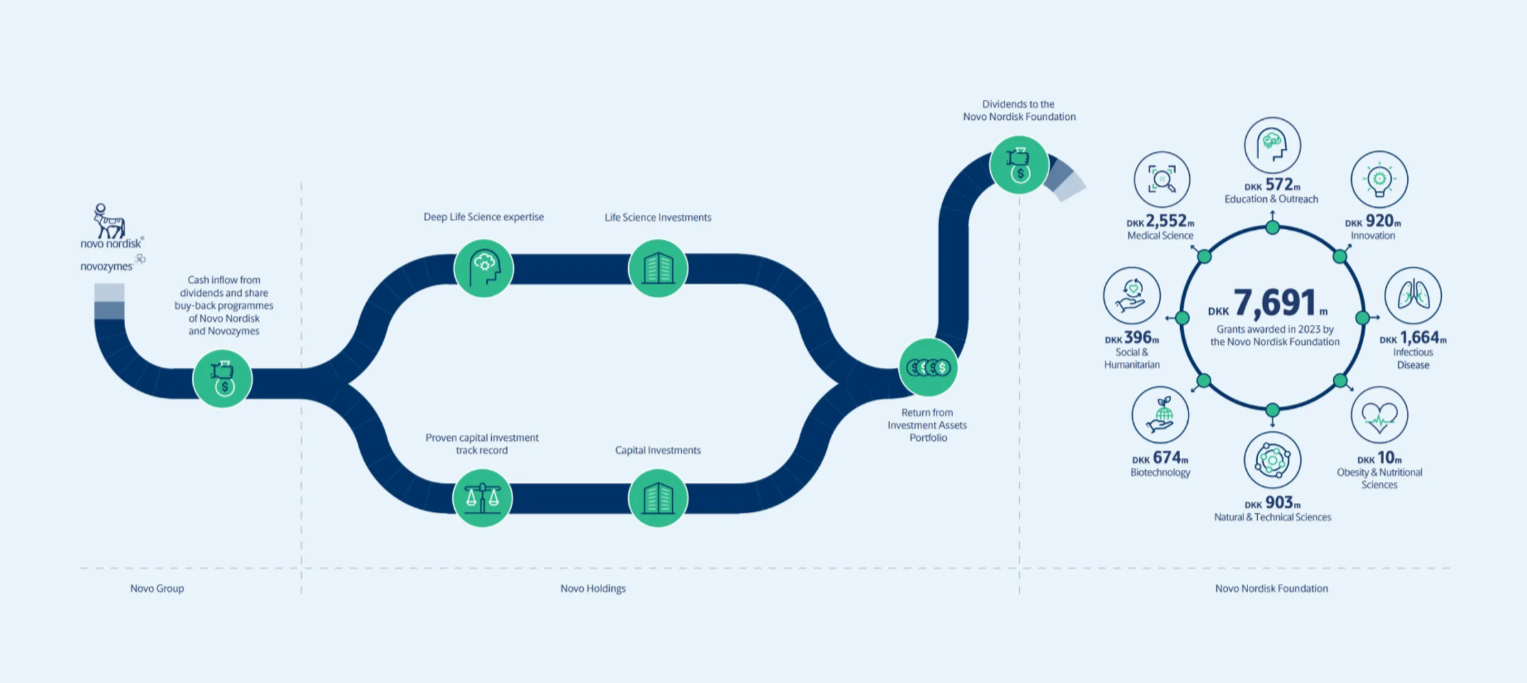
All profits generated by Novo Holdings are transferred to the foundation.
As a 100% non-profit organization, the Novo Nordisk Foundation redistributes these funds in the form of grants for the benefit of society.
This creates a cycle structure where corporate profits are reinvested through the foundation for public purposes such as science, health, and education.
The Novo Nordisk Foundation executes public-interest investments across a wide range of fields, from promoting science, technology, engineering, and mathematics (STEM) education to vaccine development, infectious disease response, and AI supercomputing infrastructure construction.
The foundation allocates an annual grant budget of USD 1 billion for these activities and plans to expand its investment to USD 2 billion over the next decade.
In fact, many scientists from around the world have flocked to major Danish universities such as the University of Copenhagen and the Technical University of Denmark, which in turn has led to an influx of talent to Danish biotech companies, including Novo Nordisk.
A representative from Novo Holdings explained, “There was a shared awareness that without attracting overseas talent, both Novo Nordisk and Danish universities would struggle to maintain their current level of research capabilities.
Through the Novo Nordisk Foundation and Novo Nordisk actively supporting research infrastructure centered in Copenhagen, we have created a virtuous cycle where talented researchers and professors from around the world are drawn to Denmark.” The foundation is also recognized as the hub of Denmark's bio-industry innovation ecosystem.
This is because the foundation directly designed and led the structure that connects early-stage science and technology with entrepreneurship.
The BioInnovation Institute (BII) is one representative example.
BII is a non-profit startup support organization established with full funding from the Novo Nordisk Foundation.
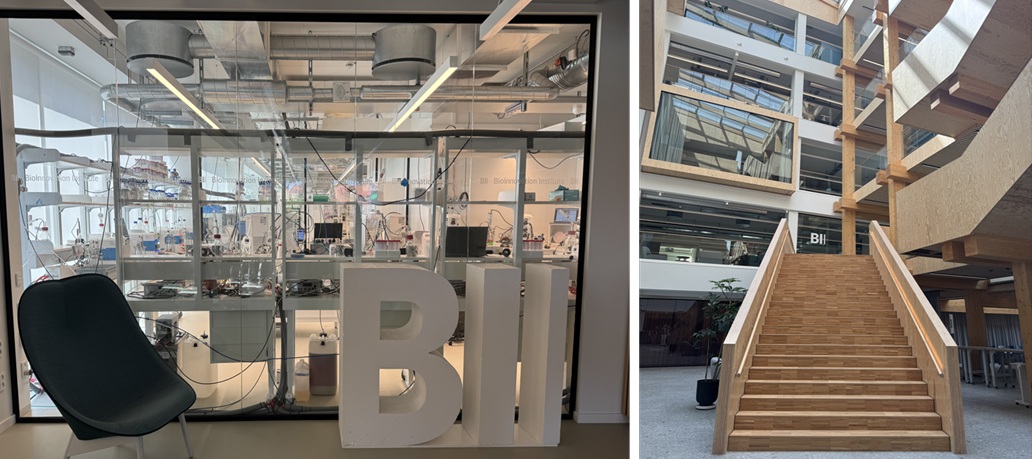
In addition, it operates a full-cycle support system that includes shared laboratory infrastructure, dedicated mentoring, investor connections, and business development strategy planning.
Currently, BII accounts for about 80% of Denmark's life science and bio sectors, playing a central role in the overall bio ecosystem.
Startups incubated by BII attract follow-up investments from Novo Holdings' venture funds and global investors.
Some form strategic partnerships with Novo Nordisk and Leo Pharma.
A BII representative stated, “To date, 80 companies that have received BII support have successfully secured external funding.
For every 1 euro invested by BII, companies secure an average of 7 euros in additional grants or investments.” This virtuous cycle has solidified the foundation-based governance structure as the backbone connecting Denmark's bio industry ecosystem.
-

- 0
댓글 운영방식은
댓글은 실명게재와 익명게재 방식이 있으며, 실명은 이름과 아이디가 노출됩니다. 익명은 필명으로 등록 가능하며, 대댓글은 익명으로 등록 가능합니다.
댓글 노출방식은
댓글 명예자문위원(팜-코니언-필기모양 아이콘)으로 위촉된 데일리팜 회원의 댓글은 ‘게시판형 보기’와 ’펼쳐보기형’ 리스트에서 항상 최상단에 노출됩니다. 새로운 댓글을 올리는 일반회원은 ‘게시판형’과 ‘펼쳐보기형’ 모두 팜코니언 회원이 쓴 댓글의 하단에 실시간 노출됩니다.
댓글의 삭제 기준은
다음의 경우 사전 통보없이 삭제하고 아이디 이용정지 또는 영구 가입제한이 될 수도 있습니다.
-
저작권·인격권 등 타인의 권리를 침해하는 경우
상용 프로그램의 등록과 게재, 배포를 안내하는 게시물
타인 또는 제3자의 저작권 및 기타 권리를 침해한 내용을 담은 게시물
-
근거 없는 비방·명예를 훼손하는 게시물
특정 이용자 및 개인에 대한 인신 공격적인 내용의 글 및 직접적인 욕설이 사용된 경우
특정 지역 및 종교간의 감정대립을 조장하는 내용
사실 확인이 안된 소문을 유포 시키는 경우
욕설과 비어, 속어를 담은 내용
정당법 및 공직선거법, 관계 법령에 저촉되는 경우(선관위 요청 시 즉시 삭제)
특정 지역이나 단체를 비하하는 경우
특정인의 명예를 훼손하여 해당인이 삭제를 요청하는 경우
특정인의 개인정보(주민등록번호, 전화, 상세주소 등)를 무단으로 게시하는 경우
타인의 ID 혹은 닉네임을 도용하는 경우
-
게시판 특성상 제한되는 내용
서비스 주제와 맞지 않는 내용의 글을 게재한 경우
동일 내용의 연속 게재 및 여러 기사에 중복 게재한 경우
부분적으로 변경하여 반복 게재하는 경우도 포함
제목과 관련 없는 내용의 게시물, 제목과 본문이 무관한 경우
돈벌기 및 직·간접 상업적 목적의 내용이 포함된 게시물
게시물 읽기 유도 등을 위해 내용과 무관한 제목을 사용한 경우
-
수사기관 등의 공식적인 요청이 있는 경우
-
기타사항
각 서비스의 필요성에 따라 미리 공지한 경우
기타 법률에 저촉되는 정보 게재를 목적으로 할 경우
기타 원만한 운영을 위해 운영자가 필요하다고 판단되는 내용
-
사실 관계 확인 후 삭제
저작권자로부터 허락받지 않은 내용을 무단 게재, 복제, 배포하는 경우
타인의 초상권을 침해하거나 개인정보를 유출하는 경우
당사에 제공한 이용자의 정보가 허위인 경우 (타인의 ID, 비밀번호 도용 등)
※이상의 내용중 일부 사항에 적용될 경우 이용약관 및 관련 법률에 의해 제재를 받으실 수도 있으며, 민·형사상 처벌을 받을 수도 있습니다.
※위에 명시되지 않은 내용이더라도 불법적인 내용으로 판단되거나 데일리팜 서비스에 바람직하지 않다고 판단되는 경우는 선 조치 이후 본 관리 기준을 수정 공시하겠습니다.
※기타 문의 사항은 데일리팜 운영자에게 연락주십시오. 메일 주소는 dailypharm@dailypharm.com입니다.