- LOGIN
- MemberShip
- 2026-07-07 07:04:00
- Dreaming of making a brighter world together with patient
- by Kim, Jin-Gu | translator | 2019-11-04 15:12:37
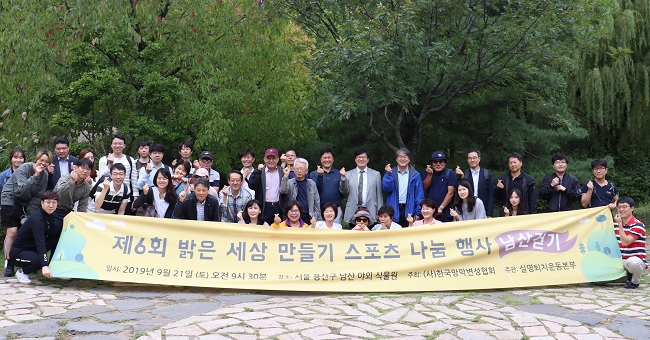
About 40 patients with retinal degeneration and medical professions were taking a group walk on Namsan hiking trail.
No one could tell who was the patient or doctor.
Each seemed to be enjoying pleasant fall breeze brushing over their face.

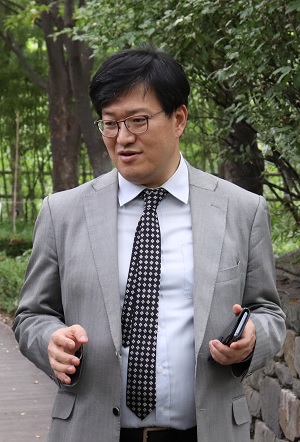
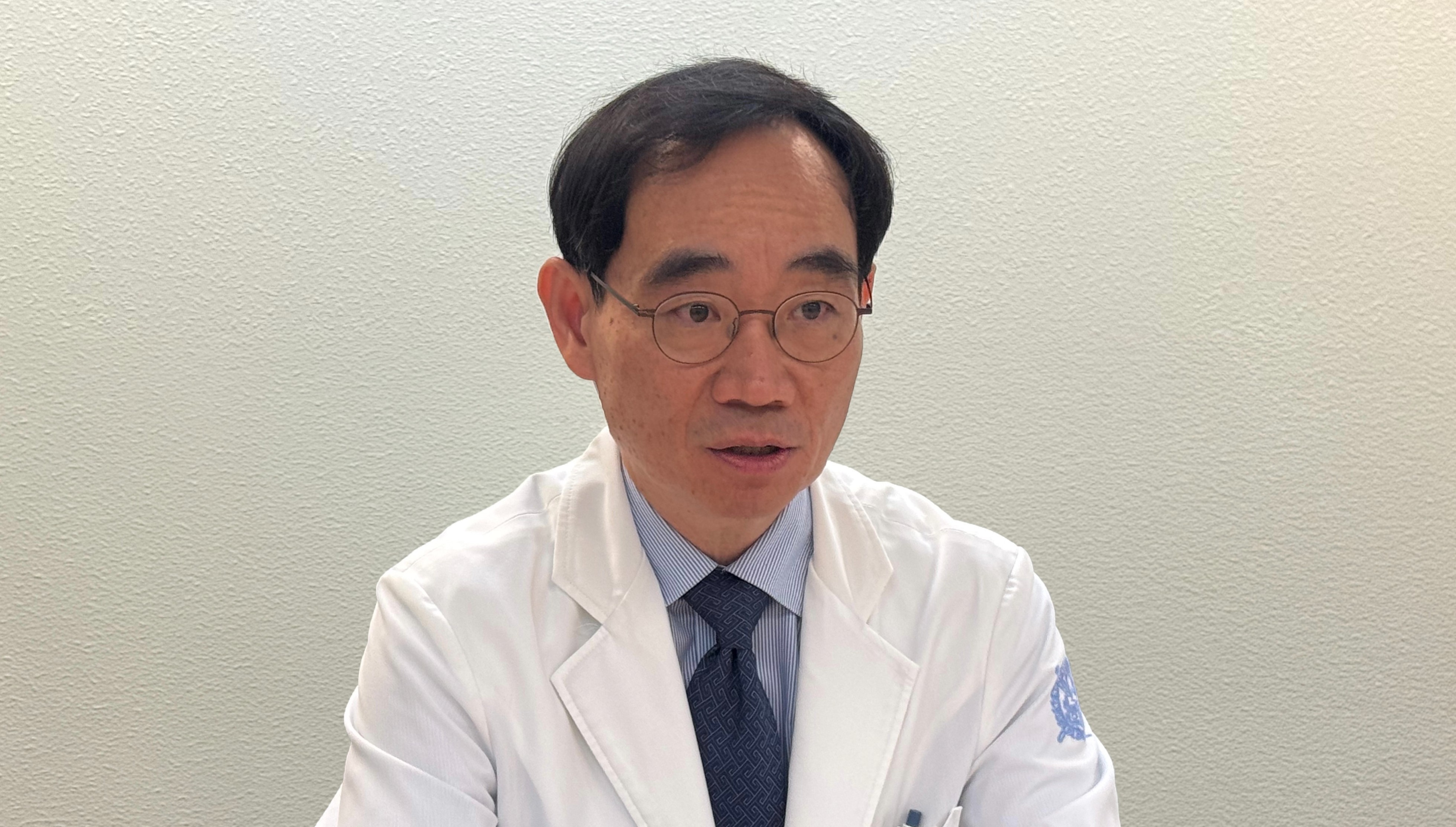
A president of KARD and an ophthalmology professor at Seoul National University Hospital, Yu said, “As you can see, distinguishing a patient or non-patient is meaningless.
We both can be considered non-patient as for retinal degeneration, but we could be a patient with other health issue”.
KARD, the organization he leads differentiates itself from other patient group or academic society.
Member consists of mix between patients and doctors, but at the same time doctors are not the face of the organization.
While studying inherited retinal degenerations (IRDs), KARD also advocates for patient support and social awareness.
During the interview, President Yu Hyeong-gon constantly emphasized the value his organization strives on; ‘making a society embracing both patients and non-patients’.
▶How about a short introduction of your organization? “Korean Association of Retinal Degeneration, or KARD, is a research organization that also supports severe retinal degeneration treatment.
First it started as a small-scale study group for medical professions.
The members contemplated much about providing practical support to patients.
So the original members all agreed to make it a public interest group.
And without any other outside donation, each professor put down some money and made an incorporated association.
“Usually an academic society is formed centering doctors.
But KARD wanted to take a step further and make a group for actual patients to participate in.
In fact in the U.S., there are plenty of groups where patients and healthcare providers come together.
The organization got bigger as time passed, and now we have 50 university hospital medical professions and bioengineering researchers, along with 30 patients as members.
And there are some outside sponsors, KARD has numerous ongoing projects varying from treatment research to retinal degeneration awareness training and public relations for general public, and even to policy making.” ▶What inspired the ‘Making a Brighter World’ event?
“The name of the event, ‘Making a Brighter World’ has two meanings; one is to bring a ray of light to patients with visual impairment by providing effective treatment, and another is to make a warmer society by bringing disabled, sick and healthy people together.
That is how the name came about.
“This marks a sixth event.
In last five events, patients and non-patients took a walk together and tried rowing and tap dancing together.
All events had different activities, but what meant the most is spending the time together”.
But recent news reported now there are new treatments available like retina implant and gene therapy. “Gene therapy was developed first than the other.
It has been about a year and a half.
We predict it would be introduced to Korea at earliest next year.
Apparently, about 260 out of 300,000 genes cause IRDs.
And one of them is identified as ‘RP65’.
“Currently approved treatment targets defect in gene RP65.
It treats to prevent death of photoreceptor cell and recovers its function to a certain level.
Eye sight may get better a bit, but the treatment cannot completely revive dead cells.
But, it is still quite meaningful.
Because most of retinal mutation is found after 20s, even a bit of improvement in sight helps the patient’s later life.
“Prosthetic retina implant has been experimented many times, before gene therapy was as developed as now.
A chip is inserted to replace dead photoreceptors.
It literally stimulates cells to see artificially.
And because the chip would replace photoreceptor cells, the principle is to conduct the procedure after the cell is completely lost.
However, the procedure is quite burdensome without healthcare coverage”.
▶Going back to the medical condition, are symptoms mainly found in adulthood as you mentioned? “Most of patients recognize the condition after their early 20s.
Some rare cases have detected symptom when they were younger than one.
It is a condition called ‘Leber Congenital Amaurosis (LCA).’ Symptoms and progression are similar to normal retinal degeneration, but it starts at a very young age.
And if it is the RP65 causing the condition, then the said gene therapy can be tried”.
▶You mentioned 260 out of 300,000 genes are responsible for IRDs and one of them is RP65.
Then, out of a hundred IRDs patient, how many could use the gene therapy?
Or maybe even less.
It may seem significantly low, but having one effective treatment out makes a difference.
After a success of this treatment, many pharmaceutical companies have initiated a pipeline on IRDs.
At the moment, 26 ongoing clinical trials are conducted around the world.
And the trials not only focus on RP65, but also on a gene called ‘MYO7A’”.
▶Is there any research done by the organization independently? “To be honest, independently researching a treatment is not that easy.
It requires advanced facilities and tools, and the cost is exponential.
So whenever there is a chance, we conduct a joint research with overseas research institute.
“Also we are actively participating in clinical trials.
Specifically, the organization has its own medical image analysis center for clinical trials.
In Korea, Chong Kun Dang Pharmaceutical is conducting a clinical trial on biosimilars.
27 university-affiliated hospitals are part of the study.
And there are other Korean companies running clinical trial on three or four other medicine.
And of course, multinational pharmaceutical companies are developing many more medicine”.
▶Heard there is an ongoing cohort study.
Have you found any new findings specifically for Korean patients? “General prevalence rate is not far off from cases in other countries.
Studies have found about one out of 2,000 has a severe IRDs, and one out of a thousand has not-so-severe IRDs.
And I published a book summarizing key findings of the condition.
“Many cases of IRDs have different causes.
Most of the cases were caused by uveitis, an eye infection, and sometimes it is found as symptoms of malnutrition, syphilis, tuberculosis, and other infectious diseases”.
▶Any notable plan in the future? “A patient has to take 200 genetic testing to get diagnosed with IRDs.
They cost about a little less than one million won per patient.
The cost is quite steep.
The organization is trying to sponsor the diagnostic tests for some patients.
We wish we can cover all patients, but the organization is not that well off.
But still our goal is to support as many patients as possible.
We are currently raising fund for 200 patients’ testing.
“KARD is now six years old.
When we turned a research group to a full-blown organization, we did not know what to expect.
But for sure, what we wanted out of it was for the sake of the public.
The organization’s schedule is getting full with events like ‘Making a Brighter World’, symposium and group counseling.
And we are now ready take the organization into another level.
So we could finally conduct creative research we have wanted to do”.
▶And lastly, few words to patients?
“It must be difficult without a clear treatment, yet.
But more treatments are getting coming soon.
Please do not let go of your hope.
KARD is here to provide various information and support for treatment.
“What matters the most is the ‘togetherness’.
Segregating patients and non-patients does not mean much.
Retina degeneration could make one a patient, but other diseases could make anyone a patient.
We hope we can bridge patients and non-patients for more help to be shared.
“I would also like to express my gratitude for all active patient members of KARD.
Many patients first join the organization for their individual agenda.
But as time passes, more of them try to help other patients based on their experience.
I know it is not that easy.
It is a right thing to do, but not everyone can do it.
We are just trying to be together and help each other.
We believe the day would come when we get good results for all endeavors”.
-

- 0
댓글 운영방식은
댓글은 실명게재와 익명게재 방식이 있으며, 실명은 이름과 아이디가 노출됩니다. 익명은 필명으로 등록 가능하며, 대댓글은 익명으로 등록 가능합니다.
댓글 노출방식은
댓글 명예자문위원(팜-코니언-필기모양 아이콘)으로 위촉된 데일리팜 회원의 댓글은 ‘게시판형 보기’와 ’펼쳐보기형’ 리스트에서 항상 최상단에 노출됩니다. 새로운 댓글을 올리는 일반회원은 ‘게시판형’과 ‘펼쳐보기형’ 모두 팜코니언 회원이 쓴 댓글의 하단에 실시간 노출됩니다.
댓글의 삭제 기준은
다음의 경우 사전 통보없이 삭제하고 아이디 이용정지 또는 영구 가입제한이 될 수도 있습니다.
-
저작권·인격권 등 타인의 권리를 침해하는 경우
상용 프로그램의 등록과 게재, 배포를 안내하는 게시물
타인 또는 제3자의 저작권 및 기타 권리를 침해한 내용을 담은 게시물
-
근거 없는 비방·명예를 훼손하는 게시물
특정 이용자 및 개인에 대한 인신 공격적인 내용의 글 및 직접적인 욕설이 사용된 경우
특정 지역 및 종교간의 감정대립을 조장하는 내용
사실 확인이 안된 소문을 유포 시키는 경우
욕설과 비어, 속어를 담은 내용
정당법 및 공직선거법, 관계 법령에 저촉되는 경우(선관위 요청 시 즉시 삭제)
특정 지역이나 단체를 비하하는 경우
특정인의 명예를 훼손하여 해당인이 삭제를 요청하는 경우
특정인의 개인정보(주민등록번호, 전화, 상세주소 등)를 무단으로 게시하는 경우
타인의 ID 혹은 닉네임을 도용하는 경우
-
게시판 특성상 제한되는 내용
서비스 주제와 맞지 않는 내용의 글을 게재한 경우
동일 내용의 연속 게재 및 여러 기사에 중복 게재한 경우
부분적으로 변경하여 반복 게재하는 경우도 포함
제목과 관련 없는 내용의 게시물, 제목과 본문이 무관한 경우
돈벌기 및 직·간접 상업적 목적의 내용이 포함된 게시물
게시물 읽기 유도 등을 위해 내용과 무관한 제목을 사용한 경우
-
수사기관 등의 공식적인 요청이 있는 경우
-
기타사항
각 서비스의 필요성에 따라 미리 공지한 경우
기타 법률에 저촉되는 정보 게재를 목적으로 할 경우
기타 원만한 운영을 위해 운영자가 필요하다고 판단되는 내용
-
사실 관계 확인 후 삭제
저작권자로부터 허락받지 않은 내용을 무단 게재, 복제, 배포하는 경우
타인의 초상권을 침해하거나 개인정보를 유출하는 경우
당사에 제공한 이용자의 정보가 허위인 경우 (타인의 ID, 비밀번호 도용 등)
※이상의 내용중 일부 사항에 적용될 경우 이용약관 및 관련 법률에 의해 제재를 받으실 수도 있으며, 민·형사상 처벌을 받을 수도 있습니다.
※위에 명시되지 않은 내용이더라도 불법적인 내용으로 판단되거나 데일리팜 서비스에 바람직하지 않다고 판단되는 경우는 선 조치 이후 본 관리 기준을 수정 공시하겠습니다.
※기타 문의 사항은 데일리팜 운영자에게 연락주십시오. 메일 주소는 dailypharm@dailypharm.com입니다.
- [Reporter's View] CSO Association set to receive official legal status
- Reporter's view | Kim, Jin-Gu