
- LOGIN
- MemberShip
- 2026-05-07 16:06:40
- Policy
- 45 generics of Dapagliflozin+Sitagliptin were approved
- by Lee, Tak-Sun Feb 03, 2022 05:57am
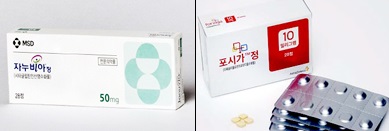
- MSD Dapagliflozin+Sitaglipin from 45 companies, which can only be sold in September next year, has been approved. Analysts say that the number of licensed companies is increasing as Dongkoo and Daewon, which succeeded in developing products, start supplying generics. On the 28th, the MFDS approved 13 additional items of Dapagliflozin+Sitagliptin. As a result, the number of Dapagliflozin+Sitaglipin increased to 45. Forxiga is an SGLT-2 inhibitory diabetes treatment and has recently grown rapidly in the diabetes treatment market. Forxiga, the original drug, recorded 42.6 billion won in outpatient prescriptions (based on UBIST) last year. Januvia has long been leading the market with DPP-4 inhibitory drugs. MSD's Januvia recorded an outpatient prescription of 459 won last year. Two single drugs are widely used as diabetes treatments, and they are often used in combination. Therefore, it is analyzed that when a combination of the two ingredients is released, the convenience of taking them will increase, and the prescription performance will increase. Due to this expectation, it is interpreted that there were many requests for the production of consigned items from Daewon and Dongkoo. So far, a total of 15 items have been approved by Daewon, including the company, and a total of 30 items have been approved by Dongkoo. Daewon's Dapacombi 10/100mg and Dongkoo's Sitaflozin 10/100mg were approved, respectively, in December last year. Both drugs are the first combinations to contain Dapagliflozin 10mg and Sitagliptin 100mg. These drugs are believed to have signed contracts and applied for permission before July last year when the consignment BA restriction system was implemented. However, these products are not immediately available for sale. Both ingredients cannot be sold to the market before September 2023 because the material patents have not expired. At the same time, there is no standard for insurance benefits for the SGLT-2+DPP-4 complex. However, insurance benefits applied by the existing licensed complex systems are expected to be completed soon, so it is expected that insurance benefits will be easily obtained before the launch in September 2023.
- Policy
- Publicized discussion on PAH reimbursement bears fruit
- by Choi-sun Jan 28, 2022 05:57am
- The issue regarding reimbursement standards set for pulmonary arterial hypertension drugs finally bore fruit three years after experts in Korea including the Korean Society of Cardiology, Korean Pulmonary Hypertension Society, The Korean Society of Hypertension, and The Korean Academy of Tuberculosis and Respiratory Diseases publicized the issue. The accumulated academic evidence presented by the academic societies on how the active use of combination therapy in the early stages directly translates to improved prognosis has shifted the government to actively embrace the data. According to societies including KSC on the 21st, the Ministry of Health and Welfare will be amending the standards for reimbursement of pulmonary arterial hypertension drugs and apply the changes from February. The average 3-year survival rate of patients with pulmonary arterial hypertension in Korea is 54.3%, ranking the lowest among OECD countries. One of the main reasons attributable to this is considered to be the fact that combined use of drugs is only allowed for reimbursement in high-risk patients in Korea, unlike global clinical practice guidelines that recommend combination therapy from the early stages of treatment. The relevant academic societies’ efforts since 2019, such as holding NA debates, releasing a Korean clinical treatment guideline, proposing improvements to relevant institutions worked as momentum and recently brought rapid change in the reimbursement guidelines. In the amendment announced by the MOHW, the phrase “Use of two-drug combinations are recognized for patients who have used monotherapy for over 3 months and saw an inadequate clinical response, who may use combination therapy by adding one more drug with a different mechanism of action” remains the same. However, the criteria used to judge clinical response were eased greatly compared to before, with reference to the guidelines overseas. The standard of the 6-minute walking distance that was set at ‘less than 300 meters’ was amended to ‘less than 440 meters,’ and the standard that patients should belong to ‘Class IV pulmonary hypertension’ under the WHO Functional Classification was eased to ‘Class III or higher.’ Also, the Peak O2 consumption level was set to ‘below 15mL/min/kg, alleviated from ‘below 12mL/min/kg’; the diagnostic index for acute respiratory distress or heart failure BNP/NT-proBNP set to ‘50/300 or higher’ from the ‘300/1800 or higher’; Hemodynamics index to ‘RAP 8mmHg or higher or below CI 2.5L/min/㎡’ from the ‘RAP over 15mmHg or CI 2.0L/min/㎡or less.’ This corresponds to the intermediate-risk group under the 3-stage evaluation criteria that classify patients as low/intermediate/high-risk groups that was proposed by the Special Committee for the Establishment of Practice Guideline for Pulmonary Hypertension in 2020. In the past, only high-risk group patients were allowed to benefit from using the combination therapy, but the improved standards now allow moderate-risk patients to use combination therapy for their conditions as well. Patients who also satisfy at least one of the following criteria - ▲clinical evidence of right ventricular failure ▲speed of symptom progression ▲syncope ▲WHO Functional Classification – as well as at least one of the following criteria - ▲BNP/NT-proBNP ▲echocardiography findings ▲Hemodynamics index – at the same time may add one more type of drug with a different mechanism of action that was not used in the two-drug combination therapy. In the past, only selexipag oral tablets were recognized for reimbursement, but the scope was extended to drugs with other mechanisms of action. Regarding such change, the academic society’s response is that ‘the most urgent issue has now been addressed’ Jae-Hyeong Park, Professor of Cardiology at Chungnam National University Hospital, said, “the standards set to judge the clinical response in patients have been greatly alleviated. This closely corresponds to the amendment proposed by the society, so I believe many inconveniences in practice will be resolved.” Park added, “I would like to express gratitude to the health authorities for accepting most of the content in the latest guidelines of overseas academic societies," adding, It would have been better if the use of three-drug combinations were also allowed for initial patients whose condition worsens greatly, but still, this is a big change.”
- Policy
- Generics for Galvus will be listed next month
- by Kim, Jung-Ju Jan 28, 2022 05:57am
- Generics, which had patent disputes with Galvus, a DPP-4 inhibitor-based diabetes treatment, will be listed in earnest next month. This is because companies applied for a change in permit conditions and the MFDS approved it, making it possible to sell it immediately. According to the industry, the MOHW is pushing for a revision (proposal) of the drug benefit list on February 1. There are a total of five items available for registration next month, including Ahngook's Avusmet 50/500mg, Ahngook newpharm's Vildamet 50/500mg, Kyongbo's Vilda 50mg, Korea United Pharm's Healusmet, and Samjin's Vilguard M 50/500mg. Earlier, these items completed the item approval process last year, but their registration was suspended. This is because it could not be sold before March 4, the expiration date of Galvus' patent duration, due to the conditions of permission. The original Galvus has been filing a patent lawsuit for the release of these generics. After the Supreme Court's appeal was rejected on October 28 last year, the expiration date of the patent was confirmed to be March 4 this year, and generic companies also submitted a "patent-related confirmation" to the MFDS. Therefore, generic companies applied for permission to change to the MFDS between December 20 and 22 last year, and the MFDS completed approval between the 14th and 17th. The change is "the case where it is determined that it does not infringe on patent rights" in the existing "sale after the expiration of the patent duration." As a result, companies will be able to sell patents immediately under the condition that they do not infringe on them, and the MOHW will include five items that were suspended after deliberation as of the 1st of next month. Meanwhile, Price of Tamiflu Capsule 75mg will be adjusted 2.6% next month to reflect the results of the pharmacy's actual transaction price survey. The government implemented a large-scale reduction in drug prices of 3,829 items as of the 1st of this month after the actual transaction price survey, of which some data were found to be missing, reflecting the drugstore's claim price for Tamiflu 75mg Capsule.
- Policy
- MNCs ask to “Innovate new drug reimbursement environment"
- by Lee, Jeong-Hwan Jan 27, 2022 05:43am
- The key content of the policy proposal that representatives of multinational pharmaceutical companies with branches in Korea presented to the People Power Party’s election campaign committee was that the government should establish or improve the National Health Insurance and drug pricing system to encourage the use of highly effective but expensive innovative new drugs. The policy proposal contained the request to pull forward the timing of insurance coverage for the companies' new drugs with measures such as preparing a separate source of finances other than the NHI finances by setting a new account for pharmaceutical expenses for severe diseases, introducing the ‘pre-(insurance) listing post-evaluation system, diversifying the risk-sharing agreement (RSA) scheme, and introducing a customized reimbursement model, etc. Also, requests on improving the domestic drug pricing system so that the innovative value of new drugs can be fully reflected in new drugs by improving the pharmacoeconomic evaluation system, and building a control tower for new drugs under the direct control of the president to reinforce nurturing/support/development of innovative new drugs. The Korean Research-based Pharmaceutical Industry Association will deliver a healthcare policy pledge proposal for the 20th presidential election that contains the contents above to People Power Party Representative Jun-Seok Lee on the morning of the 27th. The policies KRPIA asked for are laregly: ▲reducing the economic burden of patients by strengthening medical expenditure support ▲ improving the new drug listing system ▲Building a global hub to reinforce capabilities to develop blockbuster new drugs ▲introducing a global level evaluation system to rationalize the drug price decision-making structure ▲establishing a control tower for new drugs under the president. In other words, KRPIA’s policy proposal implies the need for innovation in NHI listing and reform of Korea's drug pricing system to enhance patient access to new drugs that are owned by the MNCs. The association saw that the current health insurance finances and catastrophic medical expense support system were insufficient to enhance patient access to new drugs. As its solution, KRPIA pointed to expanding subjects and the extent of catastrophic medical expense support while preparing a separate source of finances for the reimbursement of severe diseases or high-priced pharmaceuticals. In particular, the association stressed the need to establish a separate account to cover drug expenses for severe diseases by procuring additional finances from the national treasury and the Health Promotion Fund, as well as with refunds that the NHIS receives from the pharmaceutical company under their RSA contract, and cancer management fund, etc. The KRPIA also criticized the problems in Korea’s new drug listing system that reduce the use rate of new innovative new drugs compared to other advanced countries while delaying patient administration of such drugs due to the non-existence of an expedited reimbursement evaluation system. KRPIA suggested that the issue above can be resolved by introducing the ‘pre-listing post-evaluation system that allows for drugs to be listed for reimbursement first then be evaluated by health authorities to decide on a final price, diversifying the risk-sharing agreement (RSA) scheme, and introducing a customized reimbursement model, etc. Table for the pre-listing post-evaluation system KRPIA delivered to PPP KRPIA believed that signing an agreement that allows for the setting of an initial drug price based on foreign drug price while proceeding with the evaluation process so that drugs that are listed at a lower drug price or non-listed can be refunded to the government post-reimbursement, would reduce the government’s concern over wasting NHI finances. Also, as the current RSA system has a narrow scope of application, KRPIA requested that the RSA scheme cover drugs that have fiscal neutrality, recognized for the therapeutic need diseases other than cancer or rare diseases. Also, the association suggested introducing a detailed customized reimbursement model that takes into account the characteristics of individual drugs such as advanced biopharmaceuticals, rare disease drugs, and anticancer drugs and preparing an environment in which new drugs can be effectively listed through an expedited reimbursement evaluation system and advance negotiation system, etc. The KRPIA also raised the need for innovation in Korea’s drug pricing system. With the claim that the current drug pricing method cannot properly reflect the economic value of many new drugs, the association asked that the innovativeness of a drug be reflected in the drug’s price based on a drug price comparison method. Also, KRPIA stressed the need to create an environment in which the true value of a new drug is recognized by improving the evaluation process and increasing the transparency and redundancy of evaluations that are undermined during the process of multiple evaluations conducted for new drugs by several committees. In addition, the association proposed the construction of a control tower for new drugs under the direct control of the president to reinforce the competitiveness of Korea’s pharmaceutical and biopharmaceutical industry and to develop blockbuster new drugs. New drug support in the current administration is less effective as it is tended to by various ministries including the Ministry of Health and Welfare, the Ministry of Science, Technology, and Information and Communication, and the Ministry of Trade, Industry and Energy, with no control tower to oversee the process. KRPIA stressed, “We need to open the era of customized health coverage for the people in which the nation covers the innovative treatment of severe rare diseases. We need to foster Korea to become a blockbuster new drug powerhouse by building an innovative pharmaceutical and biopharmaceutical ecosystem and prepare measures such as introducing an appropriate value appraisal for new drugs.”
- Policy
- PVA guidelines are about to be revised
- by Lee, Hye-Kyung Jan 27, 2022 05:43am
- The NHIS is internally reviewing a revision to the guidelines that includes a 100 → 90% change in the arithmetic average exclusion standard and a 15 → 2 billion won increase in the claim exclusion standard from this year's "Type Da" negotiations. NHIS' Senior director Lee Sangil said at the Korea Special Press Association briefing held on the 25th, "The guidelines amendment is currently under internal review and will be revised so that it can be applied from this year's Type Da negotiations." On December 2 of last year, the NHIS announced a plan to improve the PVA negotiation system at the 10th public-private consultative body involving the MOHW, the NHIS, the HIRA, KRPIA, and KPBMA. According to the revision to the PVA guidelines, the same product group and upper limit price with the total annual claims of the same product group of less than 2 billion won are items with an arithmetic average of less than 90%. Director Lee said, "The expansion of the arithmetic average price standard is aimed at strengthening the management of large items excluded from the list because of the high insurance financial burden but lower than the arithmetic average," adding, "The upward revision to 2 billion won is to exclude items with small claims from PVA." Regarding the pharmaceutical industry's criticism that the revision of the guidelines was made to "lower prices as the pharmaceutical industry sells more," Director Lee said, "From an economic perspective, it is appropriate to cut prices because fixed costs for drug research and development will decrease costs if actual usage increases." In particular, he stressed that the more companies sell, the lower the price is in line with the purpose of PVA, which cuts the drug price of drugs that are a financial burden on insurance. Director Lee added," Jung Hae-min, head of the drug management office, also said, "As the revision of the guidelines was announced at the end of last year and the implementation date of this year was postponed, I think the pharmaceutical industry is curious about the change in details." It will be roughly released next month, he said. In addition, the NHIS has not yet delivered a review opinion to the MOHW on how to raise the maximum PVA cut rate from the current 10% to 15%. Director Chung said, "We have not yet made a proposal to raise the maximum cut rate by 15%."
- Policy
- The NHIS will begin research on improving the PVA system
- by Lee, Jeong-Hwan Jan 27, 2022 05:43am
- Manager Kim HyundukHealth insurance authorities have announced plans to place an order for research services to evaluate the PVA system and prepare improvement measures. It is said that it will further specify the targets for drug cuts and health insurance financial savings through PVA as large items. However, she replied that it is difficult to accept immediately the standard for PVA exclusion from the current 1.5 billion won to 5 billion won or 10 billion won desired by the pharmaceutical industry. On the 25th, Kim Hyun-deok made the remarks at the National Assembly's policy meeting on "Rational Improvement Plan for PVA." The NHIS said the pharmaceutical industry, pharmaceutical society, the National Assembly, and the Board of Audit and Inspection have agreed on the need to improve the PVA system, one of the ways to reduce drug costs. Kim said she is pursuing the direction of discussions on PVA amendments targeting large items and plans to order research services to prepare overall system improvement measures. Director Kim said that she is aware of the problem of applying the PVA cut formula to all medicines collectively regardless of the absolute amount of increase. Director Kim said, "We are aware of the industrial problem of reviewing only the growth rate without taking into account the absolute increase in claims," adding, "We agree that it is necessary to evaluate PVA in general and prepare improvements." We plan to order research services this year, she explained. Director Kim said, "Many demands for PVA improvement have been raised not only by pharmaceutical and pharmacist societies, but also by the Board of Audit and Inspection and Inspection, no matter how much use increases, it is unreasonable to limit it to 10% with PVA. We will review it through research, she said. "The study also plans to discuss changing the standard amount excluding PVA from 1.5 billion won to 2 billion won, but we have to go step by step," she said adding, "The pharmaceutical community talks about 5 billion won and 10 billion won, but it is difficult to go so quickly." It was originally scheduled to take effect on January 1 this year, but it seems to have been delayed to collect opinions from the pharmaceutical industry, she added.
- Policy
- PVA price reduction needs to be improved
- by Lee, Jeong-Hwan Jan 26, 2022 05:57am
- Professor Lee Jonghyuk of Chung-Ang University.There is a problem that the reduction rate of small items relatively increases compared to the financial impact by using the same formula for PVA negotiations. It was pointed out that the current PVA is operating too rigidly without reflecting the reality that medicines affect health insurance finances. Critics say that drugs that reduce health insurance finances are not considered or that the criteria for excluding PVA drug prices are unreasonable, adversely affecting sales of some drugs. Professor Lee Jong-hyuk of Chung-Ang University, who was in charge of the presentation at the National Assembly's policy meeting on the 25th, made the remarks. The current PVA cuts and adjusts prices within the range of up to 10% through negotiations if the amount of drug claims listed as benefits increases by more than a certain percentage. With the health insurance authorities announcing their plan to partially revise the current PVA, the pharmaceutical community pointed out some irrationalities in the system and asked to actively reflect their opinions in the revision. Professor Lee believes that it is necessary to examine whether the current PVA is fully considering drugs that contribute to fiscal savings as usage increases. He also said that the validity of the claim amount standard excluding PVA negotiations should be discussed aggressively now as the need for revision is emerging. In particular, Professor Lee believes that it is reasonable to apply the same formula regardless of the financial impact of health insurance or change the exclusion criteria to less than 90% of the arithmetic average during the PVA negotiations. Professor Lee said, "It is pointed out whether it is right to cut drug prices by applying collective standards to drugs that have contributed to financial savings." "We need to think about how to reasonably apply financial savings drugs to PVA negotiations," he explained. Professor Lee said, "It is necessary to fully explain the reasons and grounds for the health insurance authorities to change and revise the standard for claims excluding PVA negotiations from the current 1.5 billion won to 2 billion won." He added, "There is also an evaluation that the annual fiscal savings are about 120 million won when revised." Seo Jung-sook, the People Regardless of the financial impact, there is a problem that the reduction rate of small items is relatively large in fiscal impact by using the same formula in PVA negotiations, he said. "Change of standards excluding negotiations changes rules, so many discussions and agreements between health insurance authorities and pharmaceutical circles are needed." Rep. Seo Jung-sook of the People's Power pointed out that the current PVA is unreasonable due to the application of a uniform system and is causing reverse discrimination against innovative pharmaceutical companies in Korea. She said, "Small and medium-sized pharmaceutical products, whose claims have increased by 600 million won from 1 billion won to 1.6 billion won, have to cut their drug prices, but products with an increase of 4.9 billion won from 10 billion won to 14.9 billion won will be excluded from the cut." Unlike global new drugs that are released after fully equipped with a product line, there is also a side effect of reversely lowering the price of innovative new drugs in Korea, she pointed out.
- Policy
- The presidential candidate's pledge to expand NIP is fierce
- by Lee, Jeong-Hwan Jan 26, 2022 05:57am
- 3 HPV vaccines that have been approved for sale in Korea The expansion of free HPV vaccine vaccination is spreading to a competition for pledges of presidential candidates between the ruling and opposition parties. As the ruling party candidate adopted the application of the NIP of the bivalent and HPV vaccine as a pledge, the opposition candidate is fiercely fighting, promising to support the cost of vaccination of the expensive 9-ga HPV vaccine. On the 23rd, politicians of the ruling and opposition parties are busy promoting their pledge to strengthen health and welfare, which includes free HPV vaccine vaccination. Currently, HPV vaccine NIP targets 12-year-old female adolescents, and NIP applications are Cervarix, a divalent vaccine, and Gardasil, a quadrivalent Influenza Vaccines. As President Moon Jae In announced last year, the health insurance authorities plan to expand the age of free HPV vaccine vaccination in the first half of this year to 12 to 17 years old. Furthermore, Democratic Party of Korea candidate Lee Jae-myung and the people's power candidate Yoon Seok-yeol are determined to increase the number of HPV vaccine NIP targets and expand free vaccination items. Democratic candidate Lee Jae-myung has repeatedly emphasized the pledge since announcing the policy of expanding the HPV vaccine NIP beyond female youth to male youth as his first pledge on the first day of the new year. As candidate Lee's pledge is to expand the existing HPV vaccine vaccination age and gender, the items to be applied are expected to be divalent Cervarix and tetravalent Gardasil. In a recent video, candidate Yoon Seok-yeol promised to apply the NIP of Gadasil 9 that is more expensive than other vaccines. Candidate Yoon predicts vaccination insurance benefits for women aged 9 to 45 and men aged 9 to 26, which is the recommended age for Gadasil 9, so in some cases, it is expected to require significantly greater financial expenditure compared to the expansion of NIP. Except for the NIP application age group, the cost of inoculation of Cervarix, Gardasil, and Gardasil 9 varies considerably. Candidate Lee Jae-myung of the Democratic Party of Korea and candidate Yoon Seok-yeol of the People Cervarix's total cost is about 300,000 won, Gardasil's cost is about 400,000 won, and Gardasil 9's cost is about 600,000 won, which is about 1.5 times more expensive than other Gardasil products. The presidential candidates of the ruling and opposition parties plan to receive public support for their pledge to expand the relatively expensive HPV vaccine NIP. The National Assembly is also steadily proposing a bill to expand the HPV vaccine NIP to support pledges for presidential candidates. Rep. Han Moo-kyung of the People's Power submitted a revision to the Infectious Disease Prevention and Management Act on the 21st, which provides HPV vaccinations to all children aged 12 regardless of gender. Prior to this, Baek Jong-heon of the same party also proposed a bill in December last year to expand the scope of HPV vaccine NIP to 11-year-old and 12-year-old children regardless of gender. In addition, Rep. Choi Hye-young of the Democratic Party of Korea also proposed a bill in November 2020 to expand the target of HPV vaccine NIP to all children and adolescents under the age of 18. As a result, the policy to expand the HPV vaccine NIP after the upcoming presidential election in March is going smoothly. This is because both ruling and opposition candidates have made pledges, and specific directions for NIP expansion and applicable items are expected to be determined according to the results of the presidential election and details of subsequent pledges.
- Policy
- The MOHW has won the original drug price lawsuit
- by Lee, Jeong-Hwan Jan 25, 2022 05:55am
- The government won all dozens of lawsuits to cancel drug prices due to the expiration of original drug patents, but no civil lawsuits have been filed to get back drug benefits paid during the suspension period. The government says it is practically impossible to file a civil suit against individual pharmaceutical companies against dozens of drug price reduction lawsuits and get back the loss of health insurance finances. In response, the pharmaceutical community is confronting the need for the government to dispute in court over the feasibility of the redemption through a separate civil suit, rather than enacting the retroactive redemption of drug benefits already paid under the drug price reduction refund bill. On the 24th, the MOHW and the pharmaceutical industry disagree over some amendments to the National Health Insurance Act, which includes provisions for the return and refund of drug prices. Of a total of 64 lawsuits from 2011 to last year, a total of 20 lawsuits were filed to cancel drug prices due to the first generic registration after the expiration of the original patent. The MOHW was recognized by the court that the disposition of drug price reduction was valid without losing 20 original drug price reduction lawsuits. The MOHW did not file a civil lawsuit for redemption to receive the drug benefits paid within the suspension period after winning the case. The MOHW believes that recovering drug benefits through additional lawsuits is not a solution to preserve fundamental health finances, and that it is reasonable to stipulate the regression and refund provisions of drug prices as legislation. The MOHW said, "It is difficult to apply it in practice to file a civil lawsuit." The MOHW said, "It is inefficient and virtually impossible to file multiple civil lawsuits against each pharmaceutical company for each dozens of drug lawsuits." The MOHW said, "Excessive administrative power consumption, litigation costs are triggered, and the government has a burden of causing additional judicial disputes over cases that have already been filed," and added, "It is reasonable to clearly define health insurance losses by law to prevent waste of cost and administrative and cost." Some in the pharmaceutical industry say that the MOHW needs to file a separate civil suit for redemption rather than legalizing refunds according to the results of the administrative dispute over drug prices. The judiciary's decision to suspend the execution of drug cuts applied by pharmaceutical companies should be recognized separately from the original ruling, and whether or not drug benefits already paid can be redeemed retroactively due to winning the original bill should be judged again by the court. A pharmaceutical company's pharmaceutical manager said, "The decision to suspend execution is the authority of the judiciary, and the MOHW, the executive branch, should not affect that authority. If the drug price reduction refund bill is implemented, the court's decision to suspend execution itself could become meaningless." In particular, the judiciary has not determined whether the MOHW has the authority to recover drug benefits paid to pharmaceutical companies during the suspension period in line with the results of the lawsuit on the merits. The bill to redeem drug prices is feared to cause excessive damage to the pharmaceutical industry,"he added.
- Policy
- MFDS has completed verification of the efficacy of Retevmo
- by Lee, Tak-Sun Jan 25, 2022 05:55am
- The RET (Rearranged during transfection)) gene target anticancer drug developed by Lilly seems to be at the end of the domestic approval process. It is a drug called Retevmo (Selpercatinib), which began licensing last year, and safety and efficiency evaluation have recently been completed and is about to be approved. According to the pharmaceutical industry on the 21st, Retevmo's safety and efficiency evaluation by Lilly applied for permission, has recently ended. Analysts say that the end of safety and efficiency evaluation has further increased the possibility of product approval. In the case of new drugs, the MFDS will conduct GMP review to check safety, effectiveness, product quality, and compliance with manufacturing process standards through analysis of result data such as clinical trials to determine final product approval. The termination of safety and efficiency evaluation, which verifies drug efficacy, is interpreted as meaning that it is almost done. Retevmo is highly likely to obtain a domestic product license in that it has already received approval from the U.S. FDA based on multinational clinical trials such as data on safety and efficiency evaluation by the MFDS. At the time of FDA approval in May 2020, the drug was approved for use in adult patients with metastatic RET fusion-positive non-small cell cancer, medullary thyroid carcinoma over the age of 12, and Radioiodine-Refractory Thyroid Cancer. The RET gene is a phosphate enzyme that can cause cancer and is known to promote the proliferation of cancer cells when mutated or combined with other genes. About 2% of non-small cell carcinoma patients are found to have RET gene mutations. As RET gene mutations are also found in various carcinomas, Lilly is conducting an expanded study on Retevmo's indications. Retevmo was also designated as a rare drug in Korea by the MFDS in February last year. In addition to Retevmo, Roche's Gavreto (Pralsetinib) targeting the RET gene is also being introduced in Korea. In addition, among domestic pharmaceutical companies, HK inno.N introduced the RET target anticancer drug "VRN061782" from Voronoi in February last year and began commercialization development.
