
- LOGIN
- MemberShip
- 2026-05-08 01:52:40
- Policy
- No. of refunded RSA drugs become 23 with addition of Onivyde
- by Lee, Hye-Kyung Aug 09, 2021 06:00am
- With the new addition of Servier Korea's pancreatic cancer treatment 'Onivyde (irinotecan liposome)' that was approved for reimbursement, a total of 23 drugs are now being covered under the Risk-sharing Agreement (RSA) scheme. Patients who take RSA drugs need to bear the full cost of the drug, then request refunds to the applicable pharmaceutical company. Recently, the National Health Insurance Service (NHIS) provided information on drugs eligible for the refund and the contact information of relevant reimbursement officials in each company for patients who paid a 100/100 copayment for the use of RSA drugs. 23 drugs are currently maintaining the RSA contract. 5 drugs whose RSAs were terminated - 'Pirespa tab,' 'Revlimid cap.,' 'Xalkori cap.,' 'Soliris inj.,' and 'Naglazyme inj.,' - may also apply for refunds if the patients received the drugs within the RSA term. NHIS monitors the RSA claims data regularly and notifies the pharmaceutical companies of the RSA refund amount and the financial expense each company has incurred according to their RSA scheme. Refunds of the additional cost borne by patients who paid 100/100 copayment for their drugs are directly conducted by the pharmaceutical companies or their agencies. In 10 of the 23 companies, the patients may directly contact the company to receive the refund, however, for the other 13 drugs including 'Erbitux,' patients need to ask an agency or academic society for reimbursement. The NHIS receives a monthly notice on the details of refunds from pharmaceutical companies and sends a notice to patients who did not receive refunds after comparing the refund details with the 100/100 copayment claims records. Meanwhile, when a medical care institution such as a hospital or pharmacy prescribes or dispenses an RSA drug with 100/100 copayment by the patient, the doctor or pharmacist responsible should file a claim under Section code U (Health insurance 100/100) according to the 'Method on claiming medical care benefit expenses, and form and tips for filling out review claims and statements.' ▶RSA drugs eligible for a refund for the f00/100 patient copayment cost Erbitux Inj., Xtandi Soft Cap., Stivarga Tab., Pomalyst Cap., Opdivo Inj., Keytruda Inj., Ibrance Cap., Kyprolis Inj., Cyramza Inj., Darzalex Inj., Spinraza Inj., Perjeta Inj., Dupixent Prefilled Inj., Imfinzi Inj., Strensiq Inj., Verzenio Tab., Bavencio Inj., Kisqali Tab., Benlysta Injection, Ninlaro Cap., Hemlibra S.C Inj., Defitelio Inj., Onivyde Inj.
- Policy
- It will spend ₩2.2 trillion to become a vaccine power
- by Lee, Jeong-Hwan Aug 09, 2021 06:00am
- President Moon Jae-in has announced that he would leap forward into a 'global vaccine production, the Big Five' by 2025. It also announced plans to select vaccines as one of the 'three major national strategic technologies' along with semiconductors and batteries and invest ₩2.2 trillion over the next five years. On the 5th, President Moon presided over the "K-Global Vaccine Hub Vision and Strategy Reporting Conference" at Cheongwadae and made the remarks. He plans to foster the vaccine industry as a new growth engine for the nation's economy. It said it will strengthen its global cooperation system and support the rapid development of domestic vaccines while creating an ecosystem for the vaccine industry. President Moon said, "By 2025, Korea will become one of the top five global vaccine production powerhouses and select vaccines as the top three national strategic technologies along with semiconductors and batteries." "We will invest ₩2.2 trillion over five years," he said. "Without sufficient supply of vaccines to all countries, continuous mutations and the spread of COVID cannot be prevented. After all, the fundamental solution is to dramatically increase the supply of vaccines. President Moon said, "We will greatly expand tax support related to vaccine R&D and facility investment and self-sufficiency of essential materials, parts, and equipment to maximize production capabilities of Korean companies. We will establish K-Bio Lab Hub and designate high-tech investment zones to provide various incentives." In order to strengthen the global cooperation system, President Moon said he would strengthen the vaccine partnership with foreign countries. "We will expand our vaccine partnership with other countries such as Germany and the U.K. and strengthen communication and cooperation with international organizations such as the WHO, global vaccine institutes, and companies, and prepare a stage for vaccine hubs such as revitalizing foreign investment and attracting global companies," President Moon said. He also mentioned the rapid development of domestic vaccines. He said, "Quick development of domestic vaccines to secure vaccine sovereignty is also very important. "COVID vaccine developed by domestic companies will enter phase 3 clinical trial this month," he said. "We are expected to commercialize the first vaccine in Korea in the first half of next year and are speeding up the development of the next-generation mRNA vaccine." "Domesticization of core production technologies is taking place. The government will provide medical expenses for the rapid development of domestic vaccines, and operate various support systems such as localization of raw and subsidiary materials and patent analysis. The Global Vaccine Hub Promotion Committee should take this opportunity to develop and finish the mRNA vaccine," he ordered. Prime Minister Kim Bu-gyeom and other related ministries attended the reporting meeting, which was also the first meeting of the "Global Vaccine Hub Promotion Committee," which was launched on the same day. In the private sector, 12 civilian members of the Global Vaccine Hub Promotion Committee and representatives of Korean companies that produce vaccines such as SK Bioscience, Samsung Biologics, and ST Pharm were present. The Global Vaccine Hub Promotion Committee is headed by the Prime Minister, but President Moon's direct presidency reflects his commitment to developing domestic vaccines and global vaccine production hubs to secure vaccine sovereignty.
- Policy
- Attention is focused on licensing domestic vaccines
- by Lee, Jeong-Hwan Aug 09, 2021 06:00am
- As the supply price of COVID vaccines, which relies entirely on imported products, is confirmed to increase next year's supply price in Korea, it is necessary to develop the vaccine within this year. Attention is focusing on the development status of Korean pharmaceutical bio companies, which are about to undergo phase 3 clinical trials, will be able to complete clinical trials as planned and obtain marketing permits within this year or in the first half of next year. According to the pharmaceutical bio industry on the 4th, five companies approved by the MFDS, including Genexine, SK bioscience, GeneOne, Cellid, and Eubiologics. The goal of the five companies is to obtain approval within this year for phase 3, which is evaluated as a phase just before commercialization, with phase 2 in progress or completed. It takes time for Curatis and HK Inno.N to get a commercial license after receiving a relatively recent vaccine approval last month. The development of a domestic COVID vaccine is urgently needed as the number of new confirmed cases of COVID patients in Korea is spreading and countries around the world are forced to distribute their own vaccine supplies. U.S. pharmaceutical companies Pfizer and Moderna have also decided to raise the supply price of their mRNA vaccines. Therefore, domestic supply prices are expected to rise next year. However, there is a long way to go to develop a domestic vaccine. Major foreign media reported on the 1st that Pfizer and Modena will increase the price of a single dose of vaccine supplied to the European Union by 25% and 10%, respectively. Pfizer raised its contract price from €15.5 to €19.5. The price of a single Modena rose from €19 to €21.47. The development of domestic vaccines is to ensure that Korea is not affected by such price hikes and fluctuations in volume of imported vaccines. SK Bioscience is the fastest development among domestic pharmaceutical bio companies that are close to clinical phase 3, the final step for permission. SK Bioscience submitted a clinical phase 3 plan for "GBP510," a synthetic antigen coronavirus development substance, to the MFDS in June. SK Bioscience, which received approval for phase 2 and phase 3 in Indonesia last month, aims to receive commercial approval and release it in the first half of next year after receiving phase 3. Genexine also received phase 2 and 3 of its DNA vaccine substance "GX-19N" in Indonesia last month. Along with Genexine history SK Bioscience, it is evaluated to be the closest to clinical phase 3. Cellid, which is developing the virus vector vaccine, Eubiologics and DNA vaccine developer GeneOne are also planning to enter phase 3 in the second half of this year and release the vaccine as early as the first quarter and second quarter of next year at the latest. It is not yet clear whether Korean vaccines will be available as scheduled because phase 3 clinical trials take a long time. Health authorities also have high expectations for domestic vaccine developers. The MOHW has successfully deliberated on the National Assembly by deploying ₩98 billion in phase 3 support from five companies that have started developing domestic vaccines in the second revised budget this year. Earlier in the year, Kwon Deok-chul, Minister of Health and Welfare, was convinced that domestic vaccines, which have been developed by the five companies since the beginning of this year, will enter commercialization with permission to market by the end of this year or early next year. The government has allowed domestic vaccine developers to enter clinical trials relatively quickly. The advantage of comparative clinical trials is that the number of subjects can be reduced to thousands of people compared to existing clinical trials, which require tens of thousands of people, significantly reducing clinical costs and time. If domestic vaccines enter the commercialization stage of inoculation after obtaining market permits, they will have a positive impact on the stabilization of supply and demand in Korea and the reduction of confirmed cases. It will not matter if the price of overseas development vaccines increases or supply and demand of supplies is unstable. "In the mid- to long-term, securing vaccines in Korea is very important," said Sohn Young-rae, head of Central Disaster Management. "In addition to the price issue, there are only a few vaccine supply pharmaceutical companies worldwide, and all countries are willing to purchase them, so buyers are inferior to suppliers in the negotiation process," he said.
- Policy
- PBAC results on Leclaza that was listed in 165 days show...
- by Lee, Hye-Kyung Aug 06, 2021 06:05am
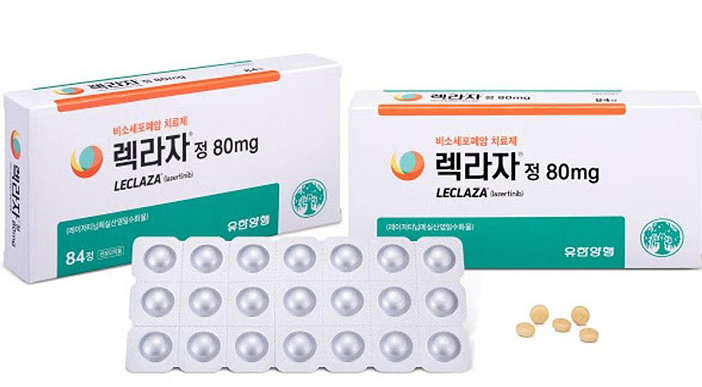
- ‘Leclaza tab. (lazertinib mesylate monohydrate),' the 31st novel drug to be developed in Korea that received approval for insurance benefit in only 165 days after its approval, was reviewed as a 'new treatment alternative for non-small cell lung cancer patients' in the evaluation process for assessing the reasonableness of the medical care benefits for drugs. The Health Insurance Review and Assessment Service (HIRA) had recently disclosed the results and minutes of the benefit evaluation that was conducted on Leclaza by the Pharmaceutical Benefit Assessment Committee on April 8th. Leclaza was approved by the Ministry of Food and Drug Safety on January 18th as a ‘treatment for patients with EGFR T790M mutation-positive, locally advanced or metastatic NSCLC who were previously treated with an EGFR-TKI, then received reimbursement from July 1st after the notice was issued on the ‘amendment to the drug benefit list and the maximum ceiling price table’ on July 1st. Yuhan Corp had applied for the insurance benefit listing of Leclaza on December 30th, 2020 with the ‘approval-benefit appraisal linkage system.’ Through the system, the drug received insurance benefits at an unprecedented pace - in only184 days from its listing application and 165 days since receiving the marketing authorization. According to data disclosed by HIRA in 2017, it generally takes 1030 days for anticancer drugs, 475 days for rare disease drugs, 550 days for general drugs to receive notification for benefit listing since MFDS approval. Compared to the average, Leclaza shortened the listing registration period by 30 months. As a domestically developed novel drug that received its first approval this year, Leclaza’s approval status in the A7 countries, listing status in drug price reference books, and data on the clinical effectiveness in textbooks and clinical practice guidelines were not available for evaluation. In the PBAC evaluation results disclosed, the committee members concluded that “it is difficult to see a difference between Leclaza, which was approved for the treatment of patients with EGFR T790M mutation-positive, locally advanced or metastatic NSCLC who were previously treated with an EGFR-TKI, and the alternative drug.” Despite the review, the reason why the domestic new drug was able to be listed for reimbursement in only 165 days since its approval was because its reasonableness of receiving medical care benefits was recognized from the cost-effectiveness aspect, as the drug ‘is therapeutically equivalent to Tagrisso (osimertinib) while being cheaper than Tagrisso when using the RSA scheme proposed by the pharmaceutical company.’ The comparator in the evaluation was Tagrisso (osimertinib), and PBAC emphasized that the “evaluation results and conditions of Tagrisso’s RSA scheme should be considered in Leclaza’s pricing negotiations.” Also, relevant academic societies including the Korean Cancer Study Group, Korean Society of Medical Oncology, Korean Association for Lung Cancer added their support, saying that, “Leclaza showed a similar effect to the already-approved Tagrisso, and demonstrated an acceptable safety profile and low cardiac toxicity. We can fully expect Leclaza to become a viable substitute to Tagrisso” The societies requested reimbursement for Leclaza stating that “The drug can bring new opportunity to patients with EGFR T790M mutation-positive, locally advanced or metastatic NSCLC who had limited treatment options.” At the Cancer Disease Deliberation Committee meeting that was conducted on February 24th before the PBAC review, the committee had set the standard - ‘medical care benefit will be recognized for patients with Stage IIIA or higher NSCLC as second-line or later therapy that belong to one of the subject numbers (other than No.22,23,24)' for Leclaza. After deliberation and decision by the PBAC and the negotiations with NHIS that followed from April 23rd to June 8th, Leclaza was applied the RSA refund-type and expenditure cap type and listed for medical care benefit at a ceiling price of ₩68,964 per tablet.
- Policy
- Last year, the drug trade surplus was achieved
- by Lee, Tak-Sun Aug 05, 2021 08:47pm
- Domestic medicine achieved its trade surplus for the first time last year. This is because biosimilar led the export. The MFDS announced on the 1st that it analyzed the production, export, and import performance of drugs, quasi-drugs in 2020. Drugs achieved the trade surplus (₩1.394 trillion won) for the first time since 1998, when the MFDS compiled statistics. The main reason for this is that exports of finished drugs, which accounted for 79.6% of total exports (₩9.96 trillion), increased 92.3% (₩7.9308 trillion) compared to 2019. Quasi-drugs showed a 124% increase in production performance of anti-COVID-19 products (₩3.7149 trillion) compared to 2019. This is largely due to the increase in demand for products to prevent infectious diseases, with production performance of masks and disinfectants rising by 818% and 926% respectively compared to 2019. The average annual growth rate of drug production is 6.9%, which is six times higher than the manufacturing average. In 2020, drug production increased 10.1% year-on-year to ₩24.565.5 trillion, while export performance increased 5.2% year-on-year to ₩9.96 trillion ($8.44 billion), 62.5% year-on-year and import performance to ₩8.57 trillion ($7.26331 billion). Its production performance was 1.2% compared to GDP and 5.1% compared to domestic manufacturers. The MFDS explained that the average annual growth rate over the past five years is 6.9%, which is more than six times higher than the total domestic manufacturing production (1.1%), indicating the possibility of the pharmaceutical industry as Korea's future industry. In 2020, there were two companies with production performance of more than ₩1 trillion, while Celltrion rose 149.2% year-on-year to ₩1.476.9 trillion, followed by Hanmi with ₩1.14.3 trillion, similar to that of 2019. Although the size of the pharmaceutical market fell 4.7% year-on-year to ₩23.17 trillion in 2020, the size of the pharmaceutical market has grown 1.6% annually over the past five years. It was attributed to a significant increase in export performance to 62.5%, respectively, compared to the increase in production performance and import performance (10.1%, 5.2%, respectively). Remsima, Herzuma and Truxima exported the most to Germany In 2020, the drug trade balance recorded ₩1.394 trillion due to rising drug export performance, the first time since 1998, when the MFDS compiled performance statistics such as drug production, export and import. The main characteristic of the domestic pharmaceutical market in 2020 is that the export performance of finished drugs, which led to the ▲ trade surplus, increased by 92.3% and ▲ biosimilar exports are active amid strong performance in the production and export of bio pharmaceuticals,▲ and this is because the proportion of Rx drugs production has been maintained and the production of new drugs in Korea has steadily increased. In the case of finished drugs, which accounted for 79.6% (₩7.9308 trillion) of total drug exports in 2020, exports increased by 92.3% compared to 2019, and were larger than 62.5% of total drug exports, leading to a trade surplus. Among the finished drugs, the top three products in the size of exports are all bio pharmaceuticals, and bio pharmaceuticals account for a large portion of all domestic pharmaceutical exports. Among the finished drugs, Remsima was the No. 1 export, followed by Herzuma 150mg with ₩98.6 billion ($80million) and Truxima with ₩75.3 billion ($60million). Germany ($1.855.96 million), the U.S. ($780.61 million), and Turkey ($589.55 million) are the countries that Korea exports the most finished drugs. And, the largest importers of finished medicines were the United States ($977.61 million), Germany ($806.65 million), and China ($887.74 million). As a result, the U.S. and Germany have been identified as the largest trading partners. Twelve of the top 20 items in 2020 were bio-medicine products, and eight out of the 12 items accounted for 79.7% ($1.69.65 billion) as bio-similar products. Exports of bio pharmaceuticals have increased significantly in Europe and North America, which is analyzed to have been approved for new item licenses or listed on the prescription list in Europe and the United States in the second half of 2019. The production performance of Rx medicines (₩17.84 trillion) accounted for 84.9% of the finished medicines, 83-84%, which has been maintained for the past five years. Six new domestic drugs produced more than ₩10 billion, and 19 new domestic drugs produced ₩322.1 billion, up 38.2% from 2019. Meanwhile, the production performance of quasi-drugs in 2020 increased by 124% to ₩3.7149 trillion from 2019 (₩1.657 trillion), the highest growth in the past three years, and the trade balance of quasi-drugs recorded a surplus of ₩214 billion in 2020.

- Policy
- No prior approval req. filed for Soliris, 47 for Ultomiris
- by Lee, Hye-Kyung Aug 04, 2021 06:01am
- ‘Ultomiris (ravulizumab),’ a follow-on drug of ‘Soliris (eculizumab)’ that was approved for reimbursement from June, has taken away all new prescriptions for the treatment of paroxysmal nocturnal hemoglobinuria (PNH) from Soliris. Reimbursement for Ultomiris, like Soliris, needs to be authorized in advance through a prior authorization application process to the NHIS before administration at a medical care facility equipped with the personnel and facilities as specified in the ‘Criteria on the medical care benefit for hematopoietic stem cell transplantation.' According to the eligibility for reimbursement of Soliris and Ultomiris deliberated in July by HIRA’s Healthcare Review and Assessment Committee, new approval applications filed by PNH patients were 0 for Soliris and 47 for Ultomiris. The doctors and new PNH patients were seen to have selected Ultomiris, which can be administered every 8 weeks as maintenance therapy 2 weeks after the initial dose, over Solaris, which needs to be administered biweekly. Ultomiris received approval from the U.S. FDA in December 2018, and from the EMA in July 2018. The drug received marketing authorization in Korea on May 21st, 2020. After receiving approval, Handok applied for the insurance benefit listing on August 31st last year. After receiving approval from HIRA’s Pharmaceutical Benefit Assessment Committee, going through NHIS’s drug pricing negotiations, and deliberation by MOHW’s Health Insurance Policy Deliberative Committee, Ultomiris was listed at ₩5,598,942 per vial from June 7th. Based on the clinical trial results, Ultomiris was found to be clinically non-inferior to its substitute Soliris. Also, Ultomiris was considered cost-effective if its price is set at Solaris's weighted average price of ₩5,598,942 or less. Meanwhile, 43 PNH patients receiving Soliris that were monitored received approval to continue administration of Soliris. 6 cases that were filed to newly administer Soliris for atypical hemolytic uremic syndrome (aHUS) were all disapproved, and 2 monitoring cases for Soliris were approved and the other 2 were disapproved.
- Policy
- Will changes be made to Hemlibra’s reimbursement standards?
- by Lee, Jeong-Hwan Aug 04, 2021 06:01am
- As the Anti-Corruption & Civil Rights Commission (ACRC) in addition to the National Assembly raised the need to ease the reimbursement standards for the hemophilia treatment Hemlibra (emicizumab), the growing sense of urgency on the Ministry of Health and Welfare (MOHW) and the Health Insurance Review and Assessment Service (HIRA)’s behalf to take follow-up actions is expected to increase. The NA and ACRC requested the standards be changed so that pediatric patients under the age of 12 can use the subcutaneous injection Hemlibra immediately without prior use of the intravenous drug treatment ‘immune tolerance induction (ITI) therapies. Sun-Woo Kang of the Democratic Party of Korea had first criticized the inappropriateness of Hemlibra’s reimbursement standards in June, then the ACRC had also made recommendations to the MOHW to change the reimbursement standards. The NA member pointed out that the existing reimbursement standards that acknowledge reimbursement of Hemlibra in pediatric patients aged under 12 only after they fail intravenous injections that accompany great pain should be changed. The ACRC also decided that it was harsh to recognize insurance benefits for Hemlibra only after the pediatric patients that have weak blood vessels undergo ITI therapy that require intravenous injections for 2-3 years. The NA and ACRC’s move was influenced by the appeals made by guardians of pediatric patients with hemophilia that were posted on the National Petition board of Cheong Wa Dae. A total of 4 requests to change the reimbursement standards of Hemlibra had been posted on the national petition board from November 2019 to date. 2019 was when JW Pharmaceutical had received marketing authorization for Hemlibra. JW Pharmaceutical received approval for Hemlibra from the Ministry of Food and Drug Safety on January 20th, 2019. In the earlier petitions, the request was focused on approving reimbursement for Hemlibra, but from last year, the content of the petitions changed to request modification or ease of reimbursement standards for patients aged less than 12 years. Recently, the caregivers of patients (parents) had requested MOHW and HIRA to delete the mandatory ITI therapy prerequisite for Hemlibra’s reimbursement in pediatric patients aged 1 to 12 years old. They criticized that the current reimbursement standards violate human rights by forcing pediatric patients to receive intravenous injections even though Hemlibra, a subcutaneous injection option, is available. Upon receiving such criticism, the MOHW and HIRA are making a move to improve the reimbursement standards. HIRA had held an expert advisory meeting on the efficient operation of ITI therapies for hemophilia A, and the MOHW is planning to amend the reimbursement standards for pediatric patients based on HIRA’s discussion results. In particular, the need to improve the standards grew with the NA strongly criticizing Hemlibra’s reimbursement standards as “standards that approve reimbursements based on the pain and suffering of our children.” Also, the fact that other countries do not limit reimbursement of Hemlibra by age raises the validity on the need for the health authorities to improve the benefit standards. The U.K .approves reimbursement of Hemlibra when the patient satisfies any one of the following conditions: those who fail ITI therapy, or cannot control bleeding, or administers the drug as maintenance therapy or bleeding therapy with bypassing agents, or as maintenance therapy to prevent bleeding symptoms during ITI therapy. In response to the continued criticism from the NA, ACRC, and caregivers of pediatric patients, the MOHW and HIRA are expected to present a bill to revise the benefit standards in the near future. On Sun-Woo Kang’s criticism, the Minister of Health and Welfare Kwon Deok-Cheol said that he would “comprehensively review the issue with experts and discuss how to improve the reimbursement standard of Hemlibra in consideration of the characteristics of pediatric patients.”
- Policy
- Daewoong has added a line-up of osteoporosis treatments PO
- by Lee, Tak-Sun Aug 03, 2021 08:27pm
- Daewoong's Evimax 45mg was approved on July 29. It is generic for Raloxifene HCl 45mg. The original for Raloxifene HCl is Evista from Alvogen Korea. Evista contains Raloxifene HCl 60 mg. Raloxifene HCl 45mg was first developed by Yuhan. In September 2019, Yuhan was granted 'Raboni 45mg', a product containing Raloxifene HCl 45mg. The company explains that safety has been increased by lowering the content of Raloxifene HCl by improving its bioavailability. Daewoong's approved product is also manufactured and supplied by Yuhan. In June, Daewoong was previously granted "Evimax D," a combination of Raloxifene HCl 45mg and a concentrated vitamin D powder. This is also an item produced by Yuhan. As a result, Daewoong will have three Raloxifene preparations, including Daewoong Raloxifene HCl 60mg, which was approved in March last year. Daewoong has been selling Daewoong Zoledronic Acid as a treatment for osteoporosis and Ricen Plus as an oral medicine. The performance is not bad either. Based on IQVIA last year, Daewoong Zoledronic Acid recorded ₩11.2 billion and Ricen Plus, which is a combination of Risedronic acid and Cholesterol, recorded ₩1.5 billion. In terms of sales, oral products are less competitive than injection products. For this reason, Daewoong needed the latest treatment for oral osteoporosis. It is believed that the company introduced Raloxifene HCl 45mg developed by its competitor Yuhan first. In the past, Daewoong sold original osteoporosis drugs such as Fosamax Plus D and had the largest share in the oral market. However, due to the termination of the contract for MSD's Fosamax, it suffered from losing its main items. Zoldronic Acid, which had little sales at the time, was successful by co-promoting with Sandoz. Since then, the Zoldronic Acid injection has been manufactured by Daewoong by purchasing copyrights. Considering Daewoong's business competitiveness in the osteoporosis treatment market, the introduction of Raloxifene HCl 45mg is also likely to be successful. Attention is focusing on how much sales Daewoong will make in the osteoporosis treatment oral market through the launch of a new product.
- Policy
- The number one treatment for mild COVID is Kaletra
- by Kim, Jung-Ju Aug 03, 2021 08:24pm
- The number one drug used to treat mild COVID in the first half of this year was AbbVie's Kaletra, which amounted to ₩596 million. The total amount of drugs spent on the entire treatment, including severe cases, amounted to ₩12.1 billion. Among the data on "COVID-19 Treatment Expenditure in the first half of the year," the "Status of Drug Administration by severe cases" showed this. According to the current status, the amount of drugs used to treat COVID-19 in the first half of this year amounted to ₩12.1 billion, or 2.5% of the total medical expenses. AbbVie's Kaletra (₩596 million) is the number 1 based on drug costs . Then, Chong Kun Dang's Tazoperan 4.5g , ₩107 million, Samsung's Combicin 3g, ₩98 million, Ukchemipharm's Trison Kit 2g is ₩88 million, Boryung's Maxipim 1g is ₩83 million, SK Chemical's Huthan 50mg is ₩72 million, Bayer Korea Avelox 400mg, ₩68 million, and Yuhan's Meropen 0.5g, ₩65 million. Following oxygen, cost of AbbVie's Kaletra is the most at ₩128 million, Yuhan's Meropen 0.5g, ₩112 million, Chong Kun Dang's Tazoperan 4.5g, ₩99 million, Maxipim 1g, ₩72 million, Huthan, ₩51 million, Avelox 400mg, ₩47 million, and Clexane, ₩45 million, Vfend 200mg, ₩4400 million. Excluding oxygen, Fresofol 2% of Fresenius Kabi Korea was the most used, followed by Meropen 0.5g of Yuhan with ₩238 million and Huthan 50 with ₩1.9 million. Greencross Human Serum Album 20%, ₩173 million, Human Serum Album 20%. ₩127 million, Vfend 200mg, ₩120 million, Boxter's Phoxilium Phosphate Solution 1.2 mmol/L, ₩85 million, and JW Life Science's Winuf, ₩83 million, respectively.

- Policy
- Pfizer aims to commercialize PF-07321332 by the end of 2021
- by Lee, Tak-Sun Aug 03, 2021 08:09pm
- On the 29th, the MFDS approved 3 multi-national clinical plans for "PF-07321332," a candidate for COVID-19 oral treatment applied by Pfizer. The first clinical trial was the oral administration of PF-07321332 to prevent postmortem infections in adults who had contact with people with COVID-19, and the validity and safety of Ritonavir's two methods. The total number of test subjects is 2,634 and 22 people will be recruited in Korea. The test is conducted at Chilgok Kyungbuk National University Hospital. The second clinical trial assesses the mediated validity and safety of oral administration PF-07321332/Ritonavir in comparison to placebo in non-admission-bearing adult participants with severe cases and low risk of progression. The total number of test subjects is 800, and the number of subjects in Korea is 14. The test will be conducted at Busan National University Hospital, Seoul Medical Center, Boramae Hospital, Chonnam National University Hospital and Chilgok Gyeongbuk National University Hospital. The third clinical trial assesses the mediated validity and safety of oral administration PF-07321332/Ritonavir compared to placebo in non-admission-bearing adult participants with severe cases and high risk of progressive coronavirus. The total number of test subjects is 2,260, and the number of domestic recruitment subjects is 62. It is carried out in the same institution as clinicians earlier. Pfizer launched a clinical trial of PF-07321332 in the United States in March. It aims to release a treatment at the end of the year after going through a large-scale clinical trial. Ritonavir, administered in conjunction with PF-07321332, is the original of the antiviral drug Norvir of AbbVie in Korea.
