
- LOGIN
- MemberShip
- 2026-05-08 08:51:44
- Policy
- MFDS investigates impurities of Sartan and Varenicline
- by Lee, Tak-Sun Jun 25, 2021 05:50am
- The MFDS has launched a full investigation as the risk of impurities in Sartan and Varenicline, a non-smoking treatment supplement, has been raised among hypertension drugs. Recently, some products have been recalled due to the detection of impurities such as carcinogens in Canada and other countries. However, in the case of Sartan, both raw materials and finished products are planned to be investigated, and in the case of Varenicline, only the finished products were ordered to be tested by related companies. The MFDS announced on the 22nd that it is conducting a safety investigation of high blood pressure treatment containing satan series and Varenicline, a non-smoking treatment aid. Antihypertensive drugs including satan are the three components of Irvesartan, Losartan, and Valsartan. The survey will be conducted to verify the safety of domestic products as impurities exceeding provisional management standards were detected in overseas-related medicines. The MFDS has already sent an official letter to a local pharmaceutical company to encourage them to review their own investigation as a precautionary measure. An official from the MFDS said, "We will work closely with related companies to obtain test results as soon as possible, and put safety first according to the results and promptly take necessary measures." "There have been no cases of impurities detected in the drug in Korea yet," he added. AZBT which is not a nitrosamine, but is known to have a mutation (the property that causes genetic mutations). The MFDS estimates that AZBT occurs due to the reaction of Br-OTBN (4'-Bromomethyl-2-cyano-biphenyl) and Sodium Azide (NaN3). The impurity of Varenicline is "N-nitroso-varenicline," which is said to be caused by the reaction of nitrite and Varenicline remaining in the finished drug manufacturing process. The MFDS said that Varenicline is an example of the original company Pfizer's own discovery of the problem, and that drugs from the same manufacturer as those recovered from overseas have not been distributed in Korea, and are under investigation by Pfizer's own investigation.
- Policy
- Zopista's price cut by 23%, Gefitinib by 22%
- by Kim, Jung-Ju Jun 24, 2021 05:54am
- The premium pricing period for Huons' Zopista has ended., and the price will fall by 23.9% at most for its strengths. Also, Hanmi Pharmaceutical applied for a voluntary price cut of its ‘Gefitinib Tab,’ and its price will fall by 22.1%. The premium pricing term for five zoledronic acid monohydrate products including Boryung Pharmaceuticals’ ‘Zoledron inj. 5mg/100mL’ will return to its original price upon expiry of their premium pricing term. The MOHW will make an amendment to the ‘Drug benefit list and maximum ceiling price table’ that contains the abovementioned changes on July 1st. ◆Term expiry for newly listed premium pricing items = The government has been providing a premium of 59.5% for newly listed generics for 1 year from the date of its initial listing. The premium rate applied increases to 68% for innovative pharmaceutical companies. However, if products of the same ingredient are produced in 3 or fewer companies even after the 1-year term has expired, the premium applied is maintained for a maximum of 5 years until the number of products increases to 4 or more. Five newly listed zoledronic acid products face premium pricing term expiry next month. The products are Boryung Pharmaceutical's Zoldron Inj. 5mg/100mL, Penmix's Penmix Zoledronic Acid Inj. 5mg/100mL, PharmGen Science's Oncebone Inj. 5mg/100mL, Dongkwang Pharm.'s Dongkwang Zoledronic Acid Inj. 5mg/100mL, and Dong Sung Bio Pharm's Zomedron Inj. 5mg/100mL. The products will be applied a price of 164,163 won from next month. ◆Term expiry for extended premium pricing items = The government allows products to maintain the premium pricing until 4 or more products of the same ingredient are listed even after the period of 1 year if the products with the same ingredient are produced in 3 or fewer companies. Nine extended premium pricing products containing the eszopiclone ingredient face premium pricing term expiry next month. The discounts that will be applied for each product and strength are as follows: Huons' Zopista Tab. 1mg, 2mg, 3mg by 23.9%, 23.7%, 23.2%, respectively; Yungjin Pharmaceuticals Yungjin Zopiclone Tab. 1mg, 2mg, 3mg by 4.1%, 5.4%, and 6% respectively; and Myungin Pharm's Zoss Tab. 1mg, 2mg, and 3mg by 10.3%, 10.3%, and 9.9% respectively. ◆Price ceiling adjustments according to voluntary price cut applications = When a pharmaceutical company submits a request to lower its drug price to an amount lower than the ceiling price set for the product, the government adjusts the insurance drug price of the product to the requested amount. The price of Hanmi Pharmaceutical's ‘Gefitinib Tab.’ will be reduced by 22.1%, and Jinyang Pharm’s ‘Jintozet Tab. 10/40mg’ will be adjusted to a 17.3% lower price.
- Policy
- Leclaza will be reimbursed for non-small cell lung cancer
- by Lee, Hye-Kyung Jun 24, 2021 05:54am
- From July 1, Yuhan Corporation's "Leclaza (Lazertinib)" will be reimbursed at the stage of secondary administration of non-small cell lung cancer. The HIRA announced that it will conduct an opinion inquiry until the 25th on the revised announcement (proposal) based on drugs prescribed and administered to cancer patients. If there is no disagreement, it will be applied from 1 July. Leclaza was approved by the MFDS on January 18 as an anti-cancer drug used to treat patients with EGFR-TKI-positive local progressive or metastatic non-small cell lung cancer. According to the HIRA's review of textbooks, guidelines, and clinical papers to set the standards, there was no mention of the drug in textbooks or guidelines as a new drug developed domestically. As a result of a single-group, phase I/II of clinical trial of local progressive or metastatic non-small cell lung cancer patients previously treated with EGFR-TKI, the median value of the progressive survival period was reported to be 9.5 months. In addition, T790M positive patients with 240mg of FDA approval content showed a median value of 11.0 months and an objective response rate of 57.9%, which is currently approved and paid for the same certificate of medical utility. The standard was set the same as Tagrisso( Osimertinib). Cross-dosing benefits are not recognized if a Tagrisso-administered patient intends to change to Leclaza after the disease progresses. However, if a patient want to change the administration to Leclaza due to serious side effects after Tagrisso is administered, it can be recognized on a case-by-case basis.
- Policy
- Standards for Trelegy Ellipta will be established
- by Kim, Jung-Ju Jun 24, 2021 05:54am
- Five drugs, including Trelegy Ellipta, a treatment for COPD are scheduled to be registered for insurance in accordance with next month's schedule, and salary standards will be established and changed accordingly. The MOHW has partially amended its notice of 'details on the criteria and methods of applying care benefits' to ensure proper insurance coverage of the drug and has entered into an inquiry. The drugs that will be applied to the revision include Trelegy Ellipta, Rosuvaco Soft Cap, Rosumega Soft Cap, and Pentosin 350mg and Ultomiris, which will be registered on June 1st. Among them, the drugs listed as of June 7 are likely to be partially changed following the Health Insurance Policy Committee's deliberation and resolution. ◆Trelegy Ellipta = COPD treatment, Trelegy Ellipta (Vilanterol trifenate + Flutisone furoate + Umeclidinium inhaler), is scheduled to be listed on the 1st of next month. The MOHW has made sure that patients who are being administered with the same compound and single drugs at the same time with the drug will be paid even if they want to switch to the drug. ◆Omega-3-acidethylesters 90 and Rosuvaco Soft Cap = Omega-3-acidethylesters 90 and Rosuvaco Soft Cap, a complex type of dyslipidemia treatment such as Rosuvaco Soft Cap and Omega-3-acid ethyl esters 90), are scheduled to be registered as of June 1st. ◆Pentosin 350mg, etc.= Compound skin infections caused by Gram-positive bacteria and Pentosin 350mg, an antibiotic, are scheduled to be registered on June 7, and the standards will be established to be used as secondary drugs within the scope of permission for Daptomycin. Detailed criteria for recognition should include nursing benefits if administration fails to administer Vancomycin or Teicoplanin to Staphylococcus aureus, which includes endocarditis by Meticillin-resistant strains, or if they cannot be administered due to side effects of both drugs. ◆Ultomiris= Adult PNH Treatment Ultomiris is scheduled to be registered on June 7, and the standards will be established by referring to the existing PNH Treatment Standards. PNH in adults is a disease in which hemolysis and blood clots occur in blood vessels due to acquired abnormalities of hematopoietic stem cells and damage to organs in the body, such as kidney function abnormalities. The benefit will be recognized within the scope of permission, and the patient will have to pay the full price of the medicine. Because it increases sensitivity to major meningococcal infections, all patients must be given a meningococcal vaccine at least two weeks before administration, and re-vaccinated in accordance with the latest vaccination guidelines. However, if the drug needs to be administered immediately, the meningococcal vaccine will be administered at the same time and antibiotics can be treated at the same time. Details of the procedures, methods, and composition of the committee for the pre-approval of the drug were determined by the director of the HIRA, and matters requiring medical judgment in the pre-approval of the drug were subject to the committee's decision. The MOHW has decided to confirm the revision after a review of opinions by the 25th..
- Policy
- Janssen's Sporanox is also expected to convert to imports
- by Lee, Tak-Sun Jun 22, 2021 05:50am
- Janssen Korea, which has decided to operate its Hyangnam plant by this year, will also import the antifungal drug "Sporanox (Itraconazole)." As a result, co-marketing with Yuhan is expected to end. According to industries on the 21st, Janssen's Sporanox Cap is going to convert its imports by changing its license at the end of June. Sporanox has long led the market as an oral antifungal drug licensed in 1989. However, other ingredients such as fluconazole have advanced, and other products have recently been in the spotlight, recording ₩3.4 billion in sales based on UBIST last year. In 2008, Janssen and Yuhan signed a co-marketing contract, and Janssen decided to supply the same ingredient of "Lyposil Cap" to Yuhan. Although Sporanox Cap and Lyposil Cap were produced at the Hyangnam plant, co-marketing with Lyposil Cap is expected to end with the import of Sporanox Cap. Lyposil Cap had a small percentage of sales among Yuhan products. Based on UBIST, Rx amount was only ₩7.49 million. As Janssen decided to operate its Hyangnam plant until this year, many products, including Invega ER, Topamax Springkle Cap, Junista SR, Concerta OROSER, and Ultracet, have been converted to imports so far. Now only a few items such as Tylenol and Ultracet ER are being manufactured, but these items will also be converted to technology transfers or imports by the end of the year to change their permits. Established as a production hub plant in Asia-Pacific in 1983, Janssen's Hyangnam Plant has been supplying major products such as Tylenol. Whanin acquired Hyangnam Plant in November last year for about ₩46 billion.
- Policy
- Quality issues alarmed the pharmaceutical industry
- by Jun 22, 2021 05:50am
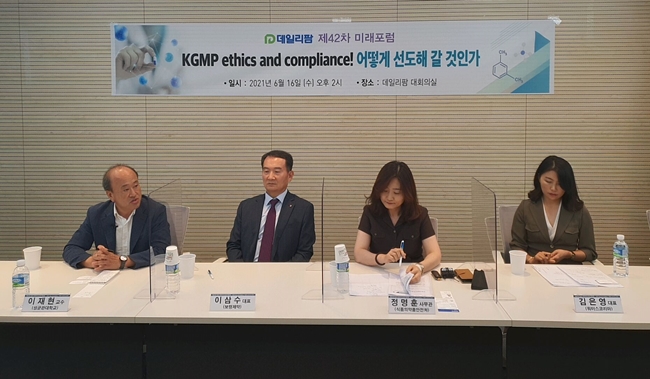
- Recent cases of GMP violations by Korean pharmaceutical companies have served as an opportunity to guard against risks throughout the industry. In addition, there are opinions that it should be improved in the wake of this incident. Until now, actual changes in standards for GMP have been sluggish according to global level. Only a few companies aiming to expand overseas have voluntarily attempted to improve. Looking at the recent cases, most small and medium-sized companies have been commissioned to produce pharmaceutical drugs to the domestic market, but even large companies, which are consignment companies, cannot avoid responsibility. The consignee lacked quality control, and the trustee had to meet the customer's needs. What efforts are being made in the industry? Dailypharm held the 42nd Future Forum under the theme of 'KGMP Ethics and Compliance! How to Lead' on the 16th and listened to industry opinions. Professor Lee Jae-hyun of Sungkyunkwan University is the head of the group, Lee Sam-soo, CEO of Boryung, Chung Myung-hoon, deputy director of the MFDS' drug quality management department, and Kim Eun-young, CEO of Waters Korea, attended the panel to express their opinions. From the left, Lee Jae-hyun, professor at SKKU, Lee Sam-soo, CEO of Boryㅕng, Chung Myung-hoon, director of the MFDS, and Kim Eun-young, CEO of Waters Korea Labor shortages, lack of technology, and lack of awareness are the causes of the situation CEO Lee Sam-soo analyzed that both environmental and technical factors played a role in the frequent occurrence of drug quality problems. According to him, there were 477 pharmaceutical manufacturers in South Korea as of 2019, and each manufacturer produced ₩49.9 billion. Among them, the average of the bottom 80% is only ₩189 billion. More than 100 finished drugs are owned per company. There was a huge shortage of manpower per plant. There are about 500 factory managers that should be mandatory, and 500 QM and manufacturing managers are also needed. The generic licensing process is also easier than that of advanced countries. CEO Lee said, "In the U.S. and Europe, generics should also have all CTD (Common Technical Document) formats, but in Korea, drugs for data-based re-evaluation are only required." There was a lack of research on quality factors or processes to be considered from the product design stage, consideration of subtle changes that occur while scaling up, and reflection of changes in pharmaceuticals, standards, and equipment. "Let's restore confidence in pharmaceuticals." No matter how important quality management is, it is useless without the will of management. Therefore, the new Drug Quality Management Innovation TF, which was established at the KPBMA, is noteworthy. The TF will be joined by Lee Sam-soo, CEO of Boryung, Kwon Ki-beom, vice-chairman of Dongkoo, Ildong's CEO Yoon Woong-seop, and Huons Global vice-chairman Yoon Sung-tae, and Hee-mok Won, chairman of the KPBMA. The team is based on owners and representative directors who can make decisions. The main role of TF is to identify each company's permission and cases of non-compliance with GMP, analyze the causes, and present solutions. It will also find matters that need to be improved. It also has a working group of TF that focuses on GMP experts from 15 businesses such as factory manager, QM manager, and research institute head. They listen to the field's opinions and share their opinions with the MFDS. Industries are actively supporting amendments to 1+3 Pharmaceutical Act by actually operating TF. The industry agreed with the MFDS that the introduction of Quality by Design (QbD) and data integrity should be emphasized to improve quality control. The purpose of the TF is to achieve various education, meetings, information sharing, and system improvement to realize these goals. CEO Lee said, "We intend to expand human resources education by opening online seminars and curricula of the association, visit each other among manufacturing plants, and share data." "We will also achieve quantitative and qualitative improvements by supplementing QA/QC personnel and supporting regular training." In order to spread the introduction of QbD, it should be accompanied by support measures. QbD, the industry believes that carrot-and-stick policies are needed to achieve a common goal of data completeness. CEO Lee said, "QbD is key to both risk assessment and statistics, and in order to become a smart factory, auxiliary tools such as PAT must be applied together." Real-time analysis does not follow simply by doing QbD. "It will cost tens of billions of won to install analysis equipment and sensors for auxiliary tools, so it will not be easy to introduce unless it is a blockbuster item." As a result, industries are strengthening regulations on quality management while also requesting support measures. It applies tax benefits for facilities/equipment necessary for QbD or data completeness, rapid review of related items, and preferential treatment of drug prices. "We will discuss with innovative TFs and actively consider operating a developmental GMP system," said Chung Myung-hoon, an official who attended as a representative of the MFDS. "We will listen to various opinions such as difficulties of small and medium-sized companies so that we can actively improve the constitution of the industry."
- Policy
- Closing the opinion gap important for the generic '1+3 bill'
- by Lee, Jeong-Hwan Jun 21, 2021 05:51am
- With the bill limiting the participating generic makers to three consignees per consignor when conducting joint biological equivalence tests or clinical tests awaiting review by the National Assembly’s Legislation and Judiciary Committee., whether the opinion gap between the large pharmaceutical companies and small- and medium-sized pharmaceutical companies can be closed is gaining attention. Despite the unanimous decision made by the Health and Welfare Committee, concerns have been rising on the influence the divided positions held by different sized pharmaceutical companies, which, if not resolved, may have on the process and result of the review conducted by the Legislation and Judiciary Committee. On the 20th, the pharmaceutical industry has been fighting a psychological battle behind the scenes on the legislation of the ‘1+3 restriction of generics’ bill The Health and Welfare Committee that passed the bill agreed that the 1+3 bill will reduce the excessive amount of generics and drugs requiring data submission and significantly improve the structure of the pharmaceutical drugs in Korea, however, the pros and cons are still fiercely being judged in the industry. While the large pharmaceutical companies that own the capability and economic scale to develop new drugs are strongly in favor of the 1+3 bill, the small- and mid-sized pharmaceutical companies that profit from generics and data submission drugs have been complaining that the bill will serve as leverage to promote the collapse and job cuts in their companies. In particular, the small- and mid-sized pharmaceutical companies have also criticized that, regardless of its purpose, legislating a bill to reduce the excessive number of items is out of order as they have been selling the data submission drugs according to the regulations set by the government. As a result, the logic that the excessive number of generic items have made it difficult for the government to respond or manage GMP violations or detection of impurities such as NDMA and that a regulation tailored for large pharmaceutical companies that does not reflect the reality of small and medium-sized companies will be clashing at the Legislation and Judiciary Committee’s review. According to the National Assembly Act, the Legislation and Judiciary Committee only owns the right to review a bill(right to review the system and order self-revision) that has been already reviewed and passed by the relevant standing committee, however, in reality, there exists cases where the bill passed by the relevant standing committee remains halted at this stage without being processed. For example, the bill to revoke the license of a doctor who was sentenced to imprisonment or higher has been on hold for more than two months after the Health and Welfare Committee’s vote due to disputes between the ruling and opposition parties during the judiciary committee's review. In other words, whether the large and small- and mid-size companies will be able to reach a consensus on the bill may act as one variable for passing the bill. The Legislation and Judiciary Committee plans to review the 1+3 bill passed by the Health and Welfare Committee in July. If the bill passes this review, the final legislative process will likely be completed at the plenary session that will be held in the same month. An official who is in charge of development at a top domestic pharmaceutical company said, “The small- and mid-sized companies are arguing that the law should allow 4 or more pharmaceutical companies to jointly develop and produce the data submission drugs as its clinical trial costs 5 to 15 billion won. However, the fact is a clinical trial that costs 10 billion won is uncommon. If the companies are really opposing due to the burden of cost, they may receive recognition as a 1+3 bill exception according to the exception clause specified in the bill. The companies need to understand how serious the excessive generic and data submission drugs issue is and work to make remedies to their system.” Another official from a small- and mid-sized pharmaceutical company said, “Regulation on generics is necessary, but I oppose to the regulations being set on data submission drugs. The small- and mid-sized companies with insufficient power to develop new drugs yet need to have some possibility of joint development to be able to maintain management and make a cash cow with incrementally modified drugs. The bill is just another order for company restructuring. The bill will directly have an impact on reducing the number of pharmaceutical companies rather than the number of generic companies. This would inevitably lead to job cuts in the companies, so I cannot agree with a bill that disregards this reality.”
- Policy
- Gov will proactively improve system for severe psoriasis
- by Kim, Jung-Ju Jun 21, 2021 05:50am
- With a year left before the re-registration of special exemption of insurance calculation for severe psoriasis, the government, payer, and patient group gathered to discuss improvement. The issue discussed was that despite reimbursement approved for severe psoriasis drugs, patients are not being properly covered as the eligibility standards for the special calculation system are too strict, which increases the actual cost borne by patients. The patient group appealed to the government and payers that the standards for severe psoriasis should be set at the same level as other severe incurable diseases rather than solely relying on expert opinions, and the authorities said that they will take a proactive stance in resolving the issue. The Korea Alliance of Patients' Organization and the Korea Psoriasis Association had raised the issue at its 'Patient Shouting Cafe' event held on the 18th. Immediately after the event, the Ministry of Health and Welfare and the National Health Insurance Service held the roundtable and expressed their positions on improving the special exemption of insurance calculation for severe psoriasis. A patient group has requested improvement of the registration criteria for the exempted calculation of health insurance for severe psoriasis that will be up for re-registration in one year to the government and payers. Pic. from the hosted by the Korea Alliance of Patients Organization The point raised by KAPO was clear and simple. Patients with severe psoriasis have to bear a very high cost of treatment that can only be relieved through the special exemption of insurance calculation. However the entry criteria for the special calculation, the new and re-registration standards, are too strict, and only 17,500 out of the 22,000 severe psoriasis patients are unable to receive any benefit from the system. In other words, for most patients, the benefit is just a 'pie in the sky.' As the re-registration of special exemption of insurance calculation for severe psoriasis will start next year, unless the system is improved now through discussions, the issue is doomed to reoccur. However, the biggest barrier to the improvement is that the experts' opposition to making changes in the registration criteria. In fact, at the National Assembly's Health and Welfare Committee plenary session on the 16th, Yong-ik Kim, president of NHIS had answered Rep. Chun-sook Jeong's inquiry that as the payer, the organization had to follow the experts' judgment as its experts opposed to the change of new registration standards for special exemption of insurance calculation for severe psoriasis. On this, the patient group emphasized that when setting registration standards for special exemption of insurance calculation, policy judgments should be made based on equity with other disease and social consensus rather than simply by reimbursement standards. They argued that the special exemption system is different from medical insurance benefit standards that require consideration of cost-effectiveness and efficacy and that the government is hiding behind experts' judgment. High-priced biologics for severe psoriasis are already being reimbursed. However, contrary to other severe diseases like Crohn's disease, ankylosing spondylitis, and severe atopic dermatitis that apply special calculations immediately for high-priced biologics, the special calculation does not apply to severe psoriasis despite the reimbursement approved for its treatment. The high out-of-pocket payment borne by the patients greatly affects the livelihood and life of the patients. On this, the Korea Psoriasis Association, a direct stakeholder to the system, suggested that the NHIS transparently discuss this issue at the Special Exemption of Calculation Committee meeting, a discussion body for various stakeholders rather than blindly follow the judgment (medical judgment) made by the expert advisory committee. MOHW's Insurance Benefits Division and the NHIS responded that they will address the issue of new registration standards of severe psoriasis in a proactive manner and identify and find solutions for the issue that was discussed at the meeting.
- Policy
- Yuhan's Raboni-D has been licensed
- by Lee, Tak-Sun Jun 21, 2021 05:50am
- Yuhan, which had a high dependence on sales for imported drugs, has recently been speeding up with the commercialization of new drugs such as Lazertinib and IMD. In particular, Yuhan refrains from entrusting or entrusting developing products and is building market competitiveness with its own products. The MFDS approved "Raboni-D," Yuhan's combined osteoporosis IMD, on the 17th. It is a combination drug of Raloxifene HCl, an existing osteoporosis treatment drug, and Cholecalciferol Concentrated Powder, known as a vitamin D. There are already six products, including Hanmi Pharmaceutical's "Rabone D" and Alvogen Korea's "Ebistrar Plus," that combine the two ingredients. However it is evaluated that it has secured safety by lowering the amount of Raloxifene that was developed by Yuhan. Raboni-D is Raloxifene 45mg, while conventional products are Raloxifene 60mg. Raboni-D is used for the treatment and prevention of osteoporosis in postmenopausal women, and is given oral administration one tablet a day. Pregabalin SR, a pain reliever, is also a self-developed item by Yuhan Corporation. 15 items, including Pfizer's Lyrica CR, are licensed. Yuhan was also granted Yuhan Pregabalin SR in 2019. However, safety and effectiveness of Yuhan Pregabalin SR have not been confirmed in patients with new functional disabilities and those aged 65 or older compared to Lyrica CR. Yuhan is focusing on securing competitive edge in products that are as good as original by expanding clinical trials. In this clinical trial, pharmacokinetic characteristics and safety will be evaluated for patients with new disabilities and healthy people who have not been established safety and validity in the past when administering YHD119 single oral administration. Yuhan has been steadily decreasing its sales share of new drugs due to the expansion of its own development items. As of the end of the first quarter, sales of products stood at 56.6%, down 3.9% points from 60.4% in the same period last year. Analysts say that at this rate, the proportion of new drugs introduced in a few years will fall below 50%. The new drugs vary greatly with copyright agreements with developers, so there is a risk of maintaining sales. Leclaza was approved early this year, starting with the commercialization of the first IMD Duowell in 2014. Attention is focusing on whether Yuhan, which generated ₩1 trillion in sales for the first time in the pharmaceutical industry, will also gain fame as a new drug development company.
- Policy
- An exception to the 1+3 Bill for IMD
- by Lee, Jeong-Hwan Jun 18, 2021 05:54am
- A letter from a pharmaceutical representative to the National Assembly affected the process of the National Assembly's Health and Welfare Committee's handling of generics, drug for data-based re-evaluation "1+3 bill." It was reflected in the revised schedule when a representative of company A sent a petition to 24 members of the National Assembly's Health and Welfare Committee that IMD, which has decided to jointly develop more than four pharmaceutical companies, could have a negative impact on development and launch. The Pharmaceutical Affairs Law, approved by the National Assembly's Health and Welfare Committee on the 16th, contains the effective date, application case, and progress measures for medicines undergoing clinical trials. The most controversial part was the transitional provision of drugs already approved, or drugs already undergoing clinical trials, regardless of the Bill. If the bill goes into effect, pharmaceutical companies that exceed the four pharmaceutical companies regulated by the bill have pointed out that it is difficult to release drugs under joint development. In line with the implementation of the 1+3 bill, the welfare committee added an additional rule to apply the previous regulations to drugs under joint development after four pharmaceutical companies were approved by the MFDS. In this case, however, data proving the decision to jointly develop must be reported to the MFDS within one month from the enforcement date of the law. The amendment also reflected claims contained in a petition letter from the representative. In a letter, he explained that IMD, an arthritis drug that the company is jointly developing with several other pharmaceutical companies, is on the verge of being suspended with the 1+3 bill. He added that IMD, which requires billions of won, is conducting Phase 3 clinical trials by investing development costs jointly with multiple domestic companies because it is difficult for small and medium-sized pharmaceutical companies to invest R&D costs alone. During the development process, the 1+3 regulation bill passed the welfare committee on April 29, and he stressed that his company was in danger of having to stop developing IMD research and development because of the bill. "We can accept the general regulations to prevent the disturbance of generic drugs," he said in a letter. "The IMD's regulations can be difficult to develop without a certain period of delay," he said. "The IMD has already received development costs from multiple domestic companies and is in the process of Phase III clinical trials." The welfare committee partially accepted his intention of IMD and established an additional clause that submits and reports evidence that he is jointly developing it to the MFDS within a month of the enforcement of the law. An official of the welfare committee said, "We collected opinions to minimize confusion among pharmaceutical companies that have been preparing for IMD development through joint development contracts regardless of the bill." "We have resolved unreasonable parts and improved the completion of the bill with the provision of transitional measures for medicines undergoing clinical trials," he explained.
