
- LOGIN
- MemberShip
- 2026-06-21 03:57:55
- Company
- New oHCM drug 'Camzyos' nearing approval for reimb in KOR
- by Eo, Yun-Ho Nov 05, 2024 05:45am
- Product photo of Camzyos. 'Camzyos,' a new drug to treat obstructive hypertrophic cardiomyopathy (oHCM), is nearing 90% approval for insurance reimbursement listing. Sources said that BMS Pharmaceutical Korea and the National Health Insurance Service (NHIS) concluded drug pricing negotiations for Camzyos (mavacamten), a new drug for obstructive hypertrophic cardiomyopathy (oHCM). The drug had previously faced a delay in the decision, but the company quickly reached an agreement this time. As a result, Camzyos is likely to be listed within this year. This drug received a re-assessment status during the Drug Reimbursement Evaluation Committee (DREC) review of the Health Insurance Review and Assessment Service (HIRA). After that, it passed the DREC review and entered a drug pricing negotiation in August, but the drug did not receive a decision during the negotiation period (60 days). Camzyos is the only drug that selectively inhibits cardiac myosin-actin cross-bridge formation, which is the cause of oHCM. Camzyos' mechanism involves dissociating myosin from actin, relaxing overstimulated heart muscle, and thereby improving left ventricular outflow tract (LVOT) structure and LVOT outflow obstruction. Due to the lack of available treatments for oHCM for a long time, off-label medications have been used to manage symptoms. After Camzyos launched, the European Society of Cardiology (ESC) updated its guidelines for managing cardiomyopathy for the first time in about nine years. Previously, the guidelines for HCM were based on evidence limited to small-scale monitoring data, retrospective analysis results, and consensus opinion. However, Camzyos has completely changed this situation. Two large-scale, phase 3 clinical trials conducted as randomized controlled trial (RCT) have confirmed the significant effect of Camzyos. Consequently, ESC guidelines recommend Camzyos with the highest evidence level A for the first time in treatment options. American College of Cardiology (ACC) and the American Heart Association (AHA) are preparing to update their guidelines. Furthermore, based on this phase 3 trial evidence, the U.S. FDA granted Camzyos Breakthrough Therapy Designation (BTD) and approval. Meanwhile, the efficacy of Camzyos was demonstrated through Phase 3 EXPLORER-HCM trials. In this trial, Camzyos improved primary endpoints, which were the patient’s symptoms (NYHA classification) and exercise capacity measured with peak oxygen uptake (pVO2), more than twofold compared to the placebo. 20% of the patients treated with Caymzyos met the NYHA classification and pVO2 improvements. It also reduced the LVOT outflow obstruction index by four-fold after exercise. 7 out of 10 patients who received Camzyos treatment had improved indexes and ended up not considering surgery, and they maintained the effects for 30 weeks.
- Company
- 'Nabota' generated KRW 115.8B over 9 mths in foreign mkt
- by Chon, Seung-Hyun Nov 05, 2024 05:45am
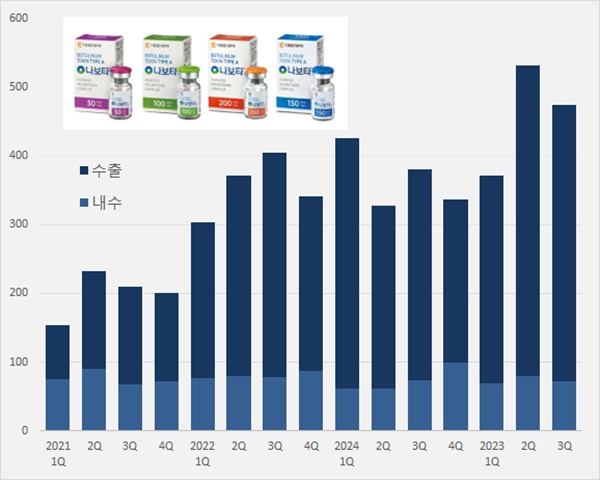
- Daewoong's Nabota, which contains botulinum toxin, is expanding its presence in the foreign market. Its export amount surpassed KRW 100 billion up to Q3 2024. Over 80% of the overall sales were accounted for by sales generated in the foreign market. It is a cash cow export product. According to Daewoong on November 2, Nabota generated sales of KRW 47.5 billion in Q3, up 25.0% from KRW 38 billion Year-over-Year (YoY). Nabota's domestic sales amounted to KRW 7.2 billion in Q3, down 2.7% from the previous year. The export amount increased to KRW 40.3 billion, up 31.7%. Nabota's cumulative sales were KRW 137.8 billion in Q3, an increase of 21.6% from the previous year. Quarterly Nabota sales trend (unit: KRW 100 million, source: Daewoong). The export sales of Nabota have significantly increased due to its established credibility in the United States, following Daewoong's settlement with Medytox in a lawsuit for a stolen strain in 2019. In February 2021, Medytox settled a tri-party agreement with Daewoong's U.S. partnering companies, Evolus and AbbVie, for the sales of Nabota (marketed as Jeuveau in the United States) in the United States. Medytox and AbbVie will grant U.S. sales·marketing rights of Jeuveau to Evolus, and they will receive royalty payments. Nabota recorded export sales of KRW 6.4 billion in Q3 2020, an increase of over six-fold in four years. Nabota recorded cumulative export sales of KRW 115.8 billion until Q3 2024, up 23.7% Year-over-Year (YoY). In just 9 months, it nearly reached last year's export sales of KRW 117.4 billion. Export sales account for 84.0% of Nabota sales in Q3. The sales in the foreign market are substantial with continued exports between Q1 and Q3 this year at around 80%. Nabota ranks second in the cosmetic market for botulinum toxin in the United States, with a 13% market share. "In the first half of the year, Nabota's U.S. cosmetic sales surpassed Ipsen France's Dysport," the company said. "Nabota has recorded the highest growth rate among the cosmetic botulinum toxin brands. We continue establishing it as an outstanding brand with the highest quality overseas." In June, Evolus officially launched Nabota in Spain, expanding into the European market. Nabota is marketed as Nuceiva in Europe, and it has been launched in Spain, the UK, Germany, Austria, and Italy, continuing to expand to European countries in addition to the United States. In June, Nabota received marketing authorization from Argentina's National Administration of Drugs, Food and Medical Technology (ANMAT), and in September, it was launched in Malaysia. Nabota received marketing authorization from 68 countries worldwide, and the company has signed partnership agreements with 80 countries. Nabota is nearing its launch into the treatment market, which accounts for half of the global botulinum toxin market. Nabota's U.S. partnering company, iON Pharma, for the treatment indication is speeding up clinical trials for indications such as ▲chronic migraine ▲myotonia ▲gastroparalysis ▲PTSD. Daewoong has begun expanding its product plant ahead of increased demand for Nabota. The company invested KRW 101.4 billion in Hyangnam plant in Hwaseong, Gyeonggi Province to build the third plant with a yearly production size of 13 million vials. The third plant construction will commence in the first half of this year. When the third plant is completed, Daewoong will secure up to 18 million vials production capacity, including a yearly 5 million vials production from plants 1 and 2. "Nabota is a high-purity toxin manufactured using a patented and proprietary 'HI-PURETM Technology.' It provides an advantage of fast and accurate effects and safety towards drug tolerance," said Daewoong representative.
- Company
- 'SGLT2·DPP4' comb market records robust growth
- by Kim, Jin-Gu Nov 04, 2024 05:48am
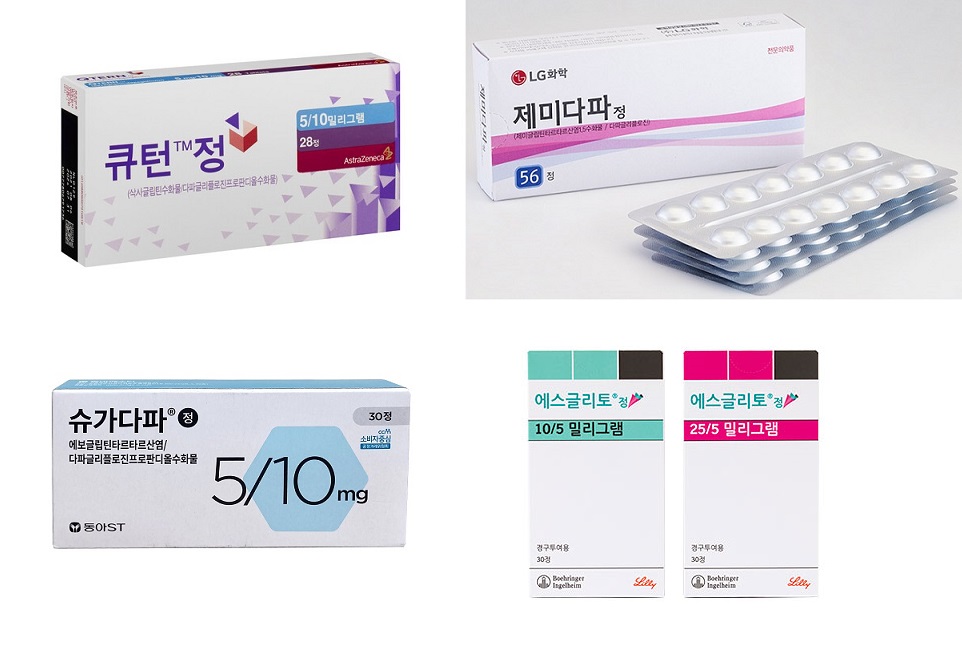
- Product photos of Qtern, Esgliteo, Esgliteo, and Sugadapa (clockwise from upper left). The market for combination drugs containing SGLT-2 inhibitor and DPP-4 inhibitor for treating type 2 diabetes is showing rapid growth. The industry expects the market size to expand by over KRW 30 billion this year. Products containing one or more original active ingredients are leading the market growth. Boehringer Ingelheim's 'Esgliteo' ranked top in prescription sales with cumulative sales of KRW 8.6 billion this year. It was followed by LG Chem's 'Zemidapa,' with KRW 6.1 billion, and AstraZeneca Korea's Qtern, with KRW 3.5 billion. 'SGLT2i+DPP4i combination drugs' generated KRW 9.5B in Q3…Will it surpass yearly KRW 30B? According to a pharmaceutical market research firm UBIST on October 2, two-drug combination drugs with SGLT-2 inhibitor and DPP-4 inhibitor generated KRW 9.5 billion in net sales in Q3 2024. The sales rose significantly over three-fold compared to KRW 2.8 billion of Q3 2023. This market was established with expanded reimbursement for diabetes combination therapy since April 2023. The government approved reimbursement of SGLT-2 inhibitor and DPP-4 inhibitor combination. After that, combination drugs containing different combinations were launched. In the same month, the patent of SLGT-2 inhibitor, 'Forxiga (dapagliflozin),' expired. Companies with original products with DPP-4 inhibitor have started to launch combination drugs with dapagliflozin class. In September, the DPP-4 inhibitor 'Januvia (sitagliptin)' patent expired. After that, generic companies without original active ingredients jumped into the competition. Quarterly prescription market size of SGLT2i+DPP4i combination drugs (unit: KRW 100 million, source: UBIST). Earlier in the launch, two-drug combination drugs generated below-expected sales. In 2023, the sales amounted to KRW 700 million in Q2 and KRW 2.8 billion in Q3. According to an analysis, the sales rose from Q4. It recorded KRW 5.3 billion in Q4 2023. This year, the sales significantly rose to KRW 7 billion in Q1, 8.2 billion in Q2, and 9.5 billion in Q3. The pharmaceutical industry expects sales to surpass KRW 10 billion for Q4 2024. The cumulative prescription sales in Q3 amounted to KRW 24.7 billion. This year's market size is expected to expand to over KRW 30 billion. Combination drugs with original products such as Esgliteo·Zemidapa show strong growth By products, products with original active ingredient are showing strong growth regardless of Korean pharmaceutical companies or global pharmaceutical companies. Boehringer Ingelheim's 'Esgliteo' generated the highest prescription sales in Q3 2024 with cumulative sales of KRW 8.6 billion. Last year, Boehringer Ingelheim launched two-drug combination drugs with its in-house originals, Jardiance (empagliflozin) and Tradjenta (linagliptin). It was followed by LG Chem's 'Zemidapa' with cumulative prescription sales of KRW 6.1 billion. Zemidapa contains LG-Chem's proprietary Zemiglo (gemigliptin) and dapagliflozin. The company launched this product after Forxiga's patent expired in April 2023. The next in sales is Astra Zeneca's 'Qtern' with KRW 3.5 billion. AstraZeneca combined its proprietary original Forxiga and Onglyza (saxagliptin). In South Korea, Ildong Pharmaceutical is responsible for the distribution of Qtern. AstraZeneca also has 'Sidapvia' with a different combination. Sidapvia's cumulative prescription sales are KRW 1.2 billion. It is a combination drug with dapagliflozin·sitagliptin. AstraZeneca collaborated with SK Chemicals to develop this drug and launched it in the market around the time of Januvia's patent expiration in September 2023. In South Korea, SK Chemicals is responsible for domestic production, and HK inno.N distributes the drug. The next drugs in rank are Chong Kun Dang's 'Exiglu-S' with KRW 1.1 billion, and Dong-A ST's 'Sugadapa' with KRW 1 billion. Chong Kun Dang launched Exiglu-S with a combination of Januvia, acquired from MDS, and dapagliflozin. Dong-A ST launched Sugadapa with a combination of its proprietary DPP-4 class Suganon (evogliptin) and dapagliflozin. The remaining 50 companies have generated cumulative prescription sales below KRW 500 billion up to Q3 2024. Most of these companies compete with products with dapagliflozin+sitagliptin. However, analysis suggests that their sales are below expected because they have entered the market later than other combination drugs with originals over five months, and many products were launched around the same time.
- Company
- Will the polycythemia vera drug Besremi be reimb in KOR?
- by Eo, Yun-Ho Nov 04, 2024 05:48am
- Whether PharmaEssentia Korea’s new drug for polycythemia vera, ‘BESREMi,’ will be listed with reimbursement in Korea is gaining attention. The drug was approved for hydroxyurea-refractory or intolerant polycythemia vera in March last year but failed to overcome the CDDC barrier in July of the same year. At that time, the CDDC determined that there was insufficient evidence to determine the clinical utility of BESREMi as a second-line treatment. In response, PharmaEssentia resubmitted its application for reimbursement in March after adding domestic clinical data on BESREMi and supplementing the evidence on the drug’s efficacy in second-line therapy. As 50,000 people signed a petition for improved access to BESREMi to the National Assembly in February, whether the company will succeed in receiving reimbursement this time is gaining close attention. BESREMi is a next-generation interferon treatment that selectively removes JAK2 mutations that cause polycythemia vera. I It was developed to improve the purity and tolerability of existing interferons so that it can be administered every two weeks for the first 1.5 years and every four weeks thereafter. It is currently recommended for the treatment of PV in the National Comprehensive Cancer Network (NCCN) and European Leukemia Network (ELN) guidelines, regardless of prior treatment history. Polycythemia vera is a rare blood disorder where a somatic cell mutation in the bone marrow abnormally activates bone marrow function and produces excessive red blood cells. According to HIRA data, about 5,000 patients are affected with PV in Korea, and hydroxyurea is mainly used for the majority of patients. However, as the current reimbursed drugs are not curative and there are no new alternatives for patients who fail hydroxyurea treatment, there remains a high unmet need for the disease.
- Company
- K-Bios globally present immuno-oncology drugs
- by Son, Hyung Min Nov 04, 2024 05:48am
- The development achievements of the domestic pharmaceutical bio industry's immuno-oncology drugs will be presented at an overseas conference. Hanmi Pharmaceutical, GC Cell, Abion Bio, ST Cube, and Y-Biologics, among others, have completed preparations to emerge into the international stage by disclosing positive clinical trial results. In particular, some companies are conducting clinical trials for combination therapies that utilize their approved immuno-oncology and targeted therapy drugs. They are aiming to increase the chances of commercialization by combining the drugs with verified therapies. Bispecific antibodies emerge as a global R&D trend, Korean companies also make a bid into the industry According to industry sources on the 4th, The Society for Immunotherapy of Cancer’s annual meeting (SITC 2024) will be held in Houston, U.S., from April 6 to 10. STIC is the world's largest immuno-oncology society with more than 5,000 industry professionals from more than 70 countries around the world. Hanmi Pharmaceutical will present the clinical trial results for its bispecific antibody, which has emerged as a global R&D trend. The company is conducting a Phase I clinical trial on BH3120, a bispecific immuno-oncology drug candidate. BH3120 simultaneously targets PD-L1 and 4-1BB. Bispecific antibodies are drugs that can bind to two different antigens simultaneously, or to two different epitopes on the same antigen. Such antibodies that simultaneously target various biomarkers have the advantage of allowing BBB penetration through targeted binding to receptors on the surface of the blood-brain barrier. In particular, anticancer drugs need to penetrate the BBB to increase drug permeability. Recently, a growing number of companies have developed multispecific antibodies by combining antibodies that bind to antigens that regulate the activity of immune cells and antibodies that bind to specific antigens on tumor cells. In clinical trials, BH3120 showed a decoupling of immune activity between the tumor microenvironment and normal tissue, confirming its safety. In addition to immuno-oncology drugs, Hanmi Pharmaceutical and Beijing Hanmi Pharm are also exploring the possibility of combining the drug with other anticancer drugs. BH3120 incorporates Hanmi’s platform technology, “Pentambody.” This is a next-generation bispecific antibody platform technology that activates immune cells while attacking only target cancer cells. Since 4-1BB is activated only in immune cells surrounding cancer cells expressing PD-L1, BH3120 minimizes the toxic side effects of 4-1BB and has long-term anti-cancer effects that prevent recurrence. Y-Biologics will present clinical results from AR092, one of its T-cell bispecific antibody pipeline. AR092 is a drug candidate generated from Y-Biologics’s proprietary next-generation T-cell bispecific antibody platform, “ALiCE.” Y-Biologics confirmed the potent anti-cancer effect and low toxicity of AR092 against solid tumors through a preclinical trial. SITC 2023(Source= SITC). Developing immuno-oncology drugs targeting novel mechanisms of actions Cell therapies and immuno-oncology drugs targeting new mechanisms of action will also be introduced at SITC 2024. G-Cell will present preclinical results of its NK cell therapy candidate “GCC4001” in combination with Merck's EGFR antibody therapy Erbitux. In preclinical studies, GCC4001+Erbitux demonstrated approximately 2 times the anti-tumor activity of Erbitux monotherapy. GC Cell believes that the combination may represent a novel treatment alternative for recurrent or metastatic head and neck cancer. GC Cell will also present unique findings on its proprietary NK cell culture technique based on eHuT-78 CDV feeder cells. ST Cube will present clinical results on its “nelmastobart,” which targets a novel biomarker, BTN1A1. BTN1A1 is a protein that regulates the immune response to cancer cells by inhibiting the activity of T-cells. This biomarker is not expressed in normal cells, but is strongly expressed in cancer cells and is mutually exclusive with PD-L1. By targeting BTN1A1, ST Cube is developing an immuno-oncology drug that may represent a new treatment option in refractory cancers. Currently, ST Cubde is conducting Phase Ib/II clinical trials in the U.S. and South Korea for nelmastobart in combination with paclitaxel in patients with relapsed or refractory extensive-stage small cell lung cancer (ES-SCLC). The company is also exploring the potential of nelmastobart in combination with capecitabine for the treatment of Stage III or higher metastatic colorectal cancer. Abion Bio is presenting preclinical results on “ABN202,” an antibody-cytokine fusion protein (ACFP) that fuses an interferon-beta variant to a tumor-targeting antibody. ACFP is a novel drug candidate that is expected to address the systemic toxicity of interferon-beta thereby offering a strong safety profile. The company will present nonclinical data confirming immuno-oncology efficacy in immunosuppressive solid tumor mouse models. Abion Bio is also exploring the potential for combination therapy with existing immuno-oncology agents.
- Company
- Reimb of Vocabria+Rekambys for HIV gains attention
- by Eo, Yun-Ho Nov 04, 2024 05:48am
- The industry’s eyes are on whether the long-acting HIV combination therapy ‘Vocabria+Rekambys’ will be reimbursed by the end of the year in Korea. According to industry sources, GSK Korea and Janssen Korea have completed the pharmacoeconomic evaluation of their HIV drugs Vocabria (cabotegravir) and Rekambys (rilpivirine) combination therapy and are awaiting the Health Insurance Review and Assessment Service's Drug Reimbursement Evaluation Committee’s review. It remains to be seen whether the drug will be reviewed by DREC by the end of the year and progress onward. As it has been more than 2 years since the drug’s domestic approval, the industry’s eyes are on whether it will be reimbursed this time. The MFDS previously approved the two drugs in February 2022 as a combination therapy for the treatment of HIV-1 infection in adult patients who are virologically suppressed, have no history of virologic failure, and have no known or suspected resistance to either cabotegravir or rilpivirine. The Vocabria+Rekambys combination was approved in Korea as a once a month or once-every-two-month injection regimen. The advantage of the combination is convenience. Previous HIV treatments required patients to take tablet formulations once a day, so every day, but with the approval of the two injectables, patients will be able to take intramuscular injections once a month or every other month, reducing the frequency and increasing patient satisfaction. The two drugs were originally developed as oral formulations and then were developed as injectables. The long-acting injectables do not cure HIV infection, but they work by targeting white blood cells to help lower and maintain levels of the AIDS virus. The combination was approved in Europe in December 2020 after demonstrating efficacy and safety in clinical trials in groups receiving the combination once every 4 weeks or once every 8 weeks. In the clinical trials, the most frequent adverse events observed in the Vocabria+Rekambys arm were injection site reactions, headache, pyrexia, nausea, fatigue, asthenia, and myasthenia. It remains to be seen if the benefit of convenience of the combination therapy will be accepted by the health authorities and be listed for reimbursement.
- Company
- New AML drug Vyxeos can be prescribed at Big 5 hospitals
- by Eo, Yun-Ho Nov 01, 2024 05:51am
- The new acute myeloid leukemia drug ‘Vyxeos’ may now be prescribed at general hospitals in Korea. According to industry sources, Vyxeos (daunorubicin+ cytarabine), a treatment for adults with acute myeloid leukemia AML, has passed the drug committees (DCs) of the ‘Big 5’ tertiary hospitals in Korea including the Samsung Medical Center, Seoul National University Hospital, Seoul St. Mary’s hospital, Sinchon Severance hospital, several medical institutions in Korea including the National Cancer Center, Samsung Medical Center, Seoul National University Hospital, and Asan Medical Center, and Sinchon Severance Hospital. The company also made progress in the drug reimbursement discussion. Vyxeos passed the Health Insurance Review and Assessment Service’s Drug Reimbursement Evaluation Committee review in August. If the company succeeds in completing pricing negotiations with the National Health Insurance Service and the drug is listed for reimbursement, it is expected to quickly lead to actual prescriptions. Vyxeos was developed by an Ireland-based global pharmaceutical company Jazz Pharmaceuticals headquartered in Ireland, and Handok owns the exclusive rights to its sales in Korea. Treatment-related adult AML and AML with myelodysplasia-related changes have a poor prognosis and are associated with lower remission rates and shorter overall survival (OS) when treated with intensive chemotherapy compared to other AML. Intensive chemotherapy, the 7+3 regimen of cytarabine and daunorubicin, has remained the standard therapy for over 50 years since its introduction in the 1970s. This is why an unmet need existed in the field for some time. Vyxeos is a liposomal formulation of a fixed combination of daunorubicin and cytarabine in a 1:5 molar ratio. Vyxeos liposomes accumulate and persist at a higher concentration in the bone marrow, where they are preferentially taken up intact by leukemia cells, maximizing synergistic antitumor activity. In a Phase III trial that demonstrated the efficacy of Vyxeos, the median overall survival of patients with t-AML or AMLM-MRC who were treated with Vyxeos was 9.6 months, which was longer compared with the 6 months in patients that received the 7+3 arm. Also, 48% of the Vyxeos-treated patients achieved complete remission (CR) and complete remission with incomplete neutrophil or platelet recovery (CRi), which was higher than the 33% in the 7+3 arm. The safety profile in both arms was similar.

- Company
- Novartis’s operating income grew 123% in Q3 with Entresto
- by Son, Hyung Min Nov 01, 2024 05:50am
- The Swiss global pharmaceutical giant Novartis' sales increased slightly compared to the previous year. Novartis showed even sales growth in various therapeutic areas, including cardiovascular, anticancer, and immunosuppressive agents. According to industry sources, Novartis reported a revenue of USD 12.823 billion in Q3 last year, up 10% YoY. The company’s operating income was approximately USD 3.627 billion, a 123% increase YoY. The largest revenue generator in Q3 was the heart failure drug Entresto. Entresto generated USD 1.865 billion in revenue, up 26% YoY. Entresto is an angiotensin receptor-neprilysin inhibitor (ARNI) class heart failure drug and is the only innovative drug that works directly on the heart. Its strength lies in its ability to be used as a first-line treatment for heart failure in combination with other medicines, including SGLT-2 inhibitors. Entresto’s sales have continuously increased with additional indications. Entresto was initially approved for use in heart failure patients with reduced ejection fraction, defined as a left ventricular ejection fraction of 40% or less. Through clinical trials, Novartis has been successful in expanding the indication of Entresto to patients with heart failure with preserved ejection fraction. Novartis' biologic treatment Cosentyx generated the second-largest revenue. Cosentyx generated sales of USD 1.693 billion, up 28% YoY. Cosentyx, which targets anti-interleukin (IL)-17, is effective in a wide range of inflammatory diseases and has emerged as a competitor to tumor necrosis factor alpha (TNF-α) inhibitors such as Humira and Remicade. The highest sales growth rate was seen in the PCSK9 inhibitor Leqvio. Leqvio’s sales totaled $198 million, a 119% year-over-year increase. Leqvio is a first-in-class siRNA drug approved in Korea, the U.S., and Europe. Leqvio uses naturally occurring siRNA to reduce LDL-C in the blood by inhibiting the production of the PCSK9 protein, which raises LDL-cholesterol (LDL-C). Leqvio has been shown to reduce LDL-C by up to 57% with twice-yearly dosing. The rise in sales of the prostate cancer drug Pluvicto was also notable. The company reported Q3 sales of USD 386 million, a 50% YoY increase. Pluvicto is a radiopharmaceutical Notavis acquired through the acquisition of US-based Endocytein in 2018. Sales of Pluvicto, which was introduced to the market in 2022, surpassed USD 200 million (KRW 260 billion) the same year. Since then, it has continued to grow, reaching nearly USD 1 billion (about KRW 1.3 trillion) in sales last year. Sales of the breast cancer drug Kisqali increased 43% year-on-year. Kisqali is a CDK4/6 inhibitor that targets HR+/HER2- breast cancer. The fact that it was the first CDK4/6 inhibitor to be prescribed to premenopausal women contributed to its rapid market growth. According to the National Comprehensive Cancer Network (NCCN) guidelines, Kisqali is recommended as a Category 1 in the first-line treatment of HR+/HER2- peri-menopausal breast cancer patients. In addition to its strong cardiovascular, oncology, and immunosuppressive pipeline, Novartis is also actively pursuing radiopharmaceuticals and cell therapies to reinforce its portfolio. Earlier this year, Novartis acquired the Dutch immunotherapy company Calypso Biotech for USD 425 million (about KRW 560 billion). Calypso owns a cell therapy candidate, ‘CALY-002,’ with other monoclonal antibodies in development for various immune disorders.

- Company
- Atopic dermatitis drug Ebglyss to enter Korea next year
- by Whang, byung-woo Oct 31, 2024 05:55am
- The atopic dermatitis drug Ebglyss (lebrikizumab), which is set to soon be released in Korea, has added competitivity by securing rationale for switching between biologics. The company plans to receive reimbursement after launching the drug without reimbursement early next year. Pic of EbglyssAt the recent Fall Clinical Dermatology conference that was held in the U.S., Lilly presented results from the ADapt Phase IIIb study, which confirmed the effectiveness of Ebglyss in patients with moderate-to-severe atopic dermatitis who were previously treated with Dupixent (dupilumab). Patients in the ADapt study were those who discontinued Dupixent due to insufficient response, intolerance, adverse events, or other reasons (e.g., burden of cost, loss of access to treatment). Results showed that among patients treated with dupilumab, the proportion of patients achieving an Eczema Area and Severity Index (EASI) of 75 after treatment with Ebglyss was 57% at Week 16 and 60% at Week 24. In addition, among patients who had an inadequate response to sarilumab, 46% achieved an EASI-75 at Week 16 on Ebglyss. These results were similar to those observed in two Phase III studies (ADvocate 1 and ADvocate 2) which evaluated the clinical utility of Ebglyss monotherapy in dupilumab-naïve patients. This confirms its competitive advantage, particularly as an alternative option for atopic dermatitis patients who have not responded to Dupixent, which owns the largest share of the atopic dermatitis treatment market. According to the drug research institution IQVIA, Dupixent generated KRW 105.2 billion in sales in 2022, but last year's pediatric reimbursement expansion led to a significant increase in sales to KRW 143.2 billion. In Q1 this year, the drug generated KRW 40.5 billion in sales, with further sales growth expected. Currently, Lilly Korea has applied for Ebglyss’s reimbursement in Korea. However, due to the time required to review its reimbursement, the drug will first be launched without reimbursement early next year. However, it is expected that the drug’s reimbursement approval will be a top priority for Lilly to enter the market even after the launch of Ebglyss, as it is difficult to penetrate the market due to the fact that several therapies, including Dupixent and JAK inhibitors, have received reimbursement. What Lilly is looking forward to is the possibility of allowing switching between treatments in severe atopic dermatitis. According to industry sources, HIRA established the standards for switching between biologics and JAK inhibitors through expert discussions in September. Although the follow-up procedures such as negotiations with the NHIS are scheduled, the fact that discussions have been initiated is receiving positive evaluations. “Due to the nature of severe atopic dermatitis, there are patients who cannot see an effect with currently available treatments, so I think there will be a demand to use Ebglyss,” said a professor of dermatology at University A Hospital. ”There is a positive trend for switching, but Ebglyss is not yet reimbursed, so it will be important to see whether it will be reimbursed in the future.”
- Company
- Oral ALS drug 'Radicava' likely to land in KOR
- by Eo, Yun-Ho Oct 31, 2024 05:55am
- Product photo of Radicava. 'Radicava,' an oral drug for the treatment of amyotrophic lateral sclerosis (ALS), is expected to be commercialized in South Korea. Sources said that Mitsubishi Tanabe Pharma Korea's Radicava (edaravone) is under consideration for domestic approval. The drug is a treatment for ALS, formerly known as Lou Gehrig's disease. Radicava is an oral suspension. It can reduce patient burden by lowering the number of hospital visits and pain compared to conventional drugs designed for intravenous (IV) injection. Radicava received accelerated approval designation from the U.S. Food and Drug Administration (FDA) in October 2019. The drug was approved in May 2022. It has significantly reduced the administration time compared to IV injection. Unlike IV injection administered as a single daily dose as a 60-minute intravenous drip infusion after 2 ampules (edaravone 60 mg) diluted in saline, 'Radicava ORS' takes only a few minutes to administer. Mitsubishi Tanabe Pharma has conducted a comprehensive clinical development program for 'edaravone' IV injection and oral formulation for over 10 years. The basis of 'Radicava ORS' approval was the Phase 3 MCI186-19 study, which involved 137 patients with ALS, in addition to several research data. In the MCI186-19 study, the ALS Functional Rating Scale-Revised (ALSFRS-R) was used to monitor the disease at 24 weeks. ALSFRS-R is a verified assessment tool. The results showed that the 'edaravone'-treated group had a 33% reduction in the loss of body function compared to the placebo group. Additionally, the company conducted seven Phase 1 clinical pharmacological studies. They have investigated the pharmacokinetics, safety, drug-to-drug interaction, dosage, bioavailability, and biological equivalence of 'Radicava ORS' in healthy patients or in patients with ALS who have or do not have percutaneous endoscopic gastrostomy (PEG) tube or NG tube. Also, its Phase 3 clinical study demonstrated the safety and drug tolerance profile of 'Radicava ORS' treatment at 24 weeks in 185 patients with ALS. The company is conducting a Phase 3 study evaluating the long-term safety and drug tolerance over 96 weeks. Meanwhile, Radicava received domestic approval as 'Radicut' oral formulation in December 2015. Currently, it is approved as 'Fra-Cut Inj' in South Korea.
