- LOGIN
- MemberShip
- 2026-09-17 19:49:38
- New drug expenditure is 13.5% of NHI finance's drug spending
- by Whang, byung-woo | translator Hong, Ji Yeon | 2024-10-23 05:49:47
It was found that the total expenditure on new drugs listed in the past six years since the Positive List System policy was implemented amounted to 13.5% of the National Health Insurance pharmaceutical spending, which is the lowest compared to the averages of A8 countries and OECD countries.

The research evaluated new drugs listed from 2007 to 2022 when the Positive List System policy was implemented to allocate financial resources to drugs.
The document compared the performance to 25 OECD countries besides South Korea.
The research aimed to set the analysis period to the past 6 years (2017-2022) and to investigate financial analysis reflecting the outcome of the government's policy implementation to strengthen patient access to new drugs.
It researched disease types contributing to patient deaths and compared domestic and overseas new drug expenditures in diseases with the highest financial burden, by analyzing pharmaceutical costs by disease.
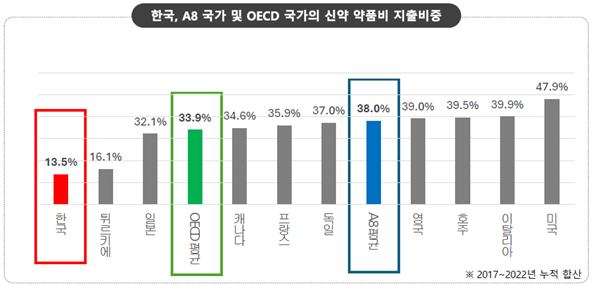
The percentage of new drug expenditure in South Korea Based on the research, the percentage of new drug expenditure in South Korea's total pharmaceutical cost amounted to 13.5%, which was below half of those in A8 countries, 38.0% on average, and in OECD countries, 33.9% on average.
The analysis suggests that the figure would be the lowest among 26 countries.
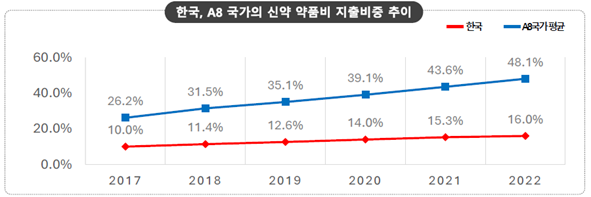
The analysis of the trend in the percentage of new drug expenditure from 2017 to 2022 indicates that the differences between Korea and the average for A8 countries grew significantly, amounting to almost a threefold difference in 2022.
In particular, the total expenditure on new drugs was merely 15-25% of those in A8 countries, including the U.K., France, Italy, and Canada, which are similar in population and GDP per capita.
The research analyzed the financial cost of disease by comparing a weighted index of disease·injury·risk factor, including death·disorder, by country, and new drug expenditure through the analysis of pharmaceutical cost by disease.
The percentage of expenditure on new drugs for treating tumors was 46.2% for South Korea, not significantly different from 54.4% in the OECD on average.
However, the percentage of expenditure on new drugs for treating cardiovascular diseases was 20.2% for the OECD on average and 2.4% for South Korea.
Furthermore, the neurological disease category was 30.1% and 4%, respectively.
The respiratory system category was 43% and 6.7%, respectively.
They showed that Korea's percentages were merely 1/10th of the OECD countries' average, indicating relatively poor patient access to treatments.
In other words, Korea showed significantly lower expenditures in the top-costing disease category, including the cardiovascular system, neurological system, and respiratory system, compared to those of the OECD and A8 countries.
The expenditure index of the number of new drugs and pharmaceutical cost by reimbursement category shows that the number of new drugs listed under the economic evaluation exemption program or essential program amounts to merely 11.6% and 3.6%, respectively.
These drugs are needed to enhance patient access to severe disease treatments.
The percentages of these drugs in the total pharmaceutical cost were 0.6% and 0.3%, which is relatively low.
Additionally, the percentage of new drugs listed after undergoing economic evaluation out of the total number of listed new drugs was 26.8%.
Excluding drugs in the antitumor category, it is merely 14.5%, indicating that the percentage of listed new drugs that are found to have values for improving clinical effectiveness is relatively small.
"After implementing the Positive List System policy, the percentage of pharmaceutical cost in the total medical cost was aimed at about 24%, and it has been maintained.
However, it seems that setting the new drug expenditure in the total pharmaceutical cost lacked specific aim and direction," said Yu.
"From a financial viewpoint, we need to consider differences in the percentage of new drugs in Korea to other major countries and set the priority to strengthen reimbursement of treatments, including reimbursement of innovative new drugs, for diseases with high cost." "The percentage of new drugs in National Health Insurance-supported pharmaceutical cost is significantly lower than those of overseas, indicating that Korean patients are not fully benefiting from new drug treatments," Lee Young-shin, vice chairman of the KRPIA, said.
"The system may need improvements, including the economic evaluation and expanding economic evaluation exemption and risk sharing agreement system, to enhance patient access to innovative new drugs and to allow them to have a better lifestyle."
-

- 0
댓글 운영방식은
댓글은 실명게재와 익명게재 방식이 있으며, 실명은 이름과 아이디가 노출됩니다. 익명은 필명으로 등록 가능하며, 대댓글은 익명으로 등록 가능합니다.
댓글 노출방식은
댓글 명예자문위원(팜-코니언-필기모양 아이콘)으로 위촉된 데일리팜 회원의 댓글은 ‘게시판형 보기’와 ’펼쳐보기형’ 리스트에서 항상 최상단에 노출됩니다. 새로운 댓글을 올리는 일반회원은 ‘게시판형’과 ‘펼쳐보기형’ 모두 팜코니언 회원이 쓴 댓글의 하단에 실시간 노출됩니다.
댓글의 삭제 기준은
다음의 경우 사전 통보없이 삭제하고 아이디 이용정지 또는 영구 가입제한이 될 수도 있습니다.
-
저작권·인격권 등 타인의 권리를 침해하는 경우
상용 프로그램의 등록과 게재, 배포를 안내하는 게시물
타인 또는 제3자의 저작권 및 기타 권리를 침해한 내용을 담은 게시물
-
근거 없는 비방·명예를 훼손하는 게시물
특정 이용자 및 개인에 대한 인신 공격적인 내용의 글 및 직접적인 욕설이 사용된 경우
특정 지역 및 종교간의 감정대립을 조장하는 내용
사실 확인이 안된 소문을 유포 시키는 경우
욕설과 비어, 속어를 담은 내용
정당법 및 공직선거법, 관계 법령에 저촉되는 경우(선관위 요청 시 즉시 삭제)
특정 지역이나 단체를 비하하는 경우
특정인의 명예를 훼손하여 해당인이 삭제를 요청하는 경우
특정인의 개인정보(주민등록번호, 전화, 상세주소 등)를 무단으로 게시하는 경우
타인의 ID 혹은 닉네임을 도용하는 경우
-
게시판 특성상 제한되는 내용
서비스 주제와 맞지 않는 내용의 글을 게재한 경우
동일 내용의 연속 게재 및 여러 기사에 중복 게재한 경우
부분적으로 변경하여 반복 게재하는 경우도 포함
제목과 관련 없는 내용의 게시물, 제목과 본문이 무관한 경우
돈벌기 및 직·간접 상업적 목적의 내용이 포함된 게시물
게시물 읽기 유도 등을 위해 내용과 무관한 제목을 사용한 경우
-
수사기관 등의 공식적인 요청이 있는 경우
-
기타사항
각 서비스의 필요성에 따라 미리 공지한 경우
기타 법률에 저촉되는 정보 게재를 목적으로 할 경우
기타 원만한 운영을 위해 운영자가 필요하다고 판단되는 내용
-
사실 관계 확인 후 삭제
저작권자로부터 허락받지 않은 내용을 무단 게재, 복제, 배포하는 경우
타인의 초상권을 침해하거나 개인정보를 유출하는 경우
당사에 제공한 이용자의 정보가 허위인 경우 (타인의 ID, 비밀번호 도용 등)
※이상의 내용중 일부 사항에 적용될 경우 이용약관 및 관련 법률에 의해 제재를 받으실 수도 있으며, 민·형사상 처벌을 받을 수도 있습니다.
※위에 명시되지 않은 내용이더라도 불법적인 내용으로 판단되거나 데일리팜 서비스에 바람직하지 않다고 판단되는 경우는 선 조치 이후 본 관리 기준을 수정 공시하겠습니다.
※기타 문의 사항은 데일리팜 운영자에게 연락주십시오. 메일 주소는 dailypharm@dailypharm.com입니다.


-
- "Leclaza, the best first-line option…expanded reimb will increase accessibility"
- PALOMA-2 recorded an objective response rate (ORR) of 90 and the 3-year overall survival (OS) rate of 70%…mOS has not yet been reached