- LOGIN
- MemberShip
- 2026-09-16 01:43:10
- Chinese API importers outnumber domestic manufacturers in Korea
- by Chon, Seung-Hyun | translator | 2026-01-05 10:39:22
The number of Chinese active pharmaceutical ingredient (API) suppliers importing APIs into Korea continues to rise. Compared to six years ago, nearly 100 more Chinese companies are now supplying APIs to the Korean market, significantly outnumbering domestic producers. The scale of Chinese API imports has also steadily grown, indicating an expanding influence of Chinese products in the domestic market. In addition, as pharmaceutical companies face price pressure and seek lower-cost APIs, the number of Indian suppliers has also grown substantially.
According to the Ministry of Food and Drug Safety on the 3rd, the total number of Chinese API importers in 2024 was recorded at 350. This represents an increase of 19 companies from the 331 recorded in 2023, within just one year.
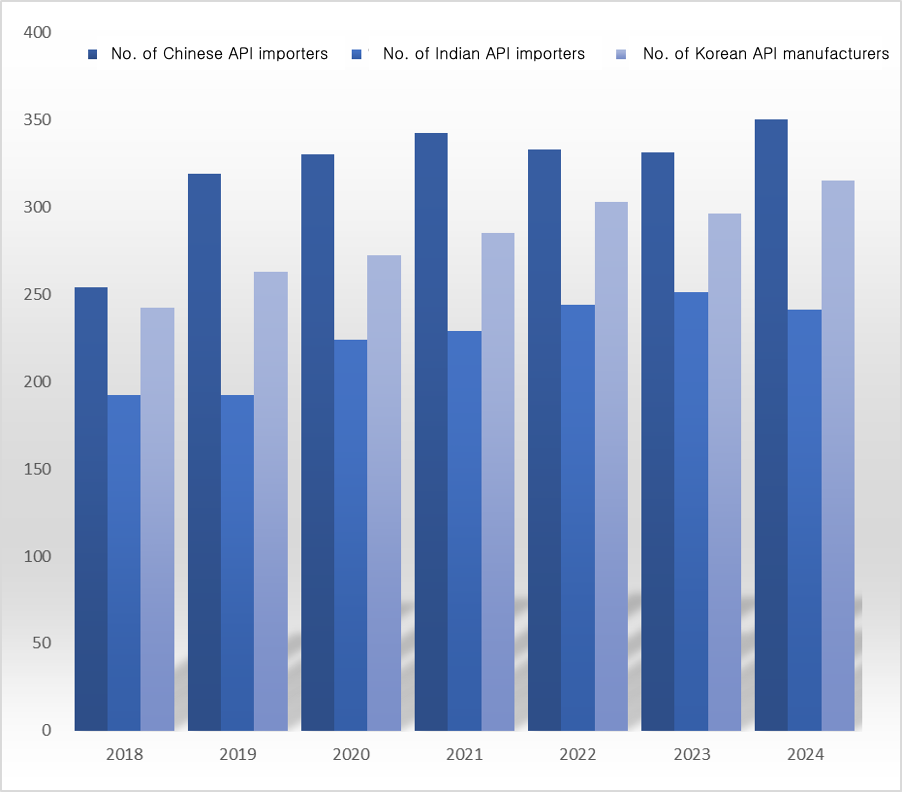
The number of Chinese API importers has shown an upward trend year after year. In 2018, APIs were imported from a total of 254 Chinese companies, meaning 96 new importers have been added over the past six years. Although the number declined from 342 in 2021 to 333 in 2022 and 331 in 2023, it rose again in 2024.
As the scale of Chinese API imports continues to grow, the number of newly identified importers is also increasing.
The value of Chinese API imports rose from USD 678.09 million in 2018 to USD 816.32 million in 2024, representing a 20.4% increase over six years.
Domestic pharmaceutical companies prefer inexpensive imported APIs to reduce costs, leading to a sustained increase in imports from China and diversification of import sources. In 2014, China ranked 6th among domestic drug import sources, but by 2024, it had jumped to 3rd place.
The number of Chinese importers now exceeds that of domestic API manufacturers. In 2024, there were 315 domestic API producers, 35 fewer than Chinese importers. While domestic producers were 12 fewer than Chinese importers in 2018 (242 domestic vs. 256 Chinese), the gap widened to 23 in 2024.
The volume of Chinese APIs used in the domestic market is comparable to that of domestically produced APIs.
In 2024, total API production amounted to KRW 4.4007 trillion. Excluding exports worth USD 2.17314 billion, APIs valued at KRW 1.43 trillion were used in the domestic market, calculated using an average 2024 exchange rate of KRW 1,367 per USD.
This calculation indicates that Chinese API used domestically last year amounted to KRW 1.1159 trillion. Considering that Chinese API is cheaper than domestic products, this suggests that domestic companies actually use more Chinese API than domestic API.
The number of companies importing active pharmaceutical ingredients from India is also steadily increasing. In 2018, 192 companies imported Indian API, but by 2024, this number had risen to 241, an increase of 49 companies over six years. In 2024, the gap between the number of companies importing Indian API and those producing domestically was only 74.
Concerns are spreading that if generic drug prices fall further, the avoidance of relatively expensive domestic APIs will intensify.
Under the revised drug pricing system scheduled to take effect this July, the pricing benchmark for generics will drop from 53.55% of the price of the original drug before patent expiration to the 40% range. A setting between 40% and 45% is regarded as most likely. Arithmetically, lowering the maximum generic price from 53.55% to 40% implies a 25% deterioration in profitability.
An industry insider stated, “Ongoing drug price-cut policies have significantly expanded efforts to source low-cost APIs from import suppliers in China and India. If the price of generics, a core revenue source for domestic pharmaceutical companies, drops sharply, they will inevitably have to further reduce API costs to cut expenses.”
-

- 0
댓글 운영방식은
댓글은 실명게재와 익명게재 방식이 있으며, 실명은 이름과 아이디가 노출됩니다. 익명은 필명으로 등록 가능하며, 대댓글은 익명으로 등록 가능합니다.
댓글 노출방식은
댓글 명예자문위원(팜-코니언-필기모양 아이콘)으로 위촉된 데일리팜 회원의 댓글은 ‘게시판형 보기’와 ’펼쳐보기형’ 리스트에서 항상 최상단에 노출됩니다. 새로운 댓글을 올리는 일반회원은 ‘게시판형’과 ‘펼쳐보기형’ 모두 팜코니언 회원이 쓴 댓글의 하단에 실시간 노출됩니다.
댓글의 삭제 기준은
다음의 경우 사전 통보없이 삭제하고 아이디 이용정지 또는 영구 가입제한이 될 수도 있습니다.
-
저작권·인격권 등 타인의 권리를 침해하는 경우
상용 프로그램의 등록과 게재, 배포를 안내하는 게시물
타인 또는 제3자의 저작권 및 기타 권리를 침해한 내용을 담은 게시물
-
근거 없는 비방·명예를 훼손하는 게시물
특정 이용자 및 개인에 대한 인신 공격적인 내용의 글 및 직접적인 욕설이 사용된 경우
특정 지역 및 종교간의 감정대립을 조장하는 내용
사실 확인이 안된 소문을 유포 시키는 경우
욕설과 비어, 속어를 담은 내용
정당법 및 공직선거법, 관계 법령에 저촉되는 경우(선관위 요청 시 즉시 삭제)
특정 지역이나 단체를 비하하는 경우
특정인의 명예를 훼손하여 해당인이 삭제를 요청하는 경우
특정인의 개인정보(주민등록번호, 전화, 상세주소 등)를 무단으로 게시하는 경우
타인의 ID 혹은 닉네임을 도용하는 경우
-
게시판 특성상 제한되는 내용
서비스 주제와 맞지 않는 내용의 글을 게재한 경우
동일 내용의 연속 게재 및 여러 기사에 중복 게재한 경우
부분적으로 변경하여 반복 게재하는 경우도 포함
제목과 관련 없는 내용의 게시물, 제목과 본문이 무관한 경우
돈벌기 및 직·간접 상업적 목적의 내용이 포함된 게시물
게시물 읽기 유도 등을 위해 내용과 무관한 제목을 사용한 경우
-
수사기관 등의 공식적인 요청이 있는 경우
-
기타사항
각 서비스의 필요성에 따라 미리 공지한 경우
기타 법률에 저촉되는 정보 게재를 목적으로 할 경우
기타 원만한 운영을 위해 운영자가 필요하다고 판단되는 내용
-
사실 관계 확인 후 삭제
저작권자로부터 허락받지 않은 내용을 무단 게재, 복제, 배포하는 경우
타인의 초상권을 침해하거나 개인정보를 유출하는 경우
당사에 제공한 이용자의 정보가 허위인 경우 (타인의 ID, 비밀번호 도용 등)
※이상의 내용중 일부 사항에 적용될 경우 이용약관 및 관련 법률에 의해 제재를 받으실 수도 있으며, 민·형사상 처벌을 받을 수도 있습니다.
※위에 명시되지 않은 내용이더라도 불법적인 내용으로 판단되거나 데일리팜 서비스에 바람직하지 않다고 판단되는 경우는 선 조치 이후 본 관리 기준을 수정 공시하겠습니다.
※기타 문의 사항은 데일리팜 운영자에게 연락주십시오. 메일 주소는 dailypharm@dailypharm.com입니다.