- LOGIN
- MemberShip
- 2026-09-16 14:51:18
- Diverging views on pricing reform surface at New Year gathering
- by Kim, Jin-Gu | translator | 2026-01-09 08:36:35
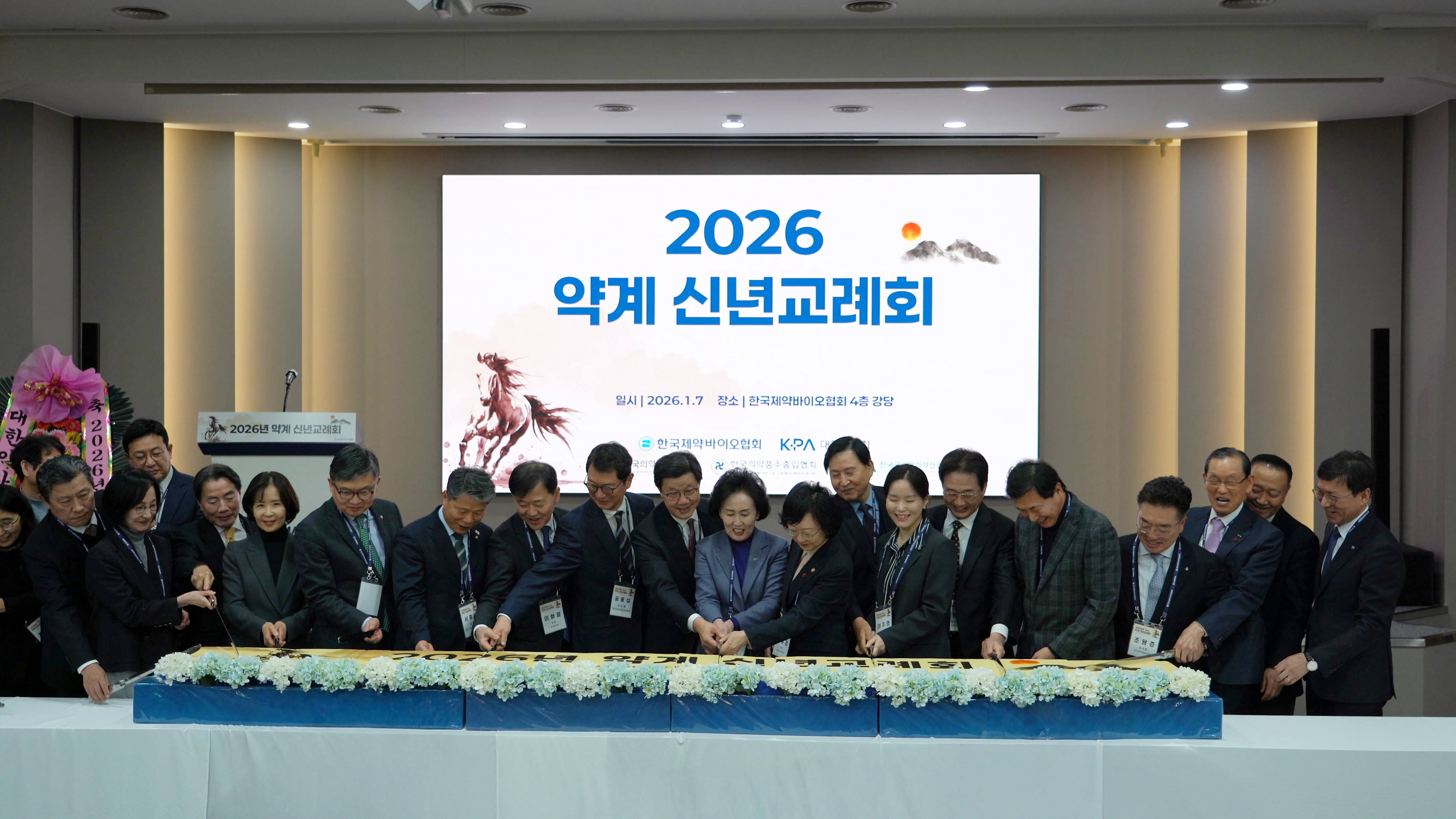
The 2026 Pharmaceutical New Year's Reception was held with the attendance of approximately 200 key figures from the government, National Assembly, and pharmaceutical industry. Amidst New Year's greetings and presentations of industry visions, differing perspectives on the government's ongoing drug pricing system reform were once again evident throughout the event.
The Korea Pharmaceutical and Bio-Pharma Manufacturers Association (KPBMA) and the Korean Pharmaceutical Association (KPA) expressed concerns about the potential industrial impact and on-site confusion resulting from the drug pricing system reform. In contrast, the government and ruling party reaffirmed the fundamental direction of the drug pricing system reform and stated their commitment to pushing forward its implementation.
In his welcome address, KPBMA Chair Yunhong Noh identified the drug pricing reform as a pending issue that may seriously affect the entire industry.
Noh stated, “The drug pricing system reform is an issue that could shake the very foundation of Korea's pharmaceutical and biotech industry. Rather than pushing ahead the government's set schedule, the reform must be redesigned through consultation with industry stakeholders to strike a balance between public health, industrial growth, and pharmaceutical expenditure.” His remarks were interpreted as a clear call for adjusting the pace of reform and supplementing or recalibrating the system.
The Korean Pharmaceutical Association also expressed concern over confusion in the field. Young-hee Kwon, President of the Korean Pharmaceutical Association, said, “Large-scale drug price cuts implemented earlier this year are expected to cause significant confusion across pharmacies. To reduce recurring confusion and improve policy effectiveness, the government must prepare clear institutional alternatives. Practical adjustments are necessary, such as addressing inventory claims and settlement issues.”
The Ministry of Health and Welfare explained the direction of the drug pricing system reform as ‘rewarding innovation and ensuring stable supply,’ and reaffirmed its commitment to continue the push.
Hyung-hoon Lee, Vice Minister of Health and Welfare, stated, “We will pursue improvements to the drug pricing system to sufficiently reward the value of innovation and ensure the stable supply of essential medicines. We will support the pharmaceutical and biotech industry’s evolution into a more innovation-oriented ecosystem.”
Meanwhile, Yu-kyoung Oh, Minister of Food and Drug Safety (MFDS), pledged regulatory support amid a changing regulatory environment. Oh said, “This year will mark the first year of a major transformation in pharmaceutical regulatory services. We will increase the speed and efficiency of reviews by expanding review personnel and introducing an AI-based review support system.”
Ruling party lawmakers largely defended the policy direction of drug pricing reform.
Yoon Kim, a lawmaker from the Democratic Party of Korea, emphasized, “Drug pricing reform should not be viewed simply as a policy aimed at cutting prices to reduce National Health Insurance spending. It is part of a broader effort to transform the pharmaceutical and biotech industry into an innovative ecosystem that has global competitiveness.”
Kim added, “Of course, I am fully aware that there are significant concerns raised in the field. However, if we share the common goal of elevating Korea's pharmaceutical industry to a global level, we can sufficiently discuss and adjust the pace and details of the system. At the National Assembly level, we will reflect the voices from the field and play our role to ensure that the drug price adjustment policy leads to industrial innovation.”
Rep. Young-seok Seo, also of the Democratic Party of Korea, remarked, “While various institutional challenges exist, the ultimate criterion for judgment is the public's right to health. We must find solutions within the broader framework of public health.”
Opposition lawmakers were generally more critical of both the current pricing system and the government’s reform direction.
Rep. Soo-jin Choi of the People Power Party, referring to the price-volume linkage system, pointed out, “The drugs that can be supplied to the public without burden are affordable generics. Setting generic drug prices below KRW 100 is effectively telling manufacturers not to produce them.”
Choi further emphasized, “Lowering the price of drugs that can be supplied more cheaply to the public simply because they are high-volume is an approach focused solely on numbers and the NHIS budget. If industry development is sacrificed solely for fiscal soundness, Korea’s pharmaceutical industry will ultimately lose competitiveness. Drug price reductions must be approached very cautiously and from a comprehensive perspective.”
Rep. Jia Han of the People Power Party also emphasized, “The system cannot outperform reality on the ground,” calling for system design that reflects industrial realities. Rep. Joo-yeon Lee of the Reform Party also expressed concern, stating, “Without concurrent regulatory improvements and creation of an investment-friendly environment, we risk falling behind in global competition.”
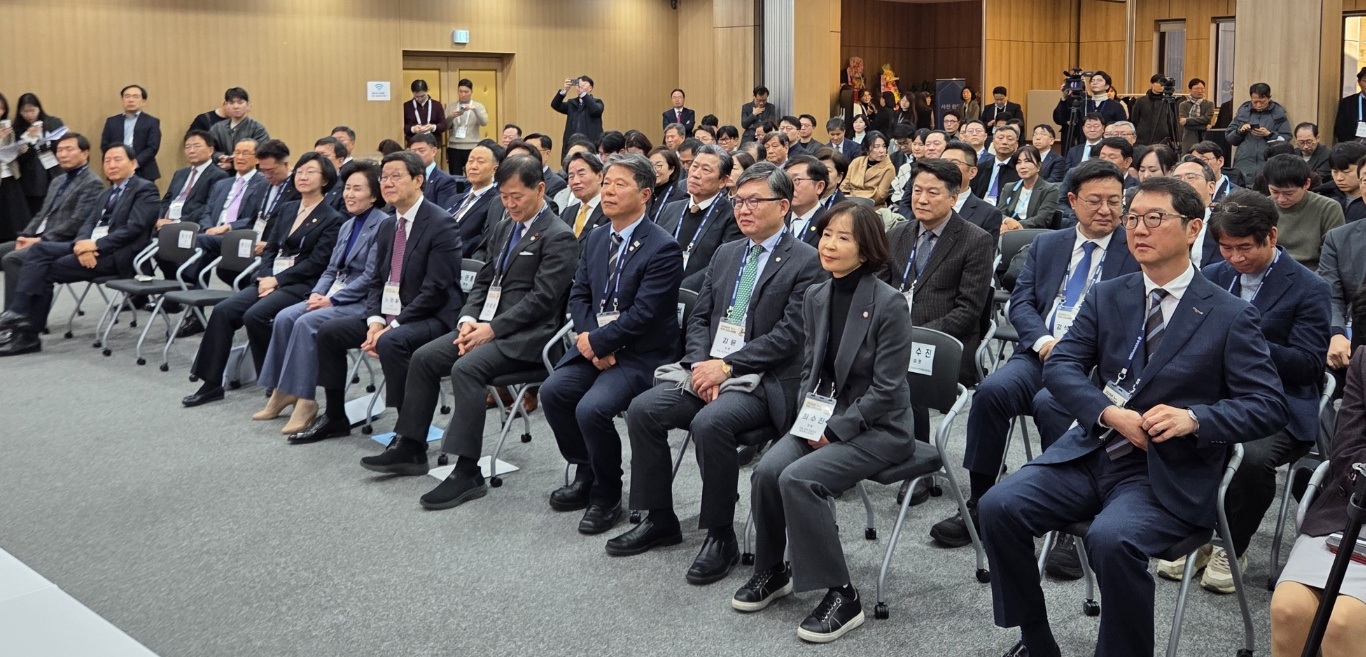
There was also discussion of international non-proprietary name (INN) prescribing and generic substitution. KPA President Kwon noted that an amendment to the Pharmaceutical Affairs Act, which simplifies post-notification requirements for substitution, has passed the National Assembly and is scheduled to take effect in February. It has been a long-standing aspiration since the introduction of the drug dispensing separation system.”
Kwon also cited specific figures regarding INN prescribing, stating, “According to research by the Korea Institute for Pharmaceutical Policy Affairs, INN prescribing could generate total savings of KRW 9 trillion, including drug costs and broader social costs.” She added that public consensus and media attention on INN prescribing are growing.
Rep. Young-seok Seo mentioned the legislative progress on generic substitution, noting that “some long-standing goals of public-sector pharmacists, including the generic substitution simplification law and pay raises, have been partially achieved.” However, regarding the broader system, Seo added that “many challenges still remain.”
-

- 0
댓글 운영방식은
댓글은 실명게재와 익명게재 방식이 있으며, 실명은 이름과 아이디가 노출됩니다. 익명은 필명으로 등록 가능하며, 대댓글은 익명으로 등록 가능합니다.
댓글 노출방식은
댓글 명예자문위원(팜-코니언-필기모양 아이콘)으로 위촉된 데일리팜 회원의 댓글은 ‘게시판형 보기’와 ’펼쳐보기형’ 리스트에서 항상 최상단에 노출됩니다. 새로운 댓글을 올리는 일반회원은 ‘게시판형’과 ‘펼쳐보기형’ 모두 팜코니언 회원이 쓴 댓글의 하단에 실시간 노출됩니다.
댓글의 삭제 기준은
다음의 경우 사전 통보없이 삭제하고 아이디 이용정지 또는 영구 가입제한이 될 수도 있습니다.
-
저작권·인격권 등 타인의 권리를 침해하는 경우
상용 프로그램의 등록과 게재, 배포를 안내하는 게시물
타인 또는 제3자의 저작권 및 기타 권리를 침해한 내용을 담은 게시물
-
근거 없는 비방·명예를 훼손하는 게시물
특정 이용자 및 개인에 대한 인신 공격적인 내용의 글 및 직접적인 욕설이 사용된 경우
특정 지역 및 종교간의 감정대립을 조장하는 내용
사실 확인이 안된 소문을 유포 시키는 경우
욕설과 비어, 속어를 담은 내용
정당법 및 공직선거법, 관계 법령에 저촉되는 경우(선관위 요청 시 즉시 삭제)
특정 지역이나 단체를 비하하는 경우
특정인의 명예를 훼손하여 해당인이 삭제를 요청하는 경우
특정인의 개인정보(주민등록번호, 전화, 상세주소 등)를 무단으로 게시하는 경우
타인의 ID 혹은 닉네임을 도용하는 경우
-
게시판 특성상 제한되는 내용
서비스 주제와 맞지 않는 내용의 글을 게재한 경우
동일 내용의 연속 게재 및 여러 기사에 중복 게재한 경우
부분적으로 변경하여 반복 게재하는 경우도 포함
제목과 관련 없는 내용의 게시물, 제목과 본문이 무관한 경우
돈벌기 및 직·간접 상업적 목적의 내용이 포함된 게시물
게시물 읽기 유도 등을 위해 내용과 무관한 제목을 사용한 경우
-
수사기관 등의 공식적인 요청이 있는 경우
-
기타사항
각 서비스의 필요성에 따라 미리 공지한 경우
기타 법률에 저촉되는 정보 게재를 목적으로 할 경우
기타 원만한 운영을 위해 운영자가 필요하다고 판단되는 내용
-
사실 관계 확인 후 삭제
저작권자로부터 허락받지 않은 내용을 무단 게재, 복제, 배포하는 경우
타인의 초상권을 침해하거나 개인정보를 유출하는 경우
당사에 제공한 이용자의 정보가 허위인 경우 (타인의 ID, 비밀번호 도용 등)
※이상의 내용중 일부 사항에 적용될 경우 이용약관 및 관련 법률에 의해 제재를 받으실 수도 있으며, 민·형사상 처벌을 받을 수도 있습니다.
※위에 명시되지 않은 내용이더라도 불법적인 내용으로 판단되거나 데일리팜 서비스에 바람직하지 않다고 판단되는 경우는 선 조치 이후 본 관리 기준을 수정 공시하겠습니다.
※기타 문의 사항은 데일리팜 운영자에게 연락주십시오. 메일 주소는 dailypharm@dailypharm.com입니다.