- LOGIN
- MemberShip
- 2026-09-13 11:39:41
- Can cutting generic prices really create new drugs?
- by Lee, Jeong-Hwan | translator Alice Kang | 2026-03-26 09:29:22
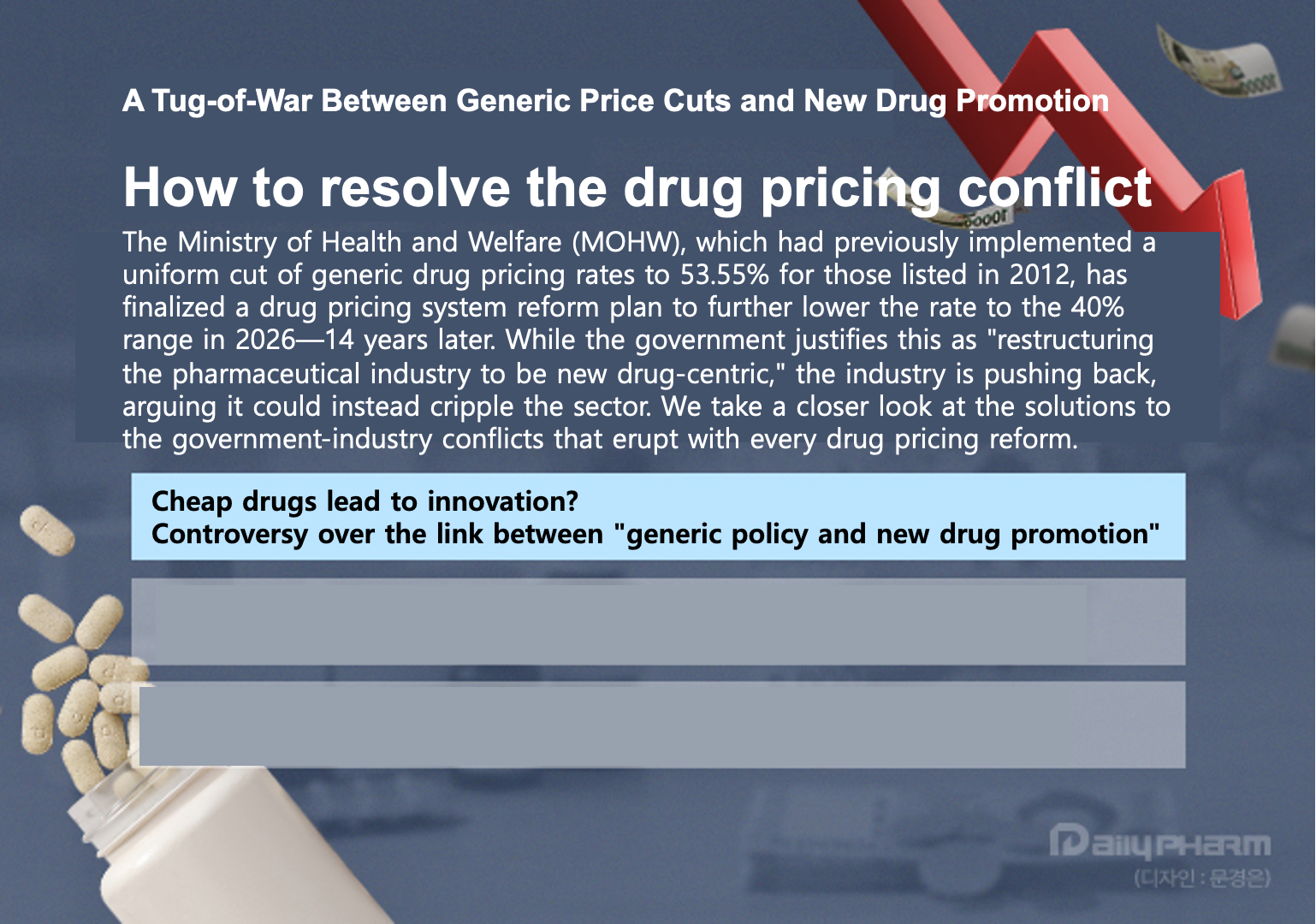
"It is unclear whether the policy objective of this drug price reform plan is to foster the domestic pharmaceutical industry or to rapidly introduce global new drugs from abroad. Will savings generated by lowering generic drug prices actually be used for domestic new drugs and robust domestic pharmaceutical companies, or end up flowing into the high-priced new drugs of multinational pharmaceutical companies? Can the government’s policy, which aims to create domestic pharmaceutical companies capable of producing blockbuster drugs by adjusting generic drug prices, truly be realized?"
Although the Ministry of Health and Welfare has proposed a drug pricing reform aimed at shifting the domestic pharmaceutical industry toward innovation-driven new drug development by lowering generic prices and differentiating pricing for newly listed drugs by company, academia is questioning both its credibility and effectiveness.
The concern is that if the government repeatedly implements across-the-board price cuts while merely touting the promotion of the pharmaceutical industry and the creation of domestic new drugs without presenting a detailed blueprint for where, how much, and how to allocate limited health insurance funds, it may ultimately result in savings from generics being used to reimburse high-cost global innovative drugs.
At the same time, critics argue that the policy paradigm itself is flawed, as it attempts to generate innovative drugs that are rooted in basic and advanced science through partial adjustment of pricing policies for generics, which is a manufacturing-based industry.
It is suggested that the MOHW must embark on a shift in its administrative paradigm, considering the need to design a two-track system that separates and distinguishes generic and new drug policies, in order to move closer to a rational policy that minimizes areas of conflict.
On the 24th, the public health community criticized the ongoing backlash from the domestic pharmaceutical industry regarding the drug pricing reform plan announced by the MOHW for implementation this year, calling it “the result of an administration that has abandoned predictability.”
While the MOHW cited “pharmaceutical industry structural innovation” as the rationale and justification for its drug pricing reform plan, which includes a drastic reduction in the pricing calculation rate for pre-listed generic drugs from 53.55% to the 40% range, the prevailing view among academics is that it is difficult to predict whether this will succeed.
“The government’s concept of ‘industry promotion’ lacks clarity in both philosophy and target”
Health economists and pharmaceutical pricing experts are questioning whether the MOHW has a clear philosophy for the rational management of drug expenditures within the national health insurance budget, and what the specific direction of its policy goal to foster the pharmaceutical industry actually is.
They argue that it is unclear whether the “development of the pharmaceutical industry” mentioned by the MOHW refers to fostering the domestic pharmaceutical industry or to improving patient access through the rapid inclusion of original new drugs, many of which are produced by multinational pharmaceutical companies, for reimbursement in the national health insurance system.
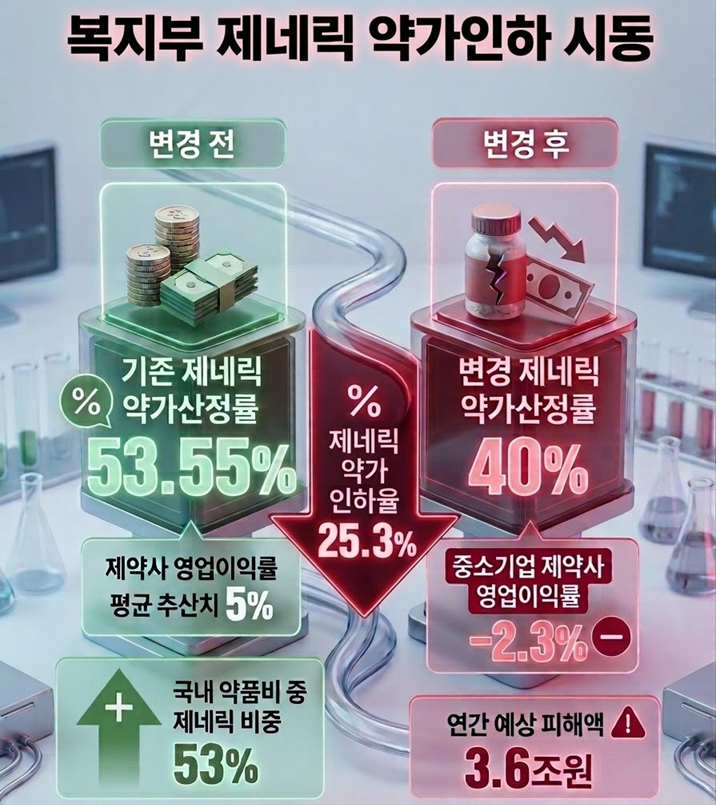
They also point out that the MOHW has not clearly defined how much pharmaceutical spending should be allowed within the insurance budget, how that spending should be allocated between prelisted generics and innovative new drugs, or how to address growing demands for coverage of ultra-high-priced drugs.
Many scholars argue that tinkering with the drug pricing system in this manner without clarity makes it difficult to set precise policy goals, inevitably leading to the vague and ambiguous slogans of “fostering the pharmaceutical industry” and “reducing health insurance costs.”
This is why concerns are being raised that the drug pricing reform plan recently proposed by the MOHW is disproportionately disadvantageous to domestic generic-focused pharmaceutical companies, while favoring multinational companies.
Professor Jong-hyuk Lee of Chung-Ang University College of Pharmacy noted that the MOHW’s reform plan failed to align the levels of price reduction regulations imposed on generics and original drugs to a similar degree, despite its stated goal of addressing fairness between domestic and multinational companies.
He argued that it is necessary to question whether the ministry is consistently lumping together generic drug regulations, which affect only domestic pharmaceutical companies, and patient access issues, which are directly linked to improved reimbursement rates for multinational companies’ new drugs, under the guise of “fostering the pharmaceutical industry.” The point is to demand transparency regarding the policy philosophy.
“The Ministry’s definition of the pharmaceutical industry is vague. Domestic and multinational sectors are being lumped together. In reality, this reform reduces the profits of domestic companies through generic price cuts, potentially reallocating those resources to reimburse multinational companies’ innovative new drugs.”
He continued, “While it is not desirable to draw a line between domestic and multinational companies, this drug pricing reform plan contains virtually no provisions that would cause losses for off-patent original drugs, and instead tends to include numerous regulations that are disadvantageous to domestic companies, such as generic price cuts. Even regarding post-listing control, the timing is being consolidated and adjusted, which will likely lead to situations where original drug prices are cut less frequently. Consequently, multinational companies are more likely to reap the actual benefits than domestic firms.”
“The government must clearly present its philosophy on how pharmaceutical spending will be allocated and what industry fostering and development concretely means. It’s unclear how much savings will be generated from generic price cuts, and whether those funds will be reinvested in domestic companies or used to expand access to innovative drugs. This is precisely why the industry is calling for joint research with the government, to clarify these uncertainties.”
Linking generic drug prices to new drug development the right approach?… time to rethink the administrative paradigm”
Some point out that the MOHW’s current administrative approach, which links generic drug pricing policies with the creation of innovative new drugs, is bound to lead to inevitable contradictions.
The argument is that generics should be viewed from the perspective of protecting manufacturing, a traditional industry, and public health security, while new drugs should be supported through an environment that fully fosters basic and advanced science; however, linking the two often leads to conflicts.
Rather than simply maintaining the current approach, where the MOHW adjusts generic drug prices to encourage more pharmaceutical companies to focus on innovative drug development, the government needs to consider a paradigm shift, such as adopting a two-track administrative system that separates policies for generics and innovative drugs.
In essence, the purpose of generic drug pricing is to ensure a stable supply of cost-effective medications to the public within the constraints of limited national health insurance funds. Cost control through price reductions and management, along with the stabilization of quality and supply, are the core elements of the system.
Conversely, fostering the development of new drugs hinges on pharmaceutical companies making bold investments in high-risk, high-return clinical trial R&D and strengthening the fundamental capabilities of basic life sciences, such as chemistry, biology, and genetics.
Accordingly, the academic community urges the government to establish a nuanced drug pricing system that allows the generic industry to grow, based on its understanding of the value of generics, while simultaneously implementing a separate administrative framework that fully supports the creation of innovative new drugs, independent of the generic sector.
Jae-hyun Lee, Director of the Pharmaceutical Regulatory Science Center at Sungkyunkwan University, stated, “The government needs to better understand the role and value of the generic industry. Generic pricing policy should focus on creating an environment where companies can sustainably produce high-quality, affordable generics. Trying to promote innovation through generic pricing is fundamentally contradictory.”
Lee explained, “This means the drug pricing system should focus solely on creating an environment where pharmaceutical companies strive to manufacture generics properly. Instead of the current approach of uniformly lowering drug prices, we need a system that differentially adjusts prices by comparing the average price per therapeutic class or ingredient with international averages.
He also criticized the reform for lacking predictability from the perspective of pharmaceutical companies.
“Government policy must ensure transparency and predictability. Without predictability, companies will resort to workarounds—such as increasing prescription volume to offset price cuts. Japan gradually reduced prices to around 40% over a decade, allowing companies time to adjust. Korea should also adopt a similar phased approach and give companies time to prepare.”
Industry voices the government’s lack of understanding on the value of generics
Domestic pharmaceutical companies also argue that the government significantly undervalues the role of generics.
They complain that every pricing reform is built on the assumption of across-the-board generic price cuts, inevitably leading to repeated government and industry conflict.
They further point out that generics play a critical role in healthcare security and should be actively supported by the government, rather than subject to one-sided cost-cutting policies that fail to adequately consider the difficulties faced by the pharmaceutical industry, including rising manufacturing costs, such as raw materials and labor expenses.
An administration focused solely on generic drug regulations, such as price cuts, will ultimately encourage the use of cheap, low-quality raw materials and lead to problems such as the abandonment of production of essential drugs with low profitability, thereby deepening reliance on imported generics.
Young-joo Kim, Chair of the Policy Planning Committee for the Emergency Task Force on Drug Price System Reform, stated, “Since generics account for about 50% of South Korea’s pharmaceutical and biotech industry, lowering drug prices will immediately trigger a massive decline in sales. This threatens the survival of pharmaceutical companies. leading to reduced R&D investment due to declining profitability, difficulties in retaining top-tier research talent, and workforce restructuring resulting from production cuts.”
“Korea currently manufactures and supplies most generics domestically, which ensures quality control and supply stability while also funding R&D. In contrast, countries that aggressively cut generic prices now rely heavily on imports, leading to various issues such as frequent stockouts, quality control issues leading to fatalities, and supply instability.”
A pricing official from a leading domestic pharmaceutical company added, “The government should move beyond abstract slogans like ‘industry advancement’ and properly recognize the value of domestic generics in its pricing policies. There needs to be clear criteria to reward companies that consistently produce and supply high-quality generics, along with a governance system that works in partnership with the industry,” he said.
The official concluded, “The negative effects of blanket price cuts are already evident, such as the collapse of the domestic API manufacturing industry. If the government insists on linking generics and innovation, then companies that demonstrate true innovation should be fully exempt from price cuts. Without such changes, conflicts between the industry and the government will persist.”
-

- 0
댓글 운영방식은
댓글은 실명게재와 익명게재 방식이 있으며, 실명은 이름과 아이디가 노출됩니다. 익명은 필명으로 등록 가능하며, 대댓글은 익명으로 등록 가능합니다.
댓글 노출방식은
댓글 명예자문위원(팜-코니언-필기모양 아이콘)으로 위촉된 데일리팜 회원의 댓글은 ‘게시판형 보기’와 ’펼쳐보기형’ 리스트에서 항상 최상단에 노출됩니다. 새로운 댓글을 올리는 일반회원은 ‘게시판형’과 ‘펼쳐보기형’ 모두 팜코니언 회원이 쓴 댓글의 하단에 실시간 노출됩니다.
댓글의 삭제 기준은
다음의 경우 사전 통보없이 삭제하고 아이디 이용정지 또는 영구 가입제한이 될 수도 있습니다.
-
저작권·인격권 등 타인의 권리를 침해하는 경우
상용 프로그램의 등록과 게재, 배포를 안내하는 게시물
타인 또는 제3자의 저작권 및 기타 권리를 침해한 내용을 담은 게시물
-
근거 없는 비방·명예를 훼손하는 게시물
특정 이용자 및 개인에 대한 인신 공격적인 내용의 글 및 직접적인 욕설이 사용된 경우
특정 지역 및 종교간의 감정대립을 조장하는 내용
사실 확인이 안된 소문을 유포 시키는 경우
욕설과 비어, 속어를 담은 내용
정당법 및 공직선거법, 관계 법령에 저촉되는 경우(선관위 요청 시 즉시 삭제)
특정 지역이나 단체를 비하하는 경우
특정인의 명예를 훼손하여 해당인이 삭제를 요청하는 경우
특정인의 개인정보(주민등록번호, 전화, 상세주소 등)를 무단으로 게시하는 경우
타인의 ID 혹은 닉네임을 도용하는 경우
-
게시판 특성상 제한되는 내용
서비스 주제와 맞지 않는 내용의 글을 게재한 경우
동일 내용의 연속 게재 및 여러 기사에 중복 게재한 경우
부분적으로 변경하여 반복 게재하는 경우도 포함
제목과 관련 없는 내용의 게시물, 제목과 본문이 무관한 경우
돈벌기 및 직·간접 상업적 목적의 내용이 포함된 게시물
게시물 읽기 유도 등을 위해 내용과 무관한 제목을 사용한 경우
-
수사기관 등의 공식적인 요청이 있는 경우
-
기타사항
각 서비스의 필요성에 따라 미리 공지한 경우
기타 법률에 저촉되는 정보 게재를 목적으로 할 경우
기타 원만한 운영을 위해 운영자가 필요하다고 판단되는 내용
-
사실 관계 확인 후 삭제
저작권자로부터 허락받지 않은 내용을 무단 게재, 복제, 배포하는 경우
타인의 초상권을 침해하거나 개인정보를 유출하는 경우
당사에 제공한 이용자의 정보가 허위인 경우 (타인의 ID, 비밀번호 도용 등)
※이상의 내용중 일부 사항에 적용될 경우 이용약관 및 관련 법률에 의해 제재를 받으실 수도 있으며, 민·형사상 처벌을 받을 수도 있습니다.
※위에 명시되지 않은 내용이더라도 불법적인 내용으로 판단되거나 데일리팜 서비스에 바람직하지 않다고 판단되는 경우는 선 조치 이후 본 관리 기준을 수정 공시하겠습니다.
※기타 문의 사항은 데일리팜 운영자에게 연락주십시오. 메일 주소는 dailypharm@dailypharm.com입니다.