- LOGIN
- MemberShip
- 2026-08-01 03:33:34
- Is this the end of the era of animal testing?
- by Cha, Ji-Hyun | translator Hong, Ji Yeon | 2026-06-09 10:01:10
After the US government unveiled its roadmap to systematically decrease reliance on animal testing in drug development, Europe has officially announced measures to reduce animal use in pharmaceutical safety assessments. This shift aims to address the ethical controversies surrounding animal experimentation while significantly enhancing the predictive accuracy of human physiological responses. As global regulatory transitions begin, South Korean domestic companies possessing non-animal testing technologies, such as organoids, are gaining attention.
EU joins systemic elimination of animal testing…accelerating safety assessment transformations
According to sources in the pharmaceutical biotech industry, the European Commission (EC) selected a roadmap on June 1st to systematically eliminate animal use in safety assessments for chemicals, including pharmaceuticals. This roadmap includes 15 distinct regulatory domains, including industrial and consumer chemicals, biocides and pesticides, human medicinal products, food and feed additives, and biocompatibility assessments for medical devices.
The EC stated, "This roadmap proposes clear and concrete steps for transitioning toward innovative, non-animal approaches. We plan to maintain the absolute reliability of safety assessments to ensure a high level of protection for human and animal health, as well as the environment."
The strategic framework presented by the EU rests on three primary pillars. ▲Accelerating the development and validation of non-animal testing methodologies ▲Expanding the utilization of research alongside artificial intelligence (AI) and data-driven analytics ▲Strengthening collaboration between EU member states and the international community.
To support the development of alternative methods, the EC intends to grant developers access to the European Reference laboratories (EURLs) at the Joint Research Center (JRC) and to introduce a structured framework to map non-animal testing methods required in real-world regulatory settings. The EC will also incentivize the development of both EU and international standards to ensure these non-animal approaches can be effectively integrated into routine safety evaluations.
Within the pharmaceutical sector, the roadmap outlines strategies to reduce the need for repeat-dose toxicity (RDT) studies for advanced cancers and severe or life-threatening conditions. The blueprint envisions substituting animal models with in vitro assays and computational simulations, and using virtual control groups to minimize the number of control animals deployed in RDT research.
The EC plans to immediately implement this roadmap along with member states, EU agencies, and relevant stakeholders. It will convene a high-level meeting in 2029 to evaluate operational progress and audit the implementation status of non-animal approaches across applicable legislative frameworks, including the Registration, Evaluation, Authorisation and Restriction of Chemicals (REACH) regulation.
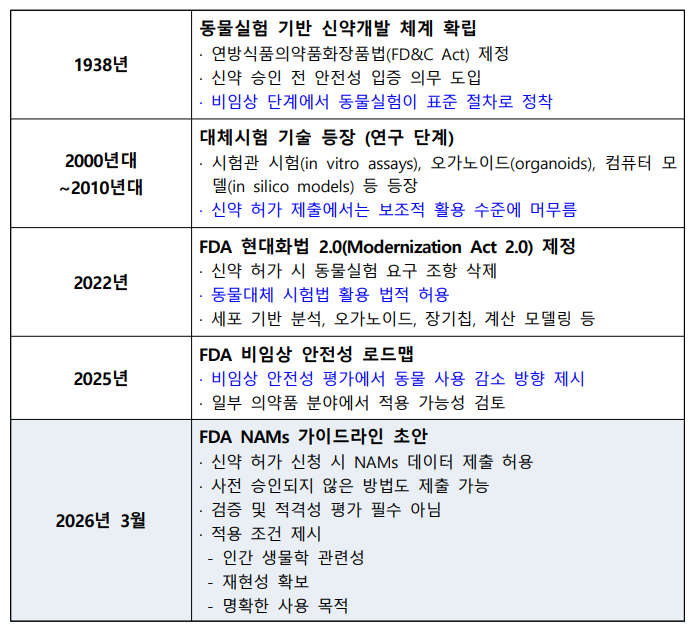
The EU's latest initiative aligns seamlessly with the ongoing policy directives driven by the United States government to reduce animal experimentation. Through the enactment of the FDA Modernization Act 2.0 in December 2022, the US Congress removed the statutory mandate requiring animal testing in the new drug approval pipeline, establishing a robust legal foundation for the use of non-animal methods such as cell-based assays, organoids, organ-on-a-chip technologies, and computational modeling.
Accordingly, in April last year, the US Food and Drug Administration (FDA) announced a systemic transition plan to reduce, refine, and replace animal testing, beginning with monoclonal antibodies and certain medicinal products. The FDA aims to reduce, refine, and replace animal testing using New Approach Methodologies (NAMs), such as organoid toxicity testing, organs-on-chips, and AI-based computational models, and to leverage relevant datasets in Investigational New Drug (IND) applications or Biologics License Applications (BLAs) for biosimilars.
In the same month, the US National Institutes of Health (NIH) also unveiled plans to establish a new organization to expand the use of human-based research technologies. The NIH intends to support the development, validation, and expanded use of non-animal approaches, including organoids, tissue chips, computational models, and real-world data—centered around the Office of Research Innovation, Validation, and Application (ORIVA).
On March 18th of this year, the FDA released a draft guidance document allowing the submission of NAMs data for novel drug approval reviews. This guidance states that testing methods not previously approved as animal testing alternatives may be submitted. That validation or qualification evaluations need not be completed in advance for non-clinical toxicity and safety assessments. Furthermore, the NIH plans to invest more than $150 million to support the development and validation of NAMs.
4.59 million laboratory animals in South Korea…Ethical lontroversies and limitations in replicating human responses
The background behind the United States and Europe starting on reducing animal testing stem from ethical concerns and the limitations of replicating human physiological responses.
First, demands to resolve the ethical problems associated with animal testing have been continuously raised, primarily by animal protection organizations, civil society, and academia. According to the EU, the number of animals used in regulatory testing from 2015 to 2023 exceeded 15 million. Among these, approximately 40% were deployed in chemical safety assessments.
The scale of laboratory animal use is also substantial in South Korea. According to the 2024 Institutional Animal Care and Use Committee (IACUC) Operational Performance Survey by the Animal and Plant Quarantine Agency, the number of laboratory animals used domestically last year totaled 4.59 million. Relevant organizations and experts argue that, since numerous animals are used in experiments worldwide each year, unnecessary animal sacrifice must be reduced and the use of alternative testing methods expanded.
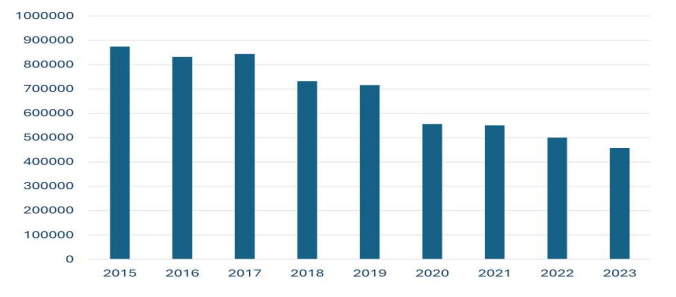
The limitations in connecting animal test results to actual human responses during the new drug development process are another factor accelerating the regulatory transition. Conventional non-clinical trials have served as an essential gateway to assess the toxicity and efficacy of candidate substances. However, criticisms persist that accurately predicting human drug responses solely from animal results has clear limitations. In particular, with the emergence of novel types of medicines, such as antibodies and cell/gene therapies, the problem that animal models alone cannot fully replicate human immune responses and disease characteristics has been highlighted.
Announcing its plan to expand the utilization of human-based research technologies in April last year, the NIH said, "Some research institutions have failed to draw sufficient conclusions when applying animal model results to human diseases, such as Alzheimer's disease and cancer. These limitations may stem from differences in anatomy, physiology, lifespan, and disease characteristics between humans and animals. Even if humans and animals share genes, there can be differences in the functions of organs and bodily systems, which can create constraints in applying animal model results to human diseases."
Even if a candidate substance confirms efficacy and safety in animal testing, its development can be discontinued if the expected effects do not manifest or unexpected toxicities are identified in human clinical trials. In such cases, years of research and development expenses, and the manpower invested in candidate discovery, non-clinical trials, and production process development, cannot be recovered, leading to the burden of delaying subsequent pipeline schedules. This is why regulatory bodies in various countries are rushing to introduce alternative testing methods.
South Korea also accelerates alternative testing implementation…Korean organoid companies rise
Along with the global regulatory shift, the institutionalization and serialization of alternative testing methods are gathering full momentum in South Korea. Following the establishment of a foundational research base, the government is refortifying the legal basis for applications within the pharmaceutical sector and taking steps to preempt international standards for advanced alternative testing methods, such as organoids.
In South Korea, the Ministry of Food and Drug Safety (MFDS) established the foundation for the development and validation of alternative testing methods by establishing the Korean Center for the Validation of Alternative Methods (KoCVAM) in 2009.
In 2011, the MFDS joined the International Cooperation on Alternative Test Methods (ICATM) and has since participated in the development of international testing guidelines alongside regulatory agencies of major countries, including the United States and Europe.
The MFDS has also officially begun to establish international standards. Last year, the MFDS launched the Committee for the International Standardization of Organoid Testing Methods and partnered with the Organisation for Economic Co-operation and Development (OECD) to develop international guidelines for organoid-based toxicity testing. The government plans to leverage the 14th World Congress on Alternatives and Animal Use in the Life Sciences (WC14), which will be held in Seoul in 2027, as an opportunity to enhance the regulatory utility of domestic technologies on the international stage.
Collaboration between industry and research institutes has also begun. Last August, the 'K-Organoid Consortium' was launched, involving 27 corporations, including Samsung Biologics, Daewoong Pharmaceutical, and JW Pharmaceutical, as well as 18 research institutions. The consortium promotes standardization of testing methods, the development of industrial support infrastructure, and international cooperation, thereby supporting the global regulatory acceptance and market entry of domestic organoid technologies.
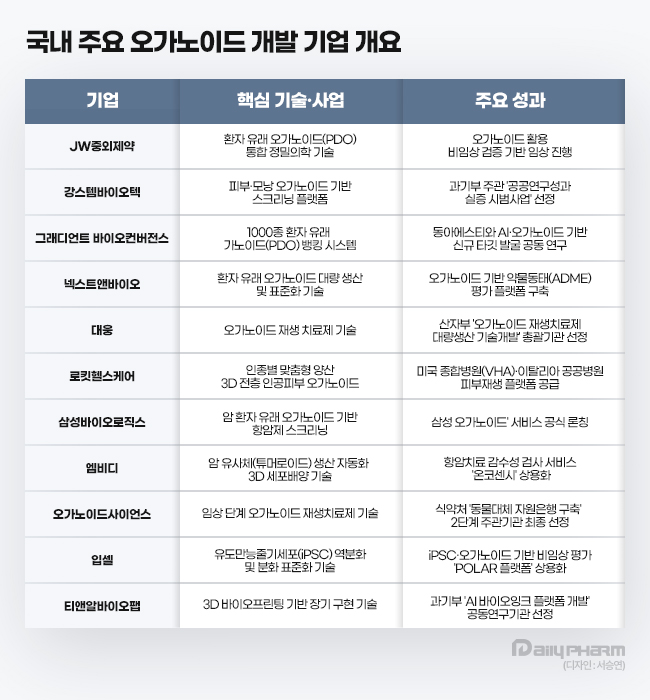
As the reduction of animal testing and the adoption of non-animal testing methodologies spread globally, Korean companies with relevant technologies are garnering significant attention. Anticipation is growing that if global regulatory bodies expand the scope of utilizing non-animal testing datasets, such as organoids, organs-on-chips, and AI-based predictive models, it will lead to increased opportunities for technical validation and collaboration with global pharmaceutical companies for domestic firms.
OrganoidSciences is regarded as one of the most active companies in the organoid field. Through its organoid-based drug evaluation platform 'ODISEI', the company replicates actual human organ architecture and disease microenvironments to evaluate the efficacy and toxicity of candidate compounds. It is also developing an organoid-based regenerative medicine pipeline called 'ATORM'; its lead asset, ATORM-C, recently secured Phase I IND approval from the MFDS for patients with Crohn's disease, successfully entering the clinical phase.
MBD is developing patient-tailored workflows for predicting anticancer drug response using 3D cell culture technology. The company has proprietary automation technologies to uniformly mass-produce tumoroids (cancer mimics) from minimal patient specimens, alongside 'OncoCensi', a tumoroid-based assay evaluating chemosensitivity to anticancer therapies. Following a successful technical evaluation in November 2024, MBD filed a preliminary KOSDAQ listing review application with the Korea Exchange this past April, officially initiating its initial public offering (IPO) process.
Samsung Biologics launched 'Samsung Organoid', an anticancer drug-screening service based on cancer-patient-derived organoids, in June last year. JW Pharmaceutical utilized human skin organoids to evaluate the hair follicle-generating efficacy of its alopecia drug candidate 'JW0061', and the candidate molecule is currently advancing toward entry into Phase I clinical trials. Daewoong is developing mass-production bioprocess technologies for organoid-based regenerative therapeutics with support from the Ministry of Trade, Industry and Energy (MOTIE). Its objective is to establish manufacturing protocols for therapeutics designed to assist in the regeneration of damaged organs and tissues, such as the heart, liver, and kidneys, and to expand its scope into treatments for intractable diseases.
Lastly, Gradient Bioconvergence is operating oncology target discovery and drug response prediction businesses that pair AI and gene-editing technologies with a repository of approximately 1,000 patient-derived organoids and genomic datasets. Kangstem Biotech is engineering skin disease models based on skin organoids. Next&Bio is developing platforms for efficacy evaluation powered by patient-derived cancer organoids and microphysiological systems. Ipsell is advancing the commercialization of 'POLAR', an alternative testing platform leveraging induced pluripotent stem cells (iPSCs) and organoids. Concurrently, T&R Biofab is developing 3D bioprinting and vascularized tissue technologies, while ROKIT Healthcare is developing a patient-centric, personalized regenerative medicine platform.
-

- 0
댓글 운영방식은
댓글은 실명게재와 익명게재 방식이 있으며, 실명은 이름과 아이디가 노출됩니다. 익명은 필명으로 등록 가능하며, 대댓글은 익명으로 등록 가능합니다.
댓글 노출방식은
댓글 명예자문위원(팜-코니언-필기모양 아이콘)으로 위촉된 데일리팜 회원의 댓글은 ‘게시판형 보기’와 ’펼쳐보기형’ 리스트에서 항상 최상단에 노출됩니다. 새로운 댓글을 올리는 일반회원은 ‘게시판형’과 ‘펼쳐보기형’ 모두 팜코니언 회원이 쓴 댓글의 하단에 실시간 노출됩니다.
댓글의 삭제 기준은
다음의 경우 사전 통보없이 삭제하고 아이디 이용정지 또는 영구 가입제한이 될 수도 있습니다.
-
저작권·인격권 등 타인의 권리를 침해하는 경우
상용 프로그램의 등록과 게재, 배포를 안내하는 게시물
타인 또는 제3자의 저작권 및 기타 권리를 침해한 내용을 담은 게시물
-
근거 없는 비방·명예를 훼손하는 게시물
특정 이용자 및 개인에 대한 인신 공격적인 내용의 글 및 직접적인 욕설이 사용된 경우
특정 지역 및 종교간의 감정대립을 조장하는 내용
사실 확인이 안된 소문을 유포 시키는 경우
욕설과 비어, 속어를 담은 내용
정당법 및 공직선거법, 관계 법령에 저촉되는 경우(선관위 요청 시 즉시 삭제)
특정 지역이나 단체를 비하하는 경우
특정인의 명예를 훼손하여 해당인이 삭제를 요청하는 경우
특정인의 개인정보(주민등록번호, 전화, 상세주소 등)를 무단으로 게시하는 경우
타인의 ID 혹은 닉네임을 도용하는 경우
-
게시판 특성상 제한되는 내용
서비스 주제와 맞지 않는 내용의 글을 게재한 경우
동일 내용의 연속 게재 및 여러 기사에 중복 게재한 경우
부분적으로 변경하여 반복 게재하는 경우도 포함
제목과 관련 없는 내용의 게시물, 제목과 본문이 무관한 경우
돈벌기 및 직·간접 상업적 목적의 내용이 포함된 게시물
게시물 읽기 유도 등을 위해 내용과 무관한 제목을 사용한 경우
-
수사기관 등의 공식적인 요청이 있는 경우
-
기타사항
각 서비스의 필요성에 따라 미리 공지한 경우
기타 법률에 저촉되는 정보 게재를 목적으로 할 경우
기타 원만한 운영을 위해 운영자가 필요하다고 판단되는 내용
-
사실 관계 확인 후 삭제
저작권자로부터 허락받지 않은 내용을 무단 게재, 복제, 배포하는 경우
타인의 초상권을 침해하거나 개인정보를 유출하는 경우
당사에 제공한 이용자의 정보가 허위인 경우 (타인의 ID, 비밀번호 도용 등)
※이상의 내용중 일부 사항에 적용될 경우 이용약관 및 관련 법률에 의해 제재를 받으실 수도 있으며, 민·형사상 처벌을 받을 수도 있습니다.
※위에 명시되지 않은 내용이더라도 불법적인 내용으로 판단되거나 데일리팜 서비스에 바람직하지 않다고 판단되는 경우는 선 조치 이후 본 관리 기준을 수정 공시하겠습니다.
※기타 문의 사항은 데일리팜 운영자에게 연락주십시오. 메일 주소는 dailypharm@dailypharm.com입니다.
- “Drug pricing intervention contributes to the crisis in essential healthcare and shortage of drugs”
- Reporter's view | Lee, Jeong-Hwan