- LOGIN
- MemberShip
- 2026-08-28 13:50:41
- Drugmakers combine in-house and external expertise in new drug launches
- by Son, Hyung Min | translator Alice Kang | 2026-08-28 09:51:38
Pharmaceutical companies face a series of choices when bringing a new drug to the Korean market.
They must decide whether to handle functions such as clinical development internally or enlist external specialists, and how to prepare their reimbursement and pricing strategies following regulatory approval. For product communications, they must divide responsibilities between in-house teams and PR agencies. After launch, they must choose whether to deploy their own sales force or enter into a co-promotion agreement with a Korean pharmaceutical company. Distribution can likewise be outsourced to a specialized distributor or handled through direct contracts with multiple wholesalers.
Cost is another major factor in outsourcing decisions. Hiring additional in-house personnel for every function required to launch a new drug increases fixed costs, including labor costs. By contrast, using external specialists on a project basis during specific periods such as regulatory approval, reimbursement, and launch can reduce the fixed-cost burden.
Ultimately, pharmaceutical companies would need to decide whether to develop the necessary expertise internally or outsource it after considering the product’s market potential and projected business scale, the capabilities of their existing organization, and the costs involved.
Collaboration with external companies has long been a common practice. What has become increasingly noteworthy is the growing range of choices involved in bringing a single new drug to market, and the increasing specialization of the areas in which external providers participate.
The proliferation of high-priced new drugs, including cancer and rare disease therapies, has made reimbursement and pricing strategies more complex. Meanwhile, continued new drug launches and indication expansions have sharply increased the associated workload. At the same time, multinational pharmaceutical companies are streamlining their internal organizations according to business priorities and actively considering the use of external capabilities where needed, rather than performing every function with in-house personnel.
The key issue in launching a new drug is no longer simply whether to outsource the work. Deciding which functions to perform internally and when and with whom to collaborate has itself become part of the market entry strategy.
Multiple choices for a single new drug… collaboration model also varies
A new drug’s entry into the Korean market begins with the global headquarters’ decision to introduce the drug. The Korean affiliate then develops detailed strategies tailored to the local market, covering regulatory approval, reimbursement and pricing, medical affairs, marketing and sales.
Various external specialists may participate at each stage. Contract research organizations and regulatory consulting firms provide support during clinical development and regulatory approval, while law firms and pricing consulting companies may conduct pharmacoeconomic evaluations and budget impact analyses during the reimbursement process.
Law firms advise on legal and drug pricing policy issues, while PR and marketing agencies handle product and disease communications. At the commercialization stage, contract sales organizations, Korean pharmaceutical companies, and pharmaceutical distributors are added to the partner list.
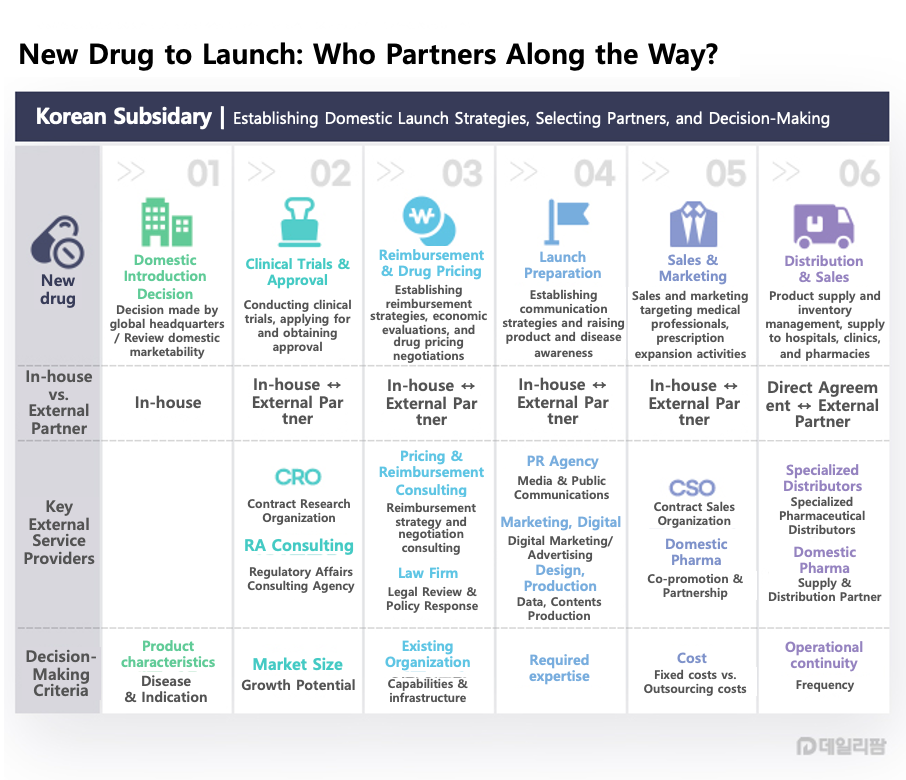
Multinational pharmaceutical companies do not adopt the same partnership model for every new drug. The partners vary according to the patient population, therapeutic area, projected sales and likelihood of reimbursement, as well as the organization and infrastructure already available within the Korean affiliate.
A company with an established sales and marketing team in a particular therapeutic area may approach the market directly. A company without one may partner with a Korean pharmaceutical company or CSO. The scope of outsourced reimbursement work also differs depending on the experience of the company’s internal pricing team and the characteristics of the product.
Workforce management is another important consideration. Maintaining in-house specialists may be advantageous for functions needed continuously over an extended period. For work concentrated within a limited timeframe, however, such as obtaining approval for a particular drug or conducting its pharmacoeconomic evaluation, using external personnel may be more efficient.
As a result, each company assembles a different partnership structure for every single new drug.
Sell directly or forge partnerships…Commercialization models also vary
Further decisions must be made regarding sales and distribution after launch.
If the Korean affiliate already has a sales organization in the relevant therapeutic area, it can sell the product directly. If its domestic sales network is insufficient or it needs to reach a broad range of medical institutions quickly, it may instead co-promote the product with a Korean pharmaceutical company or outsource some functions to a CSO.
Product characteristics also inform this decision. Rare disease treatments and certain cancer drugs, which have small patient populations and a limited pool of prescribers, can be covered by relatively small specialist teams. By contrast, products for chronic diseases with broad prescribing bases place greater importance on nationwide sales networks.
In particular, building a large sales force for a new business area creates a substantial fixed-cost burden. During the initial stage, when the size of the market and the product’s growth prospects remain uncertain, a company may consider using an external sales network and subsequently strengthen its own organization once the business has expanded.
Korean pharmaceutical companies continue to be chosen as co-promotion partners by multinational drugmakers because their established sales networks and accumulated experience in particular therapeutic areas can be put to immediate use.
Distribution is a separate decision from sales. A company that sells a product through its own sales team may still outsource logistics to a specialized distributor or contract directly with multiple distributors. Co-promoting a product with a Korean pharmaceutical company does not necessarily mean that the partner will also handle all aspects of its distribution.
Commercialization strategies are therefore becoming more segmented. Rather than bundling sales, marketing and distribution together, companies assess the appropriate model and cost for each function and assemble a combination of partners suited to the product.
Same GLP-1 market, different choices…sales and distribution strategies diverge
The rapidly growing market for GLP-1 obesity drugs illustrates how multinational pharmaceutical companies targeting the same market can adopt different partnership models.
When Novo Nordisk launched its obesity treatment ‘Wegovy (semaglutide)’ in Korea in October 2024, it chose to supply the drug through Zuellig Pharma. As market competition subsequently intensified, the company also adjusted its sales, marketing, and distribution strategies.
Last year, Novo Nordisk signed a co-promotion agreement with Chong Kun Dang for Wegovy, establishing a collaborative domestic sales and marketing system. This year, it further diversified its distribution network by adding major Korean pharmaceutical distributors to its existing supply system.
Lilly Korea, by contrast, launched its obesity treatment ‘Mounjaro (tirzepatide)’ without a co-promotion agreement with a Korean pharmaceutical company, relying primarily on its own sales and marketing organization. For product supply, it chose to contract directly with multiple pharmaceutical distributors.
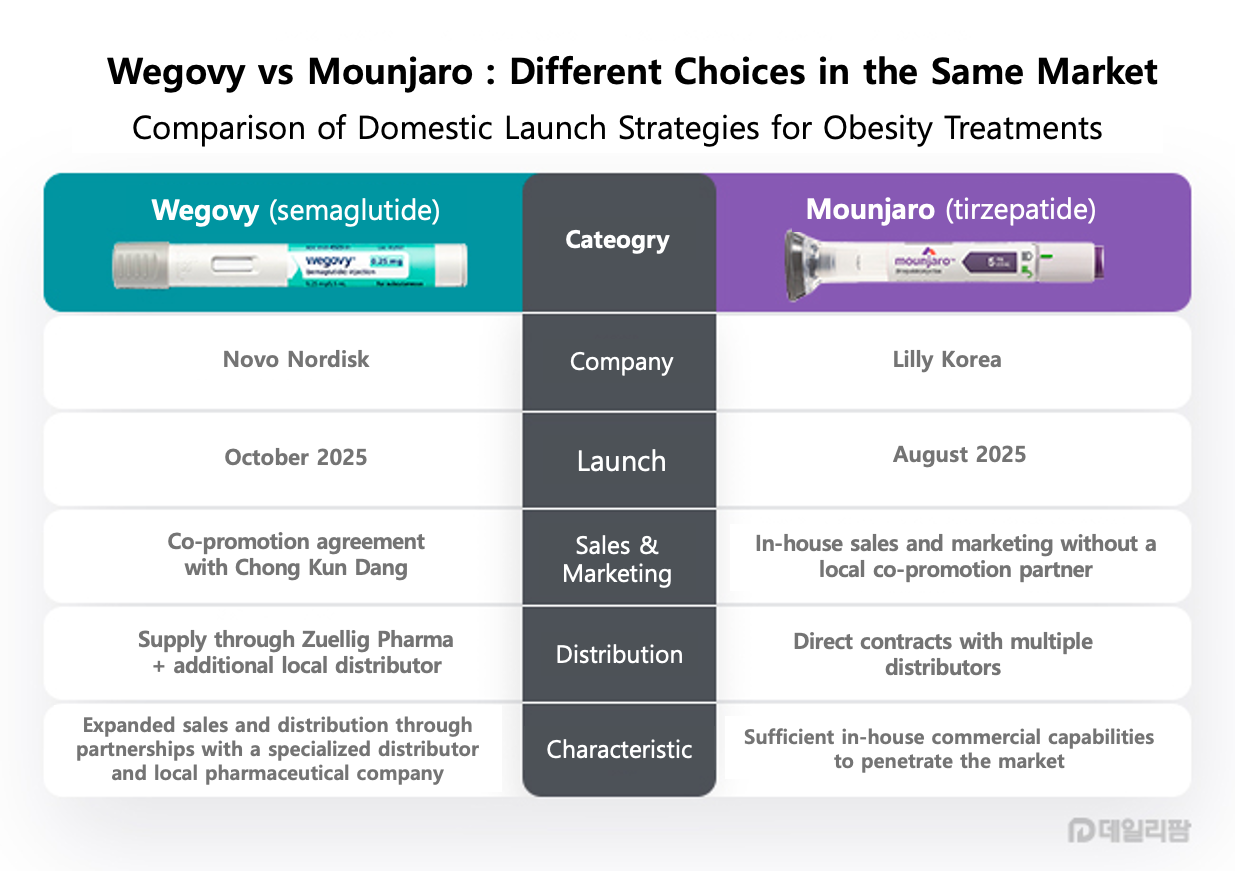
Even within the same GLP-1 obesity drug market, one company partnered with a specialized distributor and a Korean pharmaceutical company, while the other linked its in-house commercial organization to multiple distributors.
These differences cannot be explained by a product’s market potential alone. They also reflect each company’s existing sales organization and distribution network, its business experience in the therapeutic area, and its market penetration strategy.
Cost cannot be overlooked either. Building and maintaining a nationwide sales force requires substantial personnel and administrative spending. Partnering with a Korean pharmaceutical company or external organization that already owns a sales network in the relevant therapeutic area allows a company to secure the necessary infrastructure in a short period of time.
Nor are decisions made at launch necessarily permanent. As the Wegovy case demonstrates, sales, marketing and distribution partners may be reconfigured after launch as the competitive environment, product demand and supply conditions change.
Changes in drug pricing policy prompt launch strategy revisions… impact assessments conducted in early stages
Reimbursement and pricing strategies are not determined solely by a new drug’s clinical value. Depending on the reimbursement and pricing systems operated by the government, the same product may follow a different market entry route, command a different expected price or be listed at a different time.
Various mechanisms are now being used to improve access to new drugs, including expedited listing, risk-sharing agreements, exemptions from health economic evaluation submissions, the Global Innovative Products on Fast Track program and the parallel approval-assessment-negotiation pilot program. At the same time, pricing and post-listing management systems are undergoing a series of revisions. Pharmaceutical companies therefore have a growing need to assess applicable programs and their potential pricing implications from the early stages of a product’s introduction into Korea, rather than waiting until after approval to respond at the reimbursement application stage.
In particular, major changes in drug pricing policy affect not only pipeline products but also those already on the market. Companies must analyze the impact of regulatory changes on the price of each product, future indication expansions, and the broader portfolio, and adjust listing timelines and reimbursement and pricing strategies accordingly.
During this process, the Korean affiliate’s Market Access team can set the overall direction and communicate with health authorities, while external consulting firms or law firms assist with pharmacoeconomic evaluations, budget impact analyses, and product-specific impact assessments of regulatory changes. This allows companies to supplement their internal capabilities with relevant external experience rather than permanently maintaining in-house personnel to address every regulatory change.
External providers do not, however, determine a company’s pricing strategy. The pharmaceutical company sets the direction based on the product’s clinical value and market potential and combines the analyses and advice needed to respond to the changing regulatory environment.
Beyond outsourcing to “combinations”… Korean affiliates take on a greater role
The expanding participation of external specialists in new drug launches does not diminish the role of Korean affiliates.
Rather, as the number of choices increases, deciding which functions require in-house personnel and which responsibilities should be shared with external providers became more important.
Companies must compare the personnel expenses required to maintain a permanent internal organization with the cost of using external specialists on a project basis. They must also determine whether the relevant capability needs to be accumulated internally over the long term.
Even within the same company, different strategies may be adopted for different products. One product may be sold directly, while another is co-promoted with a Korean company. Depending on a product’s characteristics, a company may seek assistance from a consulting company or law firm on reimbursement and select PR partners according to the timing and scope of the work required.
Outsourcing does not invariably reduce costs. When multiple providers participate simultaneously, additional personnel and resources are needed for their management and coordination. Excessive dependence on external providers for core capabilities can also prevent experience from accumulating within the company.
Ultimately, the recent changes in new drug launches therefore cannot be explained simply as an increase in outsourcing. Rather, companies are adopting increasingly diverse ways of combining internal and external roles after considering the product’s market potential, their existing organization, the expertise required, the duration of the work, and its cost.
As new drug launches become more complex, accessing the right expertise at the right time is becoming more important than maintaining every function in-house. The role of Korean affiliates is also expanding from directly performing individual tasks to effectively coordinating internal and external capabilities.
-

- 0
댓글 운영방식은
댓글은 실명게재와 익명게재 방식이 있으며, 실명은 이름과 아이디가 노출됩니다. 익명은 필명으로 등록 가능하며, 대댓글은 익명으로 등록 가능합니다.
댓글 노출방식은
댓글 명예자문위원(팜-코니언-필기모양 아이콘)으로 위촉된 데일리팜 회원의 댓글은 ‘게시판형 보기’와 ’펼쳐보기형’ 리스트에서 항상 최상단에 노출됩니다. 새로운 댓글을 올리는 일반회원은 ‘게시판형’과 ‘펼쳐보기형’ 모두 팜코니언 회원이 쓴 댓글의 하단에 실시간 노출됩니다.
댓글의 삭제 기준은
다음의 경우 사전 통보없이 삭제하고 아이디 이용정지 또는 영구 가입제한이 될 수도 있습니다.
-
저작권·인격권 등 타인의 권리를 침해하는 경우
상용 프로그램의 등록과 게재, 배포를 안내하는 게시물
타인 또는 제3자의 저작권 및 기타 권리를 침해한 내용을 담은 게시물
-
근거 없는 비방·명예를 훼손하는 게시물
특정 이용자 및 개인에 대한 인신 공격적인 내용의 글 및 직접적인 욕설이 사용된 경우
특정 지역 및 종교간의 감정대립을 조장하는 내용
사실 확인이 안된 소문을 유포 시키는 경우
욕설과 비어, 속어를 담은 내용
정당법 및 공직선거법, 관계 법령에 저촉되는 경우(선관위 요청 시 즉시 삭제)
특정 지역이나 단체를 비하하는 경우
특정인의 명예를 훼손하여 해당인이 삭제를 요청하는 경우
특정인의 개인정보(주민등록번호, 전화, 상세주소 등)를 무단으로 게시하는 경우
타인의 ID 혹은 닉네임을 도용하는 경우
-
게시판 특성상 제한되는 내용
서비스 주제와 맞지 않는 내용의 글을 게재한 경우
동일 내용의 연속 게재 및 여러 기사에 중복 게재한 경우
부분적으로 변경하여 반복 게재하는 경우도 포함
제목과 관련 없는 내용의 게시물, 제목과 본문이 무관한 경우
돈벌기 및 직·간접 상업적 목적의 내용이 포함된 게시물
게시물 읽기 유도 등을 위해 내용과 무관한 제목을 사용한 경우
-
수사기관 등의 공식적인 요청이 있는 경우
-
기타사항
각 서비스의 필요성에 따라 미리 공지한 경우
기타 법률에 저촉되는 정보 게재를 목적으로 할 경우
기타 원만한 운영을 위해 운영자가 필요하다고 판단되는 내용
-
사실 관계 확인 후 삭제
저작권자로부터 허락받지 않은 내용을 무단 게재, 복제, 배포하는 경우
타인의 초상권을 침해하거나 개인정보를 유출하는 경우
당사에 제공한 이용자의 정보가 허위인 경우 (타인의 ID, 비밀번호 도용 등)
※이상의 내용중 일부 사항에 적용될 경우 이용약관 및 관련 법률에 의해 제재를 받으실 수도 있으며, 민·형사상 처벌을 받을 수도 있습니다.
※위에 명시되지 않은 내용이더라도 불법적인 내용으로 판단되거나 데일리팜 서비스에 바람직하지 않다고 판단되는 경우는 선 조치 이후 본 관리 기준을 수정 공시하겠습니다.
※기타 문의 사항은 데일리팜 운영자에게 연락주십시오. 메일 주소는 dailypharm@dailypharm.com입니다.

- [Reporter's View] Surgical robotics, What is needed to export domestic tech?
- Reporter's view | Hwang, byoung woo