- LOGIN
- MemberShip
- 2026-09-01 12:49:38
- Generic pharma companies weigh options to avoid price cuts
- by Chon, Seung-Hyun | translator Alice Kang | 2026-09-01 09:51:21
Pharmaceutical companies are considering whether to conduct bioequivalence studies to avoid price cuts for their already approved generics. The health authorities’ reimbursement price adjustment schedule has given them time to defend existing prices. This has raised concerns that companies may once again conduct bioequivalence studies on products that are already selling without problems solely to preserve their prices, resulting in a wasteful testing race.
MOHW to begin first price adjustment for listed generics next April…Companies may attempt to avoid price cuts using bioequivalence studies
According to the Ministry of Food and Drug Safety on the 31st, 138 bioequivalence study protocols were approved between January and August this year, averaging 17.3 per month. This represents a slight increase from the monthly averages of 16.4 in 2024 and 16.6 last year.
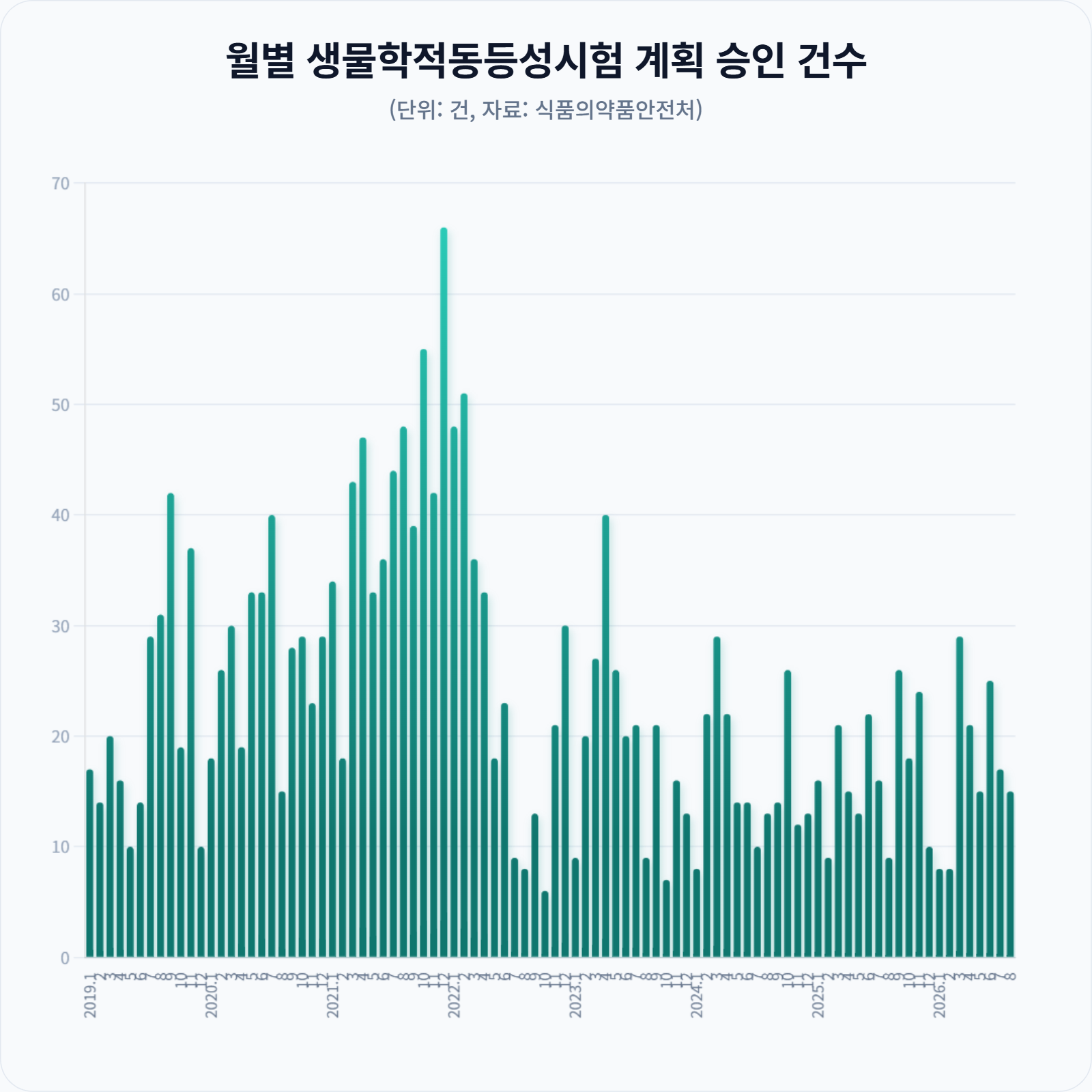
Industry observers expect bioequivalence study activity involving previously approved generics to accelerate once the government’s generic price reassessment gets fully underway.
The Ministry of Health and Welfare recently finalized the price adjustment schedule under the reassessment of listed generics. Price cuts under the first phase will take effect in April next year. Second-phase cuts will begin in October 2030 and be completed in October 2036.
The reassessment is intended to apply the drug pricing system reform, which took effect this month, to generics already listed for reimbursement. Under the revised system, the maximum reimbursement price for both off-patent drugs and generics will be lowered from 53.55% to 45% of the original drug’s pre-patent-expiry price.
The ministry plans to divide existing products into those listed before and after 2012 and gradually adjust their prices to the revised 45% rate. Both generics and off-patent original drugs with listed generics will be subject to the cuts.
The reassessment will adjust prices not only to reflect the lower maximum price but also when products fail to meet premium-price requirements, such as the requirement to conduct a bioequivalence study.
Under the revised pricing system, the discount applied for failure to meet premium-price requirements will increase from 15% to 20%. Since July 2020, a generic has had to satisfy both requirements—conducting its own bioequivalence study and using a registered active pharmaceutical ingredient—to qualify for the maximum price of 53.55%. The maximum price is reduced by 15% for each unmet requirement. A product that meets neither requirement is therefore subject to a 27.75% reduction. Applying the 15% discount lowers the 53.55% maximum to 45.52% when one requirement is unmet and to 38.69% when both are unmet.
Under the new 45% pricing benchmark and 20% discount, the maximum price will fall to 36% when one requirement is unmet and to 28.8% when neither requirement is met. This translates into a 20.9% cut from the current price for a generic failing one requirement and a 25.6% cut for one failing both.
From the company’s standpoint, therefore, they must face a 20.9% price cut for generics that have not undergone bioequivalence testing.
The ministry plans to announce the generic price reassessment schedule this month. Products subject to the first adjustment phase will consequently have 8 months until their prices are reduced next April.
Companies have begun reviewing the profitability of generics in their portfolios that face substantial cuts because bioequivalence studies were not conducted. For example, if accepting a price cut for failure to satisfy a requirement would significantly damage a product’s profitability, a company may consider conducting a bioequivalence study to avoid the reduction.
Thousands of price cuts made after 2020 reassessment…Confusion over bioequivalence studies for listed generics may recur
Industry observers warn that the confusion seen when the prices of approximately 8,000 generics were reduced in two rounds in September 2023 and March 2024 could recur.
On Sept. 5, 2023, prices were cut by up to 28.6% for 7,355 generic products. This was the result of the first generic price reassessment initiated in 2020. In June 2020, the Ministry of Health and Welfare announced a plan to reassess maximum reimbursement prices. Under the plan, generics that did not meet the premium-price requirements could preserve their existing prices by submitting documentation showing completion of a bioequivalence study and use of a registered active pharmaceutical ingredient by the end of February 2023. This was a follow-up measure designed to apply the new pricing system, introduced in July 2020, to previously listed generics.
At the time, most of the 7,355 products were subject to a 15% cut. Numerous products had their prices reduced by 15% because they had not undergone bioequivalence testing. The reduction exceeded 20% for 145 products, including 125 products that received cuts of more than 27%. These products met neither of the two reassessment requirements and therefore had to accept price cuts approaching 30%.
In March 2024, reimbursement prices for another 948 products were reduced by up to 27.9% in the second round of the generic price reassessment. Additional cuts were applied to products newly brought under bioequivalence testing requirements, including sterile formulations such as injectable drugs.
At the time, prices were reduced by up to 27.4% for 125 products containing Artemisia asiatica ethanol extract, with an average cut of 14.5%. The extract is the active ingredient in a botanical drug developed from mugwort. The originator product, Stillen, is used to improve gastric mucosal lesions, bleeding, redness, and edema associated with acute and chronic gastritis.
Price cuts were applied to 94 Stillen generics and 31 high-dose Stillen 2X generics. Stillen and Stillen 2X products had been approved on the basis of comparative dissolution and disintegration testing rather than bioequivalence studies. Because they failed to meet the bioequivalence testing requirement, one of the conditions for receiving the maximum generic price, all of the generic products were subject to cuts. Of the 125 affected products, 108 received a 15% reduction for failing to meet the bioequivalence study requirement.
At the time, the pharmaceutical companies had little choice but to accept the cuts, as it was difficult to establish equivalence for botanical products with a bioequivalence test comparing blood concentrations of their active ingredients.
There are now concerns that the revised pricing system, which further lowers generic prices, could trigger another wave of bioequivalence testing intended to preserve reimbursement prices.
During the previous reassessment, companies generally declined to conduct bioequivalence studies for low-selling generics and accepted the 15% reduction. However, with the maximum generic price falling sharply and the price cut for products without bioequivalence data steep, critics say the vicious cycle of unnecessary spending to preserve prices could return.
In fact, during the previous reassessment, pharmaceutical companies initiated bioequivalence studies specifically to maintain prices, creating unnecessary social costs.
The number of approved bioequivalence study protocols rose 81.4% from 178 in 2018 to 323 in 2020. It increased further to 505 in 2021, nearly triple the 2018 figure.
This produced the unusual phenomenon of companies initiating bioequivalence studies even for generics that had already been approved, solely to avoid price cuts. The strategy involved developing a generic version, conducting a bioequivalence study and obtaining equivalent results, then using a post-approval authorization process to avoid the price reduction. In some cases, companies switched from outsourced production to in-house manufacturing and changed their approvals to satisfy the bioequivalence testing requirement. This was why approved bioequivalence study protocols surged in 2020 and 2021.
After the generic price reassessment ended, the number of approved bioequivalence studies declined to 296 in 2022 and 229 in 2023, returning to more typical levels with 197 in 2024 and 199 last year.
The number of products recognized as bioequivalent on the basis of studies conducted directly by the applicant also more than doubled, from 81 in 2019 to 168 in 2020. This increase is believed to reflect the growing number of companies that conducted bioequivalence studies on previously approved generics in preparation for the price reassessment.
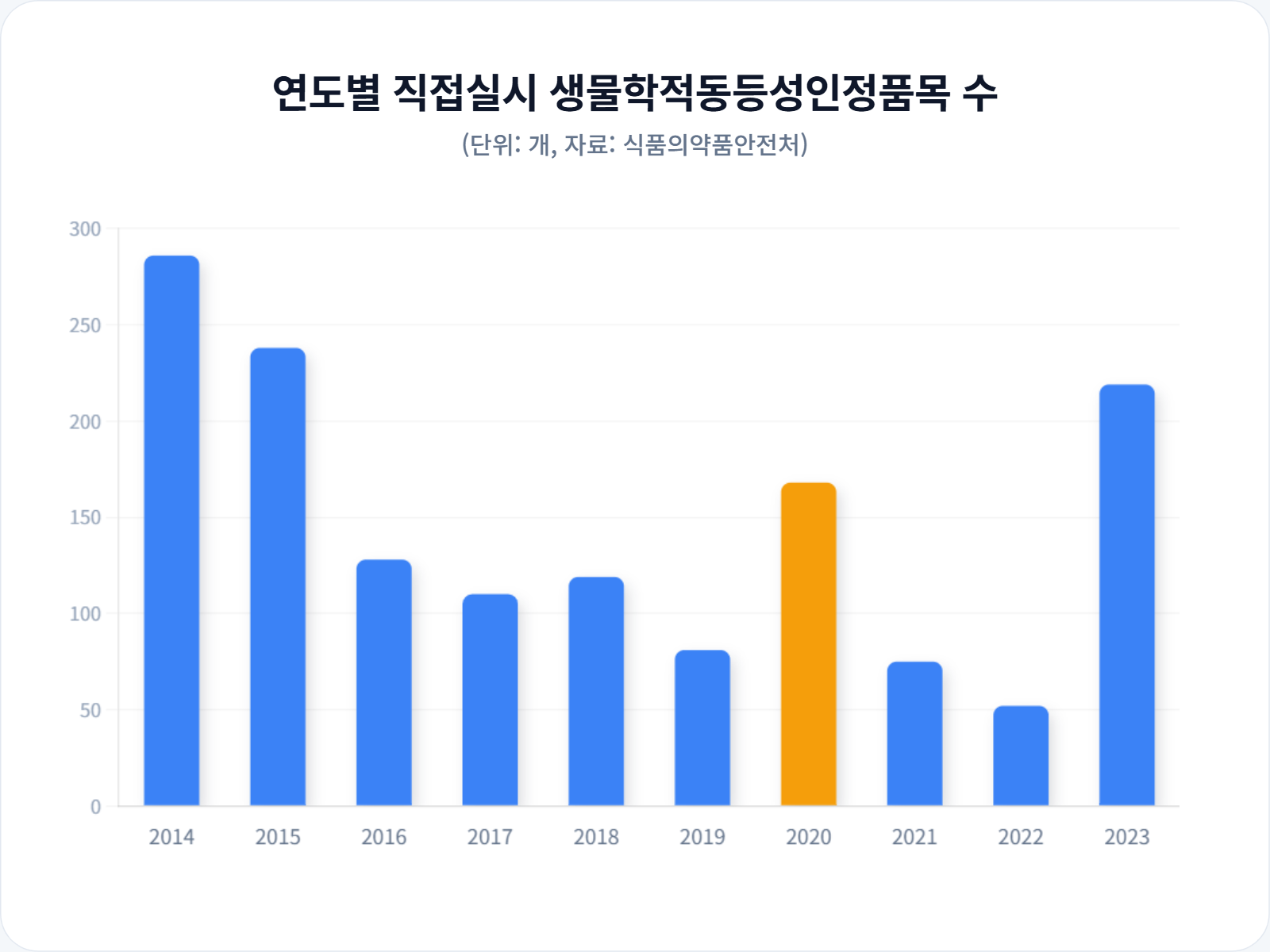
Pharmaceutical companies complained that conducting such studies on approved generics amounted to an “unnecessary waste of money.”
Their argument was that it was wasteful to spend substantial sums on repeat bioequivalence studies solely to preserve reimbursement prices when the products had already been recognized as safe and effective by the government and were being marketed without any issue. A single bioequivalence study is reported to cost as much as KRW 500 million or more. Some companies therefore have and may well spend tens of billions of won on bioequivalence studies for previously approved generics.
Some observers, however, expect that the number of bioequivalence study attempts will not surge because companies have only 8 months between the government’s reassessment notice and implementation of the price cuts. The 2020 reassessment took more than 3 years from the announcement to the cuts. By contrast, companies are considered more likely to conduct studies for products whose price reductions are scheduled for 2030.
Companies must also prepare for the risks they would face if a bioequivalence study of an approved generic failed to demonstrate equivalence.
In July 2020, the Ministry of Food and Drug Safety formally announced that products found non-bioequivalent in studies conducted to preserve their prices would be prohibited from sale and recalled. The ministry established a principle of taking measures, including recalls, based on the Class III risk criteria for products that fail to demonstrate bioequivalence.
Also, other outsourced products manufactured at the same facility as a non-bioequivalent generic would also be highly likely to face recalls. For example, if one contract manufacturer supplies the same generic to 10 companies and one product produces a non-equivalent result, the other nine outsourced generics may also be suspected of failing to meet standards.
Many pharmaceutical companies therefore opted to accept price cuts because of the substantial risks associated with unsuccessful bioequivalence studies.
An industry official said, “Among the products whose prices were reduced during the previous generic price reassessment because bioequivalence studies had not been conducted, companies will be calculating the reduction rates and sales volumes to determine whether studies would be worthwhile. We are contemplating ways to minimize losses resulting from the price cuts.”
-

- 0
댓글 운영방식은
댓글은 실명게재와 익명게재 방식이 있으며, 실명은 이름과 아이디가 노출됩니다. 익명은 필명으로 등록 가능하며, 대댓글은 익명으로 등록 가능합니다.
댓글 노출방식은
댓글 명예자문위원(팜-코니언-필기모양 아이콘)으로 위촉된 데일리팜 회원의 댓글은 ‘게시판형 보기’와 ’펼쳐보기형’ 리스트에서 항상 최상단에 노출됩니다. 새로운 댓글을 올리는 일반회원은 ‘게시판형’과 ‘펼쳐보기형’ 모두 팜코니언 회원이 쓴 댓글의 하단에 실시간 노출됩니다.
댓글의 삭제 기준은
다음의 경우 사전 통보없이 삭제하고 아이디 이용정지 또는 영구 가입제한이 될 수도 있습니다.
-
저작권·인격권 등 타인의 권리를 침해하는 경우
상용 프로그램의 등록과 게재, 배포를 안내하는 게시물
타인 또는 제3자의 저작권 및 기타 권리를 침해한 내용을 담은 게시물
-
근거 없는 비방·명예를 훼손하는 게시물
특정 이용자 및 개인에 대한 인신 공격적인 내용의 글 및 직접적인 욕설이 사용된 경우
특정 지역 및 종교간의 감정대립을 조장하는 내용
사실 확인이 안된 소문을 유포 시키는 경우
욕설과 비어, 속어를 담은 내용
정당법 및 공직선거법, 관계 법령에 저촉되는 경우(선관위 요청 시 즉시 삭제)
특정 지역이나 단체를 비하하는 경우
특정인의 명예를 훼손하여 해당인이 삭제를 요청하는 경우
특정인의 개인정보(주민등록번호, 전화, 상세주소 등)를 무단으로 게시하는 경우
타인의 ID 혹은 닉네임을 도용하는 경우
-
게시판 특성상 제한되는 내용
서비스 주제와 맞지 않는 내용의 글을 게재한 경우
동일 내용의 연속 게재 및 여러 기사에 중복 게재한 경우
부분적으로 변경하여 반복 게재하는 경우도 포함
제목과 관련 없는 내용의 게시물, 제목과 본문이 무관한 경우
돈벌기 및 직·간접 상업적 목적의 내용이 포함된 게시물
게시물 읽기 유도 등을 위해 내용과 무관한 제목을 사용한 경우
-
수사기관 등의 공식적인 요청이 있는 경우
-
기타사항
각 서비스의 필요성에 따라 미리 공지한 경우
기타 법률에 저촉되는 정보 게재를 목적으로 할 경우
기타 원만한 운영을 위해 운영자가 필요하다고 판단되는 내용
-
사실 관계 확인 후 삭제
저작권자로부터 허락받지 않은 내용을 무단 게재, 복제, 배포하는 경우
타인의 초상권을 침해하거나 개인정보를 유출하는 경우
당사에 제공한 이용자의 정보가 허위인 경우 (타인의 ID, 비밀번호 도용 등)
※이상의 내용중 일부 사항에 적용될 경우 이용약관 및 관련 법률에 의해 제재를 받으실 수도 있으며, 민·형사상 처벌을 받을 수도 있습니다.
※위에 명시되지 않은 내용이더라도 불법적인 내용으로 판단되거나 데일리팜 서비스에 바람직하지 않다고 판단되는 경우는 선 조치 이후 본 관리 기준을 수정 공시하겠습니다.
※기타 문의 사항은 데일리팜 운영자에게 연락주십시오. 메일 주소는 dailypharm@dailypharm.com입니다.