- LOGIN
- MemberShip
- 2026-09-14 22:53:41
- Dilemmas for fostering pharma and lowering drug prices
- by Lee, Tak-Sun | translator Hong, Ji Yeon | 2025-02-19 05:56:40
What would be a reasonable drug pricing policy to foster new drug development?
The government is focusing on the sustainability of the National Health Insurance, while the industry expresses concerns about decreasing new drug development due to reduced drug prices.
These conflicting perspectives are raising about the future direction of drug pricing policy.
On February 14, a 'Policy debate to foster pharmaceutical and biotechnology industry' was held at the National Assembly Building.
The debate was hosted by the Democratic Party of Korea's Future Economic Growth Strategy Committee (Lee Eun-Joo, Committee Leader and sponsored by the National Assembly's Public Healthcare Committee Rep.
Seo Young-Seok and the Korea Pharmaceutical and Bio-Pharma Manufacturers Association (KPBMA).
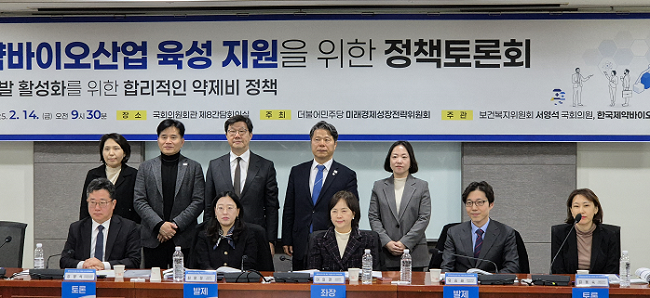
(from upper left) Kim Gook-hee, Head of the Pharmaceutical Benefits Department at HIRA, Rep.
Lee Byeong-jin, Member of the Democratic Party of Korea, Noh Yunhong, President of KPBMA, Rep.
Seo Young-seok, Member of the Democratic Party of Korea, and Cho Ha-Jin, Director of the Bureau of Health Insurance Policy division at the MOHW, (from lower left) Kang Hyun-Sik, Chairperson of the Drug Pricing System Specialist Committee of the KBPMA, Choi Yun Jeong, Professor of the Department of Economics at Yonsei University, Lee Eui-Kyung, a professor at the School of Pharmacy at Sungkyunkwan University, and Kim Dong-Sook, Professor of the Department of Health and Public Administration at Kongju National University.
The event's speakers mentioned that a large-scale reduction in drug pricing is not effective and that the post-management system needs reform.
Choi Yun Jeong, Professor of the Department of Economics at Yonsei University, said, "After the nationwide drug pricing reduction in 2012, companies directions have changed." Choi presented the research results, "The production of non-reimbursed prescription drugs increased, production of items without price reduction increased, and co-promotion of imported drugs also increased." "Changes in production types, such as an increase in production of non-reimbursed prescription drugs, have led to higher consumer drug costs, which have diminished the efforts to improve National Health Insurance improvement," Choi explained.
Choi pointed, "Changes to company's production type, which was not intended by policy, may result in side effects in the long term in the pharmaceutical industry." Choi added, "The government has aimed to reduce National Health Insurance expenditure by lowering drug prices.
However, this policy has not effectively improved pharmaceutical choices and volume management." Consequently, speakers stressed that before reducing drug pricing in large-scale, improvements must made to original and high-priced pharmaceutical preferences, pharmaceutical overspending, overprescription, and practices.
Yu Seung-Rae, Professor of School of Pharmacy at Dongduk Women's University, stressed that regular and repetitive drug pricing reduction policy must be improved, and a comprehensive pharmaceuticals post-management system is needed.
Also, the seller-distributor participation method should be established, and improvements to reimbursement monitoring, which is directly related to product quality, are required.
To achieve this, Yu explained that the current policy of individually lowering the unit price of each drug should be changed to goal-oriented and comprehensive management methods.
In particular, a 'refund system' can be utilized.
"Seven years ago, a similar topic was discussed.
If the government had initiated a mid-to-long-term project then, the current challenges would likely have been resolved," Yu said.
"Other OECD countries have simplified their post-management systems and implemented policies to provide refunds based on the potential value of new drugs." As the current policy is aimed at reducing individual drug prices, all participants agreed on the need for revision.
Dong-Sook Kim, Professor of the Department of Health and Public Administration at Kongju National University, remarked, "Both the universal drug price reduction and various post-management mechanisms create anxiety for pharmaceutical companies," Kim stressed, "To resolve this, we need a comprehensive approach to drug pricing management." Kim added, "Various post-management systems are available, but they are not being effectively implemented." Kim stressed that "Ongoing studies of comprehensive post-management systems show that the number of drug pricing reductions is typically only two for 20,000 items listed between 2007 and 2022.
The drug price remains about 87% of the initially listed price.
Therefore, we must establish a post-management system to ensure that new drug values are accurately evaluated and effectively managed." Cho Wonjun, a Project Specialist at the Public Health Division of the Democratic Party of Korea, said, "The drug pricing system has operated independently from the prescription department, making it difficult to achieve specific goals and often resulting in balloon effects." Cho added, "We need to consider whether the aim of controlling prices contradicts the initiative to reduce volume.
For instance, we should evaluate whether lowering drug prices as an administrative measure in response to previous illegal rebate practices is appropriate." Cho suggested, "The system should be structured so that the goals are reflected and contribute to improving practices." During the event, it has been suggested that an assessment reflecting domestic practices is needed as domestically produced, natural new drugs are included in the reevaluation of reimbursement appropriateness for this year.
Kang Hyun-Sik, Chairperson of the Drug Pricing System Specialist Committee of the KBPMA, said, "Domestically developed natural new drugs face more challenges in the process of approvall-reimbursement-listing compared to new drugs originating from foreign countries." Kang emphasized the need to consider special circumstances surrounding domestically developed new drugs, stating, "Evaluating these drugs similarly as those from foreign countries would be discriminatory against Korean companies." "A drug that has been used for many years and its claim amount is high indicates that its utility in clinical practices as well as societal demands are high," Kang said.
"Domestically developed new drugs need a different evaluation standard for reevaluation." Panels representing the government emphasized that the department has been putting efforts to find a balance between industry development policy, such as reflecting new drug values, and sustaining the National Health Insurance.
The department promised to bring improvements to effective post-mangagment system.
Kim Gook-hee, Head of the Pharmaceutical Benefits Department at HIRA, said, "The pharmaceutical industry is a national-level industry that holds greater importance than the semiconductor business." Kim stressed that, "A predictable system for the pharmaceutical industry is important but the government must prepare additional plans." "We should consistently implement policy, focusing on reimbursed pharmaceuticals, comprehensively managing goals from a macroscopic perspective, industry reform and R&D promotion, a direction to transform generic industry capacity to exports," Kim said.
"In the past, we have failed to pursue a policy consistently.
Therefore, we are currently assessing whether our support for the pharmaceutical industry has been effective." Kim added, "The government is working to simplify the repetitive and excessive post-management system.
The department has initiated measures to improve problems, such as promoting national essential drugs made with domestically produced ingredients and considering the value assessment of new drugs and public health and security aspects." Cho Ha-Jin, Director of the Bureau of Health Insurance Policy division at the Ministry of Health and Welfare (MOHW), said, "The policy direction of the government is changing towards balanced goals, such as supporting the pharmaceutical industry, rather than saving expenses." Cho said, "In the past, the government focused on saving expenses, but now, it is thoroughly considering ways to support industries, including new drug development and drug cost coverage for drug shortages." However, Cho explained that a significant drug pricing reduction is unlikely to lead to an increase in non-reimbursed drugs, as suggested by Professor Choi.
Therefore, the government must consider clinical utility and cost-effectiveness when reevaluating the reimbursement appropriateness.
Generally, supporting domestically produced new drugs requires careful consideration.
Choi reassured the debate participants, "Please note that the department has appointed a research team to restructure the drug pricing post-management system to formulate a comprehensive post-management method." The debate was led by Lee Eui-Kyung, a professor at the School of Pharmacy at Sungkyunkwan University who served previously as the 5th Minister to the Ministry of Food and Drug Safety (MFDS).
-

- 0
댓글 운영방식은
댓글은 실명게재와 익명게재 방식이 있으며, 실명은 이름과 아이디가 노출됩니다. 익명은 필명으로 등록 가능하며, 대댓글은 익명으로 등록 가능합니다.
댓글 노출방식은
댓글 명예자문위원(팜-코니언-필기모양 아이콘)으로 위촉된 데일리팜 회원의 댓글은 ‘게시판형 보기’와 ’펼쳐보기형’ 리스트에서 항상 최상단에 노출됩니다. 새로운 댓글을 올리는 일반회원은 ‘게시판형’과 ‘펼쳐보기형’ 모두 팜코니언 회원이 쓴 댓글의 하단에 실시간 노출됩니다.
댓글의 삭제 기준은
다음의 경우 사전 통보없이 삭제하고 아이디 이용정지 또는 영구 가입제한이 될 수도 있습니다.
-
저작권·인격권 등 타인의 권리를 침해하는 경우
상용 프로그램의 등록과 게재, 배포를 안내하는 게시물
타인 또는 제3자의 저작권 및 기타 권리를 침해한 내용을 담은 게시물
-
근거 없는 비방·명예를 훼손하는 게시물
특정 이용자 및 개인에 대한 인신 공격적인 내용의 글 및 직접적인 욕설이 사용된 경우
특정 지역 및 종교간의 감정대립을 조장하는 내용
사실 확인이 안된 소문을 유포 시키는 경우
욕설과 비어, 속어를 담은 내용
정당법 및 공직선거법, 관계 법령에 저촉되는 경우(선관위 요청 시 즉시 삭제)
특정 지역이나 단체를 비하하는 경우
특정인의 명예를 훼손하여 해당인이 삭제를 요청하는 경우
특정인의 개인정보(주민등록번호, 전화, 상세주소 등)를 무단으로 게시하는 경우
타인의 ID 혹은 닉네임을 도용하는 경우
-
게시판 특성상 제한되는 내용
서비스 주제와 맞지 않는 내용의 글을 게재한 경우
동일 내용의 연속 게재 및 여러 기사에 중복 게재한 경우
부분적으로 변경하여 반복 게재하는 경우도 포함
제목과 관련 없는 내용의 게시물, 제목과 본문이 무관한 경우
돈벌기 및 직·간접 상업적 목적의 내용이 포함된 게시물
게시물 읽기 유도 등을 위해 내용과 무관한 제목을 사용한 경우
-
수사기관 등의 공식적인 요청이 있는 경우
-
기타사항
각 서비스의 필요성에 따라 미리 공지한 경우
기타 법률에 저촉되는 정보 게재를 목적으로 할 경우
기타 원만한 운영을 위해 운영자가 필요하다고 판단되는 내용
-
사실 관계 확인 후 삭제
저작권자로부터 허락받지 않은 내용을 무단 게재, 복제, 배포하는 경우
타인의 초상권을 침해하거나 개인정보를 유출하는 경우
당사에 제공한 이용자의 정보가 허위인 경우 (타인의 ID, 비밀번호 도용 등)
※이상의 내용중 일부 사항에 적용될 경우 이용약관 및 관련 법률에 의해 제재를 받으실 수도 있으며, 민·형사상 처벌을 받을 수도 있습니다.
※위에 명시되지 않은 내용이더라도 불법적인 내용으로 판단되거나 데일리팜 서비스에 바람직하지 않다고 판단되는 경우는 선 조치 이후 본 관리 기준을 수정 공시하겠습니다.
※기타 문의 사항은 데일리팜 운영자에게 연락주십시오. 메일 주소는 dailypharm@dailypharm.com입니다.