
- LOGIN
- MemberShip
- 2026-05-02 11:39:32

- Policy
- Generic drugs without originals released in KOR
- by Lee, Tak-Sun Dec 18, 2024 05:54am
- Takeda Generic versions of drugs whose original versions are unavailable in Korea are expected to be released one after another. This is becoming a Korean phenomenon, where original drugs withdraw from the domestic market due to low drug prices and generics fill the void. According to industry sources, the National Health Insurance Service has begun negotiations for the reimbursement of a generic version of Otezla (Apremilast). Otezla is Amgen's treatment for psoriatic arthritis and psoriasis, which was approved in November 2017 but withdrawn from the market in June 2022. The drug had difficulty being listed for reimbursement. The drug had become the top-selling oral psoriasis treatment in the global market but was not even properly showcased in the Korean market due to the reimbursement hurdle. The analysis is that the drug missed its prime reimbursement time while changing hands three times, from Celgene, BMS, to Amgen. In the meantime, competitors such as Cosentyx, Stelara, Skyrizi, and Taltz entered the reimbursement market, weakening Otezla’s competitiveness in the domestic market. In Korea’s situation, as the price of the later entrants is set lower than their competitors, the pharmaceutical company’s concerns have deepened. In addition, with the patent’s expiry date approaching and the domestic generic companies’ patent challenges against Amgen, the company announced Otezla’s withdrawal from the market. As a result, generic products without original versions are on the verge of receiving reimbursement in Korea. The drugs are: Dong-A ST’s Oteria Tab, Daewoong Pharmaceutical's Apsola Tab, Chong Kung Dang's Otebell Tab, Dongkoo Bio Pharm’s Otemila Tab, and Han Lim Pharm’s Psopre Tab. In October, the Drug Reimbursement Evaluation Committee of the Health Insurance Review and Assessment Service (HIRA) held a review on the adequacy of Otezla generics and determined that their reimbursement was adequate if their price was less than the assessed value. As a result, the pharmaceutical companies accepted a price lower than the assessed value and moved on to the negotiation stage with the NHIS. Now that they have accepted the assessed value and moved on to the negotiation stage, it is expected that the products will be launched with reimbursement in the first half of next year at the latest. Takeda’s P-CAB class gastroesophageal reflux disease drug ‘Vocinti Tab (vonoprazan fumarate)’ is also expected to be the first generic product to enter the reimbursement market without an available original drug. This is because generic development by domestic pharmaceutical companies is in full swing, and Vosinty withdrew its license on the 12th. Generic companies are aiming for an early market launch by avoiding Vosinty’s patent. The product patent for Vosinty Tab expires in December 2027, but it can be released in October next year if the patent’s extended term is invalidated through patent avoidance. Vosinty also has missed the golden time for reimbursement in Korea. It is analyzed that it lost its competitiveness as domestic pharmaceutical companies' P-CAB class products such as K-CAB and Fexuclue Tab were first released on the domestic market. An industry official said, “U generic companies have the advantage of greater flexibility in drug pricing because their drug development cost is relatively low. They can enter the domestic health insurance market with a relatively lower price than the original companies, Therefore, it will be interesting to see how generic drugs without original drugs perform in the domestic market.

- Policy
- Reimb of PE exemption drugs can be ex officio rejected
- by Lee, Tak-Sun Dec 16, 2024 05:53am
- In the future, drugs that sign refund-type risk-sharing agreements will be reviewed briefly by the Health Insurance Review and Assessment Service, focusing on changes, when a drug is reimbursed through the signing of the risk-sharing agreement more than 3 times. In addition, if a drug applies as a drug that can skip submission of pharmacoeconomic evaluation data but does not meet the requirements, such application can be rejected without committee deliberation. HIRA released a revision to the 'Detailed Evaluation Criteria for New Drugs and Other Drugs Subject to Negotiation' on the 12th that contains the changes above. The revision, which was finalized after deliberations by the Drug Reimbursement Evaluation Committee on the 5th, reflects improvements to the system for rewarding the innovation value of new drugs reported to the Health Insurance Policy Review Committee last year. HIRA has already revised the criteria once to reward the new drugs’ innovative value once in August. The new revision contains simplification of review for drugs that have signed 3 or more risk-sharing contracts. Specifically, it is possible to briefly review refund-type drugs, excluding multiple RSA-type drugs, starting from the evaluation related to the expiration of the second risk-sharing contract period (in the case the drug is signing the third or further risk-sharing contract), focusing on changes. There are also new requirements set to reject applications for ineligible PE exemption drugs. If an applicant applies for a determination that a drug falls under Article 6 (Drugs deemed essential for medical treatment) or Article 6.2 (Drugs that can waive the submission of pharmacoeconomic evaluation data) of the Regulations on Evaluation Criteria and Procedures for Eligibility for Medical Treatment Benefits, etc.’ HIRA stated that this addition was made to “clarify the processing criteria for drugs that are waived submitting pharmacoeconomic evaluation data for but fail to submit required data to improve work efficiency.”
- Policy
- NHIS to expand the special estimate case system in 2025
- by Lee, Tak-Sun Dec 16, 2024 05:52am
- The National Health Insurance Service (NHIS) (Chairman: Jung Ki Suck) has announced plans to expand the reimbursement criteria for special cases of new rare diseases, starting on January 1, 2025. The NHIS aims to enhance essential medical support for individuals who currently do not benefit from receiving healthcare, including patients with rare diseases. The NHIS' special estimate case system lowers the national health insurance partial co-payments, reducing the burden of co-payments to help alleviate the financial burden on patients with severe diseases, such as cancer and rare diseases. When this special estimate case system is applied, patients receive hospitalization·outpatient co-payment rates of 0-10%. The NHIS has been expanding the reimbursement criteria for special estimate cases of rare diseases by collaborating with the Korea Disease Control and Prevention Agency (KDCA) and consulting with academic organizations and experts, then proceeding with a rare disease management committee (Ministry of Health and Welfare, MOHW) and special estimate cases committee (NHIS) reviews·decisions. This year, the NHIS has expanded special estimate cases to 66 new rare diseases, including 'achalasia (K22.0).' Rare diseases to be covered by special estimate cases system taking effect on January 1, 2025, will be increased from 1248 to 1314 cases. Following the expansion, new patients with rare diseases will pay a co-payment corresponding to 10% of the medical fee for diseases registered under the special estimate cases system and side effects directly caused by those diseases. Approximately 14,000 individuals are expected to benefit from lowered medical fees. "The NHIS will continue to collaborate with the MOHW and KDCA to identify rare diseases with severe symptoms that incur high medical costs and requires long-term treatment, thereby enhancing essential healthcare security for vulnerable populations," Kim Nam-hoon, NHIS's senior director of reimbursement, stated.
- Policy
- HLB Pharma applies for reimb of 'Citrelin ODT' for SCD
- by Lee, Tak-Sun Dec 16, 2024 05:52am
- HLB Pharma HLB Pharma has reportedly applied to the Health Insurance Review and Assessment Service (HIRA) for reimbursement of 'Citrelin ODT,' a domestically distributed treatment for spinocerebellar degeneration. This product was approved in South Korea in 2015, but it has been distributed to the Korean market as a non-reimbursed drug. However, with the successful completion of its recent Phase 4 trial, involving Korean patients, the company may now attempt to obtain reimbursement for the drug. According to industry sources on December 16, the HIRA received an application for the reimbursement of Citrelin ODT and has begun its review. Citrelin ODT 5mg (taltirelin) received approval from the Ministry of Food and Drug Safety (MFDS) in Korea on February 6, 2015. It is orally administered twice daily after a meal to improve ataxia caused by spinocerebellar degeneration. Spinocerebellar degeneration (SCD), an inherited cerebellar disorder, is a degenerative disease affecting the cerebellum or spinal cord with an unknown cause. It accompanies degenerative symptoms, including ataxia, optic atrophy, and muscle spasm. Ataxia can lead to the loss of the capacity to control arm and leg muscles, causing gait and language dysfunction. It is reported to significantly hinder patients' quality of life. HLB has signed an exclusive agreement with Japan's Osaka Synthetic Chemical Laboratories (OSCL), the Citrelin ODT developer, and has been distributing the drug in South Korea. In 2017, the company attempted to obtain reimbursement. At the Drug Reimbursement Evaluation Committee (DREC) held in October 2017, a decision for re-evaluation was issued due to insufficient evidence for reimbursement approval, such as textbooks and guidelines. It was decided that the drug needed to be re-evaluated to see if it was necessary for medical use and meeting the reimbursement criteria when the company additionally submitted documents regarding the effectiveness of the drug. After that, the review held in January 2018 concluded that the drug is non-reimbursable due to insufficient evidence proving its clinical effectiveness and its costs being higher than that of other substitute drugs. Since the decision, the company has been focusing on proving the drug's clinical effectiveness by conducting a Phase 4 clinical trial involving Korean patients. Recent results from Phase 4 clinical trials were published in the 'Journal of Movement Disorder,' a SCI-grade international journal. The clinical trial involved a total of 160 study participants, 79 receiving the treatment drug and 81 receiving a control, randomly assigned. The results showed that the drug significantly reduced the K-SARA (Korean version of Scale for the Assessment and Rating of Ataxia), an objective evaluation index for ataxia, after 24 weeks of treatment. The company stated that they have confirmed this statistical significance. It is reported that Citrelin ODT is distributed at about KRW 12,000 per tablet. It costs about KRW 9 million annually. Confirming effectiveness in Korean patients is expected to impact reimbursement listing reviews for national health insurance positively. When the drug gets listed in the reimbursement list, patients will be able to afford the drug at a much cheaper price. Attention has been drawn to whether Citrelin ODT will be listed for reimbursement 10 years after it was approved in South Korea.
- Policy
- Otezla generics enter negotiations for reimb
- by Lee, Tak-Sun Dec 13, 2024 05:52am
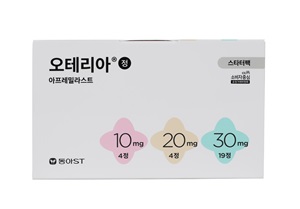
- Dong-A STGeneric to Otezla (apremilast, Amgen), which is used to treat psoriatic arthritis and psoriasis, is being considered for reimbursement negotiations with the National Health Insurance Service (NHIS). Attention has been drawn to whether a generic drug will be listed for reimbursement, the process in which a company with the original drug gave up. According to industry sources on December 11, the NHIS has recently included five products containing apremilast to the list of drugs for price negotiations. These medicines include 5 products: Dong-A ST's 'Otelia,' Daeowoong Pharmaceutical's 'Apsola,' Chong Kun Dang's 'Otebell,' Dongkoo Bio's 'Otemila,' and Hanlim Pharm's 'Psopre Tab.' Otezla received approval from the Ministry of Food and Drug Safety (MFDS) in South Korea in November 2017. However, the company withdrew from the Korean market due to difficulty listing the drug for reimbursement. Amgen voluntarily withdrew approval in June 2022. However, Otezla's sales have been skyrocketing in the overseas market. It recorded no.1 among oral psoriatic treatments in global sales last year. It is reported that Otezla recorded sales of US$3.984 billion (about KRW 5.5 trillion) last year worldwide. Recognizing Otezla's superior effectiveness and marketability, Korean pharmaceutical companies have been putting efforts into registering the drug in the reimbursement market ahead of the original drug. Pharmaceutical companies with generics successfully avoided two cases of active ingredient patents registered in South Korea. They have successfully overcome the patent challenge by signing an agreement with Amgen for the remaining usage patent. Based on these outcomes, they received approval from the MFDS in April. Generics have entered the market that the original drugs withdrew. For instance, Dong-A ST launched the Otelia tab in July as non-reimbursed. The Drug Reimbursement Evaluation Committee (DREC) review held in October ruled that medicines would be appropriate for reimbursement coverage if the company accepted the drug price below the evaluated amount. Analysis suggests that relevant pharmaceutical companies have accepted the drug price below the evaluated amount and proceeded with the negotiation phase with the NHIS. Because most companies tend to accept a drug price negotiation exemption criterion when they accept the drug price below the evaluated amount, they are likely to proceed with the negotiations for the expected claim amount. Then, they could conclude the negotiation early and be more likely to reach an agreement. Meanwhile, besides the current discussions for apremilast, the NHIS has started negotiating with the reimbursement expansion for Darzalex. Janssen, which owns Darzalex, is proceeding with getting reimbursement for DVTd therapy (Darzalex+bortezomib+thalidomide+dexamethasone) as a first-line treatment for multiple myeloma.

- Policy
- Martial law impacts the launch of the Pharma-Bio Committee
- by Lee, Jeong-Hwan Dec 13, 2024 05:51am
- The National Bio Committee directly under the President, which was scheduled to be launched this month, has been disrupted by President Suk-Yeol Yoon’s declaration of emergency martial law. As the National Assembly is in the early stages of voting on an impeachment bill against President Suk-Yeol Yoon, who was supposed to chair the committee, the establishment of the National Pharmaceutical and Biotech Control Tower is at risk of being canceled. According to the Ministry of Health and Welfare on the 10th, the first meeting of the National Bio Committee, originally scheduled for sometime this month, has been postponed indefinitely. The MOHW explained that it has not received a specific date for the launch of the committee nor a date for its future launch. The National Bio Committee, a body directly under the president, is responsible for deliberating on policies such as R&D and approval in the pharmaceutical and biotech sectors. The Ministry of Science and ICT, the Ministry of Health and Welfare, and the Ministry of Trade, Industry, and Energy, all of which are related to the industry, have been jointly preparing for its launch. Sang-Yeop Lee, Vice President of the Korea Advanced Institute of Science and Technology (KAIST), was internally designated as the Civilian Vice Chairman, and more than 20 bio experts in the field of biotechnology, including Bit-nae-ri Kim, Director at the Institute for Basic Science, Han-Seung Ko, head of Samsung Electronics' Future Business Planning Division, and Young-Tae Kim, President of Seoul National University Hospital, were scheduled to participate as civilian committee members. In particular, the controversial inclusion of a global pharmaceutical company executive among the civilian members has stirred up controversy, and the confusion surrounding the Bio Committee grew greater with the rise of the impeachment situation due to President Yoon's declaration of martial law. The government's plans to become one of the top five global bio powerhouses and create blockbuster national drugs have been compromised. In the midst of the state of impeachment, President Yoon has stated that he will leave his term and stabilization plan to his party, and the opposition party has stated that they will repeat the impeachment vote every Saturday, virtually halting all schedules for the National Bio Committee. The pharma and biotech industry has expressed regret that the martial law and impeachment aftermath has unexpectedly shaken the establishment of the Bio Committee. “There were concerns that the National Bio Committee, directly under the president, would overlap with the Bio Health Innovation Committee, an organization directly under the prime minister, but the pharmaceutical industry still had high expectations,” said a pharmaceutical industry official. ”We do not expect the Bio Committee, chaired by the president, to be able to play its role in the situation where the impeachment bill is presented in the National Assembly.” “We have effectively lost one window to directly appeal to the president for policies to strengthen state support for domestic pharmaceutical companies aiming to develop global new drugs,” the official said, adding, ”It is the hope of the pharmaceutical industry to wait for the political turmoil to be cleared up quickly and for the committee's launch and operation plan to materialize.
- Policy
- HIRA sets plan for performance assessment of 'Qarziba'
- by Lee, Tak-Sun Dec 12, 2024 05:49am
- Product photo of QarzibaThe Health Insurance Review and Assessment Service (HIRA) has established a performance assessment plant for Qarziba and notified healthcare providers to submit documents. Qarziba is a high-cost treatment for severe diseases. As of December 1, the drug was listed for reimbursement under the condition of patient performance-based Risk Sharing Agreements (RSA) for treatment effects monitoring and follow-up of reimbursement appropriateness. According to sources on December 11, the number of drugs under the patient performance-based RSA increased to six, with the addition of Qarziba. Patient performance-based RSA is a new payment system in which pharmaceutical companies' refund rate varies depending on a patient's performance after receiving a medicine. As a result, healthcare providers that have administered those medicines must submit patient monitoring documents to HIRA to follow up on patient performance. The performance assessment, introduced to Kymriah in 2022, has expanded to six drugs, including Zolgensma, Spinraza, Evrysdi, Luxturna, and Qarziba. These drugs are subjected to 'Monitoring reimbursement for high-cost medicines.' Qarziba was designated the first drug for a "Pilot Project for Integration of Product Approvals, Reimbursement Coverage Reviews, and Drug Price Negotiations." The drug's ceiling price is KRW 11.48 million, and patients can receive the medicine for KRW 10.50 million yearly with a 5% co-patient rate and the ceiling price for co-patients applied. The HIRA explained that healthcare providers must submit a document for a patient who qualifies for the reimbursement standard of Qarziba and has received a drug. The assessment period for the high-risk group is 3 years, and recurrent/refractory is 2 years. As a result, healthcare providers must submit monitoring reports every 6 months, 12 months, and every year. Required documents include ▲consent form for long-term follow-up investigation for Qarziba administration ▲patient information for Qarziba administration ▲monitoring reports for Qarziba administration. These monitoring reports must be submitted four times: within 7 months, 13 months, 26 months, and 38 months following the first treatment initiation. If a patient passes away, the monitoring report must be submitted immediately. For patients who die at a facility other than the one administering Qarziba, that facility should label the case as "lost to follow-up" and include detailed notes in the special remarks section. For patients who fail to attend follow-up visits, facilities should also mark the case as "lost to follow-up" and note relevant details. Additionally, cases where assessments cannot be conducted due to the patient's condition should be noted as "unable to evaluate" with relevant details. The HIRA will evaluate patient survival and condition at each evaluation point. "Until the monitoring system is developed, healthcare providers should submit monitoring reports via email. Once the system is ready, reports should be submitted through the "high-cost drug management system" available on the healthcare provider portal," a HIRA personnel remarked.

- Policy
- New drug approval fee to rise next year
- by Lee, Hye-Kyung Dec 12, 2024 05:49am
- The Ministry of Food and Drug Safety has begun finalizing plans to raise the new drug approval fee KRW 410 million from January 1 next year. The MFDS recently collected opinions on the “Operating Procedures for Approval and Examination of New Drug Products (Guideline for public officials)” from October 18 to November 15, and released the final revised guidelines that reflect consultative body discussions and industry opinion. The guideline, which is set to be enacted on the 11th, contains specific measures to implement the “Innovative Measures for New Drug Approval” that was announced by the MFDS on Sept. 9, including the operation of a dedicated review team for each product and prioritizing GMP-GCP on-site inspections. The new drug approval fee will be revised for new drugs (including advanced biopharmaceuticals) and orphan drugs that have been approved as orphan drugs and then converted to new drugs (change of approval). To expedite the approval of new drugs, MFDS has ▲shortened the approval period (295 days), ▲established a dedicated review team for each product, ▲prioritized manufacturing and quality control (GMP) and clinical trial (GCP) surveys, and ▲newly established a procedure for pre-registering supplemental submission data. The timing of each step, including the target approval date for new drugs under this procedure, is based on calendar days (including holidays and Saturdays) unless otherwise specified. Meeting the target approval date requires the cooperation of the pharmaceutical manufacturer to be met, with the caveat that the target date for receipt of the first supplement is D-60 and that there should be no delay in the on-site inspection schedule due to the applicant's circumstances. In addition, in the case of an application for conversion to a new drug after approval as an orphan drug (change of approval), a fee must be paid and a review conducted for the review of the areas requiring additional data review. However, no fee is required if the data submission has been completed and reviewed at the time of orphan drug approval. In addition, if the applicant reapplies for the same item within a period of 2 years from the date of rejection (withdrawal), only the supplemented data (other than the data that was reviewed before the rejection (withdrawal)) can be reviewed and processed. According to the procedure for the approval and examination of new drug applications, applicants can request a preliminary consultation before application. This can only be done a single time for each new drug that is scheduled to be filed within 3 months. The fee must be paid on the date of the application submission, and the fee cannot be canceled after submission. In the case of a complaint, the applicant may submit a possible on-site inspection period (at least three periods) for its local manufacturing site to be inspected. The preliminary review will be conducted within 7 days of application receipt, and the dedicated team for each item organized within 10 days of receipt. The initiation meeting for the marketing authorization review will be held within 14 days of receipt, either in person (in Osong), via video, or a combination of in-person and video. The outcome of the meeting will be notified to the applicant within 10 days from the date of the initiation meeting. The outcome of the initiation meeting will additionally include an estimated timeline for the agreed-upon milestones (GMP inspection schedule, expected date of first supplemental data notification, recommended date for completion of supplemental data submission for expedited processing (D-60), and target approval date). GMP inspections are conducted within 90 days of the application receipt and GCP inspections are conducted within 60 days of the first supplement. Various improvements have also been made to the supplement requests. Previously, the authorities only made the 1st and 2nd supplement notifications, but the revised proposal introduces a 1st supplement request briefing session and a 2nd supplement request briefing session to ensure that the complainant fully understands the supplement request. After the supplementation, the review process will be completed with a meeting of experts such as the Central Pharmaceutical Affairs Council, a final meeting (5 days before the target approval date), and final complaint processing by the approval department.

- Policy
- Cancellation policy for innovative pharmas certification
- by Kang, Shin-Kook Dec 09, 2024 05:47am
- Choi Sang-Mok, deputy prime minister and Minister of Economy and Finance It has been reported that the cancellation standards of 'Innovative Pharmaceutical Companies Certification' will be relaxed for pharmaceutical companies fined for rebates. Some argue that certification requirements for illegal rebates are strict. Further criticism is anticipated as these measures deviate from the government’s longstanding anti-rebate policies. On December 4, the government finalized the "Innovate Economic Regulatory Plan for Enhancing Corporate Dynamism and Promoting New Industries" at the Emergency Ministerial Meeting on Economic Affairs. This plan was prepared by the Ministry of Economy and Finance and the Office for Government Policy Coordination of South Korea, actively·promptly reflecting suggestions from economic organizations and companies. ◆Improvement of certification cancellation standards for 'Innovative Pharmaceutical Companies' = The government has determined that the strict certification requirements related to illegal rebates in the 'Innovative Pharmaceutical Companies Certification' system could discourage pharmaceutical companies from developing new drugs. In detail, the government plans to revise the standards stipulating that certification can be canceled if ▲A company receives two or more penalties for violating the Pharmaceutical Affairs Act due to illegal rebates within three years or ▲The total amount of rebates exceeds KRW 5 million. After consulting with experts from the industry and academics, the government plans to devise a draft for the revision to the cancellation standards for the 'Innovative Pharmaceutical Companies Certification' (according to the Ministry of Health and Welfare notice) next year. Meanwhile, 'Innovative Pharmaceutical Companies Certification' offers several benefits, including: ▲Incentives when participating in government R&D projects related to new drug development ▲Corporate tax deductions for research personnel development costs ▲Eased location regulations for constructing research facilities ▲Special loan arrangements for policy funds. ◆'Advanced regenerative clinical research' results to be used for drug approvals = Different standards from clinical trials under the Pharmaceutical Affairs Act have been applied to Advanced regenerative clinical research, making it difficult to use as a basis for approval in developing advanced biopharmaceuticals. Guidelines will be established this month to allow advanced regenerative clinical research results to be used as approval review data for advanced biopharmaceuticals. Guidelines will be established this month to allow advanced regenerative clinical research results to be used as approval review data for advanced biopharmaceuticals. A draft guideline, tentatively titled "Guidelines relating to the Advanced Regenerative Medicine Clinical Research and Marketing Authorization," will be developed to utilize research results that meet specific standards as part of the review data for marketing authorization. ◆To introduce simultaneous analysis methods for vitamin B products in functional foods = Currently, the "Standards and Specifications for Functional Foods" do not include a test method for simultaneously analyzing the Vitamin B group (B1, B2, B6, niacin, and folic acid), which has delayed the product development. In response, the government plans to develop·implement a test method capable of analyzing properties across various formulations for functional foods through a research project starting in January next year. ◆To develop a pilot service of a health management system for young children·adolescents = A health management service utilizing AI and digital technology will be implemented to minimize long wait times for treatment and reduce public inconvenience. In particular, with declining birth rates exacerbating the reduction of pediatric medical demand and resources, the government aims to develop a health management system for young children to address reduced access to pediatric care. The system will be designed to include AI-based support for diagnosis and treatment guidance, assistance with medical record documentation, health consultations for managing pediatric diseases and providing information to caregivers on pediatric rare diseases. The government will allocate a total of KRW 32 billion over four years for this project. Additionally, the government suggested other innovative measures, ▲Establishment·operation of a regulatory support center for digital medical products ▲Regulatory improvements for consumer direct-to-consumer (DTC) genetic testing for minors ▲Enactment of legislation to promote alternatives to animal testing ▲Support for precision oncology technology development using next-generation sequencing (NGS) panel data ▲Simplification of required documentation for filing innovative medical technology applications.
- Policy
- Janssen seeks reimb for Balversa in Korea
- by Lee, Tak-Sun Dec 09, 2024 05:46am
- ’Balversa (erdafitinib, Janssen),’ which has been approved as a targeted therapy for bladder cancer, has reportedly applied for reimbursement 2 years after being approved in Korea. It is believed that the company is seeking Balversa’s entry into Korea’s health insurance market based on its proven effectiveness in patients who have used immuno-oncology drugs. According to industry sources on the 6th, Janssen’s Balversa recently applied for a reimbursement decision to Korea’s Health Insurance Review and Assessment Service. Balversa was approved by the Ministry of Food and Drug Safety in January 2022. Specifically, the drug is indicated for the treatment of adult patients with locally advanced or metastatic urothelial carcinoma (mUC) with FGFR2 or FGFR3 genetic alterations whose disease has progressed on or after at least one line of prior systemic therapy, which includes platinum-based chemotherapy, or whose disease has progressed within 12 months of neoadjuvant or adjuvant treatment with platinum-based chemotherapy. The drug gained attention as the first targeted therapy to target a specific gene mutation in bladder cancer. It works by inhibiting a mutation in the fibroblast growth factor receptor (FGFR), which is one of the biological signals involved in cancer cell growth, and 20 to 30% of patients are known to be carrying mutations. However, even after its approval, Balversa was not released in the domestic market for two years. Then, in October, the company held a business meeting and declared that it would officially launched the drug in the domestic market. The delay is explained by the fact that immuno-oncology drugs have settled as a major treatment option for bladder cancer. In response, Balversa has focused on demonstrating efficacy in patients whose disease progressed after immuno-oncology treatment. The THOR study included patients with metastatic urothelial carcinoma with FGFR3/2 mutations whose disease progressed after first-line treatment with an anti-PD-(L)1 immuno-oncology agent. The results showed a median overall survival (OS) of 12.1 months in the Balversa arm compared to 7.8 months in the chemotherapy arm over a median follow-up of 15.9 months, resulting in a 36% reduction in the risk of death. Based on the study, the U.S. FDA formally approved Balversa in January. With the efficacy data, the company seeks to start sales in Korea. It will be interesting to see if Balversa will enter the Korean health insurance market and become a new option in the bladder cancer treatment landscape.
