
- LOGIN
- MemberShip
- 2026-07-05 07:52:51

- Company
- Investigation of Varenicline has been undertaken
- by Chon, Seung-Hyun Jun 16, 2021 05:41am
- Health authorities have launched an investigation into Nitrosamines impurities in non-smoking drugs "Champix" and generics for Champix. According to industries on the 14th, the MFDS recently ordered pharmaceutical companies to follow up on Varenicline's impurities (Nitrosamines). The MFDS said, "Recently, there is a possibility of Nitrosamines impurities among Varenicline." The MFDS requested, "To take preventive measures, we will review the manufacturing process and follow-up measures such as testing impurities in Nitrosamines." Varenicline is a major active ingredient in Pfizer's anti-smoking drug Champix. 34 domestic pharmaceutical companies have generics for Varenicline. As the possibility of detection of nitrosamines impurities was confirmed by Varenicline, follow-up measures of domestic distribution products have been taken. "We requested follow-up measures to collect information on impurities from Varenicline," said an official from the MFDS. N-nitrosodimethylamine (NDMA) and N-nitrosodiethylamine (NDEA) detected in Valsartan, Losartan, Nizatidine, Ranitidine and Metformin in Korea since 2018. Pharmaceutical companies have completed inspections of Nitrosamine impurities such as NDMA and NDEA. In November 2019, the MFDS ordered pharmaceutical companies to submit a report on the possibility of Nitrosamine-based impurities in all raw materials and finished drugs, and the data submission was completed in a year and a half. The MFDS must submit data on impurities in all medicines to allow lot release without testing for Nitrosamines impurities. It is the second time this month that the MFDS has ordered investigations into impurities. Earlier on the 4th, the MFDS asked pharmaceutical companies to submit Azido impurities evaluation and test results of three raw materials, Irbesartan, Losartan and Valsartan, by the 14th. The MFDS ordered the raw material manufacturer to submit a statement of reasons even if it is impossible to obtain related data. This is a follow-up to the recent recovery of drugs with excess Azido impurities in Canada. Health Canada took measures on the 31st of last month to recover Irbesartan, Losartan and Valsartan that exceeded Azido from nine pharmaceutical companies, including Teva and Sandoz. Azido is a type of azide carcinogen. There is no known specific risk of cancer in the human body, although it may increase the risk of cancer. Nitrosamines impurities such as NDMA have been detected in Korea since 2018, but no recovery measures have been taken due to the detection of Azide-based impurities.
- Company
- Celltrion released the results of Regkirona's clinical trial
- by An, Kyung-Jin Jun 16, 2021 05:41am
- Celltrion Kim Sung-hyun, head of the medical division, is introducing the results of clinical trial toplineCelltrion is going to launch a global targeting of Regkirona (Regdanvimab), COVID-19 antibody treatment drug developed with its own technology. The government plans to eliminate controversy over efficacy and revitalize domestic and foreign markets through large-scale clinical trials. Celltrion held an online press conference on the morning of the 14th to introduce the results of clinical trials in Regkirona. Regkirona is a COVID-19 antibody drug developed by Celltrion. Based on the results of clinical trial in February, it has been supplied to medical institutions with conditional permission from the MFDS. Among patients confirmed with COVID-19, symptoms develop within seven days and do not require oxygen treatment and are administered to patients aged 60 or older or accompanied by underlying diseases such as cardiovascular disease, chronic respiratory disease, diabetes, and high blood pressure. Celltrion announced that it has proven its efficacy and safety by releasing the results of Regkirona's global clinical trials. This is the result of administering Regkirona to 1,315 patients with COVID-19 mild to moderate symptoms in 13 countries around the world, including South Korea, the U.S., Spain and Romania, starting in January this year. In April, all subjects completed the medication and announced the results of the top line after 28 days of treatment. Based on the previously conducted clinical trial, the dosage of Regkirona was determined to be 40 mg/kg, and the administration time was reduced from 90 minutes to 60 minutes. According to the announcement, the entire group of patients who received Regkirona secured statistical significance, with a 70% decrease in severe exacerbation compared to placebo groups. It is a similar level of treatment effect to 72% of patients with high-risk groups accompanied by elderly or underlying diseases. The time it took to improve clinical symptoms was 8.4 days for the entire Regkirona' administration group, down 4.9 days from 13.3 days for the placebo group. In the case of high-risk patients, the administration of Regkirona was reduced by more than 4.7 days compared to the placebo group to 9.3 days. However, in the case of patients who received placebo among high-risk groups, the number of patients who have had clinical symptom improvement by the 14th is less than 50%, which is difficult to compare accurately. In the analysis of safety assessment results, the number of patients who experienced adverse reactions in the Regkirona administration group and placebo group was similar. One out of 652 Regkirona groups was hospitalized for skin rashes, but recovered after treatment, and most of the abnormalities were mild. Celltrion expects to calm the controversy over efficacy at the time of the announcement of the trial by securing large-scale three-phase clinical results. "Clinical Phase 2 had a limit on the number of patients by treatment group and placebo group, but sufficient cases were secured in Phase 3 clinical trials," said Kim Sung-hyun, head of Celltrion's medical division in charge of the announcement. "As a result of statistical analysis by designating four major evaluation indicators for the most important clinical outcome, the severe exacerbation rate and time to improve clinical symptoms, we proved a clear difference between treatment and placebo groups in all evaluation indicators." Celltrion plans to apply for Regkirona's item approval from the MFDS based on data from the Phase III clinical trial. According to Kim, Celltrion has completed the supply of more than 5,000 Regkirona in Korea through a supply contract with the KDCA. More than 4,500 patients were given Regkirona at 84 designated hospitals nationwide for COVID-19 treatment. Celltrion is also expected to quickly approve Regkirona from major global regulators such as the U.S. Food and Drug Administration (FDA) and the European Medicines Agency (EMA). Celltrion will introduce Regkirona-related data at the "2021 ECCMID" oral presentation session, which will be held online from July 9 to 12. It plans to announce detailed results of phase 3 clinical trials of Regkirona within the first half of the year and update group companies' response strategies for COVID-19, including variable virus response strategies. Although the number of COVID-19 vaccinations has increased worldwide, the demand for COVID-19 treatments is still sufficient. He said,"It is difficult to accurately understand global demand for supply of Regkirona." However, there is a demand for Regkirona because the number of confirmed cases of COVID-19 is still continuously occurring. He added, "We are coordinating exports of Regkirona with major foreign countries including Europe. As we have proven the efficacy and safety of Regkirona through large-scale clinical trials, it will have a positive impact on more prescribed at home and abroad."
- Policy
- Ruling/opposition parties fight over supply & COVID vaccine
- by Lee, Jeong-Hwan Jun 15, 2021 05:53am
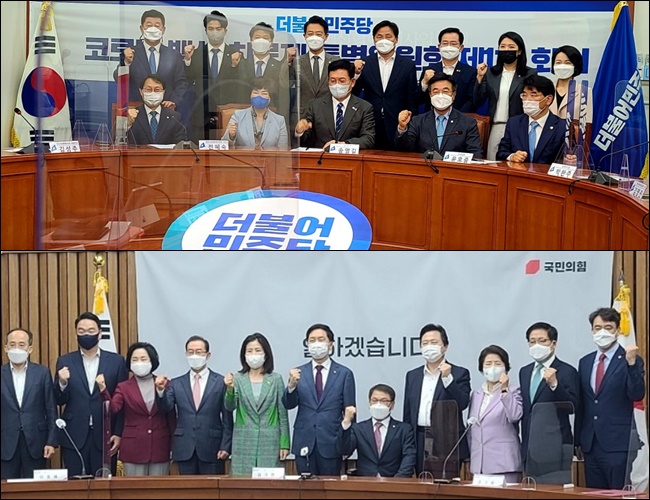
- Political circles of the ruling and opposition parties have launched a special committee on the COVID-19 vaccine and TF respectively, and are checking each other over the status of vaccine supply and vaccination performance. The ruling party has been announcing the results of COVID-19 vaccine since the Korea-U.S. summit, while the main opposition party has criticized the government for pointing out the issue of vaccine supply and demand and disruption to its goal of mass immunization in November. The ruling and opposition parties are busy with their respective activities on the COVID-19 vaccine special committee and TF, which were launched on the 14th. Currently, the Democratic Party of Korea has launched and operated the COVID-19 vaccine and treatment special committee, and the People Power Party has launched and operated the COVID-19 vaccine TF. The Democratic Party of Korea appointed Jeon Hye-sook(pharmacist), as its chairman, and Kim Sung-joo, an executive secretary of the Health and Welfare Committee, as its members, and Seo Young-seok(pharmacist). The People Power Party TF, chaired by the Health and Welfare Committee's executive secretary(Kiyoon Kang), consists of a total of 10 members, including Seo Jung-sook(pharmacist), Kim Mi-ae, Lee Jong-sung, Cho Myoung-hee, lawyer Park Joo-hyun, director Lee Sang-ho of the Korea Medical Association, and Choi Jae-wook. With the launch of the special committee, the ruling and opposition parties have begun to check the supply and demand of COVID-19 vaccine, which is the nation's biggest pending issue, and the current status and strategy of the national vaccination. Specifically, the Democratic Party of Korea held its third meeting on the 14th of this month following its first meeting on the 24th of last month to follow-up measures on COVID-19 vaccines and treatments and check major status of vaccines. In particular, the Democratic Party of Korea is determined to invite domestic pharmaceutical and bio companies and government ministries such as SK Bioscience, Huons, and Samsung Biologics to prepare effective domestic industrial support measures at the second meeting. At its first meeting on the 8th, the People Power Party TF decided to determine the exact cause of the current administration's failure to supply and demand COVID vaccines and aggressively reveal the reality that it is difficult to form a mass immunity (with a vaccination rate of more than 70%) in November. In fact, the People Power Party TF took issue with the fact that the original government budget did not reflect the purchase cost of the vaccine at all, and that the inoculation rate to the population was only 9.1% as of the 28th of last month. Furthermore, TF plans to urge the government to improve its quarantine system along with support for domestic pharmaceutical and bio industries such as securing vaccines in Korea, supporting production of consignment and self-development, and improving quarantine systems. The ruling and opposition parties are not just checking each other over COVID-19 vaccine. The ruling and opposition parties held a public hearing on the 14th to promote the formation of a special parliamentary committee to support the global vaccine hub and decided to work together to review the necessity and validity of the joint committee. It is aimed at serving as a medium for promoting cooperation between the government and businesses as South Korea's potential to leap forward as a global vaccine hub has been confirmed in the wake of the recent Korea-U.S. summit. Democratic Party of Korea Corona Vaccine Special Committee (top) & People Power Party COVID Vaccine TF The special committee aims to enhance domestic vaccine development capabilities, strengthen diplomatic capabilities to promote international vaccine cooperation, and enhance vaccine technology capabilities by establishing a global vaccine partnership between South Korea-U.S. The public hearing was co-hosted by Democratic Party of Korea Yang Ki-dae and People Power Party Choi Hyung-doo, and presented by Hanmi Pharm CEO Lim Jong-yoon and ST Pharm CEO Kim Kyung-jin. It is true that the joint public hearing has created a possibility of a joint special committee between the ruling and opposition parties for COVID-19 vaccine, but whether it will be realized depends on whether the leaders of the party will form a consensus. "Since the ruling and opposition parties have recently elected a new party leader and floor leader, it is not easy to form a consensus on the supply, vaccination and national quarantine of COVID-19 vaccines," a National Assembly official said. "The structure of forming a special committee and a TF to check will continue for the time being.However, the move to collect opinions from the pharmaceutical and bio industries through public hearings will be made together with the ruling and opposition parties and reflected in the industry promotion and vaccine hub policies," he said.
- Policy
- President Moon talks with AZ CEO at G7 Summit
- by Kim, Jung-Ju Jun 15, 2021 05:53am
- South Korean President Moon Jae-in met with Pascal Soriot, CEO of AstraZeneca, to ask for the company’s continuous support in supplying COVID-19 vaccines to Korea in the second half of this year. AstraZeneca responded positively to the request and replied that it hopes to continue a long-standing relationship with SK Bioscience as one of its top CMO partners. Also, the Korean government had announced its plan to increase contributions to the Gavi COVAX Advance Market Commitment (AMC) by 20 times to actively contribute to the inclusive recovery of the international community suffering from COVID-19. The COVID-19 Central Disaster and Safety Countermeasures Headquarters (CDSCHQ, Prime Minister Kim Boo-Kyum) today (13th) had announced the president's participation at the G7 summit that is being held in the U.K. and explained the contents of the discussions that were made with AstraZeneca regarding future cooperation plans. According to the Korea Disease Control and Prevention Agency, the G7 Summit is being held in Cornwall, U.K. on the 12th (local time). Korea was invited as a guest nation, and this is the first time in 12 years that a Korean president participated in the G7 Summit. In line with Korea's rising stature, President Moon introduced Korea’s cases in the fields of health and environment at the summit. At the summit, Korea proposed international cooperation plans to fight infectious diseases, in which Korea will act as a global vaccine production hub building on the technical capabilities of the country. Korea's plan to expand contributions to COVAX Advance Market Commitment (AMC) by 20 times, and determination to actively contribute to the inclusive recovery of the international community was also presented at the meeting. During his U.K. visit, the president had also met with Pascal Soriot, CEO of AstraZeneca, for discussions. During the talk, President Moon asked for the company’s continuous support in supplying COVID-19 vaccines to Korea in the second half of this year, and CEO Soriot replied that the company will make its best efforts in consideration of its close partnership with Korea and expressed the company's wish to maintain a long-term manufacturing partnership with SK Bioscience. The government said, “We will do our best to contribute to overcoming the global COVID-19 crisis by ensuring a stable supply of vaccines in Korea while supporting vaccine development and production.”

- Company
- The number of generics has been the lowest in 7 months
- by Chon, Seung-Hyun Jun 15, 2021 05:52am
- The number of Rx drugs' generic licences is the lowest in seven months since October last year. Recently, it was released in large numbers of generics for Atozet, but it fell back to its level shortly after the implementation of the drug price system. The proportion of consigned generics, which exceeded 80%, also fell to 50%. According to the MFDS on the 10th, the number of generics for Rx drugs was 44 last month. It is down 62% in a month from 116 in April. The figure is the lowest in seven months since 43 generics were licensed in October last year. The number of generic permits surged this year, but it plunged to the level in the second half of last year. In January, 102 generics were licensed and in February, 375 were licensed. In March and April, 177 and 116 generics were licensed, respectively. The reason for the surge in permits for generic products earlier this year is because of generics for Atozet. In February alone, 89 pharmaceutical companies were licensed a total of 256 of combinations of Atorvastatin and Ezetimibe. It is generic of Atozet sold by MSD and Chong Kun Dang. After Atozet's re-examination period expired on January 22, it applied for permission and received approval for sale at the same time. In February, 44 generics of MSD's diabetes drug Januvia were also licensed. However, as the number of Atozet's generic permits has decreased, the number of generic permits has dropped sharply. According to trends in number of licenses for generics, it has surged since early 2019 and slowed down in second half of last year. A total of 5,488 generics were licensed from January 2019 to May last year, averaging 323 per month. In 2018, a total of 1,110 generics were licensed, with an average of 93 per month. The number of permits has more than tripled in a year. The government's move to tighten generic regulations led to a surge in generic permits. The reorganized drug price system, which took effect in July last year, can maintain an upper limit of 53.55% compared to the original drug before the expiration of the patent only when generics meet both biological equivalence tests and use of registered raw materials. The system includes a stair-type drug price system in which the upper limit is lowered as the time for registration is later. If more than 20 generics are registered in Rx market, the upper limit of the newly registered items will be up to 85% of the existing lowest price. Since the implementation of the system, generic permits have been significantly reduced. The number of generic licenses, which reached 427 in May last year, fell to 73 in June. An average of 58 generics per month entered in seven months, including 74 in July, 51 in August, 45 in September, 43 in October, 58 in November and 69 in December last year. The average number of generic permits per month in the previous year and a half has been reduced to 18%. Until May last year, products that applied will be subject to previous drug price system. Generics, which has been approved since June and applied for the registration, receives low drug prices due to the new drug price system. This is why the number of new generic permits has plummeted since June. Among generics that were approved from October to December last year, 26%, 38%, and 70%, respectively. It rose to 82% in January this year, and recorded 85% in February-April, 80% and 78%. Last month it fell to 50%. It is the lowest level since November last year. The industry expects the number of generic licenses to vary depending on the opening of large new generics markets such as Atozet. In the case of Atozet, there was a large price deviation depending on the timing of the permit because it was newly formed. As drug prices fall depending on the timing of entry into the market, simultaneous competition for permits has been carried out. Competition for first generic to preoccupy drug prices is expected to be fierce because drug prices will be lower depending on the timing of entry into generic.
- Policy
- GC Pharma is working on developing DM combination drugs
- by Lee, Tak-Sun Jun 15, 2021 05:52am
- GC Pharma is busy building a lineup of ARB-based hypertension drugs called Candesartan. If Atacand, which is Candesartan's original product, has been sold for a long time, it can be seen as a measure to actively utilize its distribution network. It is currently pushing for development of other complexes in addition to single and two complexes. The MFDS approved a Phase I clinical trial plan for the test drug "GC2121" submitted by GC Pharma on the 8th. This clinical trial will be conducted to evaluate safety, pharmacokinetic and drug interactions when administered Candesartan 32 mg/Dapagliflozin 10 mg to healthy adult volunteers. It is interpreted as an early clinical trial to verify the combined effectiveness of Candesartan and Dapagliflozin, or the effectiveness of the compound. Candesartan is an ARB hypertension drug, Atacand by AZ is the original. Dapagliflozin is an SGLT-2 inhibitory diabetes treatment, Forxiga by AstraZeneca is the original. GC Pharma is related to Atacand. This is because it was co-selling with AstraZeneca Korea from 2011 to 2019. Atacand's annual performance was about ₩20 billion. Last year, Atacand also recorded ₩26 billion in outpatient prescriptions based on UBIST. GC Pharma, which had been relatively sluggish in the oral chronic disease treatment market, was evaluated to have competitive distribution while possessing the original Atacand. Since then, GC Pharma has introduced a combination of Candesartan. Rotacand (Candesartan Cilexetil-Rosuvastatin Calcium) was licensed in 2017, and Candesartan Cilexetil-Amlodipine Besylate was licensed last year. Rotacand is a hypertension drug including Candesartan Cilexetil and a hyperlipidemia drug. It is used in patients who administer Rosuvastatin at the same time. Candedipine is also used by Candesartan Cilexetil or Amlodipine Besylate monotherapy in essential hyperthesis, where blood pressure is not properly controlled. Last year, Rotacand posted a record of ₩4.4 billion by UBIST. "Neo Cande," a single product that replaces Candedipine and Atacand, has been on sale since last year, with monthly earnings steadily increasing. Currently, GC Pharma has four single and complex products containing Candesartan. High blood pressure-diabetes complexes are likely to create a new market because they are not commercialized compared to high blood pressure-hyperlipidemia complexes that have already formed a large market. However, it is pointed out that since it is not easy to research and develop a combination of the two diseases, the commercialization process should be watched for now.
- Policy
- Hepatitis C Txs are rapidly being replaced with new drugs
- by Lee, Tak-Sun Jun 14, 2021 05:56am
- Chronic hepatitis C treatments are being withdrawn from the market as new drugs are released. Roche's Pegasys, a treatment for hepatitis B and C infection, eventually withdrew from the Korean market. Pegasys PFS products were revoked on the 8th. Pegasys, which was approved in Korea in 2004, was expected to be a hepatitis C treatment injection combined with Ribavirin, especially once a week. It was later used as a treatment for hepatitis B. Sales of Pegasys which has been a blockbuster for more than ₩10 billion, dropped due to oral chronic hepatitis treatment. Last year's IQVIA sales stood at only ₩56.14 million. DAA hepatitis C drugs released since 2015 are also losing competitiveness due to better treatments. BMS' Daklinza & Sunvepra, which opened the era of DAA in Korea, were revoked in March. Gilead's Sovaldi, which once dominated the market, almost failed to meet the criteria for reexamination of new drugs due to the sharp drop in the number of patients due to the emergence of new drugs. Gilead is looking forward to a new hepatitis C treatment, Sovaldi. Recently, the MFDS' application for permission for Epclusar was completed and the review began in earnest. Epclusar is a combination of Sovaldi (Sofosbuvir) and the NS5A inhibitor family "Velpatasvir", administered once a day. Regardless of the genotype, it is expected to be a competitive drug of AbbVie's Mavyret, which currently leads the market, with a response rate of nearly 90% with 12 weeks of treatment without interferon. As new drugs for hepatitis C are being released one after another, the replacement of new drugs is rapidly progressing.
- Product
- 5 mil Tylenols will be released to market…100 per pharmacy
- by Jun 14, 2021 05:56am
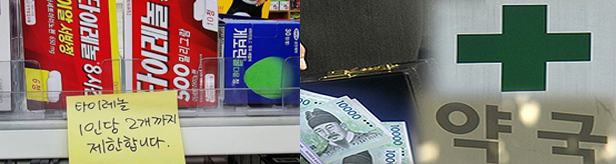
- ‘Public Tylenol will be supplied,’ ‘Why is the government unnecessarily supplying Tylenol to every pharmacy?’ On the 11th, the pharmacists’ community heat up over the Tylenol supply issue. The issue was sparked with some distributors spreading the news that ‘public rationed Tylenol will be released in the market from the 14th.' The social media chat rooms of pharmacists heated up with intense debate at the news that was spread before the government’s announcement. To clarify, the to-be-supplied Tylenol is not ‘public’ Tylenol. It is a measure made by the government to solve the current Tylenol shortage, under which the government plans to release the maximum amount of antipyretic analgesics to the market. From the released products, each pharmacy may order the amount needed, therefore the measure is not public rationing in any sense. Also, pharmacies that do not need Tylenol do not need to take up the supply, so there is no need for pharmacies to complain ‘Why the government is unnecessarily supplying Tylenol to every pharmacy?’ But it is true that the Ministry of Food and Drug Safety (MFDS) has called on relevant associations including the pharmacists', pharmaceutical, and distribution associations to address the issue. The MFDS had recently called on the Korean Pharmacists’ association, Korea Pharmaceutical and Bio-Pharma Manufacturers Association, and Korean Pharmaceuticals Distribution Association to resolve the shortage caused by the surge in demand. The government’s goal is to ‘allow the public to be able to purchase acetaminophen as needed after COVID-19 vaccinations without differences by region or pharmacy by resolving the supply-demand imbalance in pharmacies.’ As a result, 5 million 500mg Tylenol will be released on the market. This is the total amount that Johnson & Johnson had been stockpiling for the next year, and this total amount will be released in two phases, 2.4 million and 2.6 million, respectively. Each company may first secure 100 each, and the supply will be avaialbe as early as from the 15th, depending on the pharmacy. 40 wholesalers will oversee the distribution. The Korean Pharmaceuticals Distribution Association divided the pharmacies by region for 40 companies to cover. For example, a pharmacy located in Yeongdeungpo district in Seoul will receive 100 Tylenols from BaekGwang Pharm, which is in charge of the Yeongdeungpo area, even if the pharmacy uses multiple distributors like BaekGwang Pharm, Geo-young, and Yujin Pharm. The order method may also differ by the wholesaler. Some distributors may call the pharmacy or make visits to each pharmacy to distribute Tylenol. “To resolve the issue of pharmacies that works with various distributors, we divided the regions between 40 wholesalers,” explained an official from the Korean Pharmaceuticals Distribution Association. “The necessary amount may differ by the size and situation of each pharmacy, so after fairly distributing 100 to each pharmacy that wants Tylenol, the rest will be left to be ordered at an as-needed basis by each pharmacy.” The MFDS also called on each association to play its part in resolving the Tylenol shortage issue. First, the Korean Pharmacists’ association will inform consumers about the correct use of antipyretic analgesics after vaccination through medication counseling, and continue to conduct a campaign informing the public that all domestically approved acetaminophen products have the same efficacy and effect as Tylenol. The Korea Pharmaceutical and Bio-Pharma Manufacturers Association and acetaminophen producers will maximize the production volume of their drugs by releasing their inventory by mid-June as well as by mobilizing all capabilities available to adjust the production schedule to expedite supply. MFDS said, “The Ministry of Food and Drug Safety and relevant organizations will do the best to supply acetaminophen to the people in need at the right time according to the government's vaccination plan. Also, we will share the supply and demand status with relevant institutions through regular monitoring and immediately provide the necessary administrative support to suppliers to increase production of acetaminophen products.”
- Company
- Second trial on patent dispute over Bonviva
- by Kim, Jin-Gu Jun 14, 2021 05:56am
- There will be a patent dispute over the osteoporosis drug Bonviva (Ibandronate) again. It is an analysis of damages worth ₩tens of billions by domestic companies that are selling generics for Bonviva. According to the pharmaceutical industry on the 10th, British pharmaceutical company Atnahs Pharma, which owns patents of Bonviva, recently filed a lawsuit with the Patent Court to cancel the verdict of The Intelligent Property Trial and Appeal Board. In the previous first trial, Atnahs Pharma was defeated. The Intelligent Property Trial and Appeal Board ruled in March that Bonviva's patent was invalid. South Korean companies launched generic for Bonviva in 2012. Sales continued for years afterwards without patent disputes. Roche, the original company, held Bonviva's patent for use, but did not file a patent suit against the launch of the generic. Patent courts and Supreme Court did not recognize patents for indications/dosage. For the original company, there was no reason to dispute the patent because it was certain to lose. The situation was reversed in 2015. The Supreme Court scrapped existing cases in patent dispute of Baraclude (Entecavir) and admitted patents on indications/dosage. This also affected the patents of Bonviva. However, Roche did not file a separate patent dispute until then. The problem arose in 2018 when Bonviva's global patent rights were transferred from Roche to Atnahs Pharma in the UK. Atnahs Pharma has filed a lawsuit against local generics for Bonviva to ban patent infringement and seek massive damages. More than 10 generics, including Theragen, Alico, PharmGen Science, ChoA, Kolmar Korea, Huvist, and Dongkwang, which sold generics for Bonviva, jointly responded. The Intelligent Property Trial and Appeal Board sided with generic companies. With the appeal of Atnahs Pharma, the case was dealt with again in the second trial. According to UBIST, a pharmaceutical market research firm, Bonviva's prescription for out-of-pocket was ₩2.9 billion last year. It is sold by Handok in Korea. Generics for Bonviva are 93 items in Korea. Their prescription amount for last year is estimated to be around ₩10.3 billion. If the second trial makes a different ruling from the first trial, generic companies will have to deliver a large portion of their sales revenue to the original company since 2012.
- Company
- What's the future of vaccines after COVID-19 crisis?
- by Kim, Jin-Gu Jun 14, 2021 05:56am
- The rate of vaccinations against COVID-19 is increasing, especially in major developed countries. Experts say we need to brace ourselves for the 'Corona 21' and 'Corona 22' pandemic. As there is a high possibility that the pandemic will continue every year even if the current pandemic situation ends, the whole world should respond jointly. At the "2021 Bio Korea" held at COEX in Seoul on the 10th, a meeting was held to discuss future development and production of corona vaccines under the theme of "development of next-generation vaccines to cope with future infectious diseases." Experts agreed that COVID will repeat its epidemic every year in the future, just like the flu. Jerome Kim, Secretary-General of IVIAccording to him, global vaccine production in the first half of this year is worth 7.2 billion doses. Production is expected to increase to 12.6 billion doses in the second half of this year. However, if limited to vaccines officially recognized by the World Health Organization (WHO), the total number of doses in the first and second half of the year will be only 8.8 billion doses. Given that most vaccines are immunized with two doses, they are not sufficient to supply the world's population. The size is expected to increase to 1.12 million doses after next year, but there is still insufficient supply to meet global demand. "The COVID-19 virus epidemic will end in about a year and a half," he said. "Currently, global production capacity does not provide enough vaccines to underdeveloped countries. The CEPI has set a goal of supplying vaccines to 30% of the world's population by the end of this year, but vaccine producers around the world need to make efforts to ensure that they can be supplied more smoothly." "GSK, Merck, Takeda, and Daiichi Sankyo have not yet produced a vaccine for COVID" he said. Their development and mass production are required. "Various mutant viruses are reported," he added. "There must be mutant viruses that have not been reported yet," he said. "We also need to develop a Trivalent and Quadrivate vaccine to respond to them." Park Man-sung, a professor at Korea University of Medicine, also said, "We should prepare for the mutant virus epidemic." "Fortunately, COVID does not mutate as often as the influenza virus," he said. "However, numerous mutations have already been reported before the vaccine came out, and as the vaccination rate increases, COVID will adapt to it and change itself." He said, "Personally, I think there is a high possibility that COVID will evolve into a seasonal virus." "We don't know how long the immunogenicity of the vaccine we're currently inoculating will be maintained," he said. "We need to develop a new vaccine considering this situation." Variation virus reported before the start of COVID-19 vaccine. Even after the inoculation began, mutated viruses have been reported in Britain, South Africa, and India. Professor Park Man-sung predicted that more mutations will occur in the future and become a seasonal virus He also introduced plans to develop vaccines to prevent COVID and influenza at the same time. Since there is a high possibility that the two viruses will be prevalent simultaneously in winter, it is expected that demand will be very high if a vaccine is developed to prevent them at once. "Our laboratory is currently developing vaccines to prevent COVID and influenza viruses at the same time," said Professor Park Man-sung. "When initial development is completed, we will share technology with vaccine producers."
