- LOGIN
- MemberShip
- 2026-09-14 15:22:46
- Prescription drug approvals hit 3-year high in 1H 2026
- by Chon, Seung-Hyun | translator Alice Kang | 2026-07-07 08:57:42
The number of prescription drug approvals in Korea reached a three-year high in the first half of 2026, reflecting pharmaceutical companies' active efforts to expand their product portfolios and enter new markets. There are also some analyses that many companies accelerated regulatory filings to secure reimbursement at higher prices before generic pricing reforms take effect in August. Although approvals rebounded during the first half of this year, the total remains more than 70% lower than 6 years ago following tighter pricing and regulatory policies introduced since 2020.
According to the Ministry of Food and Drug Safety (MFDS), 499 prescription drugs were approved during the first half of 2026, representing a 58.4% increase from the same period last year. After reaching 585 approvals in the first half of 2023, the figure declined to 324 in 2024 and 315 in 2025 before rebounding this year to its highest level in 3 years.
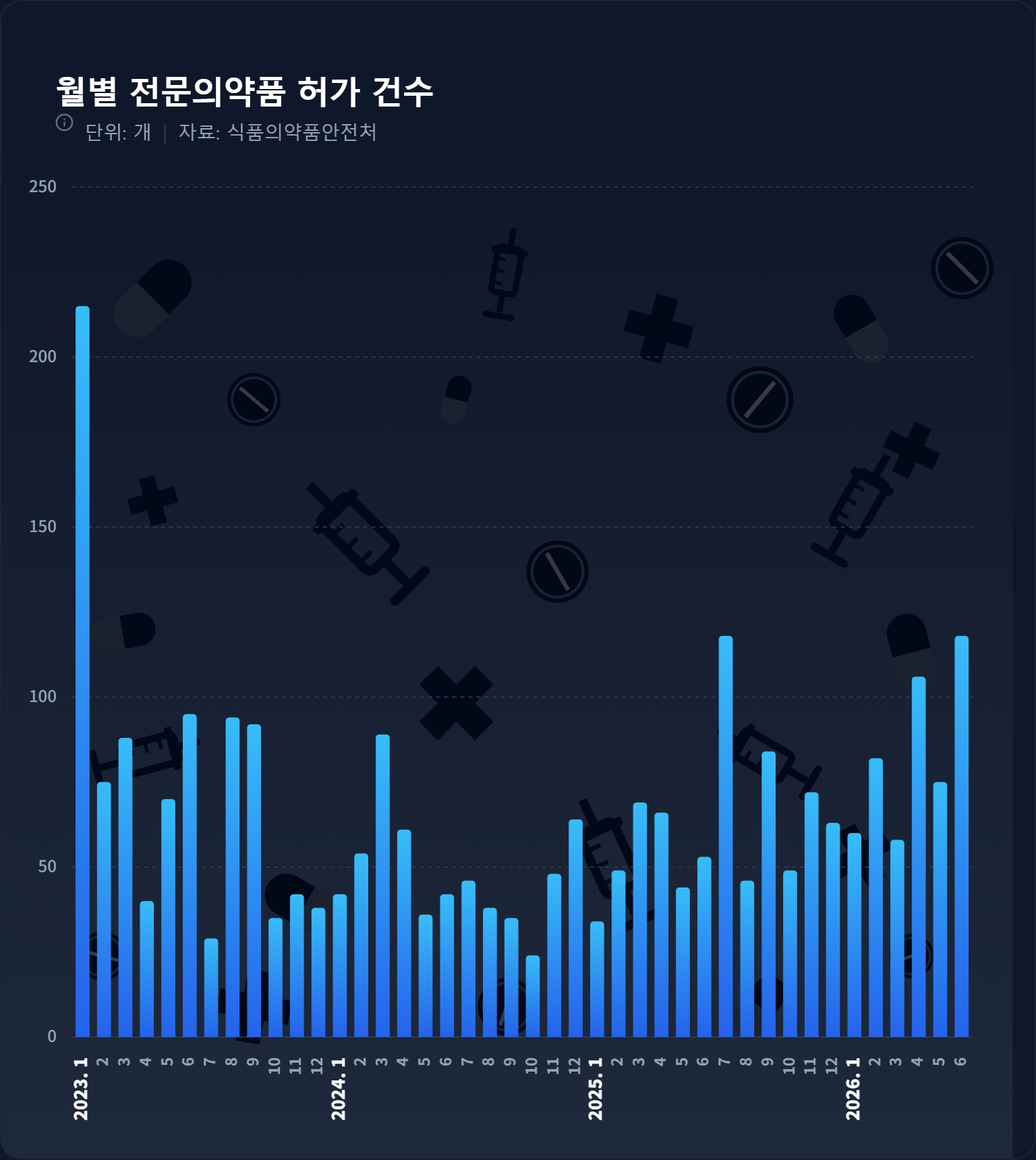
The increase suggests pharmaceutical companies have recently stepped up efforts to expand their product portfolios. June alone accounted for 118 approvals, while 106 products were approved in April, marking the second month this year in which monthly approvals exceeded 100.
By comparison, only July recorded more than 100 prescription drug approvals last year. Also, no month exceeded that level in 2024. In 2023, only January surpassed the 100-approval mark.
Average monthly approvals reached 83 products during the first half, the highest level since the 93 recorded in 2022. Although the annual monthly average had declined from 93 in 2023 to 76 in 2024 and 48 in 2025, approvals have rebounded to an upward curve this year.
Among the products approved in June, 48 orally disintegrating tablet (ODT) fixed-dose combinations of ezetimibe and rosuvastatin received marketing authorization. Companies obtaining approvals included Theragen Etex, Il-Yang Pharm, Ilhwa, Celltrion Pharm, KS Pharm, Dongkook Pharmaceutical, Mother’s Pharmaceutical, Jin Yang Pharmaceutical, HanAll Biopharma, Daehan Nupharm, Unimed Pharm, Withus Pharmaceutical, GC Biopharma, CMG Pharmaceuticals, Samjin Pharmaceutical, and GL Pharma.
Competition also intensified in the market for potassium-competitive acid blockers (P-CABs) containing vonoprazan. Vonoprazan, the active ingredient of Takeda's product Vocinti that has not yet been launched in Korea, attracted significant interest, with Korean pharmaceutical companies obtaining 58 approvals for generic vonoprazan products during the first half alone. Companies preparing to enter the vonoprazan market include CMG Pharmaceutical, Unimed Pharmaceutical, Korea PMG Pharm, Medica Korea, DongKoo Bio & Pharma, Samjin Pharmaceutical, Eden Pharma, Celltrion Pharm, Alvogen Korea, BC World Pharmaceutical, KS Pharm, Yuhan Corporation, Dongkook Pharmaceutical, Genu Pharma, YooYoung Pharmaceutical, KyongDong Pharml, Vivozon Pharmaceutical, Hana Pharm, Korea Prime Pharm, GenuOne Sciences, Kolon Pharma, Korea Arlico Pharm, Ahn-Gook Pharm, Saehan Pharm, GC Biopharma, White Life Science, Samik Pharm, Mother’s Pharmaceutical, and Kyongbo Pharmaceutical.
Industry observers believe another factor behind the increase is companies' efforts to secure as many reimbursements before the pricing reform takes effect in August.
Under proposed revisions to the ‘Standards for the Determination and Adjustment of Drug Prices’ recently released by the Ministry of Health and Welfare (MOHW), the maximum reimbursement price for both off-patent originators and generic drugs will fall from 53.55% to 45% of the original branded drug price beginning in August, equivalent to a 16% reduction in generic reimbursement prices.
Price reductions could become even steeper for products that fail to satisfy the requirements for receiving the highest reimbursement level, including conducting their own bioequivalence studies and using domestically registered active pharmaceutical ingredients (APIs).
Under the revised system, the penalty for failing to satisfy the maximum-price requirements will increase from 15% to 20%. Since July 2020, generic manufacturers have been required to both conduct their own BE studies and use registered APIs to qualify for the maximum reimbursement price of 53.55%. Previously, the reimbursement ceiling fell by 15% for each unmet requirement, resulting in a total reduction of 27.75% if neither criterion was met. Under that system, reimbursement fell from 53.55% to 45.52% when one requirement was unmet and to 38.69% when neither requirement was satisfied.
Under the revised framework, the new maximum reimbursement ratio of 45% will fall to 36% if one requirement is not met (20% cut) and to 28.8% if neither requirement is satisfied. Compared with the current system, these changes represent additional reimbursement reductions of 20.9% and 25.6%, respectively.
From the industry's perspective, obtaining reimbursement before implementation of the new pricing rules allows products to receive relatively higher reimbursement prices, providing a strong incentive to accelerate approvals.
Despite this year's rebound, prescription drug approvals remain well below historical levels. During the first half of 2019 and 2020, the MFDS approved 2,209 and 2,015 prescription drugs, respectively. The total fell to 1,073 in the first half of 2021 before declining further from 2022 onward. Compared with 2020, approvals in the first half of 2026 were 75.2% lower.
Industry analysts attribute the sustained decline in generic market entry to changes in both the drug pricing and regulatory systems.
Beginning in July 2020, Korea introduced a tiered reimbursement pricing system, under which reimbursement ceilings decline the longer the listing is delayed. Once 20 or more generic products are listed for a given ingredient, newly listed products are reimbursed at only 85% of the lowest existing reimbursement price. Because companies that do not independently develop generics or conduct their own bioequivalence studies receive substantially lower reimbursement, approvals for fully consigned generics have declined sharply.
Regulatory barriers have also become more stringent. Since July 2021, amendments to the Pharmaceutical Affairs Act introduced the so-called "1+3 rule," limiting the number of generic and incrementally modified drugs that can rely on a single bioequivalence study.
Under the regulation, if a generic is manufactured at the same facility using the same formulation and manufacturing process as the product for which the bioequivalence study was conducted, the bioequivalence data may be referenced by only three additional products. In other words, one bioequivalence study can support approval of only four generic products. Likewise, clinical data may be shared only with the original contract research organization’s product and up to three additional products.
Previously, once one manufacturer obtained approval based on a bioequivalence study, dozens of other companies frequently obtained approvals for outsourced generics using the same data. The introduction of restrictions on joint development effectively ended the practice of unlimited generic replication.
The surge in approvals during 2019 and 2020 was itself driven by anticipation of tighter government regulation. In 2018, sales of 175 valsartan-containing antihypertensive products were suspended after excessive levels of impurities were detected. In response, the MOHW and MFDS established a consultative body to develop measures aimed at curbing the excessive proliferation of generic drugs.
As the government signaled stricter regulation, pharmaceutical companies rushed to secure generic approvals before the new rules took effect. Since implementation of the reforms, however, new market entry has slowed considerably.
-

- 0
댓글 운영방식은
댓글은 실명게재와 익명게재 방식이 있으며, 실명은 이름과 아이디가 노출됩니다. 익명은 필명으로 등록 가능하며, 대댓글은 익명으로 등록 가능합니다.
댓글 노출방식은
댓글 명예자문위원(팜-코니언-필기모양 아이콘)으로 위촉된 데일리팜 회원의 댓글은 ‘게시판형 보기’와 ’펼쳐보기형’ 리스트에서 항상 최상단에 노출됩니다. 새로운 댓글을 올리는 일반회원은 ‘게시판형’과 ‘펼쳐보기형’ 모두 팜코니언 회원이 쓴 댓글의 하단에 실시간 노출됩니다.
댓글의 삭제 기준은
다음의 경우 사전 통보없이 삭제하고 아이디 이용정지 또는 영구 가입제한이 될 수도 있습니다.
-
저작권·인격권 등 타인의 권리를 침해하는 경우
상용 프로그램의 등록과 게재, 배포를 안내하는 게시물
타인 또는 제3자의 저작권 및 기타 권리를 침해한 내용을 담은 게시물
-
근거 없는 비방·명예를 훼손하는 게시물
특정 이용자 및 개인에 대한 인신 공격적인 내용의 글 및 직접적인 욕설이 사용된 경우
특정 지역 및 종교간의 감정대립을 조장하는 내용
사실 확인이 안된 소문을 유포 시키는 경우
욕설과 비어, 속어를 담은 내용
정당법 및 공직선거법, 관계 법령에 저촉되는 경우(선관위 요청 시 즉시 삭제)
특정 지역이나 단체를 비하하는 경우
특정인의 명예를 훼손하여 해당인이 삭제를 요청하는 경우
특정인의 개인정보(주민등록번호, 전화, 상세주소 등)를 무단으로 게시하는 경우
타인의 ID 혹은 닉네임을 도용하는 경우
-
게시판 특성상 제한되는 내용
서비스 주제와 맞지 않는 내용의 글을 게재한 경우
동일 내용의 연속 게재 및 여러 기사에 중복 게재한 경우
부분적으로 변경하여 반복 게재하는 경우도 포함
제목과 관련 없는 내용의 게시물, 제목과 본문이 무관한 경우
돈벌기 및 직·간접 상업적 목적의 내용이 포함된 게시물
게시물 읽기 유도 등을 위해 내용과 무관한 제목을 사용한 경우
-
수사기관 등의 공식적인 요청이 있는 경우
-
기타사항
각 서비스의 필요성에 따라 미리 공지한 경우
기타 법률에 저촉되는 정보 게재를 목적으로 할 경우
기타 원만한 운영을 위해 운영자가 필요하다고 판단되는 내용
-
사실 관계 확인 후 삭제
저작권자로부터 허락받지 않은 내용을 무단 게재, 복제, 배포하는 경우
타인의 초상권을 침해하거나 개인정보를 유출하는 경우
당사에 제공한 이용자의 정보가 허위인 경우 (타인의 ID, 비밀번호 도용 등)
※이상의 내용중 일부 사항에 적용될 경우 이용약관 및 관련 법률에 의해 제재를 받으실 수도 있으며, 민·형사상 처벌을 받을 수도 있습니다.
※위에 명시되지 않은 내용이더라도 불법적인 내용으로 판단되거나 데일리팜 서비스에 바람직하지 않다고 판단되는 경우는 선 조치 이후 본 관리 기준을 수정 공시하겠습니다.
※기타 문의 사항은 데일리팜 운영자에게 연락주십시오. 메일 주소는 dailypharm@dailypharm.com입니다.