
- LOGIN
- MemberShip
- 2026-06-29 14:55:07
- Company
- The Canadian gov. has put the drug price system on hold
- by Kim, Jin-Gu Jan 18, 2023 06:04am
- Korea to add Canada to drug price reference country this year...The domestic drug price reduction variable disappears. The reorganization of the drug price system, which was promoted by the Canadian government, has been temporarily suspended. Analysts say that the Canadian Ministry of Health officially announced that it would come up with a new reform plan due to strong opposition from the local pharmaceutical industry and that the plan to reevaluate the prices of premium drugs has virtually been canceled. Canada's move is also expected to affect South Korea's decision on the price of salaried drugs. In Korea, Canada has been added to the drug price reference country since this year. ◆ Canada's Ministry of Health decided to temporarily suspend the implementation of the drug price reform plan According to the pharmaceutical industry on the 14th, Health Canada recently requested the PMPRB (Patented Medicine Prices Review Board) to suspend the implementation of the drug price guideline reform plan. PMPRB has pushed for a reform of the patented drug price system since 2019. The reform plan focused on lowering the price of excessively high patented drugs. The core of the reform plan is to give the authority to investigate and re-evaluate ex officio whether the price of previously listed patented drugs is not expensive. To this end, a new price regulation device was added. It adds pharmacoeconomic value, including cost-effectiveness analysis data, the size of the drug market in Canada, Canada's gross domestic product (GDP), and per capita GDP. 캐나다 보건부는 작년 6월 새로운 지침을 시행하겠다고 예고했으나(위), 최근 새로운 지침은 2023년 1월 1일에 시행되지 않는다고 밝혔다(아래). 캐나다 보건부 홈페이지 캡처 On top of that, the drug price reference countries were reorganized into 12 countries, including Korea, Japan, Australia, Belgium, the Netherlands, Norway, Spain, France, Germany, Italy, Sweden, and the United Kingdom. The existing U.S. and Switzerland were excluded. The intention is to lower the average price of foreign drug prices by excluding the U.S. and Switzerland, which have high drug registration prices. Ministry of Health estimated that $13.2 billion could be saved over the next 10 years by reforming the drug price system for the first time in more than 20 years. ▲Canada's Health Ministry announced in June last year that it would implement the new guidelines (above), but recently announced that the new guidelines will not take effect on January 1, 2023 (below). Capture Health Canada However, the implementation of such a reform plan has been delayed. It was originally scheduled to take effect in January 2020, but it was implemented on July 1 last year after four delays due to opposition from the Canadian pharmaceutical industry and the influence of COVID-19. The most strongly opposed part of the industry's re-evaluation of the price of such drugs was scheduled to take effect on January 1 this year after preparing a new plan with a grace period. The industry has consistently protested, and in the end, Canada's Ministry of Health has decided to suspend the reform of the drug price system, saying it needs more review. At the same time, he said he would come up with a completely new version of the reform plan. Temporary guidelines are expected to remain in place until a new reform plan is prepared. ◆The new drug price reference country Canada's drug price cut variable disappears There have been constant concerns in the domestic pharmaceutical industry that the implementation of the new drug price system in Canada will lead to a reduction in drug prices in Korea. Canada was added as a new drug price reference country this year. As of January 1 this year, the country subject to foreign adjusted average price calculation has been reorganized from A7 (Japan, France, Germany, Italy, Switzerland, the United Kingdom, and the United States) to A8 with Canada added. The government has expressed its willingness to refer to the drug prices of A8 countries for the reevaluation of quality medicines as well as the registration of new drugs. In this situation, concerns have been raised that if the Canadian drug price decreases, the Korean drug price referring to it will also decrease. However, as Canada's reorganization of the drug price system has been temporarily put on hold, it is interpreted that variables that will affect Korea's reduction in drug benefit prices have also disappeared. In response, a pharmaceutical industry official said, "It is welcome that the potential risk factors that will lead to a domestic drug price cut have disappeared," but added, "However, since the Canadian government is still willing to cut drug prices and has decided to come up with a new reform plan, we should carefully look at future changes."
- Policy
- MOHW-NECA issues notice on colorimetric assay
- by Kim, Jung-Ju Jan 18, 2023 06:04am
- The National Evidence-based healthcare Collaborating Agency (President: Kwang Hyub Han) announced the amendments to the notice on the new health technology, ‘colorimetric assay’ for anti-Xa apixaban testing, that had been deliberated as a safe and effective health technology at the 10th MOHW New Health Technology Assessment Committee meeting in 2022. The New Health Technology Assessment system was introduced in 2007 to assess the safety and clinical efficacy of new health technologies (acts of medical practice including treatment method, and testing method), and is implemented to prevent indiscriminate use of unverified medical technology and to protect the people's right to health. The anti-Xa apixaban assay technology, the ‘colorimetric assay, ‘is a test that quantifies the concentration of apixaban in plasma samples through colorimetric assay for patients that were administered apixaban and require monitoring for apixaban concentration. As it is safe as an in vitro test that uses patient samples and is recommended as a test to monitor the concentration of apixaban in patients that are administered apixaban when clinically necessary in textbooks and guidelines, the technology was determined to be a valid technique with an acceptable level of correlation to the current standard test method, liquid chromatography-tandem mass spectrometry. Meanwhile, the results of the new Health Technology Assessment were notified under Article 53-3 of the Medical Service Act and Article 4 of the Rules on New Health Technology Assessment and may be found on the MOHW and NECA’s Center for New Health Technology Assessment website.
- Company
- Biktarvy, applies to the expansion of pediatric indications
- by Eo, Yun-Ho Jan 18, 2023 06:04am
- HIV treatment Biktarvy is aiming to expand pediatric indications in Korea. According to related industries, Gilead Science Korea recently submitted an application to expand indications for pediatric patients who weigh at least 14kg to 25kg of the HIV compound Biktarvy and have no experience in antiretroviral treatment or have been suppressed by existing antiretroviral treatment. The efficacy of Biktarvy in pediatric patients was confirmed through data from cohort 3 of clinical trials in a single clinical trial with phase 2/3 open markers. In the study, Biktarvy low-dose tablets were found to be generally drug-resistant and effective for 24 weeks in HIV-1-infected children with suppressed virus levels. Child patients enrolled in cohort 3 were continuously treated for 48 weeks and were able to continue receiving medication during the extended phase. 91% (20/22) of participants maintained virus level suppression at week 24 after switching to Biktarvy, with an average CD4% change of 0.2%. Biktarvy entered the market in earnest by applying salary in July of the same year after receiving approval from the Ministry of Food and Drug Safety in January 2019. According to IQVIA, a pharmaceutical market research firm, Biktarvy showed its potential from the first year of its launch, and its sales jumped from 400 million won to 4.6 billion won in just one quarter. In 2020, quarterly sales increased to 6.6 billion won, 7.9 billion won, and 9.8 billion won, respectively.
- Company
- Curing terminal cancer without treatment options
- by Jan 17, 2023 06:02am
- Mr. A, a 60-year-old Korean male patient, was diagnosed with gastric cancer several years ago. After struggling to treat the disease for several years, the hospital told A that there was no other treatment option available for him and that he may not be able to live for more than 6 months. As a last resort, A registered to enroll in the KOSMOS study and was told there was a breast cancer treatment available for the genetic mutation he was found with during genetic testing. The breast cancer drug stayed effective for over a year, and after seeing a significant reduction in tumor size, A left his hospital bed and was able to receive the outpatient treatment he had only dreamed of. The stage has been set to create a Korean-style precision medical ecosystem that can provide personalized treatment opportunities for cancer patients with terminal cancer who no longer have treatment options like Mr. A. A large-scale project involving academic societies, hospitals, research institutes including the Korean Society of Medical Oncology, Korean Cancer Study Group, Korea Health Industry Development Institute, National Cancer Center, Roche Korea, and Lunit Inc. is set to start this year. ◆Use without indication or approval ’OK’…brings new hope to terminal cancer patients The clinical project, KOSMOS2(KOrean precision medicine networking group Study of MOlecular profiling guided therapy based genomic alterations in advance Solid tumors II), will be recruiting 1,000 patients for 3 years. Subject patients are those with terminal-stage cancers that have a life expectancy of 6 months or less. In general, these patients are advised to leave the hospital because there is no other drug available for their use in the hospital. Therefore, their caregivers travel from hospital to hospital in search of one that can take care of their beloved’s illness just a little more. When left with no other option, most of them end up receiving hospice care. Enrolling in the KOSMOS2 study could open up new opportunities for these patients. First, patients who enroll in the KOSMOS2 study receive next-generation sequencing (NGS) to check for genetic mutations. Roche Korea provides an NGS-based comprehensive genomic profiling (CGP) Foundation Medicine Service. The results are stored on ‘Navify Tumorboard,’ Roche Diagnostic Korea’s multidisciplinary tumor board (MTBs) that was developed specifically for cancer treatment. It is a multicenter MTB that has been first attempted in the KOSMOS project that allows associated companies to share data. Academic specialists in pathology, oncology, and bioinformatics formed 6 teams to meet twice a week to analyze the patients' mutation status and discuss available drugs and treatment strategies. In the KOSMOS2 study, patients can attempt to be treated with drugs that are not approved in Korea or has no indication for their cancer if the doctors deem the drug appropriate. Therefore, the patient can receive treatment with a new drug that is not normally available, and the drug cost is borne by the pharmaceutical company. Of course, not all patients can receive treatment with new drugs. A drug that targets the patient’s mutation that had been identified through genetic testing has to first exist. The academic society estimated that around 30% of the patients will be able to receive treatment with new drugs. However, in the KOSMOS1 study, which became the basis for the KOSMOS2 study, more patients than expected were provided treatment opportunities. This was an unexpected achievement of precision medicine that even surprised the specialists. ◆Organic cooperation for Korean precision medicine...established a system for a virtuous cycle In the KOSMOS2 study, academic societies, research institutes, hospitals, and pharmaceutical companies organically work together to bring out the best results for each patient. The Korean Society of Medical Oncology and the Korean Cancer Study Group will lead the study, developing the specific design for the study and generating clinical and genomic data. As the Ministry of Food and Drug Safety’s designated national cancer data center, the National Cancer Center will be providing the technology and infrastructure required to build an integrated database for precision medicine. The NCC will also select and classify the collected data to provide a high-quality DB. Roche Korea will support pharmaceuticals and the optimal precision medical platform. To promote the project, the Korea Health Industry Development Institute will connect institutions, domestic and foreign pharmaceutical companies, and genome and software companies for collaboration. The first patient was recently enrolled in the KOSMOS2 study, which has been recruiting patients since the second half of last year. The study will enroll patients for 2 years, follow up for 1 year, and conclude the study after 3 years. The KOSMOS2 research project will provide patients with new treatment opportunities, and enable academia to realize precision medicine in the true sense regardless of their affiliation or region. Research institutes and industries can use high-quality genetic DB of cancer patients to conduct new research such as new drug development. In other words, a virtuous cycle of precision medicine and innovative new drug development will be created. Yong-Woo Kim, Lead of the Biopharmaceutical Industry Team at KHIDI, said, “It is important to build an integrated clinical genomic database as the basis for precision medicine and new drug development of pharma and bio companies in Korea. The organic cooperation between the government, academia, hospitals, and companies, will not only bring destructive innovation in precision medicine, but it will also mark the starting point for the revitalization of precision medicine in Korea."

- Product
- Dispensing drugs through text or KakaoTalk illegal
- by Kang, Shin-Kook Jan 17, 2023 06:02am
- If a patient takes a picture of his or her prescription and sends it via KakaoTalk or text message to the pharmacist, is it legal or illegal to dispense the drug? To Korean Pharmaceutical Association’s question, the Ministry of Health and Welfare recently replied that “Although the situation may differ by case, even with the patient’s consent, sending a prescription recorded on the patient’s mobile phone to the pharmacy and using it to prefill prescriptions in advance is not allowed under the current law unless there are special circumstances. The MOHW said, “According to the Supreme Court ruling and the Pharmaceutical Affairs Act, it is advised that drugs be ordered, delivered, and sold in pharmacies. Pharmacists must fill and dispense drugs according to prescriptions legally issued to patients under the Pharmaceutical Affairs Act and the Medical Service Act.” The MOHW added, “Pharmacists should receive the original prescription form from the patient and dispense the prescription after confirming the authenticity of the prescription and that the visitor is the patient or guardian of the patient specified the prescription." The issue arose with some pharmacies receiving a picture of a prescription through a pharmacist's personal cell phone or KakaoTalk message for dispensing. In other words, there were cases where patients voluntarily send a picture of their prescription using a text message or KakaoTalk to a pharmacist without any company intervention, and then visits the pharmacy with their paper prescription to receive the medicine. It is a sort of pre-booking system between patients and pharmacies.” This allows pharmacies extra time to fill long-term prescriptions for those that exceed 90 days while reducing the waiting time for the patients. Many have countered that there was nothing wrong with such acts as Kiosk-type prescription transmission between large hospitals and pharmacies is common. However, controversy is expected on-site with the MOHW concluding that it is illegal to send pictures of the prescriptions.
- Company
- Despite the largest export of diagnostic kits ever, we canno
- by Kim, Jin-Gu Jan 17, 2023 06:02am
- Exports of domestic diagnostic kits broke the record last year. However, export performance in the second half of the year is on the decline. Analysts say that as the global COVID-19 situation calms down, exports of diagnostic kits, which have been on a high march, are returning to the level of previous years. According to the Korea Customs Service on the 16th, exports of diagnostic kits in Korea amounted to USD 3.34908 billion last year. It increased 63.6% from $2.047.32 billion in 2021. This is the highest performance ever. Domestic diagnostic kits have grown rapidly with the spread of COVID-19. Exports of diagnostic kits, which stood at only $253.26 million until 2019, rose vertically to $2.170.87 billion in 2020. It then recorded $2.047.32 billion in 2021. In the first half of last year, export performance increased further. Early last year, the average monthly exports soared to $435 million due to the simultaneous resurgence of COVID-19 around the world. Exports of diagnostic kits also plunged as the global COVID-19 crisis has subsided since the second half of last year. The average monthly export of diagnostic kits in the second half of last year was only $123 million. As the global pandemic is nearing an end, it is predicted that the export performance of diagnostic kits will also return to the level of previous years. Major diagnostic kit companies are also coming up with various measures to prepare for a decrease in global demand. SD Biosensor focused on expanding its appearance and entering the global market through mergers and acquisitions. In July last year, it announced that it would acquire Meridian Bioscience, a U.S. in vitro diagnostic company, for 2 trillion won. The acquisition will be jointly carried out by SD Biosensor and private equity fund operator SJL Partners. SD Biosensor and SJL Partners will take over at a rate of 60% and 40% respectively and invest in Columbus Holding Company, a special purpose corporation (SPC) jointly established in the United States. Madeira Acquisition and Meridian, SPC subsidiaries 100% of Columbus Holding Company, merge and enter Columbus subsidiary. SD BioSensor has been steadily expanding its global distribution network since last year. On top of that, the acquisition of Meridian made it official to enter the world's largest diagnostic market and focused on expanding the global distribution network. On top of that, the company plans to further expand its global territory through additional acquisitions. Seegene is focusing on developing diagnostic kits other than COVID-19. Seegene is developing reagents and equipment that diagnose diseases other than COVID-19 through massive R&D expansion. They include reagents for diagnosing cervical cancer (HPV), sexual intervention (STI), and respiratory diseases other than COVID-19.
- Company
- Stelara biosimilar of Dong-A ST succeeded in clinical trials
- by Chon, Seung-Hyun Jan 17, 2023 06:02am
- Dong-A ST announced on the 16th that the Stelara biosimilar DMB-3115 has confirmed its safety and effectiveness in clinical trials. On the same day, Dong-A ST introduced the results of DMB-3115's global phase 3 clinical trial top line and announced that it would apply for item permission to the U.S. and European health authorities in the first half. Dong-A ST conducted a global phase 3 clinical trial of the Stelara biosimilar DMB-3115 on a total of 605 patients in nine countries, including the United States, Poland, and Estonia, from 2021 to the end of last year. Developed by Janssen, Stelara is a treatment for inflammatory diseases such as plate psoriasis and psoriatic arthritis, Crohn's disease, and ulcerative colitis. It is a blockbuster product that recorded sales of $9.134 billion in 2021. In clinical trials, DMB-3115 has proven its validity for European and U.S. item licensing. As a result of evaluating psoriasis area and severity index, which are the primary evaluation variables for European EMA item licensing, DMB-3115 statistically demonstrated therapeutic equivalence with Stella. In the US FDA evaluation index for item licensing, DMB-3115 confirmed the equivalent validity of Stelara. The safety assessment also confirmed that DMB-3115 is equivalent to Stelara. The proportion of subjects with even one new or worsening adverse reaction after administration of clinical trial drugs was about 54% in the group administered DMB-3115 and about 57% in the group administered Stelara. At 28 weeks, about 55% of the group change from Stella to DMB-3115 occurred, and no clinically significant difference was observed. The proportion of subjects with even one serious adverse reaction was similar, about 2% in the group administered DMB-3115 and about 3% in the group administered Stella. It did not occur in the group that changed from Stelara to DMB-3115 at 28 weeks. Dong-A ST said, "We plan to apply for DMB-3115 item permits in major overseas countries such as the United States and Europe in the first half of this year."
- Product
- Viagra is sold out
- by Kim JiEun Jan 17, 2023 06:02am
- Viagra, a treatment for erectile dysfunction, has joined the ranks of untimely sold-out. Some in the market say that the delay in the Viagra sales contract may be affecting supply and demand. On the 15th, Dailypharm confirmed online malls exclusively for major pharmacies and found that 100mg of Viagra was sold out in all online malls, making it impossible to order. In the case of Viagra, Jeil has been selling it until the end of last year, but Viatrice Korea and Jeil ended their sales contracts for a total of seven forms, including 50mg of Viagra and 100mg of Viagra, Cardura XL tablets, and Detrusitol SR capsules, as of December 30 last year. Menarini came to mind to succeed Jeil, but according to the industry, the sales contract between Beatrice Korea and Korea Menarini has not been finalized until now. The industry believes that the shift in sales rights is having a significant impact on the Viagra out-of-stock situation that began at the end of last year. This is because Viagra's inventory is currently running out not only in online malls exclusively for major pharmacies but also in drug wholesalers. In addition, Cardura XL tablets and Detrusitol SR capsules, whose sales contract has ended with Viagra, are all sold out at online malls. Drug distributors as well as front-line pharmacies agreed that 100mg of Viagra tablets, which are relatively prescribed, is out of stock, which has a significant impact on prescription preparation. "The problem is that we don't have stock of 100ml of Viagra, which is in high demand due to a lot of prescriptions," an official from a pharmaceutical wholesaler said. "We asked the company to secure inventory, but we couldn't give a definite answer about when it was possible to secure inventory because the right to sell has not been finalized yet." The official said, "I understand that Jeil released all related inventories on the market at the end of last year as the sales contract was terminated," adding, "The delay in the confirmation of the next runner could affect the market."
- Company
- Novartis charged with 'rebate' has been fined
- by jung, sae-im Jan 16, 2023 07:47pm
- Novartis and Media Fines…Suspension of imprisonment for those involved Novartis Korea, accused of providing illegal rebates of about 2.6 billion won to doctors, was finally fined by the Supreme Court. On the 12th, the Supreme Court rejected the appeal filed by Novartis Korea, related parties, and media outlets who were convicted in the original trial for violating the Pharmaceutical Affairs Act, and confirmed a fine of 40 million won issued to Novartis Korea. They were indicted in 2016 on charges of giving a total of 18.1 billion won in product advertising expenses to media outlets such as medical journals between 2011 and 2016, and paying 2.59 billion won to doctors in the name of manuscript fees or advisory fees. The lower court sentenced Novartis Korea to a fine of 40 million won and the media to a fine of 10 million won to 25 million won, respectively. Novartis Korea officials were sentenced to one year in prison, suspended, and fined. All five media representatives involved were sentenced to prison and suspended. Novartis Korea's former CEO was acquitted.
- Company
- Next-Generation ADC Enhertu launches in Korea
- by jung, sae-im Jan 16, 2023 07:39pm
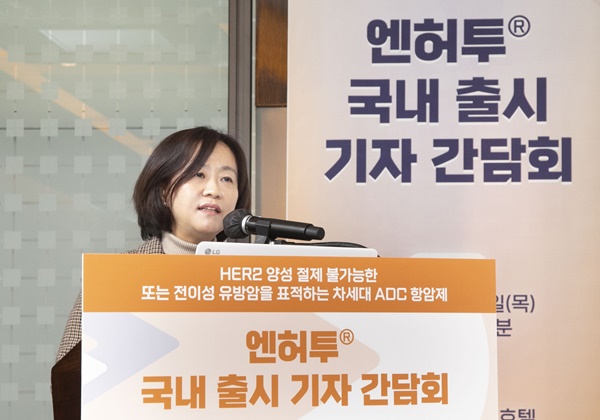
- Enhertu, which Korean breast cancer patients urged for quick permission last year, was released in Korea this month. Analysts say that it will change the paradigm of secondary treatment for HER2-positive breast cancer with a superior effect compared to existing treatments. Daiichi Sankyo held a press conference at the Westin Chosun Hotel on the 12th to commemorate the launch of the ADC (antibody-drug conjugation) new drug Enhertu in Korea. Enhertu is an anticancer new drug approved by the Ministry of Food and Drug Safety in September last year. It can be used for HER2-positive breast cancer (secondary) and stomach cancer (third). Park Yeon-hee, Professor of Hematology and Oncology at Samsung Medical Center Enhertu is a next-generation ADC jointly developed by AstraZeneca and Daiichi Sankyo. ADC is a drug made by connecting "Antibody" that binds to a specific target antigen on the surface of cancer cells and a "Payload" that has the function of apoptosis with "Linker." It is a drug that selectively acts only on cancer cells to increase treatment effects and minimize side effects. Existing ADCs have caused tumor resistance for various reasons, resulting in some poor efficacy. Enhertu was developed to compensate for these shortcomings and provide optimal anti-tumor effects. Drugs with a new mechanism of action were applied, and a high and uniform drug and antibody ratio was set. ◆"The breast cancer data is amazing"…Expected to expand the indication Park Yeon-hee, a professor of hemato-oncology at Samsung Medical Center, who was the speaker at the meeting, introduced Enhertu's major data and welcomed it, saying, "I'm happy to release Enhertu in Korea, which has proven excellent effects in breast cancer clinical trials." Major breast cancer clinical studies in Enhertu include DESTINY-Breast01 and Breast03. The Breast01 study measured the effectiveness and safety of Enhertu in tertiary or higher patients with extensive treatment. The Breast03 study is a phase 3 clinical trial compared to Kadcylla (T-DM1) when Enhertu was used as a secondary treatment. As a result of the final updated Breast01 study in March 2021, N Hutu achieved the first evaluation variable with an objective response rate (ORR) of 62%. The median reaction duration (mDOR) was 18.2 months, the median progression duration (mPFS) was 19.4 months, and the median total survival period (mOS) was 29.1 months, respectively. Enhertu Professor Park said, "In the clinical trial, Enhertu recorded a high number of 19.4 months of PFS. "OS also showed 29.1 months even though there was no drug available after this," he explained. Enhertu also demonstrated excellent effectiveness in direct comparison with the first-generation ADC treatment Kadcylla. As a result of the Breast03 study, Enhertu reduced the risk of disease progression or death by 72% compared to Kadcyla by 34.1% with a progression-free survival rate of 75.8% at 12 months. Kadcyla's mPFS was 6.8 months, while Enhertu did not reach the evaluation value. Professor Park also expressed high expectations for Enhertu's additional indications. HER2 is low-expression breast cancer. These patients account for half of breast cancer patients, but they are not suitable to use existing HER2-targeted treatments, which is an area with high unmet demand. In a clinical trial announced last year, Enhertu first introduced it in the area of HER2 underexpression by reducing the risk of disease progression or death by 50% compared to the chemotherapy group. Currently, it has acquired an American indication. Professor Park said, "I personally have high expectations for HER2 low-expression breast cancer indications," and added, "I hope the expansion of domestic indications will not be delayed further." ◆"Highly toxic but manageable, Enhertu's benefit should be applied" Enhertu has a high risk of side effects as much as its excellent effect. The most common adverse event in the Breast03 study was interstitial lung disease (ILD), which was cited as the most cautious side effect when using Enhertu. The rate of epileptic lung disease in the Enhertu group was 10.5%, which was higher than that of the Kadcylla group at 1.9%. Professor Park said, "It is true that it is more toxic than conventional drugs," but added, "But it can be managed sufficiently by dose control." He then said, "Fatal side effects were mainly found in Japanese patients, and I don't think this case can be expanded to the entire Asian region." Side effects are something to be careful about, but the prognosis varies depending on how a specialist manages them. "From my experience, I think it is manageable," he added. Professor Park urged Enhertu to register his benefit quickly. Professor Park stressed, "At least the indication received now should be covered by insurance benefits as soon as possible." Daiichi Sankyo is known to have applied for a salary registration for Enhertu breast cancer and gastric cancer on December 28 last year. The HIRA is awaiting the introduction of the Cancer Disease Review Committee. Kang Bo-sung, head of the marketing division of Daiichi Sankyo's anti-cancer drug division, replied, "We will actively discuss with health authorities to register our quick benefit."
