
- LOGIN
- MemberShip
- 2026-07-04 18:47:45
- Policy
- “Elderly polypharmacy rate Korea 70% vs OECD countries 48%"
- by Lee, Jeong-Hwan Oct 06, 2021 06:06am
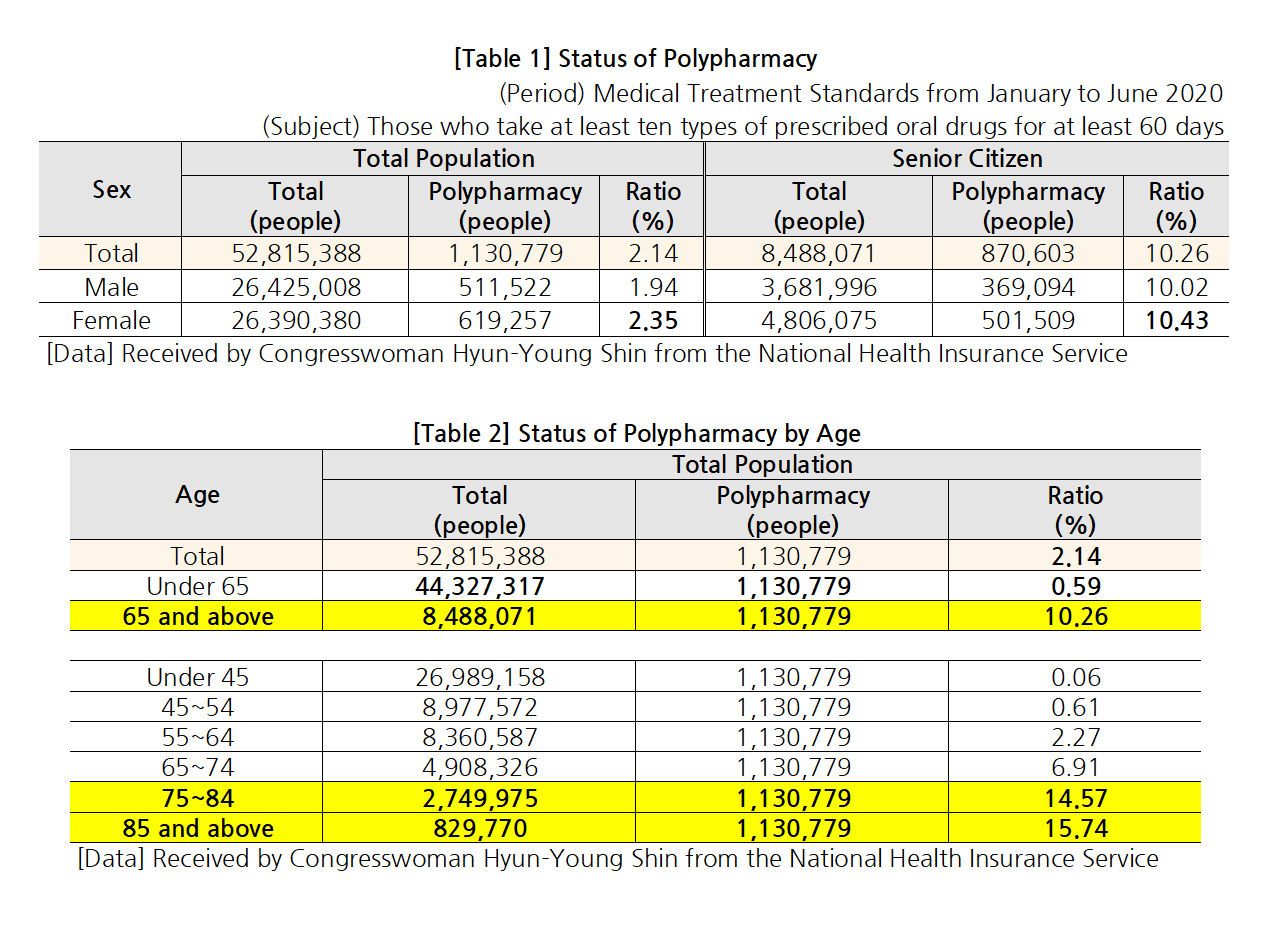
- Statistics showed that a high rate - 70.2% - of older adults (aged 75 or over) in Korea chronically take ‘more than 5 drugs for over 3 months.’ The average of 7 OECD countries other than Korea that submitted the same data was only 48%. In other words, concerns over the current polypharmacy status of elderly patients in Korea have been reaffirmed. On the 4th, NA member Hyung-young Shin of the Democratic Party of Korea announced the results above after analyzing OECD data. The medication rate of elderly patients in Korea has been globally high. According to the OECD’s data on the ‘rate of patients aged 75 or over who chronically take 5 or more drugs for over 3 months,’ the average of the 7 countries that submitted the data was 48.3%, compared to the much higher rate of 70.2% in Korea. However, Using an unnecessarily high amount of drugs in older adults can have a negative impact on their health. According to the National Health Insurance Service Ilsan Hospital's report, patients aged 65 or older who take 5 or more drugs have an 18% increased risk of hospitalization and 25% increased risk of death than those who take 4 or fewer drugs. According to the data that Shin received from the NHIS, 2.14% of the total population (1.13 million) in Korea takes 10 or more drugs. Among those, the elderly accounted for the largest proportion with 10.26%, and the polypharmacy rate was higher in women (2.35%) than men. The rate and number of patients using multiple drugs also increased with age. The polypharmacy rate was 10.26% for people over 65 but 15.74% for people over 85. By insurance premium quintile, polypharmacy rate was higher (12.52%) in medical aid beneficiaries than NHI policyholders. The polypharmacy rate in elderly medical aid beneficiaries was 22.57%, which roughly translates to one in 4 to 5 patients. Also, the proportion of the elderly was highest in the 1st and 10th insurance premium quintile (9.88%). Furthermore, the polypharmacy rate was higher in patients with underlying diseases such as diabetes, heart disease, cerebrovascular disease, asthma/COPD, chronic renal failure, pulmonary tuberculosis, etc. By population, the polypharmacy rate was highest in patients with chronic renal failure (18.38%), heart disease, (15.36%), cerebrovascular disease (13.86%). The order was the same in elderly patients but at a higher rate - chronic renal failure (23.80%), heart disease (20.97%), cerebrovascular disease (18.31%). Shin said, “As the rate of patients who take 10 or more drugs increases with age, we need to review whether the patients are taking unnecessary drugs due to over-prescription or redundant prescriptions. In other words, institutional support on the appropriate use of drugs is needed, and a system that assigns primary care physicians for the elderly should be introduced to manage the elderly’s use of multiple drugs, as well as provide customized support on the appropriate use of healthcare.”
- Policy
- The patient died due to the delay in Kymriah benefits
- by Lee, Jeong-Hwan Oct 06, 2021 06:06am
- Ko Eun-chan Korea leukemia patients organization launched a one-man protest, urging the first C-ART treatment Kymriah (Tisagencleucel)'s fast track. The Korea Leukemia Association held a press conference in front of the National Human Rights Commission of Korea at 10 a.m. on the 1st and announced that it submitted a petition to the National Human Rights Commission of Korea demanding Kymriah's health insurance registration and fast track for new drugs. Kymriah is the world's first chimera antigen receptor T-cell treatment that is effective in treating patients with recurrent or refractory B-cell acute lymphocytic leukemia and refractory giant B-cell lymphoma. Although patients are expected to have an effect of 82% cure rate even with one dose, the cost of one dose amounts to about 460 million won. Novartis applied for health insurance registration with the HIRA in March, but failed to pass the Cancer Drugs Benefit Application Committee. Lee Eun-young said, "Kymriah was not presented as an agenda at the 5th Cancer Drugs Benefit Appeal Committee in July and was not passed by the 6th Committee in September." She said, "If pts don't receive Kymriah treatment, they may die within three to six months." Lee Bo-yeon, the mother of Ko Eun-chan, who died in June while battling acute lymphocytic leukemia, also urged the introduction of fast track, saying that the government approved drugs to treat the disease, but they were useless due to the price of 500 million won. Mr. Lee said, "The government has not prepared a plan to allow high-priced drugs such as Kymriah and pay for them by dividing the amount or support the loan system for the use of new drugs." "This forced us to use loans from the second financial sector to raise drug prices," she said. "It's been nearly four months since my child died. "I thought health insurance would be applied soon because the effectiveness of the drug has already been proven and the number of people needed is limited, but I'm angry that the children are dying without any change," she said. "A malignant lymphocyte tumor progresses quickly. Through Kymriah's fast track, we need to make sure that there are no people in Korea who are dying because of lack of money like Eun-chan,"she said. Ahn Ki-jong, CEO of the Patient Association, said, "The Constitution prohibits the right to life and discrimination. Even though Korea is a citizen who pays taxes and health insurance premiums equally, people's lives should not be at stake depending on their economic capabilities." He then said, "After obtaining approval from the MFDS among the expensive new drugs, I only waited for health insurance registration. Eventually, this situation of death has been repeated over the past 15 years, at least patients who need new drugs directly related to life should temporarily apply health insurance at the same time as the MFDS approves to treat patients." Ahn also said, "Starting with Kymriah, we will not let any patients who cannot be treated because they do not have money at least in Korea." The patient association will hold a one-man relay protest in front of Novartis Korea's headquarters from the 1st to urge them to come up with active financial sharing measures. A national petition will be posted on Cheongwadae to convey the position of the patient association to the government and demand improvement.
- Company
- Yoo Byung-Jae took office as the new president of Novartis
- by Oct 06, 2021 06:05am
- Yoo Byung-Jae, the new CEO of Novartis Korea Yoo Byung-Jae took office on the 1st as the new president of Novartis Korea. New President Yoo is an expert who has accumulated organizational management and management skills in the global healthcare industry for 15 years. Until recently, he served as president of North Asia, including South Korea, Taiwan, and Hong Kong, at Johnson & Johnson Medical, exceeding his target performance every year. It is evaluated that it has created business excellence and led organizational development by growing in all business fields. New President Yoo said, "I am happy to join Novartis, which leads the global pharmaceutical industry, based on our innovative portfolio." "We will do our best to provide patients with various innovative treatments, including the cellular therapy portfolio that Novartis is currently focusing on, contribute to the innovative ecosystem of the domestic healthcare industry, and become a socially trusted company," he said. The new president Yoo, a graduate of Korea University's business administration department and Harvard Business School, joined the marketing team of Johnson & Johnson Medical's blood vessel division in 2006. Since then, he has been in charge of marketing leaders in orthopedic departments in the United States, the United Kingdom, and Australia, and has successfully led various business fields since returning to Korea in 2010. In addition, he gained brand management experience in famous consumer goods companies such as Coca-Cola and Unilever, and worked as a management consultant for Boston Consulting Group.
- Policy
- Boryung's Dukarb Plus is about to be commercialized
- by Lee, Tak-Sun Oct 05, 2021 05:58am
- Dukarb, Tuvero, and Kanarb It was found that commercialization of the high blood pressure combination drugs including Boryung's Fimasartan is imminent. If this product is approved, a total of four products will form treatment options in the hypertension treatment lineup leading to Kanarb-Kanarb Plus-Dukarb. Through this, it is expected that the diversity of patient prescriptions can be secured. According to the industry on the 4th, Boryung recently submitted an application for permission for the tentatively named Dukarb Plus to the MFDS. Dukarb Plus is a complex in which a diuretic component, HCTZ, is bonded to Dukarb (Fimasartan-Amlodipine), a second complex. Already, Boryung has conducted phase 3 clinical trials in 250 hypertensive patients at 32 hospitals in Korea since May 2019 under the name of FAH. FAH is the first alphabet of Fimasartan, Amlodipine, and HCTZ. If Dukarb Plus is approved, it will be the seventh product containing Fimasartan since the launch of Kanarb in 2011. It is the fourth product to treat hypertension only after Kanarb (Fimasartan), Kanarb Plus (Fimasartan+HCTZ), and Dukarb (Fimasartan+Amlodipine). Patients who are not well controlled by Dukarb will be able to choose Dukarb Plus with diuretics added. Including Tuvero (Fimasartan + Rosuvastatin), Dukaro (Fimasartan + Rosuvastatin + Amlodipine), and Akarb (Fimasartan + Atorvastatin), it will be released up to the 7th drug. With Kanarb showing an annual performance of 49.2 billion won (as of UBIST 2020), combination drugs are also successfully settling in the market. Sales of Dukarb recorded 35.1 billion won last year, and Dukaro is also expected to become a blockbuster with 10 billion won this year. Dukarb Plus is expected to be released amid the imminent expiration of Kanarb patents. Material patent of Kanarb expires on February 1, 2023. Accordingly, pharmaceutical companies have started developing generics for Kanarb and Dukarb. The two drugs are so popular that many pharmaceutical companies are expected to release generics. In this situation, if complex with exclusive rights comes out, it is expected to boost the competitiveness of original products. This is because if Dukarb Plus is approved, it is likely that a six-year PMS (reexamination) will be granted.
- Company
- “Dupixent, a trusted AD treatment without safety concerns"
- by Oct 05, 2021 05:58am
- The biologic agent ‘Dupixent (dupilumab)’ holds an 'unrivaled' position in the treatment of severe atopic dermatitis. In the AD treatment environment that had used immunotherapies that bring a high burden of side effects, the introduction of a safe and effective option has greatly improved the symptoms and quality of life in AD patients. Due to its strong effect, requests for reimbursement to be extended to cover the pediatric and adolescent indications have been flooding. Unlike systemic immunosuppressants, Dupxient selectively inhibits IL-4, IL-13 signals, the key drivers of type 2 inflammation, and therefore is known as a drug that can be safely used without concern over side effects. Dailypharm met with Dong Hun Lee, Professor of Dermatology at the Seoul National University Hospital to hear about the effect and safety of Dupixent. The following is a full QA with Professor Lee. Professor Dong Hun Lee-How has the introduction of Dupixent changed the atopic dermatitis treatment environment? =Before Dupixent, we mainly prescribed immunosuppressants such as cyclosporine and methotrexate, etc. to treat severe atopic dermatitis. Atopic dermatitis is a chronic condition that requires continued treatment and management, however, immunosuppressants have limitations in their treatment efficacy or have side effects that occur with long-term use that prohibit continuous use. This is why major practice guidelines do not recommend continued use of cyclosporin for over 1-2 years. In addition to clinical trials that demonstrated Dupixent’s superior efficacy, the company also recently disclosed the drug’s long-term safety data in adult patients with moderate-to-severe atopic dermatitis. Also, in clinical practice, Dupixent generally showed a good effect in patients whose symptoms were not controlled by immunosuppressants such as cyclosporine. Unlike other immunosuppressants that require regular monitoring every 1-3 months after administration, no separate blood tests are required for the use of Dupixent. In this aspect, patients may see this convenience in administration as a benefit. -Dupixent is being reimbursed applied the special calculation system in adults, but it has been pointed out that the set standards are too strict. What is your opinion on this? =First, I would like to say that I am glad and thankful that many patients with severe AD are now benefiting through the reimbursement and special calculation system. The EASI score that is used to assess the severity of AD only considers a patient’s symptoms and the extent (area) of eczema. However, adult AD patients with atopic dermatitis mainly show symptoms on exposed areas such as the face, neck, and hands, and even though the area is small, the quality of life is greatly reduced and itching is severe and requires aggressive treatment. To address this, the Korean Atopic Dermatitis Association presented an atopic dermatitis severity guideline that comprehensively reviews the Dermatology Life Quality Index (DLQI) and Numerical Rating Scale (NRS) score, in addition to the EASI score to assess the severity. -Recently, Dupixent was approved for the treatment of moderate-to-severe atopic dermatitis in pediatric patients aged 6 to 11 in addition to adults and adolescents. What were the limitations of previous treatment options for pediatric patients with moderate-to-severe atopic dermatitis? What should be considered when expanding Dupixent reimbursement to pediatric patients in the future? = Prevalence of AD is around 10% in children and 3% in adults. Like adult patients with AD, pediatric patients also often have severe symptoms and are prescribed systemic immunosuppressants or Dupixent. However, long-term use of systemic immunosuppressants is not recommended in major guidelines because of the risk of side effects with long-term administration. The burden of disease, school, peer relationships, and the increased burden of care borne by the family is larger for pediatric and adolescent patients. Considering the specificities, such as the importance of initial treatment and a relatively small number of patients who will be needing reimbursement, I do hope that the reimbursement standards are relieved to cover these patients. -Recently, a JAK inhibitor, ‘Olumiant,’ was approved in Korea for AD, with more JAKis to come. Some companies developing JAK inhibitors have been taking active steps to such as conducting head-to-head clinical trials with Dupixent in AD. How do you see the use of JAK inhibitors will go in the treatment of AD? =JAK(Janus kinase) inhibitors block a range of cytokines related to inflammatory responses by acting on the JAK signal pathway. Its MOA works broader than Dupixent but narrower than other immunosuppressants such as cyclosporine in blocking inflammatory responses. Although clinical trial results for the use of JAK inhibitors in AD are available, no real-world data is yet available. We would need to wait and observe these results from the field. Therefore it is yet difficult to make short- and long-term comparisons of JAK inhibitors and Dupxient. -I would like to know your opinion on the safety issue that recently arose for JAK inhibitors. The FDA’s black box warning does not include Dupixentl. Is Dupixent safe in this respect? =The US FDA’s recent Dear healthcare Professional letter indicated that the use of the JAK inhibitor ‘tofacitinib’ in rheumatoid arthritis patients raises the risk of cardiovascular disease compared to the use of TNF inhibitors. However, the JAK inhibitor in question is not approved for atopic dermatitis, and JAK inhibitors do not need to be avoided as a whole as drugs in the same class can also have different efficacy and safety. However, in consideration of the commonality in MOA of JAK inhibitors, continued monitoring as well as caution when prescribing the class in high-risk patients may be needed until further data is available. In the case of Dupixent, the 3-year long-term safety data of the drug in adult patients have been recently added to the product label. Also, patients in Korea who have been using the drug for over 3 years with the ‘Early Access Program (EAP)' before it was approved in Korea, are continuing their treatment in satisfaction until now. No notable adverse reactions have been observed in patients who received Dupxient long-term, therefore no separate monitoring is required for its prescription, such as blood tests. Also, patients do not prefer such additional tests. -What common characteristics do patients who do not respond to Dupixent have? =It is effective in most patients, however, there were occasional cases where the effect was relatively small in patients who have high lgE or LDH levels that reflect the severity of disease or in overweight patients. However, the level of non-response was not particularly noteworthy. Also, almost no notable side effects were observed in patients that were prescribed Dupixent. Symptoms such as conjunctivitis or facial redness did appear, but at a controllable level.
- Policy
- Rate of reimbursement expansions is falling?
- by Lee, Hye-Kyung Oct 05, 2021 05:56am
- To the criticism that the rate of reimbursement extensions for anticancer drugs have been falling, the Health Insurance Review and Assessment Service had pointed to the increased number of high-priced drugs that are being covered with the RSA system. HIRA had explained that the increased number of drugs covered through the RSA system since 2017, such as immuno-oncology drugs and targeted drugs, have increased the need to consider the cost-effectiveness and fiscal impact of drugs that require reimbursement extensions. Ahead of the NA audit scheduled for the 15th, HIRA submitted a ‘Report on the results of the requested corrections and processes from the 2020 NA audit’ that contains the matters stated above. Last year, the NA requested the authorities to realign the reimbursement priorities due to the declining rate of NHI reimbursement extensions for anticancer drugs. On this, HIRA has convened a consultative body that consists of clinical experts, government, HIRA, NHIS, etc., to discuss measures to increase the reimbursement coverage of immuno-oncology agents. HIRA said, “We will continue our best efforts to collect opinions from various stakeholders in order to enhance coverage of anticancer drugs." Regarding the request to establish a specific standard for determining reimbursement priorities for high-priced drugs and a systematic follow-up management plan, the report explained that the body “plans to review the measures for listing high-price drugs by collecting opinions from various stakeholders and consultation with the government” The institution has been utilizing the approval-assessment linkage system, PE exemption system, and the rapid assessment of treatment for rare diseases in need of an urgent and prompt introduction to reimburse high-priced rare disease treatments, and also explained that it has been continuing efforts to enhance coverage (accessibility) for patients with rare diseases by expanding the RSA scheme.
- Policy
- Kymriah's fast track is needed
- by Kim, Jung-Ju Oct 05, 2021 05:56am
- Patient groups objected to the decision of the Cancer Drugs Benefit Appeal Committee on hold against Kymriah (Tisagenleclecel), which drew attention to insurance benefits as a cell therapy and a "one-shot treatment." This is because it is a new drug that is directly related to life for leukemia patients, and even though they have to be paid in a hurry through the fast track system, the progress is slow and causes pain. Korea Leukemia patients organization said it will submit a petition to the National Human Rights Commission of Korea on October 1. Kymriah is the world's first CAR-T treatment licensed as efficacy and effect indication for treatment of recurrent or refractory B cell acute lymphocytic leukemia patients and recurrent or refractory giant B cell lymphoma adult patients. Novartis Korea was approved by the MFDS on March 5 and applied with the HIRA on the 3rd, two days ago. However, at the 6th Cancer Drugs Benefit Appeal Committee held on September 1, the progress was blocked. At that time, members of the Cancer Drugs Benefit Appeal Committee decided to quickly re-discuss the amendments mentioned. It costs about 500 million won per dose, which is an ultra-high-priced drug. The patient group expressed regret over the slow progress, saying, "If the patients do not receive Kymriah treatment, most patients with end-stage acute lymphocytic leukemia and lymphoma can die within 3 to 6 months." In fact, the drug was previously expected to be discussed at the Cancer Drugs Benefit Application Committee in July, but the patient group's demand grew even greater because it was not even proposed and was suspended in the September discussion. What the patient organization requires is to include Kymriah in the fast track system. Insurance authorities are paying for drugs that are directly related to life by stepping on a track that can make fast tracks. Korea Leukemia patients organization plans to submit a petition to the Minister of Health and Welfare in the name of not introducing a "quick registration system for new drug health insurance directly related to life" to Korea. In addition, considering that the drug is an ultra-high-priced drug, the patient association will hold a press conference at the same time urging the preparation of active financial sharing measures for fast track.

- Company
- All 15 pharmaceutical unions gathered together
- by An, Kyung-Jin Oct 05, 2021 05:56am
- The chairmen of the union of 15 pharmaceutical companies constituting the consultative body (data: NPU) A labor union composed of workers from 15 domestic pharmaceutical and bio companies has begun in earnest to integrate. According to the industry on the 29th, representatives of labor unions from 15 pharmaceutical and bio companies currently active in Korea gathered to form the National Pharmaceutical & Bio Labor Union (NPU) and began official activities. NPU is a consultative body to launch labor unions by pharmaceutical and bio industries under the Federation of Korea Trade Union and The Federation of Korean Chemical Workers' Union. Currently, Novo Nordisk, Bayer Korea, Sanofi Aventis Korea, Alvogen Korea, Amgen Korea, Ipsen Korea, Novartis Korea, Merck Korea, Beringer Ingelheim Korea, Viatris Korea, AstraZeneca Korea, Janssen Korea, and Hyundai will participate. The total number of union members is about 2,500. The reason for the launch of NPU is because of the problem of recognizing the difficulties faced by pharmaceutical industry workers as common problems in Korea's pharmaceutical industry and finding solutions together. Although public interest in the pharmaceutical and bio industries is increasing in COVID-19 pandemic, industry workers point out that they are in danger of slowing industrial growth, job insecurity and income reduction due to changes in the business environment. However, it is known that the launch of the industrial union has been delayed in consideration of the COVID-19 pandemic situation. As strengthened "social distancing" measures continued and smooth communication between large-scale gatherings and members was restricted, the government decided to temporarily operate a consultative body, which is an intermediate level. According to Article 16 of the Trade Union and Labor Relations Adjustment Act and the conventions of trade unions by each company, more than two-thirds of the registered union members must agree with the resolution. As an alliance, NPU plans to strengthen solidarity and improve the working environment of workers in the pharmaceutical industry. It is predicted that the official industrial union will be launched as early as June next year, shifting the organization form sequentially from the organization where the union member vote was completed. The ambition is to work hard to raise the working level of 2,500 union members to the next level, led by Ahn Deok-hwan, chairman of the NPU. NPU Chairman Ahn Deok-hwan said, "Although it is launched as an intermediate consultative body, we will respect and solidarity with each other like the official industrial union," adding, "We will upgrade the wages and welfare of workers in the pharmaceutical industry through strategic and efficient bargaining support. We will also respond to problems such as employment insecurity caused by low growth and digital marketing by directly communicating with the National Assembly, the government, and civic groups."
- Company
- Liver cancer pioneer ‘Nexavar,' the star in its guidelines
- by Eo, Yun-Ho Oct 01, 2021 06:09am
- There are two reasons why new drug development is slow for a certain disease: its marketability is low or the development of the drug is difficult. When developed, new drugs developed in the latter situation attract more widespread attention. Liver cancer (hepatocellular carcinoma) is a typical example of this. And the only targeted anticancer therapy that was available in this difficult-to-develop field of liver cancer for over 10 years was ‘Nexavar (sorafenib).’ Of course, new drugs are now available, such as ‘Stivargar (regorafenib)’ as second-line treatment, and ‘Lenvima (Lenvatinib),’ which is used as first-line treatment like Nexavar. Also, an immunotherapy option was added in the field with the approval of the ‘Tecentriq (atezolizumab)+Avastin (bevacizumab)’ combination therapy. Still, Nexavar’s legacy remains strong ◆The liver treatment that was introduced for the first time in 30 years Nexavar, which was the first in the world to receive FDA approval for hepatocellular carcinoma, opened the door to targeted anticancer therapy in the field. At the time, Nexavar was a significant achievement that was made after a series of attempts and failures by pharmaceutical companies for around 30 years. In Korea, after receiving the first-ever approval for hepatocellular carcinoma from the Ministry of Food and Drug Safety in March 2008, the drug has accumulated the most amount of treatment experience as the only first-line targeted therapy for over a decade since then. And the drug kept on evolving. Data from the GIDEON study that was conducted on 3,371 liver cancer patients in 39 countries around the globe, the drug showed a consistent safety profile in Child-Pugh class B7 patients with liver damage (11%, n=359) and 에서 Child-Pugh class A patients (61%, n=1968). Based on this, Nexavar is currently the only drug recommended as a first-line systemic anticancer therapy in patients with Child-Pugh class B7 in the 2020 NCCN guidelines (Version 5). ◆The significance of reimbursement approval in Child-Pugh class B7 and the rising position of Nexavar By succeeding to expand its insurance benefit, Nexavar once again strengthened its position in the field. With Nexavar’s insurance benefit approved to Child-Pugh class B7 patients, or severe disease patients, the drug’s utility in liver disease has even more increased. Before then, Child-Pugh class B7 was a sort of ‘grey area’ in the field of liver cancer. With the approval, Nexavar can now be used with reimbursement in patients with advanced hepatocellular carcinoma (HCC, including pediatric patients) who cannot receive local treatment such as surgery or transarterial chemoembolization (TACE) that are: ▲Child-Pugh class A or B7; ▲at Stage Ⅲ or higher; or ▲ whose ECOG performance status (PS) is 0-2. Also, the biggest advantage of the first-line treatment Nexavar is that it has a second-line treatment Stivarga available for use in sequence with reimbursement. A clinical trial showed that the use of Nexavar in sequence with the second-line treatment Stivarga prolonged overall survival (OS). However, limitations still exist as Nexavar is the only systemic anticancer treatment reimbursed for Child-Pugh class B7 patients, and no sequential treatment is available for use with reimbursement after Nexavar. Also, there are unfavorable views on the limited reimbursement status of its competitor drug Lenvima. ◆Patent expiry, drug price cuts, and the entrance of competitor drugs However, in terms of sales, Nexavar is now on its descent. It's not about the prescription amount, but about the patent expiry and the resulting drug price cut. According to IQVIA, Bayer’s hepatocellular carcinoma treatment sold 5.6 billion won in the first half of the year. This is a 45% decrease from the 10.3 billion won that was sold in 1H last year. In the same period, sales of Eisai’s Lenvima increased 27% from 5.7 billion won to 7.2 billion won. With the steep fall in sales of Nexavar and a significant increase in sales of Lenvima, the position of the two drugs has changed. This is a first in 13 years since the drug started being used as a liver treatment and 3 years after the release of Lenvima. Nexavar took a hard blow in February this year with its insurance ceiling being reduced by 30%. The government cut Nexavar’s drug price 30% ex officio from 18,560 won to 12,992 won. This was because Hanmi Pharm’s released Nexavar’s generic after overcoming Nexavar’s patent.
- Company
- Only Taejoon’s succeeds in avoiding Simbrinza’s patent
- by Kim, Jin-Gu Oct 01, 2021 06:09am
- Taejoon Pharmaceutical succeeds in avoiding the patent for Novartis’s glaucoma treatment ‘Simbrinza eyedrops (brimonidine+ brinzolamide).’ Being the only company to successfully avoid Novartis’s patent, Taejoon Pharmaceutical will now be able to develop a generic version of Simbrinza Eye Drops in a relatively relaxed manner. According to industry sources on the 30th, Taejoon Pharmaceutical recently won the Passive Trial to Confirm the Scope of Patent Rights it filed against the composition patent of Novartis’ Simbrinza Eye Drops. Taejoon Pharmaceutical had filed the suit in July last year, and this is the only patent registered in Korea for Simbrinza Eye Drops. The patent will expire by June 2030, and its PMS has expired in June this year. With the victory, Taejoon Pharmaceutical prepared a foothold for the early release of its Simbrinza generic. If Taejoon Pharmaceutical succeeds in developing its generic and receives marketing approval, the company may immediately release its product. Currently Taejoon Pharmaceutical is the only company to succeed in avoiding its patent. Originally, Chong Kun Dang had challenged the patent with Taejoon Pharmaceutical, however, CKD had dropped its suit, and Taejoon continued on its challenge by itself. With no generic competitor, the company will be able to continue developing its generic in a relatively easier manner. Taejoon Pharmaceutical is currently selling other glaucoma treatments in the market. Its Xalost Eye Drops (latanoprost)’ is a generic of Pfizer’s ‘Xalatan Eye Drop,’ and its ‘Combisopt Eye Drops (timolol+dorzolamide’ is a generic of Santen Pham Korea’s ‘Cosopt Eye Drops.’ Taejoon Pharmaceutical plans to bring synergy into the glaucoma treatment market by adding a Simbrinza generic to its portfolio. According to the pharmaceutical market research institution IQVIA, its Xalost sold 6.5 billion won and Combisopt sold 0.2 bill won last year. Simbrinza Eye Drops have steadily sold around 2 billion won annually. The product has recorded 1.1 billion won in sales in the first half of this year.
