
- LOGIN
- MemberShip
- 2026-06-26 15:12:36
- Company
- Oral SMA drug Evrysdi prescribed at tertiary hospitals
- by Eo, Yun-Ho Aug 14, 2023 05:21am
- The oral spinal muscular atrophy (SMA) treatment ‘Evrysdi’ may now be prescribed at tertiary hospitals in Korea. According to industry sources, Roche Korea’s SMA treatment Evrysdi (risdiplam) passed the drug committee (DC) reviews at the Big 5 tertiary hospitals in Korea - Samsung Medical Center, Seoul National University Hospital, Seoul, Asan Medical Center, Seoul St.Mary’s Hospital, and Sinchon Severance Hospital – and many other major medical institutions including the Gangnam Severance Hospital, Pusan National University Hospital at Yangsan, and Yongin Severance Hospital. As Roche is currently in the final negotiation stage with the National Health Insurance Service for Evrysdi’s reimbursement, the industry believes Evrysdi’s reimbursement listing will quickly turn into prescriptions, if it is granted reimbursement. Evrysdi was first approved in Korea in November 2020. The company applied for the reimbursement listing of its drug in July 2022 but the agenda had long been pending at the Drug Reimbursement Standard Subcommittee stage after the committee deferred making decisions. The agenda finally passed the Drug Reimbursement Standard Committee review in June this year. Whether Evrysdi will be able to complete the reimbursement listing process until the end of this time and settle as an oral treatment option for SMA in Korea remains to be seen. As the first oral option introduced in the field of SMA, Evrysdi has the advantage of allowing customized prescriptions for patients according to age and weight. Currently, Biogen’s ‘Spinraza (nusinersen)’ and Novartis's Zolgensma (onasemnogene abeparvovec-xioi) are listed for reimbursement in Korea. Meanwhile, Evrysdi’s efficacy has been demonstrated through the FIREFISH trial that was conducted on infants 2 months to 7 months of age, and the SUNFISH trial that was conducted on children and adults of 2 years to 25 years of age. In the SUNFISH trial that was conducted on 180 Type 2 or 3 SMA patients, Evrysdi improved motor function at Month 12, as measured by the Motor Function Measure 32 (MFM-32) score from baseline. Also, in the FIREFISH trial that was conducted on infants 2 to 7 months of age with Type 1 SMA, 88% of the patients that were administered Evrysdi for 2 years survived the 2 consecutive years without ventilator support. Based on the Bailey Infant Development Test (BSID-III) that measures infant development and motor activity, 59% of the infants that were administered Evrysdi were able to sit without support for at least 5 seconds. Also, 65% of the infants were able to control their necks for 1 year, 29% were able to turn on their buttocks, and 30% were able to stand with support.
- Company
- Could Lilly Retatrutide be a game-changer for obesity drug?
- by Nho, Byung Chul Aug 14, 2023 05:21am
- Attention is focusing on whether Eli Lilly can commercialize another blockbuster drug in the global obesity drug market worth 13 trillion won by entering phase 3 clinical trials for new drug candidates, Orforglipron and Retatrutide. According to related industries, the Ministry of Food and Drug Safety approved the phase 3 clinical trial to confirm the effect of once-weekly administration of Retatrutide in obese or overweight type 2 diabetes subjects in mid-March last month. Orforglipron also recently announced the results of its phase 2 clinical trial through the American Diabetes Association and is preparing for a global phase 3 clinical trial. Both candidates are a class of glucagon-like peptide-1 (GLP-1) receptor agonists that mimic hormones produced in the gut lining, which slow down digestion and act on receptors in the brain to reduce appetite and thus promote weight loss. is a mechanism that shows Retatrutide showed a weight loss effect of 24.2% after 48 weeks in the 12mg group, the highest dose, in a phase 2 clinical trial conducted on 281 diabetic patients aged 18 to 75 years. Orforglipron showed a practical pharmacological effect on weight management in phase 2 clinical trials and is expected to be released at a lower price compared to existing treatments because it is easy to produce as a non-peptide oral tablet. Two of the existing obesity treatment drugs contain Semaglutide and Tirzepatide, which are sold under the product names of Novo Nordisk Wegovy and Lily Mounjaro, respectively. According to the announcement of the American Diabetes Association, orforglipron·retatrutide has advantages over Wegovy and Mounjaro, such as high weight loss effect, low price, and ease of administration. Obesity drugs containing Semaglutide and Tirzepatide are effective in reducing body weight and blood sugar and alleviating high blood pressure but have the disadvantage of requiring weekly injections, being difficult to manufacture, and having high production costs because they are in the form of peptides. Novo Nordisk plans to develop an oral treatment for GLP-1 series Wegovy within the year and obtain US and European approval and is expected to compete with Retatrutide. This triple agonist simultaneously activates GLP-1, GIP, and glucagon receptors. GLP-1 promotes insulin secretion to lower blood sugar, suppress appetite, and reduce the rate of food excretion from the stomach and is used as a treatment for diabetes and obesity. Lilly's GLP-1 GIP dual agonist Mounjaro confirmed a 22.5% reduction effect when administered at the highest dose of 15 mg/0.5 ml for 72 weeks in obese patients without diabetes. It is approved only as an adjunct to diet and exercise therapy.
- Policy
- In order to activate new drugs & raw materials in Korea
- by Lee, Tak-Sun Aug 11, 2023 05:36am
- Opinions were suggested that in order to further promote domestically developed new drugs and domestically produced raw materials, preferential drug prices are necessary. For new drugs developed domestically, the additional system should be used more actively and reference prices should be given to support exports. In order to increase the 20% level of self-sufficiency in raw material drugs, it is an opinion that the system of preferential drug prices for finished drugs using domestic raw materials should be revived. On the afternoon of the 9th, at the 'Policy Debate for the Advancement of the Global Center for Pharmaceutical Bio' (subtitle: Appropriate value of new drugs and measures to vitalize the raw material drug industry), co-hosted by Rep. Choi Jae-hyeong and the Korea Pharmaceutical Bio Association, domestically developed new drugs and raw materials were discussed. The need for a preferential plan for drug prices was raised. Park Gwan-woo, an attorney at Kim & Chang Law Office, who presented a plan to improve the reasonable drug price system for new drugs, argued for indirect support such as ▲ the introduction of an additional supplement system, ▲ expansion of the refund contract system, and ▲ tax benefits as measures to recognize the fair value of new drugs. He explained, "In the current drug price system environment, even new drugs belonging to the best-in-class are listed in the weighted average price method of alternative drugs, so it is not possible to attract additional research and investment." He went on to emphasize that “a virtuous cycle structure that leads to appropriate drug pricing, profit creation, and new drug development is needed.” "Considering the financial impact, trade issues, and drug pricing policy, it is necessary to expand the current addition system or refund contract system for innovative pharmaceutical companies," he said. "Indirect support such as tax benefits should also be considered." As with domestically developed new drugs, it is of the opinion that a preferential drug price system is necessary for domestically produced raw materials. Jung Yoon-taek, director of the Pharmaceutical Strategy Institute, said in a presentation on 'Domestic and International Trends and development plans for raw material pharmaceuticals', "The dependence on China and India is increasing, and the overseas dependence on domestic raw material pharmaceuticals is also increasing every year." He explained, "As of 2019, domestic self-sufficiency is 16.2%, and the domestic DMF ratio in 2020 is only 13.3%." He diagnosed that domestic pharmaceutical companies use imported APIs at a ratio of 9:1 to domestic APIs, indicating that imported APIs are already dominating the market. “The current drug pricing system gives 68% preferential treatment to generic drugs compared to original drugs for one year after launch when using our own synthetic ingredients,” said Director Jeong. He continued, "However, the problem is that generic drug price cuts have continued since the introduction of the lump sum drug price cut system in 2012, and the use of cheap overseas raw materials to lower manufacturing costs is increasing." Accordingly, it is explained that it is necessary to bring back the existing policy of preferential drug prices for drugs produced directly from raw materials, which was abolished in 2012. The panelists present on the day also supported the assertions of the presenters. Han Ssang-soo, chairman of the KPBMA Raw Materials and Drugs Committee, said, “Preferential drug prices for finished drugs using domestic raw materials is the most effective policy to increase the self-sufficiency rate.” did. Kim Ki-ho, managing director of HK Innoen, mentioned K-Cab, a new drug for gastroesophageal reflux disease that was approved in 2018, and said, "This drug has a competitive price in the global market as the 'preferential evaluation standard for domestically developed new drugs for global advancement', which was virtually abolished in 2018, is applied. , which helped us to advance overseas," emphasizing the need for preferential drug prices for domestically developed drugs through actual cases. At the end of the discussion, Oh Chang-Hyeon, manager of the Insurance Pharmaceutical Division of the Ministry of Health and Welfare, said, “We are currently in the process of coordinating while continuing to share opinions with the association during the first half of this year while promoting the improvement of the drug price system related to fair value compensation for innovative new drugs.” same," he said. "Basically, we are reviewing whether to recognize PE innovativeness, improving the listing process, and improving the follow-up management system," he said. He explained, “In the category of innovativeness, we try to include clinical superiority, innovative companies, whether or not to proceed with a rapid review for approval, and domestic R&D and clinical trials.” In addition, the improvement of the drug price system includes compensation for essential drugs in the health security sector, diversification of raw material supply and demand, and improvement of the drug price system for the stable supply of national essential medicines, said Manager Oh.
- Company
- Imbruvica passed the drug reimbursement evaluation committee
- by Eo, Yun-Ho Aug 11, 2023 05:36am
- Imbruvica, a blood cancer treatment, has made progress in discussing the expansion of insurance benefits about a year after passing the cancer disease review committee. According to the related industry, Imbruvica's first-line indication for chronic lymphocytic leukemia (CLL) and small lymphocytic lymphoma (SLL) passed the HIRA drug reimbursement evaluation committee on the 3rd. Imbruvica's primary therapy indication was presented to the review committee three times from October 2021 to June 2022, but it did not pass. After that, it passed the review committee in September of last year and passed after being presented to the drug evaluation committee in August 2023. In the meantime, there have been many opinions about the need to expand benefits in the medical field. The HIRA is also judged to have no problem in terms of clinical usefulness, so it is considered that an appropriate financial sharing plan was presented at this Drug Evaluation Committee. Imbruvica demonstrated a survival benefit in CLL patients as a first-line monotherapy in the phase 3 studies 'RESONATETM' and 'RESONATETM-2'. These phase 3 clinical trials were the results of research sponsored by the NCI under the NIH, and 354 patients with an average age of less than 70 years and no prior anticancer treatment experience were enrolled in the clinical trials. As a result of the 48-month follow-up, 73% of the Imbruvica combination patient group continued Imbruvica treatment for 43 months. In particular, in the Imbruvica combination group, the risk related to PFS was reduced by 61% compared to current chemotherapy, and the risk in OS benefit was significantly reduced by 66%. Imbruvica is an oral BTK inhibitor developed for the first time and taken once a day. In Korea, it has been used in most secondary treatments for relapsed/refractory chronic lymphocytic leukemia since it was registered as a benefit in April 2018. It can be used as monotherapy, in combination therapy with obinutuzumab in previously untreated chronic lymphocytic leukemia patients younger than 65 years of age with comorbidities or at high risk.
- Policy
- GPP drug Spevigo is first approved in Korea
- by Lee, Hye-Kyung Aug 11, 2023 05:36am
- The new orphan drug Spevigo (spesolimab) that is being imported by ‘Boehringer Ingelheim Korea has received domestic marketing authorization in Korea. The Ministry of Food and Drug Safety (Minister Yu-Kyung Oh) approved the new orphan drug Spevigo on the 9th. MoA of Spevigo Generalized Pustular Psoriasis (GPP) is characterized by systemic inflammation affecting the skin and internal organs. Its symptoms include diffuse erythema, fever, neutropenia, and skin pain. Spevigo is the first drug approved for GPP in Korea, and the drug is approved as a treatment for adult GPP patients who experience rapid worsening of their conditions. Spevigo is a humanized antagonistic monoclonal antibody that binds to the IL-36R. It prevents the subsequent activation of IL-36R and downstream activation of pro-inflammatory and pro-fibrotic pathways, providing a new treatment opportunity for GPP patients. The MFDS stressed that it will continue being committed to the rapid provision of safe and effective treatment options with verified safety and efficacy to expand treatment opportunities for patients with rare and intractable diseases based on its expertise in regulatory science.
- Policy
- PVG-004 succeeded in securing BA as the 1st generic K-CAB
- by Lee, Jeong-Hwan Aug 11, 2023 05:35am
- On the 10th, Pharmavision announced that the PVG-004 (Tegoprazan) project, which had transferred technology to SCD, succeeded in securing equivalence in the K-CAB and BA test for the first time in Korea. The reexamination expiration date (PMS) for K-CAB is July 4, 2024. Substance patents expire on August 25, 2031, and crystalline patents expire on March 12, 2036. Pharmavision and SCD adopted a strategy of parallel patent avoidance and BA test for rapid market launch and entry. Right after the PMS ends on July 4, 2024, with the goal of applying for marketing permission to obtain priority sales item rights, it is proceeding with a trial to avoid material patents and neutralize crystalline patents. Pharmavision co-CEOs Jin Jong-beom and Min Tae-kwon said, "With Pharmavision's formulation technology, we have secured the equality of K-CAB and BA tests for the first time in Korea or the world." We will grow together with customer pharmaceutical companies based on trust with a solution based on. Meanwhile, K-CAB's outpatient prescriptions in 2022 are about 125 billion won. It is a product with the third highest prescription amount among domestic prescription drugs, and the effect appears quickly after taking it. Currently, many domestic pharmaceutical companies are jumping into generic development.

- Policy
- 'Apply preferential pricing to non-inferior new drugs'
- by Lee, Tak-Sun Aug 11, 2023 05:35am
- With the government planning to release a drug price reform plan that includes a fair value compensation plan for innovative new drugs as early as next month, attention is focused on whether the reform will include a preferential measure for new drugs that demonstrate non-inferiority. This is because most of the new drugs that domestic pharmaceutical companies have successfully developed are new drugs that have demonstrated non-inferiority to existing drugs. Until now, non-inferior new drugs have been listed at a price below the weighted average of its alternatives. Therefore, the industry has been criticizing how the prices do not properly reflect the innovativeness of the developed new drugs. In addition, industry officials have pointed out that the low drug prices set in Korea render it difficult for companies to release their drugs overseas. To address this, domestic pharmaceutical companies have requested the government to provide additional scores for non-inferior new drugs as compensation while discussing the fair value of innovative new drugs. The government's policy on providing preferred measures for non-inferior new drugs was partially revealed on the 9th at the 'Policy Discussion for the Industry’s Leap to Become a Global Pharma & Bio Center (sub: Applying an Appropriate Value to New Drugs and Measures to Revitalize the API Industry)' that was co-hosted by Rep. Choi Jae-Hyung of the People Power Party and the Korea Pharmaceutical and Bio-Pharma Manufacturers Association. Director Chang-Hyun Oh from MOHW is discussing measures to compensate for the innovativeness of new drugs at a NA policy debate At the debate, Chang-Hyun Oh, Director of the Pharmaceutical Benefits Division of the Bureau of Health Insurance Policy at MOHW introduced, ▲clinical superiority, ▲innovative company designation status ▲expedited review subject status, and ▲domestic trial status as categories that the MOHW recognizes as innovative. Although Oh did not specify whether the clinical superiority of non-inferior drugs will be accepted, industry officials believe that this is highly likely. However, while explaining the point of Korea's positive listing system, Director Oh said that the current system’s structure does not provide preferential treatment to non-inferior new drugs and that he will work to take into account the pharmaceutical companies’ opinions to the extent that it would not jeopardize health insurance’s finances. An industry official who attended the event said, “Oh’s remarks may mean that only drugs that show clinical superiority can receive preferential treatment under Korea’s positive listing system and that non-inferior drugs are not subject to such treatment. However, the government also said it will consider reflecting the concept of an innovative new drug that was discussed by the public-private consultative body, such as taking into account the company’s innovative company status, domestic clinical trial status, MFDS expedited approval track status, etc., In that case, the non-inferiority criteria may not be important." Oh also added that the announcement was delayed due to the financial impact simulations the government conducted to assess the impact of the innovative new drug value compensation plan, and the results are likely to be released next month. The value of compensating non-inferior drugs was also emphasized by Gwan-Woo Park, a lawyer at Kim & Chang, who gave a presentation that day. Park, who had worked at the Health Insurance Review and Assessment Service for 4 years after graduating from Sahmyook University College of Pharmacy, said that most new best-in-class drugs that treat chronic conditions are being listed at 90% of the weighted average price of alternative drugs. Park said, “When a new drug for a chronic disease is released, it is difficult to convert the drug’s benefit into life expectancy extension or health-related life indicators required for QALY (quality-adjusted life year) calculation even if the drug has demonstrated clinical superiority. Therefore, a very low ICER (Incremental Cost-Effective Ratio) threshold is applied to those drugs. In particular, for indications that have generics drugs released, it is difficult for new drugs to obtain a price higher than that of the generics." Park explained that this was why most of the new drugs for chronic diseases are listed at 90% of the weighted average price of alternative drugs that were already listed for reimbursement. New drugs that were recently developed by domestic pharmaceutical companies are non-inferior drugs that target chronic diseases and are often listed at the weighted average price level of alternative drugs. On this, the pharmaceutical industry believes that for non-inferior new drugs to be properly valued, compensation should be provided so that the patients can receive the highest price of its alternatives.
- Policy
- Health insurance finance approved by the government alone
- by Lee, Jeong-Hwan Aug 11, 2023 05:35am
- It was pointed out again that health insurance finance should be included in the national finance and operated as a fund. There are concerns that if the health insurance finances are managed without going through deliberation by the National Assembly as it is now, transparency will be reduced and it can lead to negligence. The current method of independently reviewing and approving health insurance finances by the Ministry of Health and Welfare has also been criticized for being excessively discretionary and reducing the authority of health insurance subscribers. On the 10th, the National Assembly Budget Office announced this through an analysis of the Ministry of Health and Welfare’s financial statements for fiscal year 2022. Currently, health insurance finance is being operated through the health insurance general account of the National Health Insurance Corporation. The national pension, public servants pension, military pension, teacher pension, employment insurance, industrial accident compensation insurance, and long-term care insurance for the elderly are included in the national finance and operated as a fund. The Ministry of Budget and Policy considered it a problem that decision-making on health insurance finances was made without external control by the Health Insurance Policy Deliberation Committee, which was established and operated under the Ministry of Health and Welfare, and the Ministry of Health and Welfare approved NHIS accounting, budget, and settlement. It is unreasonable that the Ministry of Health and Welfare, which is the main body of health insurance policy establishment, has the right to review the budget and settlement of health insurance projects at the same time. The Ministry of Budget and Policy said that it is necessary to strengthen the National Assembly's control over the health insurance finance managed outside of the national finance, and to strengthen the transparency and accountability of financial operations. As a basis for this, it was said that national insurance premiums, which are the main financial source of health insurance finances, are in fact a quasi-tax, and that the government subsidizes a total of 20% of the expected income from health insurance premiums for that year, which causes limitations in figuring out the national fiscal balance. It pointed out the problem that if the increase in health insurance fiscal expenditure is not properly controlled, subscribers and the general public who pay insurance premiums and taxes will cover the cost. In particular, the National Fiscal Management Plan includes only a portion of the health insurance budget, which underestimates the scale of health and welfare expenditures and limits the ability to accurately grasp the actual total national expenditure. In addition, it was criticized that the health insurance policyholders' voting rights were not sufficiently guaranteed as the Ministry of Health and Welfare could take the lead in making decisions on major agendas related to health insurance finance input through a separate advisory meeting without deliberation and resolution by the Health Policy Deliberation Committee. During the deliberation on the calculation of the amount of compensation for losses in the medical sector caused by the promotion of reimbursement for ultrasound and MRI examinations, there were also cases where the Ministry of Health and Welfare did not provide enough data necessary for deliberation, such as reporting to the Health Policy Deliberation Committee on reduced profits in the medical sector. In response, the Ministry of Budget and Policy ordered the establishment of a health insurance fund, reconsideration of transparency in financial operations such as health insurance expenditure and income, and concrete measures to strengthen democratic control of the National Assembly, taking into account the characteristics and conditions of health insurance finances and the lack of a control function. The Ministry of Budget and Policy explained, “If the health insurance finance is operated as a fund, it is possible to operate it flexibly compared to the budget so that it can respond appropriately to the characteristics of short-term insurance.” Next, the Office of Budget and Policy pointed out, "Political issues in the National Assembly basically conform to the principle of representative democracy. The current decision-making structure rather exaggerates the scope of the government's discretion." “Expanding health insurance coverage and securing financial soundness is the premise and goal of health insurance finance operation, and the criticism that the expansion of coverage is hindered when funded is insufficiently grounded in logic,” he said.
- Company
- Will Darzalex be reimb as 2nd-line treatment for MM?
- by Eo, Yun-Ho Aug 11, 2023 05:35am
- Whether progress will be made on the discussions on extending reimbursement of the multiple myeloma treatment ‘Darzalex’ as second-line treatment is gaining attention. According to industry sources, Janssen Korea is reattempting to apply for reimbursement of its 'Darzalex (daratumumab)' to be reviewed by the Health Insurance Review and Assessment Service's Cancer Disease Deliberation Committee. The company had succeeded in setting reimbursement standards for Dazarlex as first-line therapy for multiple myeloma in combination with Velcade® + thalidomide + dexamethasone (DVTd), and the agenda is awaiting deliberation by the Drug Reimbursement Review Committee (DREC) soon. However, the drug failed to receive reimbursement standards as second-line therapy at the DREC level in March for its DRd (daratumumab+lenalidomide+dexamethasone), DVd(daratumumab+bortezomib+dexamethasone), and DKd (daratumumab+carfilzomib+dexamethasone) indications. Therefore, whether the company will succeed in extending the much-needed Darzalex’s reimbursement to the second line this time remains a focus of attention. The NCCN and ESMO guidelines recommend Darzalex as part of standard first- and second-line combination therapy for multiple myeloma and as part of the first-line DVTd therapy in patients who are eligible for autologous stem cell transplant. Darzalex is a human monoclonal antibody that targets CD38, a cell surface protein that is overexpressed on multiple myeloma (MM) cells. The drug induces direct celluar apoptosis via ▲ complement-dependent cytotoxicity (CDC), ▲ antibody-dependent cell-mediated cytotoxicity (ADCC), ▲ and antibody-dependent cellular phagocytosis (ADCP) triggered complement-dependent cytotoxicity (CDC).
- Policy
- Out of stock of GLP-1 injections
- by Moon, sung-ho Aug 10, 2023 05:33am
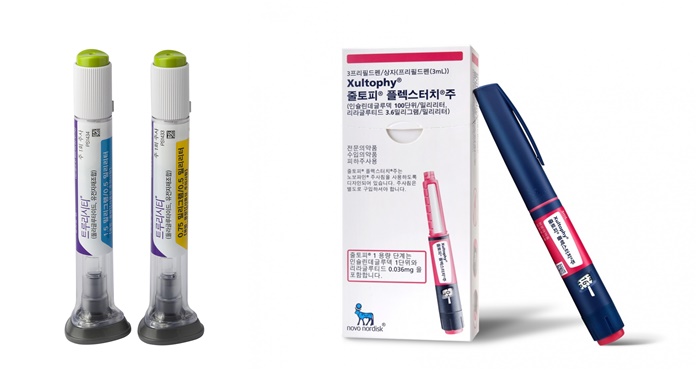
- As the news of GLP-1 (Glucagon-like peptide-1)-type diabetes treatments being used in clinical settings is reported one after another, concerns about this are growing. According to the medical community on the 4th, Novo Nordisk Pharmaceutical Korea is currently informing the clinical site of the out-of-stock news of Xultophy, a GLP-1 series diabetes treatment. Xultophy is a drug that controls blood sugar in adult type 2 diabetic patients and is a fixed ratio combination (FRC) of our company's basal insulin degludec and the GLP-1 analog liraglutide. After approval by the Ministry of Food and Drug Safety in Korea in 2019, it was applied as a benefit in May 2021 and is being used in clinical settings. However, due to the imbalance between demand and supply around the world, the aftermath also affected domestic clinical sites, resulting in out-of-stock products. The problem is that Lilly Trulicity, which was widely used as a GLP-1 diabetes treatment in domestic clinical settings prior to Xultophy, is also out of stock. In the clinical field, in the case of Trulicity out of stock, it is evaluated as the effect of concentration of production of Mounjaro, which is expected as a new drug for diabetes and obesity. A professor of endocrinology at general hospital A, who requested anonymity, said, "I heard that Xultophy may be out of stock soon after Trulicity. We inform patients in advance during treatment." The professor explained, "While checking the inventory status of the drugstore, some patients who were prescribed Trulicity are replacing it with DPP-4 inhibitor drugs." As a result, Soliqua is the only GLP-1 diabetes treatment that can be used as reimbursement in clinical settings. In the case of Xultophy, it can be replaced with Soliqua, but in the case of Trulicity, it is not easy to replace it with the corresponding treatment, the clinical field explains. Another professor of endocrinology at a tertiary general hospital who is an executive officer of the Korean Diabetes Association said, “There is no GLP-1 treatment that can be replaced with reimbursement for Trulicity, so the burden of non-reimbursement drugs will increase for patients. "For patients who are prescribed both insulin and Trulicity, Soliqua or Xultophy can be substituted, but there is no direct substitute for Trulicity," he pointed out. He said, “In this situation, as even Xultophy is out of stock, it seems that only Soliqua will be able to prescribe normally for the time being.” It is expected that the prescription of type 1 diabetes drugs will be disrupted." Meanwhile, current domestic and international diabetes treatment guidelines recommend preferentially considering GLP-1 injections, which have proven cardiovascular benefits, with SGLT-2 inhibitors in patients with atherosclerosis. Due to the high weight loss effect of GLP-1 injection, it is considered first in obese patients. Thanks to the guidelines, the domestic GLP-1 injection market, which is being applied as a benefit, is growing day by day. According to UBIST, a drug research institute, Trulicity recorded 54.7 billion won in sales last year, expanding its influence in the domestic clinical field. It recorded sales of 27.9 billion won in the first half of this year, continuing the upward trend of the previous year. Similarly, Xultophy recorded sales of 7.9 billion won in the first half of this year following the prescription record of 11.1 billion won last year. Soliqua is also showing sales growth, recording 6.3 billion won last year and 3.4 billion won in the first half of this year.
