
- LOGIN
- MemberShip
- 2026-07-05 02:14:52

- Company
- It surpassed ₩1 trillion in monthly drug imports
- by Kim, Jin-Gu Sep 23, 2021 05:43am
- In August, pharmaceutical imports surpassed ₩1 trillion for the first time. This is due to the fact that imports of Pfizer, Moderna vaccines were reflected in statistics following July. Drug exports rose 10% year-on-year to ₩700 billion last month. However, as imports increased sharply around the COVID-19 vaccine, the deficit in the drug trade balance hit the highest level since December 2019. ◆In August, vaccine imports amounted to ₩340 billion, the highest ever According to the Korea Customs Service on the 15th, imports of domestic medicines in August were $870.81 million. This is the first time that monthly drug imports have surpassed 1 trillion won. Compared to $50.32 million in August last year, it jumped 64%. It renewed its highest import amount ever for two consecutive months following July. In July, drug imports amounted to $819.58 million. As imports of COVID-19 vaccines began in earnest, the total amount of medicines imported increased significantly. Domestic vaccine imports were only $34.45 million by February this year, but as COVID-19 vaccine imports began in earnest, they surged to $49.82 million in March, $54.91 million in April, $58.88 million in May, $15.51 million in June, and $211.62 million in July. It recorded $291.53 million in August, once again breaking the record for the highest amount set in July. Considering that the domestic supply of Moderna vaccine has been disrupted in July and August, it is predicted that vaccine imports may increase further after September. Excluding vaccine imports, monthly drug imports remain around $600 million, similar to last year. ◆Pharmaceutical exports amounted to ₩690 billion, the largest trade deficit in 20 months Exports of medicines in August amounted up to 10% from$50.303 million a year earlier. As imports increased significantly compared to pharmaceutical exports, the domestic pharmaceutical trade deficit increased significantly. The drug trade balance recorded a deficit of $277.78 million in August. The deficit is the largest in 20 months after recording $317.24 million in December 2019. The domestic drug trade balance has steadily recorded a surplus from August last year to March this year, except for October last year, due to increased biosimilar exports. However, since the import of COVID-19 vaccines began in earnest, the deficit has gradually increased.

- Policy
- Price for Kymriah needs a new management method
- by Lee, Hye-Kyung Sep 23, 2021 05:43am
- The NHIS continues to discuss finding a new drug price management method for the rapid registration of ultra-high-priced "one-shot treatments." However, he said he would consider the introduction of "post-registration evaluation" required by patient organizations as one of several alternatives, not the correct answer. The Guidelines for Calculating Estimated Claims, which have been prepared since the beginning of this year, will be released around October, and negotiations will finally be concluded today (15th) for Choline alfoscerate. Lee Sangil, the senior director of the NHIS, held a briefing with the Korea Special Press Association on the 14th and announced issues in the second half of the year on overall issues related to benefit guarantees, projects, and drug prices. ▶It is argued that a one-shot treatment that is directly related to the life of ▶ patients should be registered first and evaluated afterwards, and what is the director's personal opinion about rapid registration? "Unlike in the past, Breakthrough Therapy such as Kymriah and Zolgensma, which patients can only administer once in their lifetime, has been released. Instead, costs range from hundreds of millions to billions of won. Accessibility should be guaranteed because the drug itself is essential to patients. However, I think a new approach is necessary because it is difficult to guarantee accessibility for patients with existing drug price management. The NHIS is discussing with the pharmaceutical companies on what method would be appropriate. Since this drug has already been registered in other countries, we will review foreign cases and find appropriate measures for Korea. I think the evaluation plan after the first registration is one of several alternatives. The introduction of this plan cannot be immediately answered." ▶ It was said that it would disclose the guidelines for calculating the estimated claim amount Since April, a consultative body has been formed with KPBMA, KRPIA, and KoBIA to prepare guidelines for calculating the expected amount of claims. Currently, The NHIS and associations are in the process of collecting opinions on guidelines created through consultative bodies. The guidelines will be completed by October." ▶Is there any countermeasure to prevent litigation similar to Choline alfoscerate? All applications for suspension of execution by pharmaceutical companies related to the Choline alfoscerate lawsuit have been dismissed, and the main lawsuit remains. We cannot guarantee the possibility of similar lawsuits, but we plan to come up with countermeasures through consultations with related agencies such as the MOHW and the HIRA in the future." ▶ What projects will you focus on as a policy task in the second half of the year? In order to improve the effectiveness of the conversion index calculation model raised in annual fee negotiations, we intend to promote system improvement centering on the institutional development council formed for communication between stakeholders. In addition, the government will continue to strengthen the medical safety net for the vulnerable by improving the disaster medical expenses support system on November 1, implementing pregnancy maternity medical expenses in January next year, and a three-stage pilot project for disabled people. In addition, we plan to come up with a reasonable payment plan for expensive drugs that take into account patients' access to treatment so that they can be introduced stably."
- Company
- The once-daily Xeljanz XR lands in general hospitals
- by Eo, Yun-Ho Sep 17, 2021 05:56am
- The new extended-release formulation of Xeljanz, Xeljanz XR, has started its landing process in general hospitals. According to industry sources, Pfizer Korea’s rheumatoid arthritis treatment ‘Xeljanz XR 11mg’ passed the Drug Committees (DCs) of the Big-5s general hospitals in Korea - Seoul National University Hospital (SNUH), Asan Medical Center (AMC), Seoul St. Mary’s Hospital, Samsung Medical Center (SMC), and Severance Hospital – as well as other major medical institutions in the nation. Xeljanz XR, which was listed for insurance benefit since April last year, can be used in adult rheumatoid arthritis patients that meet the ACR/EULAR criteria whose: ▲DAS28 is more than 5.1, or ▲DAS28 is between 3.2 to 5.1 with radiographic damage progression in the joints, that have been treated with over 2 types of DMARDS (including MTX) for 6 months (3months each) but had inadequate treatment effect or discontinued treatment due to side effects of the drugs. However, Xeljanz XR was approved only for the rheumatoid arthritis indication and was unable to add indications for psoriatic arthritis or ulcerative colitis. The new approval hold significance as the Xeljanz 5mg that was previously approved for the treatment of rheumatoid arthritis in Korea was administered twice daily, but the new 11mg dose that was approved allows for once-daily dosing. Meanwhile, Xeljanz XR 11mg demonstrated non-inferiority with Xeljanz+methotrexate (MTX) in the ORAL SHIFT study. The study was conducted on 533 patients with rheumatoid arthritis who achieved low disease activity (LDA) with a Clinical Disease Activity Index (CDAI) of 10 or less after 24 weeks of treatment with Xeljanz+MTX combination to assess the non-inferiority of Xeljanz monotherapy (11mg, once-daily) in comparison to Xeljanz+MTX. The primary endpoint of the study was least squares (LS) mean changes in DAS-28-4(ESR) from weeks 24 to 48, which was deemed non-inferior if the difference between the two arms was less than 0.6. Results showed that the mean change in DAS-28-ESR from weeks 24 to 48 was 0.33 for the Xeljanz monotherapy group and 0.03 in the Xeljanz+MTX groups, demonstrating Xeljanz XR’s non-inferiority with an LS mean difference of 0.30 (95% CI; 0.12~0.48).
- Policy
- Azelnidipine was approved in Korea
- by Lee, Tak-Sun Sep 17, 2021 05:56am
- Azelnidipine, which was approved in 2003 in Japan as a calcium channel blocker (CCB), was also approved in Korea. There was no previously approved finished product. The MFDS approved Azelnidipine 8mg of Introbiopharma on the 14th. Azelnidipine is a treatment for hypertension, a drug administered oral after breakfast once a day. Previously, Dongbang FTL's and Jeil's drug substances were approved for export, but there were no domestic drug products. Azelnidipine has been used for a long time, but it has not been introduced because other CCB such as Amlodipine are widely used in Korea. The original is Calblock of Daiichi Sankyo Korea. It was approved for Japan's Ministry of Health, Labor and Wellness in 2003. It has already been approved for 18 years. As such, it is an item that has been proven to be safe and effective overseas, and the MFDS approved Introbiopharma's product in accordance with laws and regulations. Daiichi Sankyo is a family of ARB in Korea. It is focusing on supplying Olmesartan. The approval of Introbiopharma's Azelnidipine is not expected to change the market much. This is because existing CCB-based hypertension treatments have steady sales in the domestic market. However, other domestic pharmaceutical companies are expected to show interest because new options have been released for product development.

- InterView
- "A tenure professor’s calling is in developing a new drug"
- by Sep 17, 2021 05:56am
- On August 24th, the Hemato-Oncology Department of the Eijeongbu Eulji Medical Center was busy preparing for its new occupant. Professor Dongwook Kim (60), who looked new to his office, was busy discussing matters with various visitors including the hospital employees. Although the center had opened less than 6 months ago, its Hematol-Oncology Department looked more vibrant than ever. Professor Dongwook Kim, one of the leading authorities in the field of Chronic Myelogenous Leukemia (CML), had joined Eijeongbu Eulji Medical Center of the Eulji University after serving 30 years at the Seoul St.Mary’s Hospital. During his term at Seoul St.Mary’s Hospital, Professor Kim had made many first-ever achievements. At St.Mary's Kim had led the research of the first targeted therapy, ‘Gleevec,’ and many other next-generation drugs, and had also led the study on ‘Supect,’ the only locally developed targeted therapy for CML. His focus on gene analysis, to identify the causes why patients show different treatment effects, had laid the grounds for Korea's treatment environment to advance into precision medicine. Kim's efforts paid off, and the Seoul St.Mary’s Hospital became the first hospital to establish a center specializing in blood disorders - the Catholic Hematology Hospital - at which Kim served as the founding director. Professor Dongwook Kim When asked about why he joined Eijeongbu Eulji Medical Center after achieving so much, Kim's answer was “to conduct more research for a longer period of time.” Kim talked about a professor he met at the International Society of Hematology conference. The professor, who was over 90, came to chair one of the discussion sessions with a cane in one hand. This had left a deep impression in Kim’s mind. Also, he said that there are professors over the age of 80 in the Leukemia Network, for which 35 experts around the globe meet every 5 years to establish the standard of care for CML. Unfortunately, the circumstances at St.Mary’s Hospital were unfit for a professor to continue researching for the rest of his life. In medical schools in Korea, professors generally retire from his/her university at age 65, and stays as a professor emeritus, then continues work at a different hospital for 5 years before retiring. “As a director, I’ve watched many of my seniors retire. These able professors perform surgeries until the last day of their retirement. After 55 years of age, most professors experience reduced consultation hours and a lack of research labs. I also experienced this. My lab also saw a decline in funding and was on the verge of reducing our staff. In Korea, the government does not give government projects to professors over the age of 60. On the contrary, many senior professors over the age of 80 and even 90 take on research projects in Europe and the U.S. It is that different." With only 5 years left to retirement, Kim was also concerned about his patients, as they require lifelong treatment. Many patients asked professor Kim about his retirement plans. Those that were recently diagnosed showed the most concern. That was why Professor Kim started to consider seeking an environment where he can continue on his research without worries about retirement or lab reductions. And Eijeongbu Eulji Medical Center was the perfect place for Kim. “The Eijeongbu Eulji Medical Center promised full support and a stable environment where I could conduct research with my researchers for a long period of time. Thanks to such support, we are currently setting our new lab in the new building behind. We plan to sign MOUs with KAIST, UNIST, and Kwangwoon University and conduct joint research after my lab officially opens.” Professor Kim said, “We have already been planning various research projects. One is ‘Investigation on the single-cell dynamics related to the occurrence/recurrence of CML,’ which was selected as a research project by the government last year. The project aims to investigate the cause of CML and why the treatment effect differs in each patient." In other words, Kim and his team will attempt to find the cause of different treatment effects by analyzing the patient’s genes and the tens of thousands of cells in their blood. If the team discovers a gene related to leukemia, this may enable personalized treatment for each patient. This is what Professor Kim is investing most efforts in. Also, Kim is actively participating in the development of new drugs like ‘Supect’ in collaboration with bio ventures. Also, he had joined in the development of AI that can recommend appropriate treatment for each patient since 2 years ago. Kim plans to complete the government project within 5 years. Kim believes that the research will enable HCPs to discern which treatment is required for each patient according to their genes. Two new candidates were already discovered for new drug development. Also, the AI that Kim had started developing 2 years ago is now being tested in practice. After inserting all the characteristics of a patient from his/her age, gender, favorite food to genetic disorders, the program selects the most appropriate treatment among the 5 targeted therapies for CML, then recommends further measures according to each patient’s treatment response and side effects such as dose adjustments or discontinuation and switching. The goal is to be able to completely replace experts in the field. One of the questions I encounter most often during lectures is on ‘What drug to select.’ We aim to build an AI that can provide a perfect answer to that question. We are formulating the increase in speed, degree, grade of cancer cells to predict which patients will experience recurrence and how fast. This will allow us to predict how likely a patient may discontinue treatment within 5 years.“
- Policy
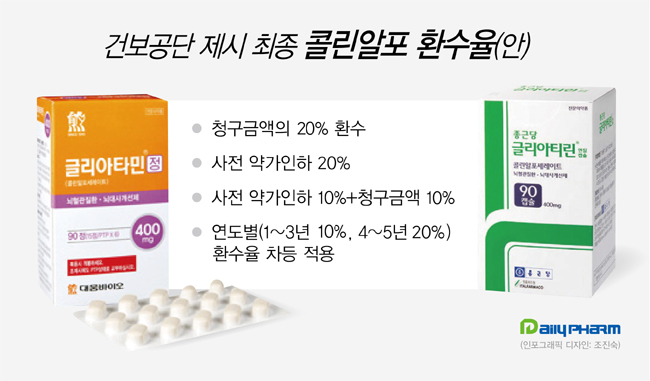
- 58 companies agree on the redemption of α- GPC benefits
- by Lee, Hye-Kyung Sep 17, 2021 05:56am
- Negotiations on the conditional return of benefits for clinical reevaluation of "Choline alfoscerate," a brain function improving agent that has been going on for about nine months, will end today (15th). The final result is that all 58 pharmaceutical companies with 123 Choline alfoscerate agreed to "return 20% of their health insurance claims from the date the MFDS approves the clinical trial to the NHIS if the clinical trial fails." The details of the agreement apply slightly differently to each pharmaceutical company. The method of redemption, such as a pre-drug price reduction or differential application of the redemption rate by year, will follow the plan chosen by each company. It is not known in detail how far it will be applied to the temporary payment or installment payment plan of the amount of redemption that has been coordinated until the end. Lee Yong-gu, head of the drug price management office at the NHIS, said at a briefing of the Professional Journalists' Council held on the 14th, "The redemption period was contracted in a lump sum five years (after clinical re-evaluation)."He said, "Some pharmaceutical companies complained of difficulties. "We are reviewing it as the clinical period is long and the cumulative amount depends on the results." There is a possibility that the contract may be changed in the final negotiations that run until today (15th). "There are several more clinical re-evaluation drugs other than Choline alfoscerate," he said, "We will discuss and decide when Choline alfoscerate negotiations are completed, but since this negotiation is completed, it is reasonable to negotiate the return of other clinical re-evaluation items."
- Company
- Blockbuster anticancer drug series 4 - Avastin
- by Sep 17, 2021 05:55am
- "By blocking blood vessels generated to proliferate cancer, cancer is starved to death.There is a drug that realizes the theory of a professor at Harvard University in the U.S., who caused a "sensation" in the 1970s. Avastin, a Vascal Endothermic Growth Factor (VEGF) inhibitor, which is also considered a good partner for immuno-cancer drugs. It's the first anti-VEGF event to surpass 100 billion won. Avastin was launched when Genentech in the United States was interested in angiogenesis research and discovered VEGF and genes. Avastin has greatly succeeded along with new antibody drugs such as Rituxan and Herceptin. After Avastin's approval, Roche completely acquired Genentec. Avastin received a lot of expectations and concerns at once. Avastin, which started as a treatment for colorectal cancer, had indications for various carcinomas such as breast cancer, lung cancer, and kidney cancer. In particular, Avastin significantly increased the treatment effect in carcinoma. However, side effects such as high blood pressure, blood clots, and heart failure caused by excessive inhibition of angiogenesis have become controversial. Indications for breast cancer have been withdrawn in the United States due to ambiguous effects against toxicity. Controversy also arose in unauthorized indications. Wet macular degeneration, which causes blindness, is also caused by excessive proliferation of new blood vessels under the retina. Avastin preference was much higher because of the low cost. Avastin was widely used in the treatment of macular degeneration. In Korea, Avastin has expanded its indications relatively smoothly to breast cancer, non-small cell lung cancer, kidney cancer, glioblastoma, ovarian cancer, and cervical cancer since it was approved as a treatment for colorectal cancer in 2005. It was used as a primary treatment in all indications other than glioblastoma and became essential for chemotherapy. With the first registration in 2014, Avastin surpassed 100 billion won in sales for the first time in 2018, 13 years after approval based on IQVIA. Last year, it posted 118 billion won in sales. This is the third-highest selling figure in the entire drug market in Korea. Will Avastin find a new opportunity? Avastin is a good drug to use with other anticancer drugs due to its mechanical nature. It is used with conventional chemotherapy in all indications other than glioblastoma. Targeted anticancer drugs have obtained primary treatment indications for EGFR-positive non-small cell lung cancer with good effects with Tarceva, an EGFR target treatment. It is also used in primary maintenance therapy for ovarian cancer in combination with the PARP inhibitor Lynparza. Roche received primary treatment indications for liver cancer and non-small cell lung cancer through combination therapy with its anti-PD-L1 immuno-cancer drug Tecentriq and Avastin. Keytruda and Opdivo are also exploring the possibility of being used in combination with Avastin in various carcinomas. It is expected that anti-VEGF drugs will compensate for the limitations of cancer immunotherapy alone. Some clinical trials have failed, but combination of cancer immunotherapy and Avastin is still a good strategy. Avastin is widely used. Big Pharma such as Amgen, Pfizer, and Beringer Ingelheim are participating overseas, and two biosimilars have been released in Korea this year. They are Onbevzi of Samsung Bioepis and Zirabev of Pfizer. Onbevzi, the first simulator sold by Boryeong Pharmaceutical, has been paid since this month, and is in the midst of preparing for prescriptions at general hospitals. However, Zirabev is more advantageous in indications. Onbevzi, did not receive some indications for ovarian cancer related to the patent for use. Celltrion and Prestige Biopharma are also developing biosimilar products, so competitive drugs are expected to increase further. When competition begins in earnest, Avastin sales, which amount to 120 billion won, are expected to be inevitable. Avastin sales have already declined as biosimilars have already entered the largest European and U.S. markets. Global sales fell 25% year-on-year last year. In the case of Korea, drug prices have been continuously lowered since Avastin was registered, and the actual difference between the original and biosimilars is expected to be insignificant as only 5% of the patient's burden is applied. The results may vary depending on the non-reimbursed item. In particular, there are biosimilars that are cheaper than Avastin in off-label diseases such as macular degeneration. Sales of expired patents are usually falling, but Avastin has new opportunities. It is an expansion of benefits in combination with Tecentriq. In the primary treatment of liver cancer, combined therapy passed the HIRA's Cancer Drugs Benefit Application Committee in February. In particular, it is more difficult to replace biosimilars with combination therapy with immuno-cancer drugs. The primary benefit for liver cancer is currently in the presumption stage for more than six months. The key is how quickly Roche Korea and the government will be able to reach an agreement over Avastin drug prices, which are burdensome at high prices.

- Company
- JAK inhibitors may fall to 2nd-line due to safety concerns
- by Nho, Byung Chul Sep 16, 2021 05:59am
- With the health authorities seriously considering changing the reimbursement standards for Janus kinases (JAK) inhibitors which have recently been caught up in controversy over its safety issues, what the results will be is gaining industry-wide attention. According to industry sources, the Ministry of Health and Welfare (MOHW) and the Health Insurance Review and Assessment Service (HIRA) have been collecting opinions from relevant academic societies on the clinical efficacy and sequential therapy (first-line·second-line treatment) of JAK inhibitors for consideration. Although there had been cases where the authorities had removed drugs from the insurance benefit list according to the revocation of licenses, the authorities’ preemptive and voluntary action to change and amend the prescription guidelines is very rare, to the extent that actual cases of such examples are difficult to find. This is interpreted as the health authorities’ determination to take a step closer to advancing regulatory science for public health and prioritizing the patient’s safety in drug intake in line with the vision set by the FDA, the authority that is considered the international standard for drug approval and regulations. Recently, the MFDS had issued a Dear Healthcare Professional Letter regarding the safety of JAK inhibitors such as Pfizer’s ‘Xeljanz (tofacitinib),’ Lilly's ‘Olumiant (baricitinib),’ ‘Abbvie’s ‘Rinvoq PR Tab (Upadacitinib),’ etc. The MFDS’ measure was made after reviewing the results of the FDA’s randomized, large-scale clinical trial on the safety of ‘tofacitinib’ that was released on the 1st. The FDA had announced that tofacitinib increased the risk of serious heart-related events such as heart attack, stroke, cancer, blood clots, and death. The drug that is receiving particular interest among the JAK inhibitors is Pfizer’s Xeljanz, which had already had a safety issue in 2019 in addition to the heart attack risk that was discussed this time. Xeljanz is an oral JAK inhibitor indicated for rheumatoid arthritis and ulcerative colitis. After discussions with Pfizer, the FDA had ▲changed the ulcerative colitis indication from first-line to second-line and ▲added warnings to refrain from prescribing the drug to patients at risk of embolisms, at the time of issue development. On why the health authorities have made such prompt measures to address the issue of JAK inhibitors is considered to be because this is the second time the safety issue of the JAK inhibitor Xeljanz rose in 3 years with concerns for two side effects - increased risk of heart attacks and the 'risk of embolism.'. The prospect is that the academic society will show neutral or tacit consent to the authorities' move to amend the other reimbursement standards after changing the scope of approval. As in the FDA’s case of restricting Xeljanz's indication from first-line to second-line, where academic societies abroad made changes to the prescription guidelines after taking a neutral stance in respect to the opinions set by the regulatory authorities, rather than showing strong consent. If the Korean health authorities and academia reach a consensus on changing the indication for JAK inhibitors from 1st line to 2nd line treatment, the market for injectable traditional biopharmaceuticals is highly likely to expand. The current market established for JAK inhibitors is around ₩30 billion, and the prescription market for biologics such as Humira, Remicade, Simponi, Mabthera, Actemra, Cosentyx, Kynteles, and Stelara is around ₩350 billion annually.
- Company
- Nocdurna can be prescribed at general hospitals
- by Eo, Yun-Ho Sep 16, 2021 05:59am
- #iNight urination treatment "Nocdurna" has been settled on the prescription ticket of a general hospital. According to related industries, Nocdurna (Desmopressin), co-sold by Ferring and Chong Kun Dang, passed DC, drug committee of Big 5 General Hospital such as SNUH, SMC, Seoul St. Mary's Hospital, and except for Sinchon Severance Hospital. In addition, Korea University Anam Hospital, NMC, Inje university Busan Paik hospital, Inje university Ilsan Paik hospital, Ewha Womans University Medical Center, Pusan National University Hospital, Haeundae Paik Hospital, Ajou University Hospital, Chonnam National University Hospital, and Chungnam National University Hospital also completed the process Ferring and Chong Kun Dang have been jointly selling "Minirin," a treatment for night urination, since 2019. Nocdurna, which signed an additional contract, is said to have reduced the burden of hyponatremia, which was feared in elderly patients, with Minirin's low-dose product. Nocdurna improves night urination symptoms caused by night urination, which overproduces urine at night, accounting for up to 88% of the causes of night urination. As a new treatment that can reduce the number of night urination in adults and improve the quality of sleep, Nocdurna 50 μg is administered once a day for men and Nocdurna 25 μg is administered once a day for women. As a result of the phase 3 study, Nocdurna 25μg and Nocdurna 50μg were found to be effective in controlling night urine-related symptoms in women and men, respectively. Nocdurna reduced the average number of night urination compared to placebo, and extended the initial sleep period due to increased time until the first night urination. Compared to placebo, the quality of life and sleep related to night urine have increased significantly. Meanwhile, Nocdurna, like the existing anti-diuretic hormone drug (Desmopressin), is covered by insurance benefits to treat night urination symptoms caused by nighttime urination.
- Policy
- Will Jeil Pharm gain a hold over the varenicline market?
- by Lee, Tak-Sun Sep 16, 2021 05:59am
- Following the government’s measures to reduce impurities in smoking cessation drugs that contain varenicline, Jeil Pharamceutcial’s products, which satisfy the set standards, is expected to gain a hold over the smoking cessation treatment market for the time being. The Ministry of Food and Drug Safety has allowed the lot release of varenicline products that only contain less than 185ng/day of N-nitroso-varenicline (NNV). On the 7th, the MFDS announced the NNV test results and that the ministry will temporarily allow varenicline products that contain less than 185ng/day of NNV. Also, drugs that exceed the 733 ng/day NNV limit were voluntarily recalled by the manufacturers. Accordingly, CTC Bio has been recalling 19 lots of 3 products (including 2 CMO products). Three companies have been distributing manufactured or imported varenicline products in the domestic market. Among the three, Jeil Pharmaceutical and CTC Bio manufacture varenicline products domestically on consignment for 24 and 7 companies, respectively. Pfizer Korea, which supplies the original Champix, is the only company that imports its products for distribution. Results of the self-inspections showed that the level of NNV was 16.70~43.28ng/day for Jeil Pharmaceuticals, 151~632ng/day for Pfizer Korea, and 812~1849ng/day for CTC Bio. Accordingly, items that were produced by CTC Bio exceeded the accepted level for lot release as well as the recall standards. On the other hand, Pfizer’s products managed to barely avoid recalls, but not all the items met the acceptable level of NNVs for lot release. Jeil Pharmaceutical's items were the only items to meet the NNV level allowed for lot release. Due to this, concerns on whether Jeil Pharamcetucial alone can meet the demand for varenicline products were raised at the Central Pharmaceutical Affairs Council on the 30th, prior to the MFDS’s announcement. Regarding the concern, the MFDS had explained that “The 0.5mg and 1.0mg dose varenicline products produced by company C (presumed to be Jeil Pharmaceutical) account for 10% and 5% of the domestic supply. Upon inquiry, the company had replied that it can produce the amount sold by Company A (presumed to be Pfizer) and Company B (presumed to be CTC Bio) by focusing on producing varenicline products, if necessary.” The minutes of the meeting also presented the case for Champix, which currently holds the dominant share of the market. The MFDS said, “Varenicline products in the US exceed the NNV level of 733 ng/day, and were unfit under the distribution standards. Therefore, the products that are imported to Korea are Apo-Varenicline distributed in Canada, and the NNV detected in the said drug exceeds 37ng/day, but is less than 185ng/day. The ministry stressed that it will take some time for companies other than Jeil Pharmaceutical to satisfy the 185ng/day or less level set for the lot release. For example, Champix, whose supply was discontinued since June, had been able to avoid recalls but is still unable to resume its supply in Korea. Therefore, according to the NNV reduction measures, the dominant opinion is that products produced by Jeil Pharmaceutical will increase its hold over the market. On how this change will affect the market structure remains to be seen.
