
- LOGIN
- MemberShip
- 2026-06-23 12:58:09
- Company
- Nabota records KRW 92B in North American sales in Q2
- by Son, Hyung-Min Aug 05, 2024 07:51am
- Evolus has posted record quarterly sales thanks to a surge in sales of its botulinum toxin Nabota. The company generated USD 126 million in sales in the first half of the year, lighting a green light to achieving its performance target for the year. Evolus plans to continue to grow sales by expanding Nabota's international approvals and launching new filler products to market. According to industry sources on the 2nd, Evolus' revenue in Q2 this year was USD 66.9 million (KRW 92 billion), up 35.6% from the USD 49.35 million it had made in the same period a year ago. Evolus Most of Evolus' revenue came from sales of Nabota (U.S. brand name: Jeuveau). Daewoong Pharmaceutical signed a supply agreement with Evolus in 2013 worth USD 296.8 million (approximately KRW 375 billion). Evolus then introduced Nabota to the North American market in 2020. Nabota was first approved in the North American market. Nabota was initially approved in Canada in 2018, then in the U.S. in February 2019. Since then, Nabota has been further approved in Europe, Australia, Russia, South Africa, and Japan. Evolus' revenue has been increasing steadily since Nabota’s launch in North America in 2020. In Q1 2021, when Nabota was launched, Evolus posted revenue of USD 13.5 million, but the amount increased 151.9% to KRW 34 million in Q1 2022. Evolus surpassed USD 50 million in quarterly revenue for the first time in Q3 last year. Evolus' revenue continued to grow this year as well. In Q1 of this year, the company generated USD59.3 million in revenue, and Q2 revenue was KRW 66.9 million, breaking its record every quarter. Evolus is also looking to expand into the European market upon the official launch of Nabota in Spain in June. In Europe, Nabota is currently available under the brand name Nuceiva in Spain, the United Kingdom, Germany, Austria, and Italy. Botulinum toxin Nabota(U.S. brand name:Jeuveau)Evolus added 770 new Nabota accounts in Q2. The company has increased the number of customers who have purchased Nabota since its launch to 14,000. The reorder rate of Nabota users is 70%. The growth of Nabota puts Evolus on track to meet the revenue goals it set last year. Evolus had set a revenue target of USD 265 million (KRW 350 billion) this year. In the first half of the year alone, the company achieved about half of its annual target, generating USD 126 million. In addition to Nabota, Evolus is looking to expand sales through new filler products. In May last year, the company secured exclusive U.S. sales and distribution rights to a filler developed by France's Symatese. Evolus recently submitted a premarket approval application (PMA) to the U.S. Food and Drug Administration (FDA) for 2 filler products, Evolysse and Evolysse Lift. The company expects the two to be approved in Q2 next year
- Company
- Pemazyre may be prescribed at general hospitals in Korea
- by Eo, Yun-Ho Aug 05, 2024 07:51am
- Pemazyre, a treatment for intrahepatic bile duct cancer(cholangiocarcinoma) can now be prescribed at general hospitals in Korea. According to industry sources, Handok's Pemazyre (pemigatinib) has passed the drug committee (DC) of top general hospitals in Korea including Samsung Medical Center, Seoul National University Hospital, and Asan Medical Center. The drug is indicated for the treatment of adults with previously treated, unresectable locally advanced, or metastatic cholangiocarcinoma with a fibroblast growth factor receptor 2 (FGFR2) fusion or other rearrangement. Pemazyre is the first drug in Korea to be approved for this patient population. In March 2022, Handok signed an agreement with the global biopharmaceutical company Incyte Corp for the registration and supply of Pemazyre in Korea. Pemazyre was designated as an orphan drug by the Ministry of Food and Drug Safety in November 2021. A dire need existed in the field of cholangiocarcinoma due to the lack of a standardized second-line therapy for patients who fail first-line therapy. Surgery is the best treatment for bile duct cancer, but typically only 20-30% of patients are eligible for surgery at the time of diagnosis. Even after surgery, bile duct cancer has a high recurrence rate of 60-70% and a reported 5-year survival rate of less than 20%. Specifically, fusions or other rearrangements of the FGFR2 gene, for which Pemazyre is indicated, occur in approximately 10-16% of patients with intrahepatic cholangiocarcinoma. The approval of Pemazyre is based on the Phase II FIGHT-202 study. The open-label, single-arm Phase II FIGHT-202 study enrolled 107 adult patients (mean age 56 years) who had received at least one prior therapy for locally advanced or metastatic cholangiocarcinoma with a fusion or rearrangement of the FGFR2 gene. The results showed that the primary efficacy endpoint, objective response rate (ORR), was 35.5% and the secondary endpoint, median duration of response (DOR), was 7.5 months in the Pemazyre arm. In addition, the reported median progression-free survival (PFS) was 6.9 months, and the median overall survival (OS) was 21.1 months. The most commonly reported treatment-related adverse event was hyperphosphatemia, which was mostly low in severity (Grade 1 or 2) and manageable.

- Company
- Obesity drugs, 'Wegovy vs Mounjaro' after expanded approval
- by Hwang, Byung-woo Aug 05, 2024 07:51am
- Wegovy and Mounjaro, regarded as next-generation treatments for obesity, have expanded indications. As a result, intense competition in the market is expected. (From the left) Product photos of Mounjaro and Wegovy. On July 1st, Eli Lily's Mounjaro (ingredient: tirzepatide) received approval as an adjunct for chronic weight management, a year after it received approval as a type 2 diabetes treatment in June last year. The expansion of Mounjaro's indication suggests that it will likely shift the market for obesity drugs in South Korea. Novo Nordisk's Wegovy (ingredient: semaglutide) and Mounjaro (U.S. product name: Zepbound) are currently dominating the global market. Wegovy generated global sales of US$4.5 billion (about KRW 6 trillion) last year, and Zepbound, launched in Q4 of last year, generated sales of US$176 million (KRW 240 billion). Before Mounjaro, Wegovy had already won domestic approval. In April, Wegovy received approval as an adjunct for chronic weight management. Two drugs have already accumulated the basis of prescription data, expanding their presence in the market. In the STEP study, used for the basis for Wegovy's domestic approval, patients treated with Wegovy (1306 patients) had a 14.9% weight loss on average compared to the baseline over 68 weeks, showing a significant difference of 2.4% compared to the placebo group (655 patients). Mounjaro's SURMOUNT-1 and SURMOUNT-2 studies showed statistically significant weight loss effects compared to the placebo in all doses. The percentage of patients losing weight over 5% in Mounjaro-treated patients was higher than in the placebo group. As Wegovy and Mounjaro, already competing in the global market, are set to launch in South Korea, they will likely cause a shift in the domestic market. Based on real-world prescription data, the recent real-world data (RWD) study showed that the latecomer Mounjaro had more significant weight loss effect than Wegovy. However, it may be too early to predict the market competition when considering the long-term effects and weight gain after discontinuing treatment. Furthermore, there is another factor to consider related to market competition. Wegovy recently received approval as a treatment for reducing the risk of major cardiovascular events in patients with obesity. It has been indicated for 'reducing the risk of major cardiovascular events (cardiovascular death, heart attack, or non-fatal stroke) in patients with established cardiovascular disease (CVD) and either overweight or obesity who have an early body mass index (BMI) of 27kg/㎡.' In August last year, Novo Nordisk confirmed Wegovy's potential as the standard therapy to prevent major adverse cardiovascular events (MACE) in the SELECT cardiovascular outcomes trial. The clinical study showed that semaglutide 2.4 mg statistically significantly reduced the risk of MACE by 20% compared to placebo, achieving the primary endpoint. When these two drugs launch, they will likely target the market with different indications in addition to those related to obesity treatments: Wegovy's 'obesity and cardiovascular disease' and Mounjaro's 'type 2 diabetes and obesity.' "The competition between Wegovy and Mounjaro is expected to focus on treating obesity," pharmaceutical industry personnel said. He added, "However, as each drug is additionally indicated for either type 2 diabetes or cardiovascular disease, their impact will vary depending on patient conditions."

- Company
- Pulmican·Pulmicort prescriptions surge in asthma Tx mkt
- by Chon, Seung-Hyun Aug 05, 2024 07:50am
- The prescription market for 'budesonide' asthma drugs has expanded significantly. The drug price hike at the end of last year led to increased production and an expansion of the prescription market. The prescription market has also shown growth due to the resolution of the supply and demand imbalance made for drugs with supply and demand imbalance. According to the market research institution UBIST, outpatient prescriptions for budesonide single-agent asthma drugs totaled at KRW 6.8 billion in the first half of last year, up 23.0% year-on-year. Prescriptions for budesonide single-agent drugs totaled at KRW 3.1 billion in Q1 this year, up 19.5% YoY, and then at KRW 3.7 billion in Q2, up 26.2% Yoy. Quarterly outpatient prescriptions of budesonide asthma drugs (Unit: KRW 1 million, Source: Financial Supervisory Service) Budesonide is a medication used to treat bronchial asthma and acute laryngotracheobronchitis in infants and children. Two budesonide products - AstraZeneca's Pulmicort and Kuhnil Pharmaceutical's Pulmican - are currently available in Korea. The market for budesonide asthma medicines has faced supply shortages due to a surge in demand last year. Since the shift to the COVID-19 endemic, the demand for asthma medicines has increased due to the increase in the number of cold and flu patients, leading to a supply-demand imbalance where the supply could not keep up with the demand. The prescription market for budesonide asthma drugs was worth KRW 2.8 billion in Q2 last year but fell by half to KRW 1.6 billion in Q3 as the supply shortage spread. The government’s decision to raise the price of budesonide to increase production is analyzed to have expanded the prescription market. The Ministry of Health and Welfare raised the insurance ceiling price of Pulmican by 18.5% from KRW 946 to KRW 1,121 since December last year. Pulmicort’s price increased by 12.5% from KRW 1,000 to KRW 1,125. The price hike was decided upon after discussions between the health authorities and pharmaceutical companies to encourage expanded production to address the frequent supply and demand shortages that arose with the surge in demand. Sales of both Pulmicort and Pulmican increased. Pulmicort's prescriptions in the first half of the year totaled at KRW 3.6 billion, up 48.0% year-on-year. Pulmicort's prescriptions soared 62.3% year-on-year to KRW 1.6 billion in Q1 and then up 38.2% to KRW 1.4 billion in Q2. Pulmicangenerated KRW 2.9 billion in prescriptions in the first half of last year, up 10.6% to KRW 3.2 billion in a single year. Pulmian’s prescriptions grew 3.0% and 28.6% year-over-year in Q1 and Q2, respectively.
- Company
- Bosulif, 2nd-generation leukemia drug available in Big 5
- by Eo, Yun-Ho Aug 05, 2024 07:50am
- Product photos of Pfizer Korea The second-generation leukemia drug, 'Bosulif,' has landed in 'Big 5' general hospitals. According to industry sources, Pfizer Korea's chronic myelogenous leukemia (CML) drug, Bosulif, has passed the drug committees (DC) of tertiary general hospitals, including Samsung Medical Center, Seoul National University Hospital, Seoul St. Mary's Hospital, and Sinchon Severance Hospital. It is now available for prescription at 21 nationwide medical centers. After making the insurance reimbursement list in January, it has quickly become available for prescription. However, some patients are expressing disappointment regarding the reimbursement criteria. Bosulif's reimbursement criteria are set as 'the second-line treatment of patients over ages of 18 years old with chronic phase, accelerated phase, or blast phase Philadelphia chromosome-positive CML (Ph+ CML) who have previously demonstrated resistance or intolerance to neoadjuvant therapy, including Gleevec (imatinib).' However, since the indication for the basis of approval does not include age limits and the drug can be prescribed beginning from the first-line treatment, patients are pointing out the problem of the narrow reimbursement standard. Therefore, all eyes are on whether the issues related to the reimbursement criteria of the latecomer, new CML drug Bosulif will be solved. Bosulif is a second-generation, targeted anticancer drug alongside Novartis Korea's 'Tasigna (nilotinib),' BMS Korea's 'Sprycel (dasatinib),' and Il-Yang Pharmaceutical's 'Supect (radotinib).' The efficacy and safety of Bosulif have been confirmed in the Phase 3 NCT02130557 study, which enrolled newly diagnosed CML patients. The primary endpoint of Bosulif was a major molecular response (MMR) by 12 months. Patients treated with Bosulif had an MMR of 47%. Patients treated with the control drug, first-generation drug Gleevec (imatinib), had an MMR of 36%. MMR at month 60 was 74% for Bosulif versus 66% for Gleevec. After 60 months of follow-up, the median time to MMR in responders was 9.0 months for bosutinib and 11.9 months for Gleevec. Additionally, Bosulif has recently shown potential to treat Lou Gehrig's disease, also known as amyotrophic lateral sclerosis (ALS). In a Phase 2 study conducted by a research team including, the Center for iPS Cell Research and Application (CiRA) at Kyoto University, 26 ALS patients were treated with the CML drug Bosulif. Based on the result, Bosulif has been demonstrated to suppress the progression of motor dysfunction in almost half of the patients.
- Company
- Fresenius Kabi launches 2 Ntense amino acid solutions
- by Eo, Yun-Ho Aug 02, 2024 05:52am
- On the 1st, Fresenius Kabi Korea (CEO&President: Noah Park) announced the launch of its high-strength amino acid nutritional solutions ‘Ntense’ and ‘Ntense EF’ in Korea. Ntense, which stands for “Nitrogen Intensify,” is a three-chamber bag product that provides ▲nutritional treatment for critically ill patients with a high risk of muscle loss even with short-term hospitalization and ▲the 'protein: calorie ratio (1.5g:20kcal)' required by critically ill patients. The name comes from nitrogen, which is a component of amino acids. In addition, the Ntense EF version does not contain electrolytes and is the only 3-chamber bag product licensed in Korea that is approved for Intradialytic Parenteral Nutrition (IDPN) during hemodialysis. According to the international guidelines on nutritional support for severe patients, high protein and moderate energy are recommended for critically ill adult patients requiring nutritional therapy. The U.S. National Kidney Foundation’s Kidney Disease Outcome Quality Initiative International Guidelines (KDOQI) and European Society for Clinical Nutrition and Metabolism (ESPEN) guidelines recommend IDPN as a treatment option to maintain or improve the nutritional status of hemodialysis patients. "Ntense is an original nutritional fluid already being used globally since its initial launch in Europe, Ntense provides a high protein and adequate calorie option for critically ill patients,” said Noah Park, CEO & President of Fresenius Kabi Korea. “We believe Ntense EF will improve malnutrition in patients with electrolyte imbalance and hemodialysis patients.” Meanwhile, Ntense comes in 4 sizes - 506ml, 1012ml, 1518ml, and 2025ml. The Ntense EF version comes in 2 sizes - 506ml and 1012ml. The amount can be customized according to the patient's malnutrition status and calorie requirements. The insurance price of Ntense and Ntense EF 1012ml is KRW 40,197 each, while the 506ml and 1518ml sizes are KRW 26,798 and KRW 50,246, respectively, as announced on August 1.
- Company
- GC·Hanmi submit IND apl. for new 'Fabry disease' drug
- by Son, Hyung-Min Aug 02, 2024 05:52am
- GC Biopharma and Hanmi Pharmaceutical announced on July 1st that they have submitted Investigational New Drug (IND) application to the U.S. Food and Drug Administration (FDA) for Phase 1/2 clinical trials of ‘(LA-GLA),’ a treatment for Fabry disease that they are co-developing. LA-GLA is an innovative new drug to treat Fabry disease. GC Biopharma and Hanmi Pharmaceutical are co-developing it as the 'world's first once-monthly subcutaneous dosing.' Fabry disease is a rare disease inherited in an X-chromosome and is a type of lysosomal storage disease (LSD). It occurs when 'alpha-galactosidase A,' the enzyme needed to break down the glycolipid in the lysosome. It is a progressive, rare, incurable disease caused by unbroken glycolipid building up in the body, resulting in cell toxicity and inflammatory response. It can damage many organs, and severe complications lead to death. Currently, patients with Fabry disease are treated with enzyme replacement therapy (ERT), an intravenous infusion of enzymes created using recombinant DNA technology. This therapy requires receiving inconvenient and burdensome intravenous injection every two weeks at the hospital. There are limitations regarding the efficacy in suppressing the progressive kidney disease. LA-GLA is a 'next-generation long-acting ERT' with improvements to such limitations of existing treatments. During the non-clinical development phase, it received an Orphan Drug Designation (ODD) from the U.S. FDA in May based on superior efficacy in improving kidney function, vascular disease, and peripheral neuropathy compared to conventional therapies. GC Biopharma and Hanmi Pharmaceutical official said, "Commencing in the United States, we also plan to conduct Korean and global clinical trials." He added, "Based on our experiences, knowledge, and skills in developing lysosomal storage disease treatments, we will strive to develop new drugs and provide new treatment options to patients suffering from Fabry disease."
- Company
- Next Biomedical seeks IPO…knocks on global GI mkt
- by Hwang, Byung-woo Aug 02, 2024 05:52am
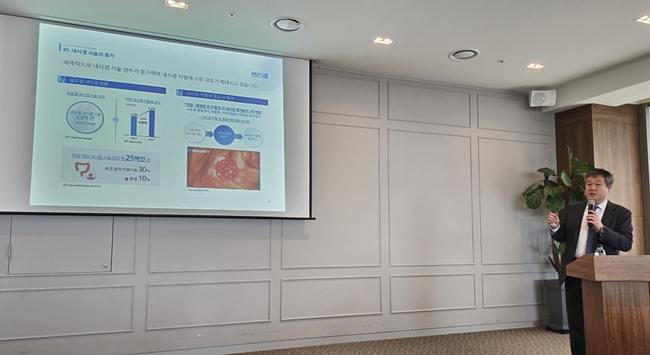
- Next Biomedical will seek KOSDAQ listing in August based on its achievements in the GI field. The company has been collaborating with the global company Medtronic to expand into the endoscopic hemostatic agent market with its flagship product. Based on the revenue growth, the company plans to establish the drug as a standard-of-care in the global market. Don-Haeng Lee, CEO of Next Biomedical, is making a presentation Established in 2014, Next Biomedical is an innovative bio-solution company that develops therapeutic materials based on its polymer and drug delivery system technologies. Its main products include an endoscopic hemostatic powder (Nexpowder), an endovascular embolization microsphere (Nexsphere), and an arthritis pain embolization treatment (Nexsphere-F). Of these, the product that generates significant sales is the endoscopic hemostatic powder Nexpowder, which is a powder-type hemostatic treatment that can be used through endoscopes to hemorrhage bleeding sites and prevent rebleeding in the event of gastrointestinal bleeding. In particular, Next Biomedical signed a global licensing agreement (excluding Korea, Japan, and Greater China) with Medtronic in 2020 to sell its products in 29 countries including the United States, Canada, and Europe. The company's prominence in the digestive field can be attributed to CEO Lee's background as a professor of gastroenterology at Inha University Hospital. Based on Lee’s clinical experience, the company was able to build a consortium of academic and university hospital collaborations and secure a network of key stakeholders in the GI field in Korea and abroad. "The rise in endoscopic procedures has also led to the rise in GI bleeding amongst patients, rendering hemostasis and rebleeding prevention an important task for all surgeons including gastroenterologists,” said Lee. "After feeling the need while performing endoscopic procedures in the field, we developed a product, which is being exported to the US and Europe." The company has succeeded in rapidly commercializing the finished product of the therapeutic material in Korea and abroad, which has shown results in terms of sales and exports. Excerpt from Next Biomedical Last year, Next Biomedical posted sales of KRW 4.8 billion, which was nearly double the KRW 2.7 billion it had posted in 2022. In Q1 this year, sales were KRW 2.3 billion and are expected to exceed KRW 10 billion. However, the company is still recording an operating loss due to an increase in SG&A expenses caused by the increase in R&D expenses. However, this is expected to turn into a profit after the IPO, supported by the growth in overseas sales in the U.S. and Europe, which accounted for 88% of sales last year. "We estimate sales of about KRW 12 billion this year and consider the operating profit break-even point to be KRW 15 billion,” said Lee. "We don't have much cost burden because Dong-A ST is in charge of sales and marketing in Korea and Medtronic is in charge overseas, so we think we will able to record a surplus next year." Will seek to enter the U.S. guidelines as a standard of care...is conducting post-marketing clinical trials In particular, the company is conducting post-marketing clinical trials to enter the endoscopic hemostasis guidelines as a standard of care with its Nexpowder. It plans to build clinical evidence with 278 patients in 10 hospitals in the U.S., Canada, and Europe. Don-Haeng Lee, CEO of Next Biomedical The trial is being led by Dr. Loren Laine, Past President of the American Gastroenterological Association (AGA) and Professor of Medicine at Yale University School of Medicine, and sponsored by Medtronic. The company believes the number of patients in the trial is sufficient to build evidence for its use as a hemostatic agent after endoscopic bleeding. "We aim to be listed as a standard of care by utilizing the clinical evidence obtained from the clinical trial,” said Lee. "If the guidelines include the use of Nexpowder as a first-line treatment, the demand for the product is expected to increase significantly due to its differentiated competitiveness." In addition, the company is focusing on occupying the market with Nexsphere-F, a fast-resorbable hydrophilic gelatin-based embolic microsphere for endovascular embolization. The drug reduces pain without side effects by embolizing abnormal blood vessels that cause arthritis pain with fast-acting microspheres that break down within a short period of time (2 to 6 hours). Post-marketing clinical trials are already underway for the drug in Korea for a new health technology application, and post-marketing clinical trials are also soon to begin in Europe. In addition, the company recently completed filing an Investigational Device Exemption application to the U.S. FDA to confirm the efficacy and safety of Nexsphere-F, with plans to receive approval by 2026. "Based on our rapid product commercialization experience and abundant clinical evidence, we will take the initiative to open and preoccupy new markets by listing all our products as the global standard of care,” said Lee. “We will successfully enter the US market by completing the ongoing clinical trials and KOSDAQ listing."
- Company
- Mounjaro bids into Korea's obesity treatment market
- by Hwang, Byung-woo Aug 02, 2024 05:51am
- Mounjaro brand logo Lilly Korea announced on the 1st that its GIP/GLP-1 dual-acting agent, Mounjaro (tirzepatide), has received approval from the Ministry of Food and Drug Safety (MFDS) as an adjunct for chronic weight management. Mounjaro is the first and, to date, the only (as of July 2024) GIP/GLP-1 dual receptor agonist available. It selectively binds to and activates both GIP and GLP-1 receptors, the targets of endogenous GIP and GLP-1, to lower fasting and postprandial blood glucose concentrations and reduce body weight and body fat. GIP and GLP-1 are two primary incretin hormones that stimulate insulin secretion, improve insulin sensitivity, reduce glucagon secretion, regulate appetite, and maintain satiety. The approval authorizes the use of Mounjaro as a once-weekly subcutaneous injection as an adjunct to a reduced-calorie diet and exercise regimen for chronic weight management in adult patients. It is indicated for ▲ obese adult patients with an initial body mass index (BMI) of 30kg/m² or greater, or ▲overweight patients with an initial BMI of 27kg/m² or greater but less than 30kg/m² with one or more weight-related comorbidities (e.g., hypertension, dyslipidemia, type 2 diabetes, obstructive sleep apnea, or cardiovascular disease). In June 2023, Mounjaro was first approved as an adjunct to diet and exercise to improve glycemic control in adults with type 2 diabetes. The approval was based on the Phase III SURMOUNT-1 and SURMOUNT-2 clinical trials. SURMOUNT-1 was a 72-week study that evaluated the efficacy and safety of Mounjaro in 2,539 adults with obesity (BMI≥30 kg/m²) or overweight (27kg/m²≤BMI

- Company
- New oHCM drug 'Camzyos' is under review for reimb list
- by Eo, Yun-Ho Aug 02, 2024 05:51am
- Product photo of BMS Korea The new drug for obstructive hypertrophic cardiomyopathy (oHCM), 'Camzyos,' has entered the last stage for reimbursement listing. Sources said that the Ministry of Health and Welfare (MOHW) ordered the National Health Insurance Service (NHIS) to initiate a drug price negotiation for Bristol Myers Squibb Korea's Camzyos (mavacamten), a treatment for obstructive hypertrophic cardiomyopathy (oHCM). The company encountered several hurdles with Camzyos during the review process; for instance, the drug received a re-assessment status during the Health Insurance Review and Assessment Service (HIRA) review. Therefore, all eyes are on whether Camzyos will be approved for the reimbursement list. After clearing the Economic Evaluation Committee of Health Insurance Review, it was rapidly considered for the Drug Reimbursement Evaluation Committee (DREC) review. Camzyos is the only drug that selectively inhibits cardiac myosin-actin cross-bridge formation, which is the cause of oHCM. Camzyos' mechanism involves dissociating myosin from actin, relaxing overstimulated heart muscle, and thereby improving left ventricular outflow tract (LVOT) structure and LVOT outflow obstruction. Because no treatments have been available to treat oHCM for a long time, Off-label medications were used to manage symptoms. Because of Camzyos, the European Society of Cardiology (ESC) updated its guidelines for managing cardiomyopathy for the first time in about nine years. Previously, the guidelines for HCM were based on evidence limited to small-scale monitoring data, retrospective analysis results, and consensus opinion. However, Camzyos has completely changed this situation. Two large-scale, phase 3 clinical trials conducted as randomized controlled trial (RCT) have confirmed the significant effect of Camzyos. Consequently, ESC guidelines recommend Camzyos with the highest evidence level A for the first time in treatment options. American College of Cardiology (ACC) and the American Heart Association (AHA) are preparing to update their guidelines. Furthermore, based on this phase 3 trial evidence, the U.S. FDA granted Camzyos Breakthrough Therapy Designation (BTD) and approval. Considering these factors, Camzyos appears to have met the criteria of an innovative new drug, announced by the government last year: ▲There are no alternative products, therapeutically equivalent products, or therapies available ▲Extending the survival period significantly and showing clinically meaningful improvements ▲Has been approved for MFDS’ GIFT (priority review designation), U.S. FDA’s BTD, or Europe’s EMA expedited review (PRIME). Meanwhile, the efficacy of Camzyos was demonstrated through the Phase 3 EXPLORER-HCM trials. In this trial, Camzyos improved primary endpoints, which were the patient’s symptoms (NYHA classification) and exercise capacity measured with peak oxygen uptake (pVO2), more than twofold compared to the placebo. 20% of the patients treated with Caymzyos met the NYHA classification and pVO2 improvements. It also reduced the LVOT outflow obstruction index by four-fold after exercise. 7 out of 10 patients who received Camzyos treatment had improved indexes and ended up not considering surgery, and they maintained the effects for 30 weeks.
