
- LOGIN
- MemberShip
- 2026-06-27 00:29:42
- Company
- Rozanolixizumab has been designated as an orphan drug
- by Eo, Yun-Ho Jun 14, 2023 05:37am
- Rozanolixizumab, a new drug for generalized myasthenia gravis, has been designated as an orphan drug. The Ministry of Food and Drug Safety recently announced that it designated UCB's gMG treatment Rozanolixizumab as an orphan drug. The target indication is the treatment of generalized myasthenia gravis in patients who are anti-acetylcholine receptor or anti-muscle-specific tyrosine kinase antibody positive and require additional therapy with corticosteroids or non-steroidal immunosuppressants. This drug was designated for expedited review by the U.S. FDA in January and is currently undergoing approval procedures in Japan. Rozanolixizumab is a type of monoclonal antibody for subcutaneous injection that targets the emerging Fc receptor (FcRn) and has proven its effectiveness through phase 3 clinical trials. Myasthenia gravis is a rare disease that affects about 5 per 100,000 people, and can occur in people of all ages. In children and the elderly, symptoms of decreased muscle strength are caused by diseases of the immune system. In 60% of patients with this disease, symptoms begin in the eye muscles. In particular, ptosis, in which the eyelids droop, and double vision, in which objects are seen twice, may occur. Systemic myasthenia gravis is an unpredictable chronic autoimmune disease, and as autoantibodies that induce the onset can target specific proteins in the postsynaptic membrane and impair synaptic transmission in the neuromuscular junction, major countries are developing candidates. It is designated as an expedited review target and orphan drug. Looking at the current status of myasthenia treatment development, Argenx's Efgartigimod alfa has obtained US FDA approval. Nipocalimab from Johnson & Johnson is also close to commercialization. In addition, Batoclimab, which received technology transfer from Hanall Biopharma, a domestic company for Immunovant, also completed phase 3.
- Company
- Ildong makes initial lead in the SGLT2·DPP4 combo market
- by Kim, Jin-Gu Jun 14, 2023 05:35am
- Pic of Qtern, Zemidapa, Esgliteo, and Sugadapa (clockwise from the upper left corner) Full-fledged competition has begun in the ‘SGLT-2 inhibitor+DPP-4 inhibitor’ two-drug combination therapy market for the treatment of diabetes. In the first month after 5 products were launched, outpatient prescriptions reached KRW 300 million, and AstraZeneca and Ildong Pharmaceutical's Qtern led the market bringing in prescriptions of KRW 200 million. This market is expected to expand further after the term expires for Januvia (sitagliptin) in September. Fierce competition is expected after the 86 generic companies release their two-drug combination of dapagliflozin + sitagliptin at the same time after September. According to the market research institution UBIST, SGLT-2i+DPP-4i two-drug combination therapies have posted KRW 300 million in outpatient prescription sales in May this year. The government had extended insurance reimbursement to cover three-drug SGLT-2i+DPP-4i+metformin combinations in April. With the approval, pharmaceutical companies have been applying for the reimbursement of their SGLT-2i+DPP-4i two-drug combination therapies. As of May 1st, 5 products, ▲Chong Kun Dang’s Exiglu-S Tab (dapagliflozin+sitagliptin); ▲AstraZeneca’s ‘Qtern Tab (dapagliflozin+saxagliptin); ▲Boehringer Ingelheim’s Esgliteo Tab (empagliflozin+linagliptin); ▲MSD’s Stegluzan Tab (ertugliflozin+sitagliptin); ▲LG Chem’s Zemidapa (dapagliflozin+gemigliptin), were listed for reimbursement. Front-line hospitals and clinics have been prescribing these products by adding the single-agent metformin to the two-drug combinations. In the first month after reimbursement listing, Qtern recorded the most prescriptions with sales of KRW 192 million among the 5 newly listed products. Zemidapa followed with KRW 66 million, and then Exiglu-S with KRW 22 million. Monthly prescriptions of Esgliteo and Stegluzan were less than KRW 20 million. The variable in the market is the coming entry of its latecomers. Over 90 companies will engage in competition by the end of the year. Dong-A ST’s Sugadapa (dapagliflozin+evogliiptin) has already entered the competition this month. Sugadapa was listed for reimbursement from the 1st of this month. Dong-A ST started the sale of its product in May without reimbursement in advance to offset the weakness of entering the market a month later than its competitors. With the addition of Dong-A ST, the number of competitors in this market has expanded to 5 domestic companies and 3 multinational pharmaceutical companies. In addition to LG Chem, Chong Kun Dang, and Dong-A ST are exclusively marketing their products. On the other hand, Boehringer Ingelheim has signed an agreement with Yuhan Corp to co-promote and sell its drug, and MSD with Chong Kun Dang. AstraZeneca’s Qtern is exclusively sold in Korea by Ildong Pharmaceutical. Also, many generics are expected to join the market from September this year. Generic companies are expected to release generics of the dapagliflozin+sitagliptan combination at the same time after Januvia's patent expires in September. 86 pharmaceutical companies have currently received approval for their generic versions of dapagliflozin+sitagliptan. The patent term for dapagliflozin (Forxiga), another drug, had expired in April. Daewoong Pharmaceutical's combination drug that contains its Envlo (enavogliflozin) is also expected to be released next year. Daewoong Pharmaceutical is developing a combination drug with Zemiglo (gemigliptin) to combine with its Envlo. Daewoong Pharmaceutical plans to release its combination product by Q1 next year. Some are predicting that the SGLT-2 inhibitor + DPP-4 inhibitor two-drug combination will not produce as good results as expected. As the addition of metformin is required for the reimbursement of the two-drug combination, the criticism is that the advantage of convenience in intake offered by combination drugs has faltered somewhat. In fact, prescriptions with the new products have no significant difference from the previous prescriptions that added a single DPP-4 inhibitor to SGLT-2 inhibitor+metformin two-drug combinations. Therefore, industry analysis is that the SGLT-2 inhibitor+metformin combination, which was previously released in bulk with Forxiga's patent expiry, will become mainstream in the prescription market.
- Policy
- Handok's Imported Monjuvi Licensed
- by Lee, Hye-Kyung Jun 13, 2023 07:39pm
- The Ministry of Food and Drug Safety (Minister Oh Yoo-gyeong) announced on the 9th that it had approved Monjuvi, an orphan drug used to treat diffuse large B-cell lymphoma. For adult patients with relapsed or refractory diffuse large B-cell lymphoma who are unsuitable for autologous hematopoietic stem cell transplantation and who have failed one or more prior therapies, use this drug in combination with lenalidomide, and then use it as monotherapy. Monjuvi provides a new treatment opportunity for diffuse large B-cell lymphoma by binding to CD19, a B-cell surface antigen protein, and inducing direct apoptosis, antibody-dependent phagocytosis, and antibody-dependent cell-mediated cytotoxicity, resulting in B-cell depletion. For reference, this drug is an immunoglobulin (IgG) subtype humanized monoclonal antibody drug that targets CD19, a cell surface antigen protein on the surface of B-cell lymphocytes. Monjuvi was designated for expedited review on January 18 last year as a treatment for life-threatening or serious diseases (improving efficacy). If designated as an expedited review target, the Ministry of Food and Drug Safety shares the overall review schedule, such as prior planning for approval review schedules, along with close consultation on the preparation of data in consideration of item characteristics. The time required to review is shortened to within 75% of the general review period through 'additional accompanying review', in which prepared materials are reviewed. It is approved and used in the US and Europe and was designated as an orphan drug in December 2021 in Korea.
- Company
- Discussions on expanding benefit for Jakavi's GVHD are slow
- by Eo, Yun-Ho Jun 13, 2023 05:43am
- Discussions on expanding insurance coverage for Jakavi's Graft-versus-Host Disease (GvHD) indication have been sluggish. According to the industry, Novartis Korea Jakavi passed the harmaceutical Reimbursement Criteria Subcommittee of the Health Insurance Review and Assessment Service last February, but it has not been submitted to the Financial Impact Assessment Subcommittee, which is a step before the Pharmaceutical Reimbursement Evaluation Committee. In May 2022, after obtaining indications for graft-versus-host disease in Korea, the drug submitted an application for an extension of coverage. However, after being put on hold for more than 8 months, discussions on salary have begun. GvHD is a serious complication that can occur after an allogeneic hematopoietic stem cell transplant (allo-SCT). The transplanted donor's T cells recognize the patient's normal cells as foreign substances and attack them, affecting various organs such as the skin, gastrointestinal tract, liver, and lungs. As symptoms can appear throughout the body, GvHD poses another challenge to patients who have survived allogeneic hematopoietic stem cell transplantation and affects their quality of life. Steroids are used as the first-line therapy, but about 50% of them fail, and in these cases, standard treatment has not yet been established, so there is an unmet demand for effective treatment options. Jakavi is an option for the treatment of patients with acute or chronic graft-versus-host disease aged 12 years or older who do not respond adequately to prior corticosteroid therapy in these circumstances. Kim Hee-jae, chairman of the Korean Society for Hematopoietic Stem Cell Transplantation (Professor of Hematology at Seoul St. Mary’s Hospital), said, “Jakavi has shown good effects through clinical studies in the treatment of acute and chronic patients, and similar results have been shown in actual practice. “It opens up new possibilities for many patients,” he said. Jakavi has proven its efficacy in GvHD through the phase 3 REACH2 study. As a result, the overall response (OR) on day 28 of the Jakavi-administered group was 62% (96/154), which was higher than that of the control group, Best Available Therapy (BAT)-administered group, 39% (61/155). On the 56th day, the durable overall response was confirmed to be 40% (61/154), about twice as high as 22% (34/155) of the control group. More about this source texture text is required for additional translation information.
- Company
- Severe asthma Tx Tezpire to soon be commercialized in Korea
- by Eo, Yun-Ho Jun 13, 2023 05:43am
- The new drug for severe asthma, ‘Tezpire' is soon to enter the Korean market. According to industry sources, AstraZeneca Korea has submitted an application for the approval of ‘Tezspire (tezepelumab)’ in Q2 to the Ministry of Food and Drug Safety and is receiving review. At this pace, Tezspire is expected to be commercialized in the second half of the year. As a viable competitor to Sanofi’s ‘Dupixent (dupilumab),’ Tezspire inhibits the action of the thymic stromal lymphopoietin (TSLP), a key epithelial cytokine that sits at the top of multiple inflammatory cascades, to block the inflammatory chain reaction. The drug was approved by the US FDA in 2021 as a treatment for adult and pediatric patients aged 12 years and older with severe asthma., and added a self-injection formulation to its approval in February this year. Tezspire demonstrated a significant reduction in asthma exacerbation in the Phase II PATHWAY trial and Phase III NAVIGATOR trial, which included a broad population of severe asthma patients irrespective of key biomarkers, including blood eosinophil counts, allergic status, and fractional exhaled nitric oxide (FeNO). The most common adverse reactions shown in those that received Tezspire in the trials were pharyngitis, rash, arthralgia, and injection site reactions. The findings from the NAVIGATOR study were previously published in The New England Journal of Medicine. The Korea National Enterprise for Clinical Trials had selected Tezspire as the No.1 drug in need of an urgent introduction to Korea in its report on the ‘List of foreign new unintroduced drugs that should be promptly Introduced to Korea.’
- Opinion
- [Reporter's view] It's time to share the achievements
- by Lee, Seok-Jun Jun 13, 2023 05:43am
- Biopharmaceutical companies attend major overseas conferences in late May and early June. ASCO, EULAR, and BioUSA. During this period, it is said that key workers in the R&D and BD fields are not in Korea. Looking at BIO USA alone, more than 500 Korean companies participated in the event, second only to the US. It is truly a global conference. The purpose is to promote its own pipeline. Through this, it promotes achievements such as partnering and technology transfer. Intangible assets such as building a human network for future partnerships are also obtained. Numerous companies announce their participation through press releases before overseas conferences. content is similar. They were 'invited' to the world's largest academic conference for related diseases, 'selected as a presenter', 'there are plans to meet with a number of multinational pharmaceutical companies', and 'we will promote technology transfer for our own pipeline'. Some attend posters but do not hesitate to advertise extensively. Occasionally, the name of a global pharmaceutical company scheduled for a meeting is also mentioned. The stock price also shines before publicity. Many companies are different before and after attending the conference. It is difficult to make an accurate count, but looking at the annual trend, half of the public relations companies before attending did not release additional data as if nothing had happened. Suddenly, a certain biotech CFO Ha So-Yeon comes to mind. After going public in 2015, the company regularly attends overseas conferences every year. It does not discriminate between large and small conferences. However, it is not producing any significant results. The reason was simple. This is because the company did not have global meeting capabilities. Just because you're good at English doesn't mean you're good at it. To get results, you need to know the global pharma process. Even if clinical results are shared at meetings with foreign pharmaceutical companies, there is no way to transfer technology. The head of the research center discusses the technology transfer contract, and the CFO discusses clinical trials. There are many times when communication is difficult because attendees do not understand the value of their company. Foreign pharmaceutical companies have the property of not moving to the next stage even if the clinical results are good if the communication is not professional. This is the reason why our company has not achieved results despite participating in overseas conferences for several years. Meetings do not bring out the needs of global pharmaceutical companies. From a certain point on, the significance of participation is placed on it. It is safe to see it as a way to raise domestic stock prices. This may be an example of some ventures. There is a way to clear up the misunderstanding. to share achievements. Of course, contracts such as technology transfer are made secretly and can be broken even a few hours in advance, so it is right to keep them confidential. However, the part that can be disclosed should share the achievements. Only then can the objective corporate value be judged. Clinical progress updates, conference attendees' roles, main track presentations, booth grades, number of meetings, and scale of participation can be objective indicators. Now that most of them have returned to Korea after completing overseas conferences, it is necessary to share their achievements. There are already places that share feedback from overseas academic societies through press releases. However, most of them are limited to a few, including large domestic pharmaceutical companies. In addition to this, it is necessary to make efforts to publicize the results. The data that can be disclosed can be limitless, depending on what the company thinks. Investors can judge the value of a company only when there is a lot of information that can be shared. It may be part of it, but it should be part of it, but there should be no more one-time publicity press releases before attending conferences to raise stock prices. Now is the time when it is important to share even small achievements and have their value objectively recognized in the market.
- Company
- Sales of Soliris and Ultomiris rise despite changes
- by Kim, Jin-Gu Jun 13, 2023 05:43am
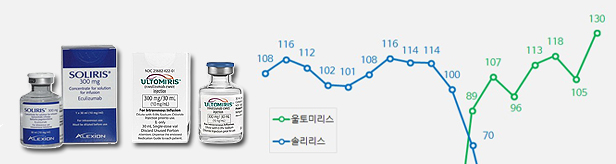
- Soliris(left) and Ultromiris Quarterly sales of the rare disease treatments ‘Soliris (eculizumab)’ and ‘Ultomiris (ravulizumab)’ had risen significantly in Q1 this year. Although sales of Soliris remained similar to last year, sales of Ultomiris, its follow-on drug, soared in the same period. The analysis is that the generation change between the two drugs has neared completion. According to the market research institution IQVIA on the 12th, sales of Ultomiris in Q1 were KRW 13 billion, up 35% from KRW 9.6 billion in Q1 last year. During the same period, Soliris’s sales slightly fell from KRW 2.8 billion to KRW 2.4 billion. Soliris is a rare disease treatment indicated for the treatment of ▲ paroxysmal nocturnal hemoglobinuria, ▲ atypical hemolytic uremic syndrome (aHUS), ▲generalized myasthenia gravis, and ▲ neuromyelitis optica spectrum disease. Ultomiris is a follow-on of Soliris. As it has a half-life that is 4 times longer than that of Soliris, the drug may be administered every 8 weeks. However, the indication for the drug is limited to paroxysmal nocturnal hemoglobinuria/ Both drugs were introduced to Korea by Handok from Alexion. Soliris was approved in January 2010 and applied for reimbursement in 2018. Ultomiris was approved in May 2020 and its reimbursement was applied from June 2021. The combined sales of the two drugs peaked at KRW 15.9 billion in Q3 2021 and then was on a gradual decline. In Q4 last year, its sales decreased to KRW 12.9 billion. However, sales showed a rebound in Q1 this year, recording combined sales of KRW 15.4 billion. Quarterly Sales of Soliris·Ultromiris (Unit: KRW 100 mil, Data: IQVIA) The sales rebound received more attention because the domestic sales rights for the two drugs were transferred from Handok to AstraZeneca in Q1 last year. AstraZeneca acquired Alexion in 2020 for USD 39 billion (approximately KRW 42 trillion). After the sales rights agreement between Handok and Alexion expired in January this year, AstraZeneca Korea retrieved the sales rights to sell the two rare disease drugs directly in Korea. However, the prevailing opinion in the industry is that the sales right transfer had little or limited effect on the sales rebound. AstraZeneca established a rare disease Business Unit at the end of last year and completed the composition of the business unit in February of this year in time for the retrieval of Soliris and Ultomiris’s sales rights. The company was able to start full-scale marketing activities only in March. Therefore, the sales rebound could be rather interpreted as performance derived under the strong influence of Handok. Industry experts believe that the impact of the sales right transfer would only be measurable after Q2.
- Company
- Beova can be prescribed at general hospitals
- by Eo, Yun-Ho Jun 12, 2023 05:42am
- Beova, a new drug introduced by Jeil Pharmaceutical, will be available for Rx at general hospitals. According to related industries, Beova, an overactive bladder treatment, is currently available at 22 medical institutions nationwide, including SMC and AMC, as well as advanced general hospitals, Gangnam Severance Hospital, Sangnam Sacred Heart Hospital, Dongtan Sacred Heart Hospital, Chungnam National University Hospital, and Hanyang University Hospital (headquarters, Guri). Beova is a new drug introduced by Jeil Pharm from Japan's Kyorin Pharmaceuticals in November 2019. It obtained domestic development, manufacturing, and sales rights, and imported raw materials to produce finished products in domestic factories. In order to obtain domestic approval, Jeil Pharmaceutical conducted a phase 3 bridging clinical trial to compare and evaluate the safety and effectiveness of Beova in 210 overactive bladder patients at 20 domestic institutions, including Seoul Asan Medical Center, from May 2020 to this year. As a result, it was confirmed that the change in average urination frequency per day at 12 weeks from baseline as the primary efficacy evaluation variable was improved by -2.38 times compared to -1.22 times with a placebo. In the secondary endpoints, the average number of urinary urgency per day, the number of urge incontinence, the change in the number of urinary incontinence, and the change in the average voiding volume per time, there was a significant improvement compared to the placebo. Beova is a new β3-adrenergic receptor agonist that selectively acts on sympathetic nerve receptors to relax the bladder detrusor muscle, helping to treat symptoms such as frequent urination, urgency, and urgency urinary incontinence. Mirabegron was the only β3-adrenergic receptor agonist currently on the market, but the launch of Beova is expected to form a competitive landscape. Vibegron is known to be more than 9000 times more selective for β3 receptors than β1 and β2 receptors. In addition, Vibegron's maximum response rate for β3 receptors is 99.2%, which is higher than 80.4% for Mirabegron, the same β3 agonist. It is an ingredient that has the advantage of having a low risk of cardiovascular side effects because it does not stimulate receptors. It is known that there is very little concern about interactions with drugs that pass through the CYP2D6 metabolic pathway and that it can be administered in normal doses even to patients with hepatic or renal impairment. Lee Gyu-seong, professor of urology at SMC, said, "Beova is a new drug that is introduced in Korea. It will help provide high-quality treatment effects to overactive bladder patients in Korea with excellent symptom improvement and low adverse reaction rates."
- Company
- Eisai applies for approval of its AD drug lecanemab in KOR
- by Jung, Sae-Im Jun 12, 2023 05:42am
- Pic of lecanemab The drug that is being considered the next blockbuster candidate, Eisai and Biogen’s Alzheimer’s treatment ‘lecanemab,’ is set to enter the Korean market. Eisai announced on the 8th that it had submitted an application for the marketing authorization of lecanemab to the Ministry of Food and Drug Safety to treat mild cognitive impairment or mild dementia stage of disease arising from Alzheimer’s disease (AD). This is the third application the company had filed in Asia after Japan and China. Lecanemab was jointly developed by the two companies. Lecanemab selectively binds to neutralize and eliminate soluble, toxic amyloid-beta (Aβ) aggregates (protofibrils) that are thought to contribute to the neurodegenerative process in AD. The drug received accelerated approval from the U.S. Food and Drug Administration in January. As Eisai applied for formal approval, the FDA plans to hold an advisory committee on the 9th (US local time) and decide whether to grant approval next month. Unlike 'Aduhelm (ingredient: aducanumab)', which failed commercialization, high expectations are in place for lecanemab’s growth into a blockbuster drug. Clarivate, a global academic information service company, predicted that lecanemab’s sales would reach USD 1.02 billion (KRW 1.32 trillion) in 2027 in its ‘Drugs to Watch’ report that it released earlier this year. Eisai’s application to the MFDS is based on the Clarity AD Phase III and Phase IIb clinical studies that confirmed that lecanemab reduced clinical cognitive decline in early Alzheimer's disease. The Phase III Clarity AD compared lecanemab with placebo in 1.705 patients aged between 50 to 90 with early AD. The primary efficacy endpoint was the change in clinical decline on the global cognitive and functional scale, CDR-SB, compared with placebo at 18 months. Key secondary endpoints were ▲the AD Assessment Scale-cognitive subscale14 (ADAS-cog14), ▲change from baseline at 18 months compared with placebo of treatment in amyloid levels in the brain measured by amyloid positron emission tomography (PET), ▲AD Composite Score (ADCOMS), etc. Change in CDR-SB score with lecanemab -placebo (primary endpoint) (data: Biogen) Results showed that the lecanemab arm recorded a CDR-SB score of 1.21 at 18 months, which is a 27% reduction in clinical decline compared with the 1.66 recorded in the placebo arm. This delay started as early as six months. The drug also achieved statistically significant in its key secondary endpoints compared with placebo. In the amyloid PET subgroup analysis, the lecanemab arm showed a statistically significant reduction in brain amyloid accumulation from 3 months. The ADAS-Cog14 evaluation results showed that cognitive decline was delayed by 26% with lecanemab. ADCOMS results also showed a 24% delay in disease progression at 18 months with lecanemab.
- Company
- Fidanacogene Elaparvovec designated as an orphan drug
- by Eo, Yun-Ho Jun 12, 2023 05:42am
- Fidanacogene Elaparvovec, a one-shot hemophilia treatment, has been designated an orphan drug. The Ministry of Food and Drug Safety recently announced that it has selected Fidanacogene Elaparvovec, Pfizer's hemophilia B gene therapy, as an orphan drug. Fidanacogene Elaparvovec is a method that combines adenoviral vector (AVV) capsid and highly active coagulation factor IX gene and is characterized by producing coagulation factor IX in one cycle instead of regular injection am. The drug has been designated as a Breakthrough Therapy, Advanced Regenerative Medicine and Therapeutics (RMAT), and Orphan Drug by the US FDA, and PRIority MEdicines and Orphan Drug by the European EMA. The phase 3 BENEGENE-2 study confirming the effectiveness of Fidanacogene Elaparvovec also received significant attention. The study evaluated the efficacy and safety of Fidanacogene Elaparvovec in patients with a factor 9 of 2% or less, and the participating patients were evaluated for 6 years based on a single intravenous injection. The main purpose of this study is to determine how much gene therapy reduces ABR compared to SOC. According to the topline results released recently, the Fidanacogene Elaparvovec group met the primary endpoint by demonstrating non-inferiority and superiority compared to standard therapy in ABR. From 12 weeks to 15 months, the average ABR of the Fidanacogene Elaparvovec group was 1.3, whereas that of the standard therapy group was 4.43. Gene therapy reduced ABR by 71%, confirming its superiority over standard therapy. The main secondary endpoint was the ABR measured based on treatment. The Fidanacogene Elaparvovec group reduced treatment-based ABRs by 78% and annual infusions by 92% compared to the standard-of-care group. The Ministry of Food and Drug Safety is operating an orphan drug designation system to support the development of treatments for rare and incurable diseases. Among drugs used for the purpose of diagnosing or treating rare diseases, drugs that cannot be replaced or that are significantly improved over drugs that can be replaced may be designated as orphan drugs. If designated as an orphan drug, you can receive benefits such as being subject to expedited review at the time of product approval.
