
- LOGIN
- MemberShip
- 2026-06-30 12:24:23
- Company
- Asthma treatment Cinqair attempts reimb again in Korea
- by Eo, Yun-Ho Dec 15, 2022 05:55am
- The asthma treatment Cinqair for asthma is again attempting reimbursement listing in Korea. According to industry sources, Teva-Handok has recently submitted an application for the reimbursement listing of its interleukin-5 antagonist monoclonal antibody Cinqair (reslizumab). Following Cinqair’s steps, other biological drugs for asthma including GSK Korea’s ‘Nucala (mepolizumab) are also moving to start their reimbursement listing processes as well. As an interleukin-5 antagonist, Cinqair reduces levels of blood eosinophils, a type of white blood cell that is involved in the development of asthma exacerbation. The drug had first been first approved in Korea in 2017 as an add-on maintenance treatment for adult patients with an eosinophilic phenotype of asthma (those who have a blood eosinophil count of at least 400/㎕ before treatment) that were not adequately controlled with existing treatments. The company had applied for its reimbursement being launched without reimbursement in 2018 but failed. Teva-Handok has been jointly marketing Cinqair with Handok Pharmaceutical since its release. Meanwhile, Cinqair’s efficacy had been demonstrated through five placebo-controlled clinical studies that evaluated the safety and efficacy of Cinqair 3mg/kg in 1,028 adult and adolescent asthma patients that were uncontrolled with currently available therapies. In three Phase III clinical trial programs that were conducted on asthma patients with high blood eosinophil counts, Cinqair reduced the frequency of asthma exacerbations by up to 59% and significantly improved lung function, symptoms, and the asthma-related quality of life. Also, Cinqair received attention for releasing the post-hoc analysis results of asthma patients that require Step 4 and Step 5 treatment among all patients that participated in the Phase III trials. Cinqair reduced the clinical degree of asthma exacerbations in patients classified as Step 4 or 5 under the Global Initiative for Asthma guidelines by 53% and 72%, respectively, and increased the level FEV1 (forced expiratory volume in 1 second) by 103ml in Step 4 patients and by 237ml in Step 5 patients, demonstrating that the benefit was found to be greater in Step 5 patients.
- Company
- Verzenio expects to address the unmet demand
- by Eo, Yun-Ho Dec 15, 2022 05:55am
- Professor Son Joo-hyuk Expectations are high for securing early breast cancer indications for Verzenio, a breast cancer treatment with CDK4/600 inhibition mechanism. Lilly Korea held a press conference on the 14th to commemorate the expansion of permission for early breast cancer indications at high risk of recurrence of the anticancer drug Verzenio. Verzenio obtained approval from the Ministry of Food and Drug Safety on the 18th of last month as a treatment used in combination with hormone receptor-positive, human epithelial cell growth factor 2 negative (HR+/HER2-), early breast cancer adult patients at high risk of recurrence of lymph node-positive, and endocrine therapy. Verzenio's approval is meaningful in that the first CDK 4&6 inhibitor for early breast cancer patients at high risk of HR+/HER2-lymph node-positive recurrence was introduced in Korea. Sohn Joo-hyuk, a professor of oncology at Severance Hospital, shared the medical unfulfilled needs of HR+/HER2-lymph node-positive recurrence early breast cancer patients and the clinical value of Verzenio confirmed through the monarch clinical study, which was the background of approval of MFDS. In the first topic of the presentation, "HR+/HER2-High-Risk Early Breast Cancer Patients' Medical Unfulfilled Demand," Professor Sohn said, "Most of the female cancers in Korea are diagnosed early due to screening activation, especially in the standard treatment of HR+/HER2- patients, to prevent recurrence after surgery. He added, "The prognosis of HR+/HER2-early breast cancer is generally known to be good, but high-risk patients are highly likely to recur, making it difficult to expect long-term survival." According to domestic statistics, the survival rate of general early breast cancer patients is more than 90%, which is higher than that of other diseases. However, patients with recurrence risk factors such as lymph node-positive, high tumor grade, large tumor size, and fast cell proliferation are known to have a higher risk of remote recurrence and death than general patients. Studies have shown that if the tumor size exceeds 5cm, the 5-year survival rate of breast cancer patients decreases from 57% (without lymph node metastasis) to 21% (with lymph node metastasis). Professor Son said, "The recurrence of early breast cancer patients after the first treatment is usually one to two years, and more effective postoperative auxiliary treatment is needed to reduce the risk of recurrence and death." However, since the introduction of aromatase inhibitors in the early 2000s, the absence of new treatment options for HR+/HER2-early breast cancer patients has led to a medical non-fulfillment demand." Verzenio's monarch clinical trial is the only study that has confirmed successful results in about 20 years as a combination of endocrine therapy as an adjunct treatment for HR+/HER2-early breast cancer. In monarch cohort 1, which served as the basis for this indication expansion permit, Verzenio+ endocrine therapy confirmed remote recurrence risk reduction results through Distance Relapse-Free Survival (DRF) indicators as well as Invisible Disease-Free Survival (IDFS) indicators compared to endocrine therapy alone.
- Product
- Menarini Korea is expected to distribute Viagra
- by Kim JiEun Dec 15, 2022 05:55am
- Viagra, which was sold by Jeil, is likely to be distributed at Menarini from next month. According to the pharmaceutical industry on the 12th, Menarini is in charge of distributing urological treatments such as Viatris Korea's Viagra, Cadura, and Detrusitol. The move follows the termination of Viatris and Jeil's sales rights contract for these products. In addition to Viatris Korea and Viagra, Jeil has been conducting joint promotions of Lipitor Plus, and it is known that the promotion of Lipitor Plus is maintained. Medications that stop distribution through Jeil are 50 mg of Viagra tablet, 100 mg of Viagra L film, 100 mg of Viagra L film, 100 mg of Detrusitol SR 2 mg, 4 mg of Detrusitol SR, and 4 mg of Cadura XL. The date of discontinuation of distribution is December 23rd. There is a rumor in the industry that Viatris Korea has already decided on its next partner. Menarini is said to be the most likely related company. Prior to this, Menarini recently announced to trading drug distributors that it would change the OX-2 inhibitor Arcoxia 30mg seller. Organon Korea will take over Arcoxia's sales rights. Arcoxia was sold by Menarini under a global partnership agreement after MSD ended its green cross and co-marketing in 2018. In the industry, some analysts say that Viatris Korea's right to sell urology-related treatments such as Viagra may have been chosen as a follow-up measure following Nemarini's termination of Arcoxia sales rights. An official from the distribution industry said, "Viatris Korea has Menarini in mind as Jeil's next partner, and I know that only the final decision is left," adding, "It is expected to be a measure following the end of Arcoxia sales rights." 정품 비아그라 https://xoad79.com
- Policy
- MFDS “Increasing AAP manufacturing well in progress”
- by Lee, Hye-Kyung Dec 14, 2022 05:57am
- To the issue that had been raised on how the supply shortage is continuing in the field even after increasing the price of acetaminophen, the Ministry of Food and Drug Safety replied that it has reviewed the monthly production schedule and the increase in production is progressing according to plan. Also, the MFDS added that the acetaminophen stock shortages found in some online malls may not be an actual lack of stock, and that it would be necessary to check with the distributors. In other words, some online malls may be leaving the category as out of stock to prevent the large pharmacies to preoccupy the whole stock in online malls at once and allow small pharmacies the purchasing opportunity. Eun-hee Moon, Director of the Pharmaceutical Policy Division Eun-hee Moon, Director of the Pharmaceutical Policy Division at MFDS, said so at a briefing with the medical trade journal correspondents on the 13th. Director Moon said, “Even at the increased price, it is said that the companies cannot manufacture more because they are already at their maximum capacity, and some pharmacies are saying there isn’t enough supply. However, when checking with the manufacturers and reviewing their monthly production schedule, no company has yet said they are having difficulty matching the demand.” The Ministry of Health and Welfare raised the ceiling price of 18 products that contain acetaminophen 650mg to at least KRW 70 to a maximum of KRW 90 as of December 1st. The different ceiling prices have been set according to the manufactured amount. After holding drug pricing negotiations with pharmaceutical companies, the National Health Insurance Service and the companies agreed to increase the monthly average manufacture amount by 50% more for 13 months until September of next year. Also, in consideration of the increased demand and exhaustion of market inventory in the winter and in-between seasons, the period from this month to April next year will be set as an intensive management period, and the monthly target manufacture amount set by 60% more during that period. The average monthly supply will rise the previous 45 million tablets per month to 67.6 million per month for the 13 months, and to 72 million tablets per month during the intensive management period. Also, the MFDS issued an ‘Emergency management and import order for medical products,’ ordering companies that supply prescription acetaminophen 650mg to report their manufacture and import plans, expected monthly manufacture and import and manufacture and import results from December 1, 2022, to April 30, 2023. Director Moon said, “The monthly manufacture amount submitted by the pharmaceutical companies has been set by adjusting the manufactured volume of other drugs. It was not vaguely made." For companies that consign productions, the companies agreed on the price increase after making the production plans for all of its products and confirming their production schedule with their factories. Director Moon emphasized, “Hanmi Pharmaceutical and Chong Kun Dang switched their consigned acetaminophen products to self-manufacturing and submitted their specific manufacture schedules before signing the price increase agreement. The companies are working hard to achieve the goal of expanding production by 50% and 60% more from the previous period according to the plans set by the government.” The MFDS believes that the supply shortages raised in the field will not occur as the contracts that were signed mandate companies to refund the drug price if the production volume does not reach the target amount. Director Moon said, “The MFDS’ manufacture and import order was issued to address the concern that not enough acetaminophen will be supplied in the file even after the NHIS signed agreements with companies that link the production and supply amount to the drug price. As the MFDS and NHIS are managing the issue together, I believe the production of acetaminophen will be carried out as planned." Moon added, “Companies that cannot fulfill the manufacture/import orders were directed to consult with the MFDS, but there has been no talk of companies being unable to meet the volume yet. I have reviewed the production volume until early December, and more acetaminophen is being supplied compared to November." However, as the specific production volumes of acetaminophen in November and December need to be compared, the actual difference can only be found at the end of the year. The MFDS is also preparing a plan to prepare for the supply shortage of raw materials for cold medicine that may arise due to China’s recent lifting of COVID-19 restrictions. Director Moon said, “When checking the raw material suppliers, most were from the US, China, and India, and we think we can use Indian suppliers if there is a disruption in the supply of raw materials in China. While receiving plans for increased production of acetaminophen from companies, we are also checking the current status of raw material supply” The exemptions from the mandatory small-package packaging of prescription cold medicine also continue to be in effect. Moon explained, "We had originally decided to apply the small packaging exemption for the period when we monitor the supply and demand, which is conducted once every two weeks."
- Company
- Samsung Epis's Soliris biosimilar bioequivalent to original
- by Dec 14, 2022 05:56am
- Study results that show Samsung Bioepis’s Soliris biosimilar is bioequivalent to the original drug have been presented. On the 13th, the company announced that its biosimilar, SB12 has demonstrated equal effect to its original drug Soliris at the American Society of Hematology (ASH) Annual Meeting that is being held in New Orleans. Soliris is a rare disease treatment used to treat incurable rare diseases like paroxysmal nocturnal hemoglobinuria (PNH) that was developed by the US pharmaceutical company Alexion. SB12 is a biopharmaceutical drug developed using the same active ingredient contained in Soliris, eculizumab. Samsung Bioepis presented statistical analysis results in the form of a poster to add credibility to the clinical results through additional analysis of its Phase III clinical trial. The company had previously demonstrated the bioequivalence of SB12 to Soliris in terms of clinical efficacy and safety through a Phase III trial that had been conducted from 2019 to last year. The primary efficacy endpoint of the SB12 Phase III trial was the level of lactate dehydrogenase (LDH) at Week 26 and the time-adjusted area of under the effect curve (AUEC) of LDH from Week 14 to Week 26 and from Week 40 to Week 52. The red blood cell of patients are destroyed and LDH is released into the blood when a patient develops PNH. LDH is one of the biomarkers that can diagnose this. Elevated LDH levels are usually associated with liver disease and increased fatigue, etc. The trial looked at the time-adjusted area under the effect curve (AUEC) of LDH from Week 14 to Week 26 and from Week 40 to Week 52 to observe whether these levels were similar to the original. Results showed that the LDH level lay within the pre-defined equivalence margin, indicating that the SB12 was bioequivalent to the original drug. Samsung Bioepis conducted a further sensitivity analysis to add reliability to the accuracy of the results of the Phase III trial. Statistical analysis derived the same conclusions as the primary efficacy endpoint results that were observed in the Phase III trial. An official from Samsung Bioepis said, “SB12 contains the core purpose of biosimilars that seek to expand patient access to expensive medicines. We will continue to make efforts to provide more treatment opportunities to patients suffering from rare diseases.”
- Company
- Champix supply interruption
- by Kim, Jin-Gu Dec 14, 2022 05:56am
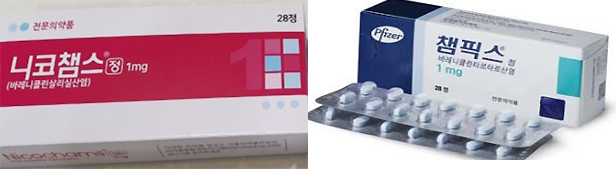
- Jeil Pharmaceutical's Nico Chams has dominated the market for anti-smoking treatment aids with Varenicline ingredients. Analysts say that while sales of major products, including Pfizer Champix, were suspended due to the detection of impurities in NNV components in September last year, it succeeded in digging into the gap and raising its influence to the level of market monopoly. ◆ First Pharmaceutical's Nico Chams share is 1% to 87% According to IQVIA, a pharmaceutical market research firm on the 13th, Jeil Pharmaceutical's Nico Chams' cumulative sales in the third quarter were 7.3 billion won. It increased more than nine times from 800 million won accumulated in the third quarter of last year. Sales have risen vertically since a series of impurities were detected in the anti-smoking treatment aid containing Varenicline in September last year. At that time, the Ministry of Food and Drug Safety announced the results of the NNV detection test on Varenicline-based drugs and decided to suspend sales only for products exceeding 185 ng/day. Products with a detection amount of 733 ng/day or more were ordered to be recovered. Among the products that were distributed in Korea, sales of seven products that CTC Bio had commissioned and one product that Pfizer Pharmaceutical Korea imported have been suspended. Nineteen manufacturing number items from three companies produced by CTC Bio have been ordered to be recovered. Pfizer Pharmaceutical Korea voluntarily recalled it. In the case of products produced by Jeil, impurities were detected for 16.70 to 43.28 ng/day, and they survived the recovery as well as the suspension of sales. Nico Chams' share also increased significantly around this point Until the second quarter of 2021, just before the suspension of sales, Nico Chams' market share was only 0.7%. However, the market share jumped to 24% in the third quarter of 2021, right after the suspension of sales. It then increased to 68% in the fourth quarter, and further expanded to 87% in the third quarter of this year. Based on sales in the third quarter, Nico Chams is actually over-exclusive with 2.4 billion won, and the rest is less than 200 million won. ◆Varenicline Market 34% in a Year↓ The lack of smoking cessation business overlaps with the prolonged suspension of sales. With the withdrawal of major products, the size of the anti-smoking treatment aid market for Varenicline ingredients decreased by 34% from 13 billion won in the third quarter of last year to 8.6 billion won in a year. This market has been on the decline for the past four consecutive years. As the government launched an anti-smoking treatment support project in 2015, the market expanded to 65 billion won in 2017 but has since shrunk to 16.2 billion won last year as it has steadily declined. This is the result of a combination of a reduction in drug prices and a decrease in the number of participants in the anti-smoking treatment project. On top of that, it is expected to decrease further this year due to the prolonged suspension of sales of impurity drugs that occurred in the third quarter of last year. Champix, which previously led the market, has still been suspended from sales and distribution as the impurity issue has not been resolved. Champix's sales plunged from 4.6 billion won in the second quarter of last year to 600 million won in the third quarter. Since then, sales of less than 10 million won have been recorded every quarter. Pfizer Pharmaceutical Korea said, "We are waiting for the resumption of supply at the global headquarters," adding, "We do not know the plans for the resumption of sales at this time."
- Company
- 2022 Pharmaceutical Industry Advertising Target Call Members
- by Dec 14, 2022 05:56am
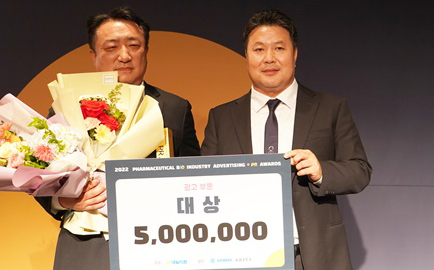
- Dailypharm held the 2022 Pharmaceutical Bio Industry Advertising PR Awards on the 7th. Representative Lee Jung-seok (6th from left) and the winnersDaewon Pharmaceutical's "Coldewon" and Sanofi's "Honey Jam Market for Those Who Can't Sleep" won the grand prize in the advertising and PR categories at the 2022 Korea Pharmaceutical Bio-Industry Advertising and PR Awards. Chong Kun Dang Benfobell won the grand prize in the "Special Award for Pharmacist Selection" category, which was decided by the votes of pharmacists. Dailypharm (CEO Lee Jung-seok) held an award ceremony for the 2022 Korea Pharmaceutical Bio-Industry Advertising and PR Awards at the Diamond Hall of InterContinental Seoul COEX Hotel on the 7th. More than 200 advertising and public relations officials from domestic and foreign pharmaceutical bio companies, including Won Hee-mok and Lee Young-shin, vice chairman of KRPIA, attended the event. At the ceremony, which marks its 10th anniversary this year, a total of 72 works were submitted in five categories, including TV, printing and radio, the Internet, and PR. More than 200 advertising and PR workers from the pharmaceutical bio-industry attended the event The awards were divided into advertising and PR categories. The advertising sector was divided into two categories: TV, Internet, and radio. The grand prize in each field and three excellence awards were selected along with the grand prize. In the PR category, the grand prize, one grand prize, and three excellence awards were honored. A special award was also given to 1,300 pharmacists who voted directly. Daewon Pharmaceutical's Coldewon won the grand prize in this year's advertising category. The award-winning work was awarded a prize of 5 million won along with the trophy. Yoo Seong-kwon, director of Daewon Pharmaceutical, said, "This year seems to have been a year when Coldewon received a lot of attention and took a leap forward. I am grateful that I received that energy and received a good award, he said. "I will try to stand here next year with good advertisements for new items." In the TV category, Shinshin Pharmaceutical's Arex was selected as the best prize, and a prize of 3 million won was given along with the trophy. ▲ Sanofi Allegra, ▲ Ildong Pharmaceutical's Aronamin C Plus Tab, and ▲ Limited's Mag-B Speed Excellence Award. The excellence award was awarded a trophy and a prize of 2 million won. In the Internet/radio category, HKinno.N's "Condition" won the grand prize. ▲Houns Radio Corporate Advertising ▲ Johnson & Johnson Nicorette ▲ JW Pharmaceutical 'Himom bands' were selected for the Excellence Awards. The award-winning film was given a trophy and prize money. In the PR sector, there were many entries that threw meaningful messages, including social contribution activities. This year's PR category was won by Sanofi's campaign to improve awareness of atopic dermatitis diseases, Honey Jam Market for those who can't sleep. The award-winning work was awarded a prize of 5 million won along with the trophy. Kim Hyun-jung, director of Sanofi Specialty Care, said, "We have been campaigning to improve awareness of atopic dermatitis diseases for four years since 2019. This year, the "Honey Jam Market for People Who Can't Sleep" was held to form a consensus on the physical and mental pain of patients. It is an honor that the patient's sincerity has paid off with a good award. "I will continue to make efforts to hold various campaigns for patients," he said. Yoo Seong-kwon, director of Daewon Pharmaceutical (left), and Lee Jung-seok, CEO of Daily Farm, who won the Grand Prize in advertising Dongkuk Pharmaceutical's "pupil earthquake" campaign was selected as the best prize in the PR category. ▲Ginexin, the god of memory (SK Chemical) ▲Growup Bio-Up Campaign (Amgen Korea) ▲YYPharm, including blood donation of love, won the Excellence Award. In the special prize category selected by online voting of 1,300 pharmacists, Chong Kun Dang was selected as the Benfobell target and won a trophy and 5 million won in prize money. Lee Sang-soo, deputy director of Chong Kun Dang, said, "Since the launch of Benfobell, it has been loved by pharmacists so far. It has a special meaning because pharmacists voted for it themselves. I think it's thanks to your consistent communication with us. "I'll be Benfobell who works harder." Donghwa Pharmaceutical Itchi won the grand prize in the special award for pharmacist selection. ▲Master Pharmaceutical Mayqueen ▲ Dong-A Pharmaceutical Panpyrin and others received the Excellence Award. Ahn Dae-cheon, former chairman of the Korea Advertising Association (Professor of Inha University), was the judge, while Chung Jae-hoon, a professor at Chonbuk National University, and Lee Jae-guk, executive director of the Korea Pharmaceutical Bio Association, participated as professional judges. Ahn, chairman of the judging committee, said, "The review of the advertising sector was based on whether the message was well matched and clearly delivered, secondly on the novelty of the idea, and thirdly on the reliability of the information. The PR division considered whether it could contribute to enhancing its image from a long-term perspective and whether messages and activities could elicit timely and consumer sympathy, he said. "We praise your efforts to develop advertising and promotion in the pharmaceutical bio industry." The Korea Pharmaceutical Bio-Industry Advertising and PR Awards began in 2013 with the aim of encouraging advertising promoters who give new values to the pharmaceutical industry and drugs and encouraging pharmacists, who are primarily advertising consumers, to produce advertisements that form a consensus. Lee Jung-seok, CEO of dailypharm, said in a greeting, "Many excellent works have been submitted this year, so I would like to thank pharmaceutical bio officials. I would like to congratulate you on your award-winning work. "We will make it a more fruitful and beneficial event next year," he said. Sanofi Specialty Care Director Kim Hyun-jung and CEO Lee Jung-seok, who won the PR category grand prize Chairman Won Hee-mok then said, "In the age of aging, the category of health management and prevention along with treatment has expanded, and the proportion of OTC drugs is increasing. At the same time, as the subject of the information is digitally transferred to consumers, changes are taking place in general drug advertisements, he said. "I hope it will be a place to find a new paradigm of general drug advertisements." "Thank you to Daily Farm for planning the advertising and PR targets," he said. Vice Chairman Lee Young-shin said, "With the development of artificial intelligence and digital healthcare, it has become an era of understanding the development of science and technology in the global beyond Korea. Advertising and promotion of drugs is no exception, he said. "I would like to thank advertising and public relations officials and media officials who have recognized new changes and delivered more accurate information in the regulated healthcare industry and contributed to improving the quality of life of the people." "KRPIA will also make efforts to grow with the domestic pharmaceutical bio industry."
- Policy
- $25.5 billion in exports to the health industry
- by Kim, Jung-Ju Dec 14, 2022 05:56am
- Exports of health medicine-related industries this year amounted to $25.5 billion, similar to last year, but the export of medicines such as biosimilars and vaccines was notable. The pharmaceutical sector is expected to surpass $10 billion for the first time next year based on a single item, raising expectations as a next-generation "good son export sector." The Health Industry Promotion Agency (Acting Director Kim Young-ok) announced the "2022 Major Export Performance and 2023 Export Forecast" this afternoon (7th). Although it recorded the highest performance in the first half of the year* thanks to increased demand for COVID-19 vaccines, treatments, and diagnostic products, the decline in quarantine goods (vaccines and diagnostic products) was noticeable due to full-scale enddemicization in the second half. Looking at export trends in the first half of 2022, it grew by 8.5% to a total of $13.35 billion, of which pharmaceuticals increased by 45% to $4.35 billion. Medical devices grew 5.2% to $4.93 billion, and cosmetics fell 11.9% to $4.06 billion. In particular, exports of medicines are expected to increase by 23.9% year-on-year due to biopharmaceuticals (biosimilars) and vaccines, but exports of medical devices and cosmetics are expected to decrease by 7.3% and 10.1% due to the full-fledged COVID-19 endemic and worsening external conditions. This year, the average monthly export of the health industry was $20.8 billion, continuing positive growth for 33 months since September 2019, and turning to negative growth since June this year. By industry, pharmaceutical exports are expected to rise 15.5% year-on-year to $10.1 billion, cosmetics are expected to rise 6.7% to $8.8 billion, and medical devices are expected to fall 6.2%, to $8 billion. Exports by region are expected to grow 5.8 percent to $13.6 billion, Europe to $6.8 billion, and North America to $4.2 billion, with Asia/Pacific exports expected to account for more than half. Diagnostic products, which had increased exports due to the global pandemic, are expected to continue to decline in exports, and exports of anti-pathogenic biological drugs such as biosimilars and toxins will continue to increase, accounting for 23.8% of the market share (based on division). Among them, pharmaceutical exports are expected to surpass $10 billion next year, up 15.5% from this year, based on the first single item ever. Exports of vaccines and treatments, which have soared since the end of last year, are expected to gradually decrease, and overall exports of medicines are expected to grow steadily due to continued demand for biosimilars. In the case of medical devices, exports are expected to fall 6.2% from this year to $8 billion next year. Existing major items such as ultrasound imaging devices, implants, and radiographic devices are expected to exceed exports in 2019, before COVID-19, thanks to a rapid recovery. On the other hand, exports of reagents for diagnosis in Korea are expected to gradually decrease as demand for COVID-19-related products decreases worldwide. Han Dong-woo, head of the Health Industry Innovation Planning Division at the Promotion Agency, said, "In 2023, health industry exports are expected to increase 5.4 percent year-on-year to $26.9 billion as cosmetics exports turn positive along with steady exports of medicines." "Since COVID-19, our health industry has proven its growth potential due to rapid increases in exports, but it may be more sensitive to external shocks such as weak economic conditions, global supply chain instability, high export dependence on the U.S. and China, and policies to strengthen protectionism," Han said. Meanwhile, the agency explained that it is working to support the industry and support government policies by providing information on exports and imports in the health industry, investigating overseas perceptions of the health industry, analyzing the impact of supply chain reorganization, and collecting opinions from the industry.
- Company
- Prolia's annual sales are expected to be 100 billion won
- by Kim, Jin-Gu Dec 14, 2022 05:56am
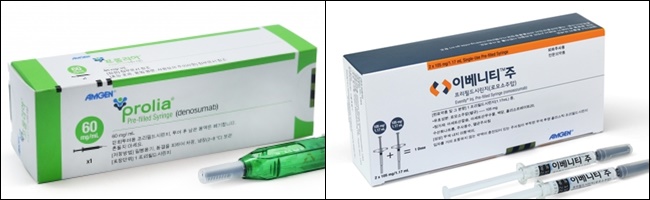
- Prolia & Evenity Amgen's Prolia, which dominated the osteoporosis treatment market, is further strengthening its dominance system. Sales are expected to surpass 100 billion won by the end of this year. Evenity, a generic for Prolia, is also rapidly increasing its sales. It has grown into the second-largest product in the osteoporosis treatment market in less than two years since the salary was applied in December 2020. According to IQVIA, a pharmaceutical market research firm, Prolia's cumulative sales in the third quarter of this year were 83.8 billion won. It increased by 28.6% compared to the same period last year-on-year. Prolia is a mechanism drug that inhibits bone absorption. It has become the first standard treatment for osteoporosis due to its superior effectiveness and convenience of administration compared to BP, which has been widely used in the past. It is difficult to take BP for patients, such as taking a sufficient amount of water on an empty stomach 1 to 2 hours before a meal and not lying down for at least 30 minutes after taking it. It was difficult for patients to continue to take medicine because side effects such as gastrointestinal disorders may occur when taking it for a long time. Prolia only needs to be administered once every six months. Even after 10 years of long-term treatment, the effect of continuous bone density improvement and consistent safety profile were confirmed. Prolia's beneifit was applied only to the secondary treatment in 2017. From April 2019, the range of benefits has been expanded to primary treatments. Sales rose vertically shortly after the benefit increase. Prolia's sales, which stood at only 14.3 billion won in 2018, more than tripled in a year to 47.3 billion won in 2019. It has been steadily increasing to 75.1 billion won in 2020 and 92.1 billion won in 2021. This year, sales of more than 80 billion won in the third quarter are expected to surpass 100 billion won at the end of the year. During this period, Prolia's price was reduced by 17.6% on three occasions. The drug price, which was 215,678 won at the time of initial registration, fell to 190,000 won in April 2019, 177,650 won in December 2020 and 168,800 won in July this year. As usage soared, drug prices were lowered by PVA. Considering the reduction in drug prices, it is possible to estimate that Prolia's use at the prescription site has increased significantly than sales growth. It is analyzed that the expansion of benefits and the strengthening of sales power also contributed to Prolia's growth. Amgen has been selling Prolia with Chong Kun Dang since September 2017. Amgen Korea is in charge of sales and marketing of Prolia at hospitals and Chong Kun Dang at clinics. Evenity's rise, released as Prolia's generic, is steeper. The cumulative sales in the third quarter of this year were 12.2 billio wonn, up 47.4% from the cumulative 8.3 billion won in the third quarter of last year. Evenity is a bone formation agent with a dual effect of promoting bone formation and inhibiting bone absorption.Amgen is devising Evenity's positioning strategy as sequential administration from Evenity to Prolia . Evenity, which was granted in June 2019, was registered in December 2020. Even before the registration, the drug received great attention at the prescription site. It generated 3.8 billion won in sales in 2020. It has been growing more rapidly since the benefit registration. In 2021, sales more than tripled in a year to 12.3 billion won. Until the third quarter of this year, sales were almost the same as last year. It is expected to record sales of more than 15 billion won at the end of the year. As Amgen's two products made strides, sales of existing BP formulations were low. Eli Lilly Forsteo's cumulative sales in the third quarter of this year were 9.7 billion won. It remains at the same level as last year. The cumulative sales of Hanmi Pharmaceutical's RaboneD in the third quarter decreased by 1.5% from 7.4 billion won last year to 7.3 billion won this year. The rest of the products have a bigger drop in sales. Daewoong Zoledronic Acid saw its sales fall 33.6% from 7.8 billion won to 5.2 billion won during the period. Jeil's Bonviva and Bonviva Plus fell 21.3% from 8.1 billion won to 6.4 billion won. Since October, Jeil has taken over the domestic rights of Bonviva and Bonviva Plus from Handok. Handok has been in charge of Bonviva's domestic sales and marketing for the past seven years.
- Company
- Baxter ranks first in the 70 billion hemostatic market
- by Nho, Byung Chul Dec 13, 2022 06:07am
- In the 70 billion won-shaped hemostatic market, Baxter Floseal is likely to surpass 30 billion won in sales this year, and is expected to rank first for the third consecutive year. According to the drug distribution performance data, Baxter Flossal's sales reached 25.3 billion won and Hyundai Pharmaceutical's Tachosil's sales reached 12.5 billion won until the third quarter of this year, ranking first and second, respectively. GC Pharma s Greenplast Q and Tisseel posted 8.8 billion won and 7.6 billion won in sales. The Beri Plast P Combi Set in Germany remained in the bottom ranks with 1.8 billion won in performance. Floseal's breakthrough has seen 23.2 billion won and 27.3 billion won (2021) from 2020, far exceeding Tachosil's sales of leading products, 17 billion won and 16 billion won. Except for Floseal and Greenplast Q, all three products of Tachosil, Tisseel, and Beri Plast P Combi Set have a right-downward sales curve in the box. Greenplast Q's performance in 2018, 2019, 2020, and 2021 was 9.8 billion, 10.9 billion, 11.5 billion, and 11.8 billion won. During the same period, the appearance of the Tisseel and Beri Plast P Combi Set is 10.3 billion, 10.6 billion, 10 billion, 10.1 billion, and 2 billion, 4.3 billion, 3 billion, and 2.4 billion, respectively. Floseal, which obtained approval from the Ministry of Food and Drug Safety in 2008, is a syringe kit-type product that is rarely listed as non-payment among major hemostatic products with 500 IU/mL of human thrombin and 704mg of purified gelatin. Tachosil is a white sponge-type hemostatic agent at room temperature below 25 °C. The health insurance drug price is listed as 71,752 won for 3cm*2.5cm, 374,597 won for 9.5cm*4.8cm, 193,697 won for 4.8cm*4.8cm, 211,642 won for 4.8cm*4.8cm. Greenplast Q in the form of PF syringe is a hemostatic agent mainly composed of 500 IU/mL of thrombin, 1000 kIU/mL of afrotin, and 95 mg/mL of fibrinogen. Like Tisseel - 20 °C is a biological product of frozen storage and distribution. The drug price is 85,028 won for 2mL and 167,314 won for 4mL. Tisseel, which was approved in 2004, has a pre-field syringe with 3 000kIU of Aporotinin, 5.88mg of calcium chloride hydrate, 500U/mL of human Thrombin, and 91mg of Fibrinogen, and the registration consists of 2mL, 119,508 won, 4mL, 191,268 won, 10mL, and 506,27 won. Beri Plast P Combi Se is a similar composition to Tisseel, and the packaging unit is in the form of freeze-dried vial + liquid vial, forming an insurance drug price of 95,590 won for 1mL and 191,234 won for 2mL
