
- LOGIN
- MemberShip
- 2026-06-30 12:24:16
- Company
- “Immunotherapies take lead in liver cancer treatment"
- by Dec 09, 2022 06:04am
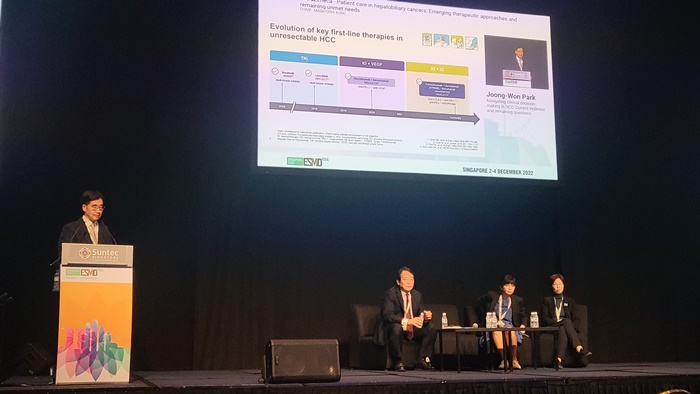
- “Immuno-oncology drugs have brought great advances in the treatment of unresectable advanced hepatocellular carcinoma. However, the unfortunate fact is that these are not well used in the field due to lack of later-line options.” Professor Joong-Won Park, Division of Gastroenterology, National Cancer Center Korea, said so to Dailypharm at the ‘ESMO Asia Congress 2022’ that had been held in Singapore. On the same day, Professor Park introduced the latest research trends in liver cancer treatment at a session held on ‘Patient care in hepatobiliary cancers: Emerging therapeutic approaches and remaining unmet needs.’ According to Professor Park, the treatment paradigm for unresectable advanced liver cancer (hepatocellular carcinoma) has been evolving quickly with the introduction of immuno-oncology drugs. Roche’s ‘Tecentriq’ had been granted as a first-line treatment for HCC in combination with the VEGF inhibitor ‘Avastin.’ It became the first immunotherapy approved for the systemic treatment of liver cancer. Following the combination, AstraZeneca’s immuno-oncology drug Imfinzi’ was also approved in combination with ‘Imjudo,’ another immuno-oncology drug with a different mechanism of action. The Imfinzi+Imjudo combination was approved in the US in October and is expected to be soon introduced to Korea as well. Through the STRIDE regimen (single dose of Imjudo as an initial dose followed by Imfinzi every four weeks), the Imfinzi+Imjudo combination improved the effect while minimizing safety risks. Another benefit of using Immuno-oncology drug combinations is that patients can worry less about the risk of hepatotoxicity that arises from the use of TKIs or bleeding from Avastin. Professor Park said, “We consider bleeding risk an important factor when selecting primary treatments. Patients with hepatic-portal hypertension must be tested for risk of hemorrhage. Slight concerns (adverse event) remain in the use of Imjudo in the Imfinzi+Imjudo combination, but it is only administered once, so if the patient well passes that period, the combination is well-tolerated." Its effect was also positive. According to the HIMALAYA Phase III trial, the Imfinzi+Imjudo combination using the STRIDE regimen recorded a median overall survival (mOS) of 16.4 months and reduced the risk of death over Nexavar by 22%. At 36 months of follow-up, the proportion of patients that reached OS in the Imfinzi+Imjudo group and Nexavar group was 30.7% and 20.2%, respectively, demonstrating an improvement in long-term survival with the use of Imfinzi+Imjudo. The Asian (excluding Japan) subanalysis results of the HIMALAYA trial were also disclosed at the ESMO Asia Congress. In Asians, the mOS of Imfinzi+Imjudo was 16.5 months, consistent with the global data. At 35 months, the OS was 32.2% in the Asian group. Professor Park explained, “It is encouraging that the data showed positive results in Asians, as we have a higher prevalence of hepatitis B than in the West. Immuno-oncology drugs came to the fore in this year’s guideline for HCC treatment in Korea. According to the '2022 Practice Guideline for Diagnosis and Treatment of Hepatocellular Carcinoma’ that was published by the Korean Liver Cancer Association, the Tecentriq + Avastin and Imfinzi + Imjudo combinations received A1 recommendations. This is the first time an immuno-oncology drug received a priority recommendation, overtaking Nexavar, which had been the standard treatment for liver cancer for a long time. The biggest challenge that remains for the use of these immunotherapy combinations is in receiving reimbursement. The key lies in how fast the Imfinzi + Imjudo combination will be able to receive reimbursement after it is introduced to Korea. The high prices of Tecentriq and Avastin had been the biggest barrier to their reimbursement in HCC. Fortunately, the introduction of Avastin biosimilars after the expiry of Avastin's patent lowered the drug price and allowed progress in their reimbursement. On the other hand, Imfinzi's partner, Imjudo, is expected to have a higher price barrier because it is a new immuno-oncology drug. The later-line therapies following the use of immunotherapy-based regimens also remain a barrier. The guidelines recommend physicians and patients consider the use of 6 drugs including Nexavar, Lenvima, Stivarga, and Cabometyx. However, in practice, the only realistic option is to use Nexavar without reimbursement. Lenvima is not approved for use in the second line in Korea. In the case of Stivarga and Cabometyx, they are only allowed for use after using Nexavar in the first line. Professor Park said, “Using Nexavar or Cabometyx in the second line is not an issue in the US or in Japan. It is even covered by insurance there. However, in Korea, reimbursement is strictly set for each line of therapy, therefore, it is difficult to use new drugs that are introduced in Korea due to the lack of later-line options. Using the recommended drugs in the later line as in the US or Japan is off-label and illegal or rejected from reimbursement. This is one of the biggest barriers in HCC treatment in Korea.”
- Company
- Ildong's new migraine drug Reyvow can be prescribed at gener
- by Eo, Yun-Ho Dec 09, 2022 06:04am
- According to related industries, Lilly and Ildong Pharmaceutical's Reyvow passed the Drug Commission (DC) of medical institutions such as Kangwon National University Hospital, Nowon-eulji Hospital, and Sinchon Severance Hospital, and advanced general hospitals such as Seoul National University Hospital, Asan Medical Center, and Seoul St. Mary's Hospital are also undergoing procedures. Reyvow is attracting attention as an expected replacement for tryptan-based drugs, which are most commonly used to treat migraines. This drug targets serotonin (5-HT) 1F receptors like conventional tryptan drugs, but has the advantage of not having cardiovascular side effects by acting selectively. On the other hand, tryptan-based drugs were limited in use because they contract blood vessels in the mechanism, causing cardiovascular diseases such as myocardial infarction and stroke. Reyvow proved its validity through a three-phase study. In two studies of 4,439 migraine patients, 28-39% of the Raybow administration group disappeared within two hours, and 41-48% were free from Most Bothersome Symptom (MBS) symptoms that overreacted to light, sound, and nausea. Reyvow is still unpaid. In August, the HIRA received a conditional salary judgment, but the company did not accept the offered drug price. Ildong Pharmaceutical plans not to give up the registration process afterwards. Meanwhile, Ildong Pharmaceutical signed a development partnership with Raybow developer CoLucid in 2013 to secure copyrights in eight ASEAN countries, including Taiwan, including domestic sales licenses.
- Policy
- “Yoon admin’s healthcare policy reduces coverage"
- by Kim, Jung-Ju Dec 09, 2022 06:03am
- "Stop deceiving the public with an erroneous essential healthcare policy that lays the responsibility for wasteful spending of commercial healthcare to the patients. Civic groups related to healthcare united and strongly voiced their opposition to the essential healthcare measures that were announced by the government. The Korean Federation Medical Activist Groups For Health Rights (KFHR) issued a joint statement in the afternoon today (8th) to “condemn the erroneous essential healthcare policy that reduces coverage of the national health insurance and solidifies the commercial healthcare system.” The Ministry of Health and Welfare had previously held a public hearing after announcing ‘Measures to Improve the Sustainability of Health Insurance and Support Essential Healthcare.’ The KFHR strongly criticized, “Contrary to what’s indicated in the title, the content aims to pass the pain on to the patients by reducing health insurance coverage, and use the issue of essential healthcare that requires the expansion of public health as an excuse to provide financial support to private hospitals. The Yoon Yoon Seok-yeol administration is the first administration to propose a plan to reduce coverage ever since the universal health insurance system was introduced in 1988. The reasons for KFHR’s opposition were: ▲ The plan to reduce health insurance coverage is a historical regression that has never been proposed ever since the introduction of national health insurance, ▲It is passing on the responsibility for wasteful financial expenditures that had been generated by the commercial medical system to the patients ▲And is providing support to private medical institutions and calling them essential healthcare support. KFHR said, “Korea's level of healthcare coverage is placed at the lowest among OECD countries, and this was why all the previous governments had no choice but to come up with a target plan to strengthen coverage, however insufficient. But the Yoon administration is attempting to reduce the little coverage that we have under the pretext of fiscal soundness rather than reinforcing it. The federation also voiced criticism on how the government is shifting the responsibility for wasteful financial expenditures caused by the commercial medical system to the patients. “Excessive medical treatment is prevalent in Korea because the government maintains a system that encourages profit in an extremely commercialized system where private medical institutions account for 95%. Many countries in Europe that run nearly free healthcare systems have fewer issues with excessive medical treatment because this is not caused by high coverage, rather, it is due to the commercialization of healthcare.” Regarding the support for essential healthcare, KFHR criticized it as an attempt to increase compensation to private medical institutions. In other words, the government is repeating the failures of the past. KFHR said, “Many premium fee systems are already in place in Emergency, Pediatrics, and Thoracic Surgery departments, the departments are still being avoided by private medical institutions due to their small number of non-reimbursed services and difficulty in filing excessive medical treatments. These issues cannot be resolved just by raising medical service fees.” KFHR added, “We oppose the government’s enforcement of such erroneous policy after holding a public hearing in which only some interested parties as a formality. Citizens have no choice but to resist if the government, the one that caused the Itaewon disaster, tries to cause a medical catastrophe that will drive people to death and suffering. The government must rescind the health insurance reforms and erroneous policies it is pursuing under the name of essential healthcare.” The KFHR consists of the Korean Nurses Association for Health Rights, the Pharmacists’ Association for Healthy Society, the Dentists' Association for Healthy Society, Solidarity for Worker's Health, the Association of Physicians for Humanism, and Doctors of Korean Medicine for Health Rights.
- Company
- Enhertu seeks approval as 2nd-line tx in breast cancer
- by Eo, Yun-Ho Dec 08, 2022 06:05am
- The antibody-drug conjugate anticancer drug ‘Enhertu’ is attempting to extend its indication to the second line in breast cancer. According to industry sources, the Ministry of Food and Drug Safety is currently reviewing whether to expand the indication for the ADC drug Enhertu (trastuzumab deruxtecan). Its approval is expected in Q1 next year (2023) at the earliest. The indication extension is to treat adult patients with unresectable or metastatic HER2-positive breast cancer who have received a prior anti-HER2-based regimen either in the metastatic setting or in the neoadjuvant or adjuvant setting and have developed disease recurrence during or within 6 months of completing therapy. The drug has been approved to extend its indication to the second line by the US FDA in May and by the European Commission in July. In Korea, Enhertu is being jointly promoted by AstraZeneca and Daiichi Sankyo. The drug is considered a next-generation ADC drug that has been designed using DXd ADC technology. With the drug yet to be listed for reimbursement, what strategy the companies will implement to attract prescriptions after expanding indications remains to be seen. The efficacy of Enhertu in the second line had been identified through the Phase III DESTINY-Breast03 trial. DESTINY-Breast03 is a head-to-head trial that evaluated the efficacy and safety of Enhertu versus the first-generation ADC ‘Kadcyla (trastuzumab emtansine).’ The trial enrolled 524 patients to evaluate the efficacy and safety of Enhertu in patients with HER2-positive unresectable and/or metastatic breast cancer previously treated with trastuzumab and a taxane. The primary efficacy endpoint of DESTINY-Breast03 was progression-free survival (PFS) based on blinded independent central review (BICR). Secondary efficacy endpoints included overall survival (OS), objective response rate (ORR) based on BICR, duration of response (DoR), and PFS based on investigator assessment. Results showed that Enhertu reduced the risk of disease progression or death by 72% compared with Kadcyla in patients with HER2-positive unresectable and/or metastatic breast cancer previously treated with trastuzumab and a taxane.
- Policy
- Dong-A launches its first generic Dapapro
- by Lee, Tak-Sun Dec 08, 2022 06:05am
- Despite the patent dispute, Dong-A ST has released Dapapro, the first generic of SGLT-2 diabetes treatment Forxiga. Dapapro was listed for the upper limit of 684 won this month. According to industries on the 7th, Dong-A ST started selling with Dapapro salary registration. Dapapro is a prodrug product with a different chemical structure from the original. When Dapapro is absorbed, the structure changes afterwards, showing the same medicinal effect as Forxiga. SGLT-2 inhibitors such as Forxiga and Dapapro have the effect of lowering blood sugar by selectively and reversibly blocking SGLT-2 involved in glucose absorption, inducing the remaining glucose to be discharged into urine. It succeeded in evading the material patent of Forxiga. Exactly, the argument that the 917 days of existence added to the Forxiga material patent are not included in the patent rights restricting Dapapro was accepted. This is the decision of the Patent Tribunal last month. However, there is a high possibility that AstraZeneca, the patentee, will appeal to the patent court against the trial decision. There is a possibility that the ruling will change. Earlier, Dong-A requested a trial to confirm the scope of rights for the same patent, but it was cited in the first trial, but it is difficult to predict the conclusion of the patent dispute because it has a history of losing in the second trial. Dong-A's rush to sell products seems to be a willingness to preoccupy the generic market before the patent expires in April next year. This is because other generics are likely to pour out after April next year. Currently, 266 Dapagliflozin products are licensed only by the Ministry of Food and Drug Safety. An industry official analyzed, "From Dong-A's point of view, it would have been difficult to miss the opportunity he had taken for the first time in a while." Dong-A also has a DPP-4 diabetes treatment new drug called Suganon. It is calculated that sufficient synergy can be seen in conjunction with Dapapro, an SGLT-2 formulation. With Dong-A's launch of the product, attention is now focused on the direction of patent disputes. It remains to be seen whether Dong-A will resolve patent disputes and preoccupy the generic market of Forxiga worth 100 billion won.
- Company
- AbTis contracts ADC technology cooperation/ world's #1
- by Dec 08, 2022 06:05am
- ApTis, a company specializing in antibody-drug conjugate (ADC) development, announced on the 7th that it has signed a technology cooperation contract for antibody-drug combination platform for new drug development with global CDMO company Ron. With this cooperation, AbTis' "AppClick" platform technology will be included in Lonza's customized solution toolbox for developing antibody-binding candidate drugs. AppClick is a location-selective ADC linker platform technology that allows users to easily and quickly connect various drugs without antibody deformation. Appclick improved the chemical stability of ADCs by using cyclic peptides that irreversibly bind to specific sites of antibodies. By being included in Lonza's customized solution, AbTis has opened the way to expand technology partnerships with various ADC new drug development companies. In addition, AbTis will be able to receive integrated services on the development and manufacture of Lonza's antibody-binding drug. "The AppClick platform is expected to be used in various ways because it can selectively combine various drugs with existing antibodies," said Gene Christophe, president of Hibert Lonza's bio division. "When developing new treatments such as ADC, it is possible to provide effective technology to various customers who suffer from antibody modifications." In the process of realizing the entry of the AbTis ADC linker platform into the global market, we are very happy to cooperate with the global No. 1 CDMO investor, said Jeong Sang-jeon. "Through this cooperation with Lonza, many ADC new drug developers are expected to apply AbTis Technology to shorten the period of development."
- Company
- The power of FDA-approved new drugs
- by Chon, Seung-Hyun Dec 08, 2022 06:05am
- SK Biopharm announced on the 6th that it won the "Tower of Exporting $100 million" at the 59th Trade Day ceremony held at COEX in Gangnam-gu, Seoul on the 5th. SK Biopharm's independently developed innovative new drug, Cenobamate, surpassed $100 million in exports to the U.S. and Europe from July 1, 2021, to June 30, 2022. This is the first time that a domestic pharmaceutical company has won the top $100 million in exports with a single innovative new drug developed by itself. Cenobamate is a new drug for epilepsy that SK Biopharm has independently carried out the entire process from initial development to FDA approval. It is prescribed for adult epilepsy patients with partial seizure symptoms. It is an action mechanism that alleviates seizure symptoms by simultaneously controlling two targets related to excitatory and inhibitory signaling that cause epilepsy. Cenobamate has been licensed to market by the U.S. Food and Drug Administration (FDA) in 2019 and is being sold under the product name XCOPRI. Since May 2020, it has been selling directly through SK Life Science, a local subsidiary in the U.S. Cenobamate has been on the rise every quarter since its local release in the U.S. It exceeded 10 billion won in the first quarter of last year and exceeded 20 billion won in the fourth quarter of last year. It recorded 31.7 billion won in the first quarter of this year and achieved high gains in both the second and third quarters. Cenobamate's cumulative sales in the U.S. were estimated at 200 billion won. Last year, it joined hands with its partner Angelini Pharma to enter the European market under the product name "ONTOZRY." The Export Tower Awards are held on Trade Day on December 5 every year under the auspices of the Korea International Trade Association. The association awards the "Tower of Exports" to exporters who have contributed to Korea's international status and economic development over the past year.
- Opinion
- [Reporter's view] A plan to expand the reference country
- by Lee, Tak-Sun Dec 08, 2022 06:05am
- The pharmaceutical industry is strongly opposed to the government's plan to expand drug price reference countries. Although the Ministry of Health and Welfare says it has gone through a sufficient discussion process, the industry is strongly criticizing it as a one-sided push. The revision of the HIRA's administrative notice on the 21st of last month calls for expanding the comparative reference countries of PE drugs to two countries. It is to add Canada and Australia to the current reference countries such as the United States, Japan, the United Kingdom, Germany, France, Italy, and Switzerland. On the 5th, the KRPIA clarified its opposition that the amendment seriously undermines access to new drugs for patients with severe and rare diseases, as well as hinders the development of the domestic pharmaceutical industry. The KRPIA said, "There are cases where benefits are delayed or abandoned due to too low prices and difficulties in insurance registration in Korea, but this amendment will delay the introduction of new anticancer drugs and severe and rare diseases, seriously affecting patients' access to new drugs." Multinational pharmaceutical companies with many new drugs are expressing concerns that the expansion of reference countries could lower the price of related drugs. The domestic pharmaceutical industry, which focuses on generic business rather than new drugs, is also strongly opposed to the revision. This is due to concerns that the revision of the expansion of reference countries could be used to re-evaluate registered drugs in the future. Moreover, Australia argues that the price of generic drugs in Korea will inevitably be lowered further if the re-evaluation is carried out due to the low price of generic drugs. Based on the results of policy research conducted in 2019, the government claims that the revision has been sufficiently collected as it has been discussing the revision by forming a working-level association with the pharmaceutical industry for four months since May this year. However, as expected from the announcement of the implementation of the revision bill in January next year, which is opposed by the pharmaceutical industry as a whole, it cannot be said that the opinions of both sides have been well collected. The Korea RPIA also expressed regret that the government unilaterally pushed ahead with the announcement of policy results focused only on reducing drug costs without drawing a reasonable agreement with the industry. In order to push for a proposal that the parties are opposed to, there must be a good reason, but it is difficult to understand even if you look at the reasons for the Far from persuading the parties, it is questionable why this amendment is necessary to anyone who is a third party. The HIRA announced in advance that it has prepared the revision to enhance transparency and clarity and supplement validity due to the long and insufficient formula for calculating adjusted prices that convert drug prices from seven overseas countries. However, there is a lack of explanation as to why the existing calculation formula lacks evidence and whether additional inclusion of Australia and Canada complements transparency, clarity, and validity. The revision is known to be based on the "Measures to Improve Reference Standards for Foreign Pharmacists" conducted by Gachon University's Industry-Academic Cooperation Group in 2019. In this study, Taiwan as well as Canada and Australia were added to the existing seven countries. The reason for the addition is that Canada and Australia have similar economic levels as Korea, and HTA (medical technology evaluation) plays an important role in the process of determining drug benefits. In the case of Taiwan, it was added because the economic level and health insurance system were similar and geographically close. However, it is reported that Taiwan was excluded because it was conscious of China. However, this explanation seems to be insufficient as a justification for Canada and Australia to be added to the reference countries among many countries. In addition, it is not known why it is a problem to charge drug prices with the existing seven countries as reference countries. Although pharmaceutical companies strongly oppose the revision during the period of submitting their opinions on the revision, it is under the impression that the government is not properly explaining the legitimacy of the revision. In this way, even if the amendment is implemented, it is difficult to avoid criticism that it is a hasty push.

- Company
- Immunotherapy shows effect as first-line treatment for BTC
- by Dec 08, 2022 06:05am
- Biliary tract cancer has long remained an area in which no new drug has been developed. Following targeted therapies, immunotherapies have led to remarkable advances in anticancer treatment, but biliary tract cancer has been neglected in terms of developing new drugs. This is because it has a lower prevalence rate than other cancers like lung cancer or stomach cancer, and even lower incidence in the West, which has been leading the development of new drugs. In this area with minimal progress, AstraZeneca’s cancer immunotherapy Imfinzi obtained indication in Korea and abroad as a first-line treatment in biliary tract cancer. In Korea and abroad, Imfinzi became the first immunotherapy to be approved as a first-line treatment in biliary tract cancer, and this latecomer among immunotherapies beating its competitors like Keytruda and Opdivo and won the “first” title. One thing to note is that a Korean medical team led to Imfinzi’s global approval in biliary tract cancer. Professor Do-Youn Oh’s persuasion was what moved the pharmaceutical company to pursue this unattended area. At the European Society of Medical Oncology (ESMO) Asia Congress 2022 that had been held on the 2nd (local time) in Singapore, Professor Oh said, “I believe the biggest achievement that has been made is that Imfinzi’s first approval as a first-line treatment in biliary tract cancer opened the stage for other immunotherapies to take on research into the field of biliary tract cancer.” Professor Do-Youn Oh Around 10 years ago, Professor Oh proposed an investigator-led trial to pharmaceutical companies that own cancer immunotherapies after finding out that immunotherapies show relatively higher effects in biliary tract cancer. However, companies at the time were more focused on cancers that have many patients and showed little interest and a low understanding of biliary tract cancer itself. Oh recalled, “I proposed a clinical trial on biliary tract cancer to all companies that own cancer immunotherapies at the time. I offered to test the drug myself to AstraZeneca’s clinical team. The company accepted my offer, and so began the investigator-led Phase II clinical trial. The trial went well thanks to the AstraZeneca team's active engagement. Professor Oh and AstraZeneca designed a detailed and thorough clinical trial after long discussions. They added 2 cohorts and enrolled more subjects. Based on the anti-tumor effect and safety confirmed in Oh’s trial, a global Phase III trial was initiated, and Professor Oh took the role of principle investigator (PI) in the Phase III TOPAZ-1 trial. The TOPAZ-1 trial was a success. The Imfinzi arm (Imfinzi+ gemcitabine + cisplatin) showed a 20% improvement in overall survival (OS) versus the placebo arm (placebo+ gemcitabine + cisplatin). Further analysis showed a higher OS improvement of 24% in the Imfinzi arm. At 2 years, the 2-year survival rate in the Imfinzi arm was 23.6% compared with 11.5% in the placebo arm. Median PFS (mPFS) was 7.2 months for the Imfinzi arm, a 25% improvement over the 5.7 months shown in the placebo arm. Also, the Imfinzi arm achieved an objective response rate (ORR) of 26.7% (91 cases), 2.1% (7 cases) of which showed complete response, and 24.6% (84 cases) showed partial response. Based on Oh’s investigator-led trial and TOPAZ-1 results, the US FDA approved Imfinzi for the treatment of biliary tract cancer. Furthermore, the National Comprehensive Cancer Network recommended Imfinzi as the standard (Category 1) first-line treatment in biliary tract cancer. For the first time, a cancer immunotherapy drug was listed as a standard of care in a field that only had chemotherapy options. This was a very unusual case where a clinical trial initiated by a Korean healthcare professional led to global approval and a standard-of-care designation. Professor Do-Youn Oh is presenting her findings at the ESMO Asia Congress 2022 Even after the approval, Professor Oh is busy conducting further analysis on TOPAZ-1. At the ESMO Asia Congress, Oh presented results on the impact of mutation status on efficacy outcomes in the TOPAZ-1 trial. The result of the study, which was the first to analyze the effect of cancer immunotherapies according to mutation status, was that there was no significant difference in the effect of cancer immunotherapies depending on the presence or absence of major mutations. Professor Oh referred to the entry of Imfinzi in biliary tract cancer as a ‘starting point’ that opens the stage and drives the development of biliary tract cancer treatments. In other words, an area that has not been tried due to lack of knowledge and lack of interest has opened up for research. Oh said, “With the TOPAZ-1 study, people have come to recognize that immunotherapies can be developed for biliary tract cancer as well. With so many cancer immunotherapies of various mechanisms of action in development, the biggest significance held by the success of the TOPAZ-1 trial is that the stage has been set for these to be tested in biliary cancer as well.” Above all, Oh expressed pleasure in providing new hope for biliary tract cancer patients. Professor Oh said, “Polarization of treatment options exists in the field of cancer as well. Some cancers offer many treatment options, others less than few. Biliary tract cancer was one of those that had almost no available treatment options. Whenever my patients asked why they can’t use immunotherapies, all I could do was tell them that a research was underway. With an immunotherapy option now available for biliary tract cancer, I look forward to more progress being made in the field and various more studies to come.”
- Product
- MFDS' statement of consent to Rx of the active ingredients
- by Kang, Shin-Kook Dec 07, 2022 05:55am
- While Oh Yoo-kyung, the head of the Ministry of Food and Drug Safety, said, "I agree" with the prescription of the ingredient name, he took a step back, saying in an official letter sent by the Ministry of Food and Drug Safety to the doctors' organization. According to an official letter sent by the Ministry of Food and Drug Safety to the Korean Medical Association on the 5th, "As the current form of the division of medicine is agreed upon through consultation, the prescription of ingredient names and product names is considered to be a matter of social consensus such as medicine led by the competent ministry." The Ministry of Food and Drug Safety's official letter is a reply to a protest sent by the Medical Association to the Ministry of Food and Drug Safety. In an official letter to the Ministry of Food and Drug Safety in October, the Medical Association criticized, "Prescription of active ingredients is a serious matter that damages the doctor's right to prescribe and patients' right to care and health." Director Oh briefly responded to Seo Young-seok's claim to introduce a prescription for ingredient names during a parliamentary audit on October 20, saying, "I actively agree." Oh's remarks eventually drew opposition from the medical community. Led by the Pediatric and Adolescents Association, the Internal Medicine Association also criticized Oh's remarks, claiming "selective division of labor." Pharmacist groups also issued a series of counter statements, saying, "It is the professional selfishness of doctors to stick to the prescription of the product." In the end, the controversy over the prescription of the ingredient name turned into a lawsuit between the Pediatrics Association and the Seoul Pharmaceutical Association. Why were doctors so opposed to the remarks of the head of the Ministry of Food and Drug Safety, who was not in charge of prescribing active ingredient names? The analysis that the biggest reason is a special situation called the Corona pandemic is gaining traction.
