- LOGIN
- MemberShip
- 2026-09-14 15:16:59
- "Lorviqua has suggested new long-term trt standard for ALK-positive NSCLC"
- by Son, Hyung Min | translator Hong, Ji Yeon | 2026-07-01 09:17:55
"Lorviqua," a treatment for ALK-positive non-small cell lung cancer (NSCLC), has demonstrated long-term effectiveness in inhibiting disease progression in a 7-year long-term follow-up analysis, establishing a new treatment standard in ALK-targeted therapy.
Notably, Lorviqua reduced the risk of disease progression or death by 81% compared to conventional therapy. It achieved long-term suppression of central nervous system (CNS) metastasis, which is the most significant clinical challenge in ALK-positive lung cancer. Analysis suggests that this drug is leading a paradigm shift in treatment.
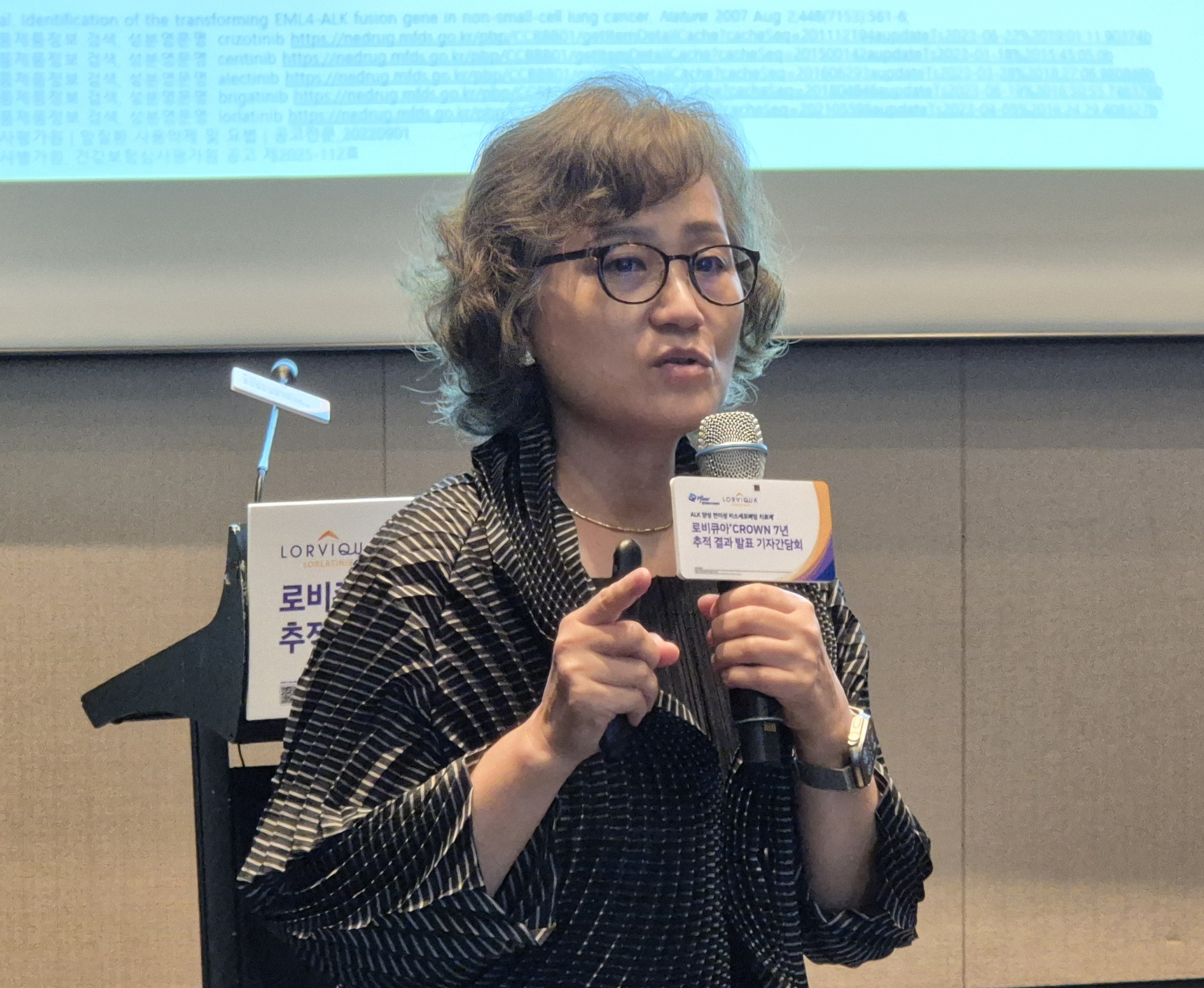
On June 30, Pfizer Pharmaceuticals Korea hosted a press conference at the Conrad Seoul Hotel in Yeouido to showcase the clinical value of Lorviqua (lorlatinib). Pfizer recently announced the 7-year follow-up results from the global Phase 3 CROWN study, confirming the long-term efficacy of Lorviqua.
ALK-positive NSCLC is a rare oncogenic driver mutation in NSCLC, accounting for approximately 3% to 5% of all NSCLC cases. It frequently occurs in a relatively younger patients and exhibits a high incidence of brain metastasis during the disease course; thus, long-term disease control and the suppression of CNS metastasis are considered critical determinants of clinical outcomes.
In fact, the development of ALK-targeted therapies has evolved continuously to address these specific unmet medical needs.
The first-generation ALK inhibitor, 'Xalkori (crizotinib),' established the foundation for treating ALK-positive lung cancer but faced limitations in sufficiently suppressing CNS metastasis due to restricted blood-brain barrier (BBB) penetration. Subsequently, second-generation ALK inhibitors such as 'Alecensa (alectinib)' and 'Alunbrig (brigatinib)' emerged, improving intracranial control. However, the development of therapeutic agents to achieve more potent ALK inhibition and overcome resistance mechanisms continued.
Lorviqua is a third-generation ALK inhibitor designed to overcome these limitations. Unlike existing drugs, it incorporates a macrocyclic structure engineered to bind more selectively and potently to the ALK protein, and it is characterized by its ability to effectively penetrate the blood-brain barrier (BBB) to maintain high intra-CNS drug concentrations.
Professor Ji-Youn Han of the National Cancer Center explained, "Because brain metastasis is highly prevalent in ALK-positive lung cancer, how effectively an agent crosses the BBB to control intracranial disease is the linchpin of long-term therapy. Lorviqua is a drug specifically developed to address this requirement."
The CROWN study is a global, randomized, open-label Phase 3 clinical trial comparing Lorviqua versus Xalkori in 296 treatment-naive patients with advanced ALK-positive NSCLC.
At 7-year follow-up, the median progression-free survival (PFS) in the Lorviqua group was not reached (NR), compared with 9.1 months in the Xalkori group. The PFS rates at 7 years were 55% and 3%, respectively.
The risk of disease progression or death was reduced by 81% compared to Xalkori (HR 0.19). The risk reduction efficacy previously validated in the 5-year follow-up has been sustained seamlessly through the period of 7-year.
Notably, among the patients who were free of disease progression at 24 months after treatment initiated, 79% maintained their progression-free status at the 7-year mark. This indicates that a vast majority of patients who maintain therapeutic efficacy during the first 2 years go on to achieve durable, long-term disease control.
Professor Han evaluated, "An HR of 0.19 in advanced lung cancer is an unprecedented level of benefit," and added, "It is highly significant that a degree of risk reduction typically observed only in the adjuvant targeted therapy setting for early-stage lung cancer has been sustained long-term in the advanced-stage setting."
Professor Han added, "It is also noteworthy that most patients who did not progress within the first two years maintained durable long-term disease control thereafter".
In this updated analysis, the intracranial control efficacy was reconfirmed as a foundational mechanism supporting Lorviqua's prolonged systemic PFS.
No new intracranial progression events were reported in the Lorviqua group after 30 months of treatment. The median time to intracranial progression was also not reached with Lorviqua, compared to 16.4 months in the Xalkori group.
Furthermore, durable CNS disease control was consistently maintained over the long term, both in patients with baseline brain metastases and in those without.
Professor Han explained, "The primary reason for the sustained PFS in this long-term follow-up ultimately is the continuous protection of the CNS," and added, "This can be interpreted as the effective suppression of brain metastases in highly ALK-dependent patients, translating into remarkable long-term survival and disease control outcomes."
The safety profile was consistent with the previously reported 5-year follow-up results. All-cause Grade 3 or 4 adverse events occurred in 77% of the Lorviqua group and 57% of the Xalkori group; however, permanent treatment discontinuations due to treatment-related adverse events (TRAEs) remained low at 5% and 6%, respectively. No new permanent treatment-related discontinuations were observed in the Lorviqua group after the first 26 months of therapy.
An additional analysis on dose reductions was also presented. Patients who underwent dose reductions due to adverse events successfully maintained both systemic PFS and intracranial disease control, providing robust evidence that dose adjustments during toxicity management do not compromise long-term therapeutic efficacy.
However, overall survival (OS) data have not yet reached the protocol-specified analysis endpoints, and further follow-up is ongoing. The industry anticipates that since these outcomes have re-confirmed Lorviqua's long-term disease-modifying capabilities, significant focus will remain on the upcoming definitive OS datasets.
-

- 0
댓글 운영방식은
댓글은 실명게재와 익명게재 방식이 있으며, 실명은 이름과 아이디가 노출됩니다. 익명은 필명으로 등록 가능하며, 대댓글은 익명으로 등록 가능합니다.
댓글 노출방식은
댓글 명예자문위원(팜-코니언-필기모양 아이콘)으로 위촉된 데일리팜 회원의 댓글은 ‘게시판형 보기’와 ’펼쳐보기형’ 리스트에서 항상 최상단에 노출됩니다. 새로운 댓글을 올리는 일반회원은 ‘게시판형’과 ‘펼쳐보기형’ 모두 팜코니언 회원이 쓴 댓글의 하단에 실시간 노출됩니다.
댓글의 삭제 기준은
다음의 경우 사전 통보없이 삭제하고 아이디 이용정지 또는 영구 가입제한이 될 수도 있습니다.
-
저작권·인격권 등 타인의 권리를 침해하는 경우
상용 프로그램의 등록과 게재, 배포를 안내하는 게시물
타인 또는 제3자의 저작권 및 기타 권리를 침해한 내용을 담은 게시물
-
근거 없는 비방·명예를 훼손하는 게시물
특정 이용자 및 개인에 대한 인신 공격적인 내용의 글 및 직접적인 욕설이 사용된 경우
특정 지역 및 종교간의 감정대립을 조장하는 내용
사실 확인이 안된 소문을 유포 시키는 경우
욕설과 비어, 속어를 담은 내용
정당법 및 공직선거법, 관계 법령에 저촉되는 경우(선관위 요청 시 즉시 삭제)
특정 지역이나 단체를 비하하는 경우
특정인의 명예를 훼손하여 해당인이 삭제를 요청하는 경우
특정인의 개인정보(주민등록번호, 전화, 상세주소 등)를 무단으로 게시하는 경우
타인의 ID 혹은 닉네임을 도용하는 경우
-
게시판 특성상 제한되는 내용
서비스 주제와 맞지 않는 내용의 글을 게재한 경우
동일 내용의 연속 게재 및 여러 기사에 중복 게재한 경우
부분적으로 변경하여 반복 게재하는 경우도 포함
제목과 관련 없는 내용의 게시물, 제목과 본문이 무관한 경우
돈벌기 및 직·간접 상업적 목적의 내용이 포함된 게시물
게시물 읽기 유도 등을 위해 내용과 무관한 제목을 사용한 경우
-
수사기관 등의 공식적인 요청이 있는 경우
-
기타사항
각 서비스의 필요성에 따라 미리 공지한 경우
기타 법률에 저촉되는 정보 게재를 목적으로 할 경우
기타 원만한 운영을 위해 운영자가 필요하다고 판단되는 내용
-
사실 관계 확인 후 삭제
저작권자로부터 허락받지 않은 내용을 무단 게재, 복제, 배포하는 경우
타인의 초상권을 침해하거나 개인정보를 유출하는 경우
당사에 제공한 이용자의 정보가 허위인 경우 (타인의 ID, 비밀번호 도용 등)
※이상의 내용중 일부 사항에 적용될 경우 이용약관 및 관련 법률에 의해 제재를 받으실 수도 있으며, 민·형사상 처벌을 받을 수도 있습니다.
※위에 명시되지 않은 내용이더라도 불법적인 내용으로 판단되거나 데일리팜 서비스에 바람직하지 않다고 판단되는 경우는 선 조치 이후 본 관리 기준을 수정 공시하겠습니다.
※기타 문의 사항은 데일리팜 운영자에게 연락주십시오. 메일 주소는 dailypharm@dailypharm.com입니다.