
- LOGIN
- MemberShip
- 2026-06-23 19:07:24
- Opinion
- [Reporter's View] No more exemptions, just deferrals
- by Eo, Yun-Ho Jun 24, 2024 05:47am
- The Korean government has set out to fix the pharmacoeconomic evaluation exemption system. Although the authorities coined it as an “improvement,” the direction seems to be near a “reduction.” A report on a study commissioned by the Health Insurance Review and Assessment Service was released at the end of last year. The study, titled 'Study on Preparing a Plan to Improve the System for Exemption from Submission of Pharmacoeconomic Evaluation Data,' analyzed the current status and issues of Korea’s pharmacoeconomic evaluation exemption system, which was introduced in 2015, and proposed measures for its improvement. The report claims that the core of the improvement plan is to change the exemption system into a deferral system. The report pointed out that the core of the positive-listing system is the cost-effectiveness evaluation, therefore, Korea should not exempt drugs from evaluations when other countries do conduct evaluations. Based on the research results, HIRA proposed a revision of the current PE exemption system. To this end, the HIRA and the Korean Research-based Pharmaceutical Industry Association (KRPIA) recently held their first meeting. The industry's reaction to this is understandably grim. The PE Exemption System is literally the only way out for drugs that are difficult to evaluate but deemed necessary. It contains various financial control devices and has embraced an "expenditure cap" design since its inception. In fact, the industry has been constantly claiming that the current system has too high a threshold and has consistently emphasized the need for its expansion. Of course, the contents of the recent report will not be reflected 100%. However, the proposed measures in the report will hardly be satisfactory for the industry. Even now, it is not easy for companies to apply for the PE exemption system, and the number of eligible drugs will be significantly reduced if the reform is implemented. For example, contrary to how the current 200 patients or fewer (the usual threshold required to be eligible for the PE exemption) requirement refers to the number of patients that fall within the drug's scope of use, the proposed reforms refer to a stand-alone disease, meaning that a drug that would have been eligible if it met the 200 patients or fewer requirement based on its genotype or line of therapy indication must now have 200 or fewer patients affected by the disease itself. The fundamental purpose of deferring the PE exemption is more difficult to understand. The pharmaceutical industry has constantly requested the application of a flexible ICER threshold. And we have heard endlessly about how Korea’s ICER threshold is too strict for drugs to be reimbursed. It is doubtful whether drugs that would not have been listed if not for the PE exemption system will be able to remain reimbursed when evaluated after the deferred period. If some regulations are tightened, some need to be loosened as well. The government is already planning to save national health insurance finances by implementing bold drug price reduction mechanisms such as external reference pricing reevaluations and revision of the price-volume linkage system. It may be that the number of applicable drugs has increased since the implementation of the system, rendering improvements necessary. However, it is also true that this system has served as a 'breathing hole' in Korea's listing system, we need to devise other ways out before closing that hole.
- Policy
- Will GMP One-strike-out be loosened?...MFDS, 'negative'
- by Lee, Hye-Kyung Jun 24, 2024 05:47am
- While pharmaceutical companies advocate for loosening the 'Cancellation of the GMP compliance decision' act, the Ministry of Food and Drug Safety (MFDS) says it will start a discussion once it receives an official submission of opinions. This is in response to biopharmaceutical companies’ submission of a statement last month regarding the necessity of improving the 'Cancellation of the GMP compliance decision' act. The groups have continuously voiced concerns over the policy. According to industry sources on June 24th, the MFDS’ GMP One strike-out was applied to Korea Syntex Pharmaceutical earlier this year, following Hutecs Korea Pharmaceutical at the end of last year. After the court suspended execution due to administrative claims, opinions were gathered to rediscuss the policy. “We are open to meeting regarding the issue,” Kim Sang Bong, Director of the Pharmaceutical Safety Bureau, said. “To our knowledge, there is an official committee within the Korea Pharmaceutical and Bio-Pharma Manufacturers Association (KPBMA), and we would like them to submit an official statement of opinions.” According to a statement from biopharmaceutical companies, if non-compliance with GMP has been unintentional, a different set of measures should be applied instead of one strike-out. "The National Assembly legislation has enacted a policy for the cancellation of the GMP compliance decision,” Kim said. “As this policy is not part of the MFDS’ administrative rules, MFDS is simply carrying out the legislative body’s policy.” As a result, even if companies request that the policy be loosened within the law, MFDS has nothing to offer because it is a regulatory agency. “We acknowledge that the pharmaceutical industry regards the one-strike-out policy as a significant issue, we are open to meeting when they request discussion through the Quality Committee,” Kim said. “When there is an agenda, we will visit the KPBMA for a discussion.” On December 11, 2022, the MFDS initiated a GMP one-strike-out act. According to this act, when a company is found to violate the Good Manufacturing Practices (GMP) for medicinal products, such as falsely receiving GMP approvals or falsely documenting GMP repeatedly, their GMP compliance approval may be revoked. Hutecs Korea Pharmaceutical was the first target of this act and received a disposition, and their plant was suspended and then re-opened after the suspension of execution. Korea Syntex Pharmaceutical was in the process of canceling the GMP compliance decision, but it has been put on hold. Dongkoo Bio&pharma is expected to be the third target for canceling the GMP compliance decision. An official from the MFDS said, “In general, the details of disposition are posted through the website, and we cannot provide answers to a matter under review.” “We have released the first case details of Hutecs Korea Pharmaceutical through a press release to inform the industry of GMP adherence. We reviewed the scope of the disposition and criteria,” an official added. The MFDS states that apart from Hutecs Korea Pharmaceutical, other companies that receive the cancellation will not be disclosed when there is a suspension of the act through trials. Once the cancellation is confirmed, it will be posted on the website.
- Company
- K-Bios make bid into pancreatic cancer treatment environment
- by Son, Hyung-Min Jun 24, 2024 05:47am
- The domestic pharmaceutical and bio-industry has made a bid into the development of new drugs for pancreatic cancer through the use of combination therapy. Despite the development of various treatments to date, the five-year survival rate of pancreatic cancer has remained the lowest among the top 10 cancers, at 12.6%. Pancreatic cancer is difficult to detect early due to its organ location and is known for its poor prognosis. Domestic pharma and biotech companies have chosen 'combination therapy' as a strategy to improve the treatment effect of its pancreatic cancer treatments while reducing the side effects of existing platinum-based chemotherapy. Currently, NeoImmuneTech, CG Invites, MedPacto, and Prestige Biopharma have started development of new drugs for pancreatic cancer. Companies pursue new drug development as combination therapy…many enter clinical trials According to industry sources on the 22nd, NeoImmuneTech recently disclosed the results of its Phase IIa clinical trial that evaluated its new drug candidate NT-I7 in combination with Keytruda. NT-I7 is a treatment that amplifies T-cells and is currently being tested in patients with poor response to immuno-oncology drugs. The study evaluated the efficacy and safety of NT-I7 plus Keytruda in 50 patients with previously treated metastatic colorectal cancer and 48 patients with pancreatic cancer. Results showed that 3 of the 48 pancreatic cancer patients achieved a partial response (PR). The median overall survival (OS) was 11.1 months. In addition, NeoImmuneTech plans to investigate the feasibility of combining NT-I7 with an anti-cancer vaccine. CG Invites has finalized the dose and begun dosing patients in its Phase II clinical trial of ivaltinostat, which it is developing for pancreatic cancer. The company received investigational new drug (IND) approval from the U.S. Food and Drug Administration (FDA) to initiate its Phase Ib/II trial in 2022. Ivaltinostat is an HDAC histone deacetylase (HDAC) inhibitor class anticancer drug. This new drug candidate binds to HDAC inhibits tumor cell activity and regulates the expression of oncogenes, inducing cancer cell death. Ivaltinostat is known to inhibit HDACs 1, 2, 3, 6, and 10. The Phase II trial evaluated the efficacy of the ivaltinostat plus capecitabine combination in 52 patients with advanced or metastatic pancreatic cancer whose disease has not progressed after receiving folfirinox therapy. Medpacto is identifying potential new medicines for pancreatic cancer by combining its vactosertib with FOLFOX therapy, and with a protein arginine methyltransferase 5 (PRMT5) inhibitor, ‘T1-44.’ PRMT5 is an enzyme that promotes cancer growth and shows increased expression in a variety of cancers, including pancreatic cancer Vactosertib selectively inhibits the transforming growth factor-beta (TGF-β) signaling pathway, which impairs the therapeutic effect of immuno-oncology drugs. Medpacto plans to maximize its treatment effect by combining its use with a PRMT5 protein inhibitor, which inhibits the enzyme known to promote cancer growth. The recently published preclinical results showed that vactosertib plus T1-44 showed anticancer activity in a mouse model with pancreatic cancer. Specifically, the combination of vactosertib and T1-44 increased mouse model survival by 60% compared to T1-44 alone. The combination also showed changes in genes involved in apoptosis and the extracellular matrix processes. Prestige Biopharma has initiated a clinical trial for its antibody-drug candidate PBP1510 in the US. PBP1510 neutralizes the Pancreatic adenocarcinoma up-regulated factor (PAUF) protein, a target for the treatment of pancreatic cancer. Prestige Biopharma plans to confirm the safety and tolerability of PBP1510 in combination with gemcitabine in a Phase 1 clinical trial. In addition, GC Cell is investigating the combination of its anticancer immune cell therapy Immunecell-LC with gemcitabine as a potential new drug for pancreatic cancer. GC Cell is also looking to expand the indication for Immunecell-LC, which is currently approved for liver cancer. The company received approval to initiate a Phase III clinical trial in 2021 and began dosing patients.

- Policy
- Price of BI’s diabetes drug Trajenta is cut 30% from July
- by Lee, Tak-Sun Jun 24, 2024 05:46am
- Price of Boehringer Ingelheim’s flagship diabetes drugs ‘Trajenta’ and ‘Jardiance’ will both be cut in July. Trajenta will receive an ex officio price cut due to the entry of its generic while Jardiance will see a price cut after completing price-volume agreement (PVA) negotiations. According to industry sources on the 21st, the insurance ceiling price of Boehringer Ingelheim’s diabetes drug brands Trajenta and Jardiance will be adjusted as of July 1st. Trajenta is a DPP-4 (dipeptidyl peptidase-4) inhibitor class, and Jardiance is an SGLT-2 (sodium-glucose co-transporter 2) inhibitor for diabetes. Based on UBIST, Trajenta generated KRW 61.3 billion in outpatient prescriptions, and Trajenta Duo, which is a combination of Trajenta and metformin, generated KRW 62.1 billion. In the same period, Jardiance generated outpatient sales of KRW 58.1 billion. The two are leading products in the diabetes drug market. Trajenta’s drug price cut is being made ex officio with its generic versions being listed for reimbursement from the 9th. 15 single-agent Trajenta generics and 108 combination Trajenta Duo generics are currently listed. As a result, the price of the single-agent Trajenta Tab will be reduced 30% from KRW 750 to KRW 525. In addition, the price of the 3 combination Trajenta Duo Tab products will be reduced from KRW 387 to KRW 338 for the 2.5/500mg and 2.5/850mg dose (12.7%p price cut), and to KRW 344 for the 2.5/1000 mg (11.1%p price cut) dose. Jardiance’s price ceiling was adjusted under Type B of the Price-Volume Agreement. Type B negotiations are initiated when a product’s insurance claims amount increases by more than 60% from the previous year, or when the product’s claims amount increases by more than 10% and the amount exceeds KRW 5 billion. Accordingly, the price of Jardiance Tab 10mg will be reduced from KRW 650 to KRW 618 and Jardiance Tab 25mg will be reduced from KRW 839 to KRW 798. The price reduction rate is 4.9% each. Jardiance is the only foreign SGLT-2 inhibitor class brand being used in Korea. Other SGLT-2 inhibitor class single agent drugs from abroad such as Forxiga, Steglatro, and Suglat withdrew from the Korean market. Among domestic brands, Daewoong Pharmaceutical's ‘Envlo Tab’ is available as an SGLT-2 inhibitor class drug.
- Company
- Pfizer reapplies for reimb listing of Vyndamax in Korea
- by Eo, Yun-Ho Jun 21, 2024 05:47am
- ‘Vyndamax,’ a new drug for transthyretin amyloid cardiomyopathy (ATTR-CM), is again attempting reimbursement listing in Korea. According to industry sources, Pfizer Korea had recently submitted an application for the insurance reimbursement of Vyndamax, its new drug for transthyretin amyloid cardiomyopathy (ATTR-CM). Vyndamax failed to receive the essential drug designation in its first reimbursement attempt in early 2021. The company then conducted a pharmacoeconomic evaluation in the first half of the same year and made its second attempt through the risk-sharing agreement (RSA) track, but to no avail. In April 2022, the drug again failed to pass the MFDS’s reimbursement standard subcommittee threshold again, then passed the threshold in July of the same year, but was rejected by the Drug Reimbursement Evaluation Committee after 9 months. It is believed that the government and the pharmaceutical company were unable to reach an agreement on the risk-sharing plan. Vyndamax is virtually the only treatment option available for ATTR-CM. ATTR-CM is a fatal condition with a poor treatment outcome due to a lack of specific treatment and is often mistaken for simple heart failure If not treated properly, patients with ATTR-CM have a survival period of only 2 to 3.5 years. In this area with a dire need, Vyndamax demonstrated a reduction of cardiovascular events in ATTR-CM patients and improvement in their functional athletic ability in the six-minute walk through the Phase III ATTR-ACT study. Based on these results, healthcare professionals in Korea are also insisting on the necessity of prescribing Vyndamax. Due to its high cost, the decision lies in the will of the government and the company. As the little attention paid to reimbursement listing of rare disease treatments is emerging as an issue, whether Vyndamax will bring a different result this time remains to be seen. Jung-Woo Son, Professor of Cardiology at Wonju Severance Christian Hospital, said, “The domestic ATTR-CM treatment environment has made rapid progress with the approval of Vyndamax last year, the only drug that provides practical survival benefits to ATTR-CM patients. However, the continued non-reimbursement of the drugs brought on the unfortunate situation where patients cannot start treatment even after diagnosis.”
- Policy
- Low-dose 'nicergoline' is increasingly becoming available
- by Lee, Hye-Kyung Jun 21, 2024 05:47am
- Il Dong’s Sermion, the original drug containing nicergoline. Old drugs containing the active ingredient 'nicergoline' are on the rise for substituting 'choline alfoscerate,' which is under reassessment of clinical and reimbursement. The lower doses are also being approved. Previously, companies mostly received approvals for items containing 30 mg doses, which obtained indications for the first-line treatment of symptoms associated with dementia. However, Hanmi Pharm, Chong Kun Dang Pharm, and Whan In Pharm have also secured 10 mg doses, following in the footsteps of the original 'Sermion' by Il Dong. According to the Ministry of Food and Drug Safety (MFDS), Whan In Pharm received approval for its 'Niceon Tab 10 mg' on June 19th. Low-dose items containing 5 mg and 10 mg nicergoline have the efficacy and effectiveness in ▲ improving cerebral infarction cerebral circulation ▲ migraine in elderly associated with arteriosclerosis ▲ adjuvant therapy for high blood pressure. For adults, 5-10 mg of these drugs can be taken orally 2-3 times per day, before each meal. After Il Dong Pharm received approval for 'Sermion Tab 10 mg' in 1986, the second approval came 27 years later with Hanmi Pharm’s 'Nicegoline Tab 10 mg.' In January of last year, Hanmi Pharm obtained approval for two doses of nicergoline: 10 mg and 30 mg. After that, pharmaceutical companies considered nicergoline as a potential substitute for choline alfoscerate and began releasing products containing 30 mg doses. There are now 35 products approved as nicergoline 30 mg, and 26 products simultaneously became reimbursed last month. Nicergoline is an antagonist of alpha-1 adrenoreceptors, leading to the dilation of blood vessels and increased artery blood flow. It then improves neurotransmitter functions, inhibits platelet aggregation, and increases metabolic activities. According to the market research firm QYResearch Korea, the global market size for nicergoline will likely grow by 16.6% annually on average, reaching US$2.35 billion (approximately KRW 3.14 trillion) by 2029.
- Company
- AprilBio licenses out novel drug to a U.S. firm
- by Son, Hyung-Min Jun 21, 2024 05:47am
- AprilBio, a company developing biopharmaceuticals, announced on June 20th that it has licensed out 'APB-R3,' an autoimmune diseases candidate, to the U.S.-based novel drug developer Evommune. It has been contracted for up to US$475 million (approximately KRW 655 billion), including a non-refundable upfront fee of US$15 million (KRW 20.7 billion), with a separate royalty payment for sales. APB-R3 is a biological candidate targeting interleukin (IL)-18. Since there are no commercialized products with the same mechanism, APB-R3 will be the first-in-class drug when it is commercialized. AprilBio demonstrated the drug tolerance and safety of APB-R3 in recently disclosed phase 1 trial results. A clinical trial enrolling 31 healthy adults showed that all recipients treated with APB-R3 did not have severe adverse reactions. Furthermore, there were no reported deaths related to the treatment. Evommune is a biotechnology company founded in April 2020. The company is developing novel drugs for inflammatory diseases and is working on developing treatments for atopic dermatitis and psoriasis.
- Policy
- DLBCL treatment Epkinly is approved in Korea
- by Lee, Hye-Kyung Jun 21, 2024 05:47am
- The Ministry of Food and Drug Safety(Minister: Yu-Kyoung Oh) announced that it had approved the orphan drug 'Epkinly (epcoritamab)' that is being imported by Abbvie Korea on the 20th. Epkinly is a bispecific monoclonal antibody that binds to both the CD3 on the surface of T-cells and CD20 on the surface of B-cells and is indicated for the treatment of adult patients with relapsed or refractory diffuse large B-cell lymphoma (DLBCL) after 2 or more lines of systemic therapy. As one of the most common blood cancers, DLBCL is a type of non-Hodgkin's lymphoma it spreads out over a large area (diffuse) and is characterized by its rapid progression. Epcoritamab binds to CD3 to activate T cells and binds to CD20 to bring B cells to the side of activated T cells and induce T-cell–mediated killing of CD20+ malignant B cells. The MFDS said, “We expect Epkinly’s approval to prove new treatment opportunities to patients with relapsed or refractory DLBCL who have received two or more prior therapies. We will continue to build on our regulatory science expertise to ensure that new therapies are promptly supplied to expand treatment opportunities for patients with rare and intractable diseases.”
- Company
- JW Pharmaceutical’s new drugs enter clinical trials
- by Son, Hyung-Min Jun 21, 2024 05:46am
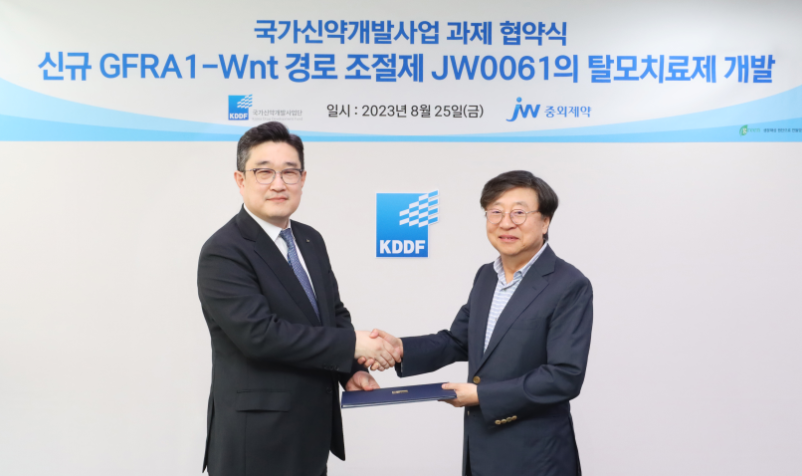
- JW Pharmaceutical is accelerating the development of innovative first-in-class drugs. Recently, the company's STAT3-targeted anticancer drug candidate entered Phase I clinical trials. In addition to targeted anticancer drugs, the company also owns first-in-class drug candidates in the fields of atopic dermatitis, hair loss, and blood cancer. JW Pharmaceutical's competitive edge in drug development is its R&D platform. JW Pharmaceutical is developing innovative new drugs by utilizing its own platforms JWELRY (JW Excellent LibraRY) and CLOVER (C&C researchLaboratoriesOmics serVER) and 3D cancer organoids secured through open innovation, and artificial intelligence (AI). 3 3 candidates enter clinical trials through the CLOVER platform...secures many first-in-class new drug candidates According to industry sources on the 21st, JW Pharmaceuticals received approval for its IND (investigational new drug application) to initiate a Phase I trial for its targeted anticancer drug candidate JW2286. The Phase I clinical trial will evaluate the safety and tolerability of JW2286 in 70 healthy Korean and Caucasian adults at Seoul National University Hospital. In the preclinical trial, JW2286 demonstrated efficacy and safety compared to standard of care in STAT3-overexpressing solid tumors. In particular, JW2286 showed an effect in hard-to-target triple-negative breast cancer. JW2286 is a first-in-class drug candidate that selectively inhibits STAT3. STAT3 is known to be one of the causes of various inflammatory diseases, autoimmune diseases, and cancer, and is highly expressed in various solid tumors, including gastric, colorectal, and triple-negative breast cancers. In the past, Japanese companies such as Sumitomo Dainippon Pharma and Otsuka Pharmaceutical have been developing STA3-targeted antitumor drugs, but have failed Phase I clinical trials due to lack of efficacy and toxicity issues. JW Pharmaceutical has secured a clear mechanism of action for targeting STAT3 through its drug discovery platform ‘CLOVER’. CLOVER can derive small molecules that inhibit or activate the STAT signaling pathway and is regarded as a platform that can perform holistic research on mechanisms and biomarkers. Through the platform, JW Pharmaceutical has been developing various new drugs through the efficacy of combining candidates with immuno-oncology drugs that utilize the characteristics of tumor immune microenvironment regulation and its biomarker development strategies. Currently, the company's new drug candidates that have entered clinical trials include JW2286, JW1601 for atopic dermatitis, and URC102 for gout. JW Pharmaceutical JW1601 has a dual mechanism of action that selectively acts on the histamine H4 receptor to block the activity and migration of immune cells that cause atopic dermatitis while inhibiting histamine signaling. Histamine is a neurotransmitter involved in allergic reactions. However, JW1601 reportedly failed to meet its primary endpoint in a global Phase II trial. As there are no atopic dermatitis drugs with this mechanism, it would have been the first new drug in its class if developed but was unable to reach the commercialization stage. JW Pharmaceutical plans to review the future development direction for JW1601 with the possibility of securing new indications in mind. URC102 is a best-in-class gout drug being developed by JW Pharmaceutical. The new drug candidate has a mechanism of action that inhibits urate transporter 1 (URAT-1), which allows uric acid to be absorbed back into the body and discharged well. It was approved for a Phase III clinical trial in Korea in 2022 and has entered clinical trials in China and Taiwan to confirm its commercialization potential. In addition to STAT3 anticancer drugs, JW Pharmaceutical is also exploring the possibility of developing a STAT3-targeted atopic dermatitis drug, STAT5/3 dual-targeted anticancer drug, and an antibody-drug conjugate (ADC) using the CLOVER platform. Makes bid into the development of first-in-class new drugs in the field of hair loss and blood cancer JW Pharmaceutical has secured the first-in-class new drug candidates 'CWP291' and 'JW0061' in the fields of hair loss and blood cancer. The two drug candidates, which target the Wnt signaling pathway, were derived from JW Pharmaceutical's ‘JWELRY’ platform. JW Pharmaceuticals has been studying the Wnt signaling pathway since the early 2000s and has accumulated data to develop the JWELRY platform. Wnt plays an essential role in cell proliferation or differentiation, and organ development and morphogenesis in animals. Wnt pathway inhibition inhibits the formation, proliferation, and metastasis of cancer cells in various tissues, inhibits cancer stem cell activity, and has an anti-fibrotic effect. On the contrary, activating the Wnt pathway is known to be involved in tissue regeneration by inducing stem cell and cell proliferation. JW Pharmaceutical is developing JW0061, a new drug candidate for hair loss, through the activation of the Wnt signaling pathway. The preclinical trial results that have been recently released show that JW0061 has demonstrated superiority in hair follicle production and hair growth compared to existing standard treatments. JW0061, a Wnt-targeted hair loss treatment, was selected as a ‘2023 1st National new drug development project In animal models with androgenetic alopecia, JW0061 was administered in four groups: low dose JW0061, high dose JW0061, standard of care (dutasteride or finasteride), and placebo. Results showed that both low and high doses of JW0061 accelerated hair growth compared to standard of care. JW Pharmaceuticals is also developing CWP291, which targets blood cancers by inhibiting the Wnt signaling pathway. CWP291 is a targeted anticancer drug that inhibits Wnt/β-catenin signaling. The potential of the drug candidate is being studied for multiple cancers, including acute myeloid leukemia, multiple myeloma, and gastric cancer. According to the Phase Ia trial results to date, one complete response (CR) and one partial response (PR) were confirmed among 54 patients with acute myeloid leukemia with CWP291.
- Opinion
- [Reporter’s View] Reliability Verification Review Committee
- by Lee, Hye-Kyung Jun 20, 2024 05:48am
- The Ministry of Food and Drug Safety has formed a Reliability Verification Review Committee. In the 'Guideline for Drug Manufacturing, Sales, and Import Marketing Authorizations and Labeling Change Authorizations,' which was revised by the MFDS on the 17th, a procedure was added for the Reliability Verification Review Committee to verify the reliability of the permit data submitted by companies during the drug approval and review process. In the past, if data with questionable reliability was submitted during the approval and review process, nothing happened if the applicant withdrew the data. Unreliable data is data that is false or falsely presented data. In other words, if false data was submitted intentionally or unintentionally and detected, it was possible for the applicant to just withdraw the application in a ‘no harm no foul’ sense. However, in the future, the data submitted to MFDS will not be nullified even if the company 'voluntarily withdraws’ or 'voluntarily cancels’ the data. The reliability of all the data submitted will be verified without exception. If the committee determines that the submitted data is not credible, it will notify the headquarters and the follow-up department to initiate pharmacovigilance. This process will be applied to all data that are currently under review, even before the committee is formed. What should not be overlooked is that a suspicion of the reliability of an item in the approval/review stage can taint the reliability of the entire drug manufacturing plant during pharmacovigilance. The MFDS said that if the reliability of a single data in the early stages of review is questioned, it is possible to suspect "falsehood" and "falsity" of the entire manufacturing process. Therefore, if data submitted during the approval/examination stage is even slightly wrong, whether intentionally or unintentionally, this one issue can lead to 'revocation of the GMP certificate’ in the pharmacovigilance process. The MFDS also said that it "cannot be said that it is irrelevant" that the "questionable data" submitted by companies that do not follow the principle of good faith may be subject to future disposals up to the revocation of their GMP certificate. Although it may seem like just the MFDS reorganizing, launching a new committee, and refining its procedures, the launch of the Reliability Verification Review Committee seems to be one of those serious regulations that can even lead to the revocation of GMP certificate.
