
- LOGIN
- MemberShip
- 2026-06-24 15:53:29
- Policy
- ‘Trelegy 200 Ellipta’ concludes negotiations with the NHIS
- by Lee, Tak-Sun Feb 15, 2024 05:59am
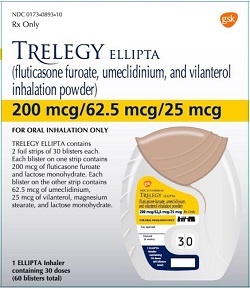
- ‘Trelegy 200 Ellipta Inhaler,’ a COPD triple combination therapy, has completed the negotiations with the NHIS in Korea. ‘Trelegy 200 Ellipta Inhaler,’ a triple combination therapy for COPD, has completed the negotiations with the National Health Insurance Service (NHIS). The drug is expected to be listed for health insurance reimbursement soon. According to industry experts on the 13th, ‘Trelegy 200 Ellipta Inhaler,’ a COPD triple combination therapy, has completed the negotiations with the NHIS and is expected to be listed for reimbursement after the final reporting to the Health Insurance Policy Review Committee. This drug has a unique feature of doubling the dosage of GSKs first triple combination therapy Trelegy Ellipta (ICS/LABA/LAMA). ‘Trelegy 200 Ellipta’ is used as a maintenance therapy for adults with asthma when the combination of long-acting beta2-adrenergic agonist and inhaled corticosteroid therapy is not providing adequate control. It contains three ingredients: fluticasone furoate, umeclidinium, and vilanterol. A combination of three ingredients provides enhanced therapeutic effects compared to existing drugs. The inclusion of LAMA in a drug combination is anticipated to help patients with asthma that is not adequately controlled with double therapy of ICS/LABA. When Trelegy 200 Ellipta is listed for reimbursement, the market for COPD triple combination therapy will become even more competitive. In January, Kolon Pharmaceutical released Trimbow (beclomethasone dipropionate plus formoterol fumarate hydrate plus glycopyrronium bromide), a single inhaler triple combination therapy. Clinical trials have shown that Trimbow has significant treatment effects by reducing exacerbations of moderate to severe symptoms, improving respiratory function, and enhancing the quality of life. Furthermore, Trimbow has been shown to improve respiratory function and reduce exacerbations of moderate to severe symptoms in patients with asthma. These results demonstrate that Trimbow is effective in managing symptoms and has a good safety profile in patients with COPD or asthma. Trimbow is advantageous for patients with small airway problems because its extra-fine particles can penetrate small airways. Trelegy 200 Ellipta passed the Drug Reimbursement Committee of the Health Insurance Review and Assessment Service (HIRA) last November. Afterwards, it was under negotiations with the NHIS.
- Company
- ‘Concerned about Korea’s stroke treatment system’
- by Son, Hyung-Min Feb 15, 2024 05:58am
- (from the left) Dr. Jae-Kwan Cha (Director, Quality Improvement Committee, KSS), Hee-Joon Bae (President, KSS), Kyung Bok Lee (Director, Policy Making Committee, KSS), The government announced the initiation of a pilot project to lay the foundation for a stroke care system, but its lack of content is being criticized by the academic society. Academics have suggested that securing human resources, establishing a compensation system, and revising the stroke disease group classification system should be made first for the establishment of any system. The Korean Stroke Society held a press conference at the Westing Chosun Hotel in Seoul on the 14th to explain its views. At the conference, Dr. Tae-jung Kim, Director of the Public Relations Committee (Department of Neurology, Seoul National University Bundang Hospital), pointed out that the number of stroke cases will continue to increase in Korea as the nation has become a super-aged society, but the lack of personnel for its care has not been addressed still. Kim said, “There are still many weak spots in stroke care in Korea. In one area where half of all stroke patients live, final stroke treatments such as intravenous thrombolysis and intra-arterial thrombectomy are not available.” According to Statistics Korea, Korea will enter the super-aged society later this year. By 2050, the country is expected to have about 20 million people aged 65 and older. Last year, 180,000 people had strokes, and the number is expected to soar to 340,000 by 2050 with population aging. Tae-Jung Kim, (Director, Public Relations Committee) Kim explained, "Currently, there are only 209 stroke specialists available in tertiary and university hospitals. In some regional cardiocerebrovascular disease centers, one specialist treats 400 to 500 stroke patients.” The government has announced that it will promote the "Cardiocerebrovascular Disease Problem-Solving Treatment Cooperation Network Health Insurance Pilot Project," a network-building and support project to encourage active communication and decision-making among medical institutions and specialists for stroke patients, and the "Essential Medical Care Package" to solve local essential medical care issues. More specifically, the government proposed policies to improve the training environment and expand essential medical care and personnel. However, the KSS stressed that before such measures, the number of on-call doctors and policy fee categories should be increased, and regional centers be expanded. Dr. Jae-Kwan Cha, Director of the Quality Improvement Committee at KSS (Department of Neurology, Dong-a Univ. Hospital), said, “The current number of stroke specialists falls short of the minimum number of people required to operate a stable medical system. The treatment system will collapse when we enter a super-aged society with the current level of specialists." "There are about 86 specialists in 74 university hospitals, but the number of specialists needs to be increased to 160 to ensure a stable personnel pool. If the government wants to build a specialist-centered medical care system, increasing the number of neurology specialists related to essential medical care should be a priority." Dr.Kyung Bok Lee, Director of the Policy Making Committee at KSS criticized how Korea currently classifies stroke as a general medical condition category and emphasized the need to revise it and move it to a specialized medical condition category. Lee said, “It's no secret that stroke is an essential critical emergency disease. Stroke is a severe condition. Nearly 80% of patients suffer from sequelae and need to be treated promptly. Currently, only a small proportion of stroke patients who undergo surgery or procedures are categorized as specialty care patients.” "This is why we need to classify stroke as a specialty disease to ensure that it is not neglected at tertiary hospitals that treat most of the acute stroke patients are often treated."
- Company
- SK Chemical ‘will continue pharma business without selling'
- by Kim, Jin-Gu Feb 15, 2024 05:58am
- SK Chemicals made an official announcement on the 14th that it has decided not to pursue the sale of its pharmaceutical business. The company said, "Amid the various internal and external variables and a rapidly changing business environment, SK Chemicals has decided to maintain its current business portfolio and pursue stable operation of its business." Last September, SK Chemicals began negotiations with Glenwood Private Equity, a South Korean private equity firm. At the time, the company formalized the sale, saying, "We are revisiting the sale of the pharmaceutical business unit and have signed a memorandum of understanding to set out the basic details prior to the signing of this agreement." The selling price was reportedly around KRW 600 billion. In October of last year and January of this year, the company made two clarifying disclosures, stating that "the parties are in talks on the specific terms and conditions." However, just over a month after the last announcement, the company made a final decision to continue the business. Going forward, SK Chemicals plans to focus on growing its pharmaceutical business and creating a new vision under the existing business portfolio structure. SK Chemicals will continue to expand its global CDMO business as it did last year, while also pursuing strategic tasks such as further growth of existing flagship products and joint marketing with domestic and foreign partners. In the mid-to-long term, SK Chemicals plans to secure tangible results from its recent open innovation program and build a new R&D infrastructure. SK Chemicals made record high sales with its pharmaceutical business last year. Last year, sales in SK Chemicals' pharmaceuticals business increased 19.9% YoY to record KRW 376.1 billion, driven by the sales of its flagship products. Operating profit was KRW 31.5 billion, down 6.3% from the previous year. SK Chemicals launched SK Plasma in May 2015 to focus on its blood products business. SK Plasma was established as a wholly owned subsidiary of SK Chemicals through a spin-off. At the end of 2017, SK Plasma became a subsidiary of SK Discovery as part of SK Chemical's reorganization into a holding company. In July 2018, its vaccine business was spun off to form SK Bioscience. SK Bioscience was initially launched as a 100% subsidiary of SK Chemicals, but its shareholding was diluted to 68.4% when SK Chemicals sold 7.65 million shares in a public offering in March 2021.
- Company
- Statin+ezetimibe combo mkt size nears ₩1 tril in KOR
- by Chon, Seung-Hyun Feb 15, 2024 05:58am
- The statin and ezetimibe combination continues to dominate the dyslipidemia treatment market. Prescriptions have more than tripled over the past 5 years, with the market size approaching nearly KRW 1 trillion. The rosuvastatin-ezetimibe combination drove market growth, posting more than KRW 600 billion in sales, while the atorvastatin-ezetimibe combination expanded more than threefold after the arrival of its generics. Prescriptions for pitavastatin-ezetimibe combinations also surged. According to the market research institution UBIST, the outpatient prescription market for the statin-ezetimibe combinations totaled at KRW 990 billion ($90.9 million) last year. This is up 24.1% from the KRW 797.6 billion in 2022. The statin-ezetimibe combination market has more than tripled in 5 years from KRW 282.3 billion in 2018. The growth has accelerated recently, more than doubling in the last 3 years from KRW 474.6 billion in 2020. This is because statin-ezetimibe combinations are more effective in lowering low-density lipoprotein cholesterol (LDL-C) and are less expensive than taking two separate drugs. Currently, 4 statin-ezetimibe combinations are available: simvastatin, rosuvastatin, atorvastatin, and pitavastatin. The rosuvastatin-ezetimibe combination owns the largest share of the statin-ezetimibe combination market. Last year, outpatient prescriptions for rosuvastatin-ezetimibe combinations totaled at KRW 616.4 billion, up 18.7% year-on-year. This is a 33.1% rise in 2 years from the KRW 450.6 billion in 2021. Compared to the KRW 197.1 billion it had made in 2018, the market has more than tripled in size in just 5 years. The rosuvastatin-ezetimibe combination accounted for 62.3% of the statin-ezetimibe combination market last year. Hanmi Pharmaceutical was the first to enter the market with the rosuvastatin-ezetimibe combination Rosuzet in 2015. Hanmi entered the market before its competitors by securing the rights to use ezetimibe from the patent holder MSD. Currently, 50 domestic pharmaceutical companies have entered the rosuvastatin-ezetimibe combination market. Prescription sales of Rosuzet amounted to KRW 178.8 billion last year, up 19.3% from the previous year, ranking second among all drugs. This is the third consecutive year it has ranked second since 2021. Rosuzet has boasted its flagship statin-ezetimibe combination drug status, posting outpatient prescription sales in the KRW 100 billion range for 4 consecutive years, after surpassing the KRW 100 billion mark for the first time in 2020. Last year, Rosuzet accounted for 29.0% of the rosuvastatin-ezetimibe combination market. Atorvastatin-ezetimibe combinations have also seen steep growth in recent years. Last year, prescriptions for atorvastatin-ezetimibe combinations totaled at KRW 267.3 billion, up 27.7% year-on-year. Their sales soared 103.4% in 2 years, from KRW 44.2 billion in 2021 to KRW 131.4 billion. The market size has expanded rapidly in a short period of time with the introduction of Atozet generics into the market in bulk. Until 2020, only 1 atorvastatin-ezetimibe combination product – Organon Korea’s Atozet, was available in Korea. However, Since 2021, more than 100 domestic companies have entered the atorvastatin-ezetimibe market simultaneously, expanding the market size. In October 2020, Chong Kun Dang received approval for Lipilouzet, a combination drug that contains the same ingredients as Atozet, after clinical trials. By this time, 22 companies had been approved to produce Lipilouzet-authorized generics and were listed for reimbursement from April 2021. Beginning in February 2021, 88 pharmaceutical companies additionally received authorizations for Atozet generics and were listed for reimbursement in May, one month later than Lipilouzet-authorized generics. In June 2021, two more companies received approval for Atozet generics, bringing the total number of domestic companies entering the Atozet market to 113. The atorvastatin-ezetimibe combination market has expanded by 240.5% in 3 years since the introduction of the generics, up from KRW 82.8 billion in 2020 when only Atozet was available. The atorvastatin-ezetimibe combination's share of the statin-ezetimibe market rose to 43.3% last year from just 22.0% in 2018. Livalozet, the first pitavastatin-ezetimibe combination that was launched by JW Pharmaceuticals in 2021, has recently gained prominence in the statin-ezetimibe combination market. Pitavastatin is the active ingredient in JW Pharmaceutical's flagship hyperlipidemia drug Livalo. After launched in October 2021, Livalozet posted prescription sales of KRW 31.8 billion in 2022, which more than doubled to KRW 72 billion last year. Simvastatin-ezetimibe combinations have been less successful. Last year, prescription of the simvastatin-ezetimibe combinations amounted to KRW 34.3 billion, down 8.0% YoY. It was the third consecutive year of decline after reaching KRW 42.9 billion in 2020. Prescriptions for the simvastatin-ezetimibe combinations were down 20.1% last year compared to 3 years ago. The original simvastatin-ezetimibe combination product, Vytorin from Organon Korea, was the first to enter the statin-ezetimibe combination market. However, its prescription market has gradually shrunk compared to other combinations. The simvastatin-ezetimibe combination accounted for 21.4% of the statin-ezetimibe market in 2017, but its share shrank to 5.6% last year.
- Policy
- The guidelines for PVA will be revised soon
- by Lee, Tak-Sun Feb 15, 2024 05:58am
- The National Health Insurance Service (NHIS) is likely to seek opinions from the pharmaceutical industry soon to revise the operational guidelines on the price-volume agreement (PVA) program. The revised guidelines draw attention as they include an agenda for easing on products that have reduced their prices more than three times in five years, as announced last year. According to industry experts, on the 14th, the NHIS plans to revise the PVA negotiation’s operational guidelines, including an agenda announced last December regarding easing the PVA for innovative new drugs. The pharmaceutical industry expects the NHIS to conclude revising the guidelines before the type ‘Da’ monitoring starts in April. Therefore, the NHIS will likely consult with pharmaceutical organizations, including the Korea Pharmaceutical and Bio-Pharma Manufacturers Association (KPBMA), for their opinions. What is most interesting is the agenda focusing on easing regulations for products that have reduced their prices more than three times. On December 22nd, the Biohealth Innovation Committee, chaired by the Prime Minister, released a report stating that pharmaceuticals produced by companies that have received an innovative designation or meet the standards will be eligible for an adjusted rate of price reduction on the third round. For instance, drugs that have already undergone two rounds of price reduction through PVA negotiations will receive a reduced rate of price reduction this year. Products undergoing the fourth and fifth rounds of price reductions will be subject to a lower rate of reduction. Upon completion of the revision guidelines this year, many products are expected to receive benefits. The industry anticipates that the rate of price reduction will fall between 30-50%. If the set reduced price is 1,000 won, then 300 won to 500 won may be deducted. However, the final revision measures will be determined following discussions among departments including the Ministry of Health and Welfare (MOHW). According to research conducted in 2022 on the evaluation of achievements and improvement measures of the PVA program, 26 products with the same ingredient have repeatedly undergone price reductions more than three times in 10 years. Among these products, nine from Korean pharmaceutical companies and 17 from multinational pharmaceutical companies have experienced price reductions more than three times. As a result, adjustments are expected to lead to lower reduction rates for many products. The revised guidelines are expected to include differential application of reductions based on claim amounts. Higher reduction rates will likely be applied to higher claim amounts, with 30 billion won as a reference amount. Also, exclusion criteria will likely be updated to include measures that raise the claim amounts to 3 billion won, up from the current claim amount of less than 2 billion won. Furthermore, the guidelines may contain measures for products with temporary increases in volume due to infectious diseases and drug shortages, allowing for a reduction rate or refund. However, the plan to increase the maximum reduction rate from the current 10% to 15% will be reflected through future revisions.
- Policy
- Price cut hold for Forxiga, Xigduo, Atmeg Combi are extended
- by Lee, Jeong-Hwan Feb 14, 2024 05:40am
- The administrative stay of execution of the price reduction disposition for AstraZeneca's diabetes drugs Forxiga (dapagliflozin), Xigduo (dapagliflozin+metformin), and Korea United Pharm’s Atmeg Combigel (atorvastatin 10 mg + omega 3) has been extended, and the insurance ceiling price for the drugs will remain unchanged until June 30. On the 7th, the Ministry of Health and Welfare announced the extension of the stay of execution of these drugs in ‘the drug reimbursement list and reimbursement ceiling price table.’ This is the result of the Seoul Administrative Court's decision to grant AstraZeneca and United Pharmaceuticals Korea's request to suspend enforcement of drug price cuts as filed by AstraZeneca and Korea United Pharmaceuticals. AstraZeneca filed for the stay of execution, claiming that the price reduction was unfair due to the difference in indications between the original Forxiga and generic drugs. Korea United Pharm also filed for a stay of execution after its 2-year drug price premium was terminated due to the listing of other 'atorvastatin 5 mg + omega-3 combination drugs' that contain different dosages of the ingredients. The company had received the pricing premium because there had been fewer than 3 generic companies that produced the same ingredient. As a result, the price of Forxiga will remain at KRW 734, and the price of Xigduo XR Tab 10/500 mg and 10/1000 mg will remain at KRW 736. The MOHW’s reduced price is KRW 514 for Forxiga, KRW 473 for Xigduo 10/500 mg, and KRW 512 for Xigduo 10/1000 mg. The insurance ceiling price of Atmeg Combigel will remain at KRW 1,219. The MOHW’s reduced price was KRW 960.
- Policy
- Chinese MM drug Xpovio reattempts reimb listing in KOR
- by Lee, Tak-Sun Feb 14, 2024 05:40am
- A new drug for multiple myeloma that was developed by the Chinese pharmaceutical company Antengene is attempting reimbursement listing again in Korea. The drug’s name is Xpovio Tab 20mg (Selinexor). The drug received a non-reimbursement decision at the Drug Reimbursement Evaluation Committee meeting that was held in November last year. According to industry sources on the 8th, Antengene applied for the reimbursement listing of its Xpovio 20mg Tab. to HIRA. The drug was approved in August 2021 for two indications: ▲ for use in combination with dexamethasone for the treatment of adult patients with relapsed and/or refractory multiple myeloma who have received at least 4 prior therapies and whose disease is refractory to at least 2 proteasome inhibitors (PI), at least two immunomodulatory medicinal products (IMiD), and an anti-CD38 monoclonal antibody (mAb); and ▲ as a monotherapy for the treatment of adult patients with relapsed/refractory diffuse large B-cell lymphoma (rrDLBCL) who have received at least two prior lines of treatment. The company has since applied and filed for reimbursement coverage, but its first reimbursement attempt was thwarted by a non-reimbursement decision at the DREC level in November last year. Established in 2017, Antengene is an anticancer drug specializing company that has received investment from the global pharmaceutical giant BMS Pharmaceuticals. Its headquarters is based in Shanghai, China. In Korea, the company obtained import authorization for the drug in 2021 and appointed Min-Young Kim, former head of Ipsen Korea, as its General Manager. Antengene successfully applied for Xpovio ‘s reimbursement from Canada in August 2022, raising expectations for its reimbursement listing in Korea. Canada is one of the 8 countries that Korea references for new drug reimbursement. The company's success in obtaining reimbursement in the US after Canada raised expectations that it would be able to set an appropriate drug price in Korea, but it failed to cross HIRA’s threshold. However, multiple myeloma patients are calling for its expedited reimbursement, explaining how Xpovio is the only drug available in the fifth line for their treatment. Therefore, the public’s eyes are on whether the authorities will fulfill the dire wishes of the patients and reimburse the drug this time. Meanwhile, the first new drug made by a Chinese pharmaceutical company to be reimbursed in Korea is Beigene Korea's blood cancer drug ‘Brukinsa’. The drug has been reimbursed for Waldenström macroglobulinemia (WM) since May last year.
- Company
- SK Chemical’s pharma biz recorded sales of 376.1 bil. won
- by Chon, Seung-Hyun Feb 14, 2024 05:40am
- SK Chemical's pharmaceutical business, which is to be sold, has reached its sales peak. The company's pharmaceuticals and new drugs under contract have demonstrated stable growth in the prescription market. On the 8th, SK Chemical reported that its pharmaceutical business generated sales of 376.1 won last year, representing an increase of 19.9% YoY. The operating profit for the same period was 31.5 billion won, showing a slight decrease of 6.3% YoY. Last year, the sales of SK Chemical’s pharmaceutical business recorded the highest amount in its history. In Q4 of last year, SK Chemical’s pharmaceutical business generated sales of 105.8 billion won, marking an increase of 32.4% YoY. As a result, the quarterly sales exceeded 100 billion won for the first time. The Quarterly sales of SK Chemical Pharmaceutical business (Left) Operating Profit (Right) trend (Unit: 100 million won, Source: SK Chemical). In the prescription market, SK Chemical’s primary products performed well. According to UBIST, a pharmaceutical market research company, the total prescription sales of ‘Joins,’ an osteoarthritis treatment, was 48.3 billion won last year, reflecting a 2.3% YoY increase. Despite being launched in 2002, Joins, a natural medicine developed by SK Chemical, continues to perform well in the market even after 20 years. The blood circulation improvement drug ‘Ginexin-F’ has generated prescription sales of 26 billion won, marking a 12.3% YoY compared to the prescription volume of the previous year. The prescription sales of Arthritis treatment Feburic in Q2 of last year amounted to 18.7 billion won, an increase by 20.2% YoY. Ultracet, a new drug introduced by SK Chemical, is showing significant growth. In February 2021, SK Chemical signed a domestic sales contract with Janssen to distribute painkiller Ultracet in Korea. The agreement included four products of Ultracet Tab, Ultracet Semi Tab, Ultracet ER Tab, and Ultracet ER Semi Tab. In the last year, Ultracet ER Tab generated outpatient prescription sales of 22.7 billion won, a 13.8% YoY increase. The analysis suggests that the surge in patients with influenza and common cold following Covid-19 endemic increased demand for painkillers, thereby resulting in the rise in prescriptions of Ultracet. SK Chemical is in talks with Korean private equity fund (PEF) Glenwood Private Equity Co (Glenwood PE) to sell its pharmaceutical business. SK Chemical is in the process of selling its pharmaceutical business. In September of last year, the company announced that “We are reviewing terms for selling the pharmaceutical division and we have signed a memorandum of understanding (MoU) before the contract.” The selling price is expected to be around 600 billion won. “We are discussing specific terms,” SK Chemical provided further explanation last month in an official announcement. If SK Chemical divests its pharmaceutical business, it will focus solely on its green chemical business, including copolyesters and functional materials. SK Chemical sold its bioenergy business in 2020. SK Chemical spun off its blood and vaccine businesses into separate entities. In May 2015, the company established SK Plasma to specialize in blood products, followed by SK Bioscience, which focuses on vaccines, in July 2018.
- Company
- Market for Pulmicort and Pulmican soars 2.6 times in 2 years
- by Chon, Seung-Hyun Feb 14, 2024 05:40am
- Last year, the prescription market for asthma medications containing the ‘budesonide’ ingredient expanded to its largest size ever. There have been significant demands for the treatment due to the circumstances surrounding the pandemic and endemic. At the end of last year, the drug pricing increase led to manufacturing and the prescription market expansion. Raising drug prices during shortages yielded a virtuous cycle of resolving the imbalance between supply and demand. According to UBIST, a pharmaceutical market research agency, on the 14th, outpatient prescription sales of asthma medications with a single component of budesonide totaled 9.9 billion won last year, representing an increase of 39.1% compared to the previous year. Budesonide is a medication used to treat asthmatic bronchitis and acute bronchitis in the larynx of infants and young children. There are two available budesonide products in Korea, including AstraZeneca’s Pulmicort and Kuhnil’s Pulmican. The yearly sales of Pulmicort and Pulmican in outpatient prescriptions (Unit: 1 million won, Source: UBIST). Pulmicort and Pulmican prescription sales last year rose 163.1% in two years compared to the 3.8 billion won generated in 2021. In the same period, Pulmicort rose 155.6%, from 2 billion won to 5 billion won, and Pulmican rose 171.3%, from 1.8 billion won to 4.9 billion won. Since the end of 2021, the treatment market for budesonide has expanded significantly due to the rapid increase in the number of COVID-19 patients. There was a higher demand for Asthma medications last year due to an increased number of patients with the common cold or influenza in addition to COVID-19 patients. The surge in demand resulted in an inadequate supply of drugs due to an imbalance between supply and demand. The increase in drug pricing of Pulmicort and Pulmican in the end of last year may have contributed to market expansion. The Ministry of Health and Welfare (MOHW) raised the insurance upper price limit of Pulmican by 18.5% from 946 won to 1,121 won. Pulmicort price rose 12.5% from 1,000 won to 1,125 won. The ministry reached an agreement with pharmaceutical companies to increase drug prices to encourage production expansion. This was to address the issue of drug shortages resulting from rising demand. Pulmicort and Pulmican coproduced prescription sales of 1 billion won in November of last year. After the increase in drug pricing, prescription sales in December rose by 39.4% to 1.4 billion won compared to the previous month. Compared to the 1 billion won in December 2022, the sales rose 36.1% YoY. Pulmicort generated prescription sales of 700 million won in December last year, a 43.3% expansion compared to the previous month and an increase by 76.8% YoY. Pulmican generated prescription sales of 500 million won in November and 700 million won in December, an increase by 35.5%. The monthly sales of Pulmicort and Pulmican in outpatient prescriptions (Unit: 1 million won, Source: UBIST). Prescription volumes for both Pulmicort and Pulmican increased more than the rate of drug price increases. Pharmaceutical companies expanded supply following insurance price raises, and with supply imbalances resolved, the prescription market showed growth rates higher than those of drug price increases. The increase in drug pricing for Pulmican and Pulmicort is the fourth instance of drug pricing adjustments for drugs in short supply. The MOHW raised the insurance upper price limit of 18 items containing acetaminophen 650 mg by up to 76.5% beginning in December 2022. The insurance upper price limit of acetaminophen 650 mg used to be between 43 to 51 won, but it has now increased to 90 won. Since pharmaceutical companies were reluctant to expand production due to the low-profit cost structure, the MOHW decided to raise the prices collectively. The MOHW initially agreed to collectively adjust the prices to 70 won last December and maintain the raised price until March. The MOHW increased the drug pricing of laxatives with magnesium hydroxide as an ingredient. Magmil’s price grew by 27.8%, from 18 won to 23 won. Cho-A’s Marogel price increased from 15 won to 22 won. Sinil Pharm’s M Tab. Sinil saw an increase in price from 16 won to 22 won. In October of last year, the prices of four pseudoephedrine drugs with a single-component were raised by up to 45%. Insurance upper price limit of Shinil Pharmaceutical's Sinil Pseudoephedrine increased from 20 won to 29 won, up by 45%. Samil Pharmaceutical's Sudafed increased from 23 won to 32 won, up by 39%. Sama Pharm's Schdafen and Kolon Pharma's Cosue also saw their insurance drug prices adjusted upwards by more than 30%, from 23 won to 30 won and 31 won, respectively.
- Policy
- Will Enhertu·Ilaris·morning sickness drugs be reimbursed
- by Lee, Tak-Sun Feb 14, 2024 05:40am
- Whether Enhertu Inj 100mg, Ilaris Injection Sol, and the morning sickness drugs that had passed the Health Insurance Review and Assessment Service's Drug Reimbursement Evaluation Committee review on the 1st, will be listed for reimbursement in April is gaining attention. As all three drugs are highly sought-after by patients and the public, the government is trying to get them on the reimbursement list ahead of the 22nd National Assembly election scheduled on April 10. According to industry sources on April 13, the companies for Enhertu Inj 100 mg (trastuzumab deruxtecan), Ilaris Injection Sol (canakinumab), and morning sickness drugs (doxylamine succinate + pyridoxine hydrochloride) I are expected to enter drug pricing negotiations with the National Health Insurance Service soon. Enhertu Inj is used to treat HER2-positive breast cancer and HER2-positive gastric or gastroesophageal junction (GEJ) adenocarcinoma. It is considered to be one of the most potent breast cancer drugs ever developed. Ilaris is used for rare diseases such as criophorin-associated periodic fever syndrome, which affects only 13 patients in Korea. Also, morning sickness drugs have been sold off-label at a price of KRW 100,000 per month ever since its launch in 2016. Due to its high price, voices had been rising even among the general public, requesting its reimbursement listing. At the DREC meeting that was held on the 1st, the committee members acknowledged the reimbursement adequacy of Enhertu and Ilaris, and granted conditional approval for the 7 morning sickness drugs including Diclectin Enteric Coated Tab, on their reimbursement adequacy if the companies accept a price below the assessed amount. Accordingly, the NHIS and the companies immediately started the drug pricing negotiation process for Enhertu and Ilaris, and the companies of the morning sickness drugs can also start negotiations if they accept the assessed price within 30 days. The government had expressed determination to expedite the reimbursement listing of these drugs. Also, the National Health Insurance Service had reportedly held preliminary discussions with AstraZeneca to expedite the pricing process. Furthermore, as Enhertu had been reviewed by DREC twice to reach the appropriate drug price level, its pricing negotiations with the NHIS are expected to be conducted relatively smoothly. The company had faced difficulties passing the economic evaluation process for Enhertu, and although the drug’s ICER ICER (incremental cost-effectiveness ratio) value was reportedly slightly higher than the threshold, the government decided to flexibly apply the threshold and accept its reimbursement adequacy. Ilaris is also expected to be reimbursed quickly as the National Assembly and patient organizations are calling for its prompt reimbursement. The NHIS has 60 days to negotiate the drug price, but it aims to reach an agreement sooner and submit it to the Health Insurance Policy Deliberation Committee by late March. Although a price acceptance process remains for the morning sickness drugs, the government's willingness to move forward with the process is raising the possibility of their speedy reimbursement as well. Through the imbuement listing, the health authorities are hoping to create a favorable public opinion for the ruling party before the general election. In response, the Ministry of Health and Welfare is expected to hold a meeting with the 8 morning sickness treatment companies around next week to clarify the government’s stance on their speedy reimbursement. An industry official said, "The fact that the MOHW is in talks with companies even before the NHIS negotiations have started is a positive sign for reimbursement. We believe the government will also hold an open ear to the company’s voices for prompt reimbursement listing.”
