
- LOGIN
- MemberShip
- 2026-06-21 20:16:28
- Will the dyslipidemia drug Leqvio be reimbursed for ASCVD?
- by Eo, Yun-Ho Feb 21, 2025 05:56am
- The industry’s attention is focused on whether progress will be made in the discussion of insurance reimbursement coverage for the new dyslipidemia drug Leqvio. Novartis' siRNA drug Leqvio (inclisiran) applied for a new drug reimbursement listing at the same time as it obtained approval from the Ministry of Food and Drug Safety in June last year, but there are significant differences of opinion on the scope of its reimbursement standard set during the review process. Dailypharm coverage found that Leqvio’s reimbursement agenda will be submitted to the Drug Reimbursement Subcommittee today (21st). The core of the discussion on the reimbursement criteria for Leqvio is whether it will be recognized for the reduction of cardiovascular events in patients with atherosclerotic cardiovascular disease (ASCVD), which has not yet been officially approved. Leqvio is only currently indicated for the treatment of the rare condition, familial hypercholesterolemia. The PCSK9 inhibitor 'Repatha (evolocumab)', which can be considered Leqvio’s competitor, was also approved for reimbursement only for familial hypercholesterolemia at the time of its initial listing, but its reimbursement criteria were expanded thereafter. Since the government has already granted reimbursement for its competitor that has the same therapeutic position, it is possible that the government has decided that it would not be a problem to delay the reimbursement of Leqvio for the same indication as much as possible. Currently, Repatha is already reimbursed in 41 countries, including major countries, and Leqvio is already reimbursed in 39 countries. However, it is worth considering whether Leqvio’s convenience in administration, being administered twice a year by medical staff directly at the hospital, has not been taken into account. Not only is the number of doses reduced, but the advantage is that the injection is administered by medical staff at the hospital rather than by the patient. 78.4% of the target patient population, including patients with atherosclerotic cardiovascular disease (ASCVD) who have been administered Leqvio for up to 6.8 years or more, have reached the target LDL-C level. In a real-world study in the United States, the group with high medication adherence (fully adherent) among patients with ASCVD, including myocardial infarction, had a 27% lower risk of major adverse cardiovascular events (MACE) compared to the low-adherence group. In addition, it was found that patients with ASCVD who were highly compliant with their medication had lower annual medical costs than those with low compliance, which reduced the risk of recurrent cardiovascular disease and the economic burden of ASCVD patients. In other words, the convenience of taking the drug provided by Leqvio has clear therapeutic benefits. If Leqvio’s reimbursement standard for ASCVD is not approved this time, the company will have to wait for the results of the CVOT (Cardiovascular Outcome Trial) and wait for official approval, which would take several years. The market for statins and ezetimibe combination drugs alone is worth KRW 1 trillion, and if we add the funds spent on statins and PCSK9 inhibitors, the funds spent on lowering LDL-C alone are estimated to be between KRW 1.5 trillion to KRW 2 trillion. However, the LDL-C target achievement rate for ASCVD patients in Korea is only 24%. “In the case of high-risk patients, medication adherence is especially important for lipid-lowering treatment. In reality, medication adherence to current treatment options is low, and only 3 out of 10 patients still achieve the target LDL-C level. This is proof that new treatment options are urgently needed for lipid-lowering therapy,” said Jon Suh, Secretary of the Insurance Committee of the Korean Society of Cardiology and a member of the Insurance Committee of the Korean Society of Cardiology. He added, “If patients are not benefiting from the coverage of the treatment benefits of Leqvio, which can be used to manage LDL-C and prevent or delay the occurrence of cardiovascular events, this could lead to national losses due to an increase in cardiovascular disease mortality in the long term.”

- Policy
- Pfizer 'Vyndamax' reimbursed from March…KRW 100,000/cap
- by Lee, Tak-Sun Feb 21, 2025 05:56am
- Product photo of Vyndamax About 20% of the non-reimbursed price…significantly reduces patient with a special exemption of calculation provisions The completion of negotiations with the National Health Insurance Service (NHIS) has been reported, so the reimbursement listing was a matter of time. The ceiling price is reported to be KRW 100,000 per capsule. According to industry sources on February 19, Vyndamax Cap was the only treatment for ATTR amyloidosis with cardiomyopathy (ATTR-CM). As Vyndamax Cap becomes added to the reimbursement list in March, the ceiling price is reported to be set as KRW 100,000. The survival time for ATTR-CM is 2 to 3.5 years when it is not adequately treated. It is a disease mistaken for simply heart failure, but the treatment outcome is poor due to the unavailability of treatment. The efficacy of Vyndamax was demonstrated through the Phase 3 ATTR-ACT study, which showed Vyndamax reduced cardiovascular-related events and improved the 6-minute walking test in CM patients. However, after domestic approval in 2020, it faced difficulty in listing reimbursement. In April 2022, the drug was considered for the Health Insurance Review and Assessment Service (HIRA)'s Drug Reimbursement Evaluation Committee (DREC), but reimbursement appropriateness was not approved. Ultimately, high drug price was the problem. Vyndamax costs US$ 225,000 (approximately KRW 300 million) annually, and in South Korea, non-reimbursed treatment is reported to cost KRW 150 million (KRW 410,000 per capsule) annually. If the ceiling price is KRW 100,000 per capsule, it costs 20% less than when it was non-reimbursed. Patients only pay a co-payment of 10% with a special exemption of calculation provisions, so the economic burden is expected to be less. If the company has reached a risk-sharing agreement (RSA), drug cost is expected to decrease even more. The number of ATTR-CM patients in South Korea is reported to be 75 as of 2021.

- Company
- The aftermath of the prolonged medical care gap continues
- by Moon, sung-ho Feb 20, 2025 05:59am
- Global pharmaceutical companies are launching new blood cancer drugs in Korea one after another, but the situation on site is impeding their access. According to industry sources on the 17th, the the medical school admission expansion policy last year has led to a continued mass resignation of residents, which has disrupted the treatment of blood cancer at university hospitals. # The blood cancer treatment environment in Korea has been improving with an increasing number of “weapons” that medical staff can use due to the recent domestic approval and coverage of various treatments. From CAR-T (chimeric antigen receptor T cell) therapy to bispecific antibody therapy, various options are being introduced into clinical settings in Korea, expanding their use. If we were to choose a therapy that has been applied to clinical settings in Korea, the representative example is Novartis' Kymriah (tisagenlecleucel), which has been reimbursed by the National Health Insurance Service as a CAR-T therapy. In addition, the Ministry of Food and Drug Safety approved Jassen Korea’s Carvykti (ciltacabtagene autoleucel), Gilead Sciences Korea’s Yescarta (exicabtagene ciloleucel) and the new domestic drug, Curocell’s Limkato (Anbasel) is awaiting approval in Korea. Also, when looking at bispecific antibody treatments with indications for blood cancers, ▲ Roche's Lunsumio (mosunetuzumab), Columvi (glofitamab) ▲ Janssen's Rybrevant (amivantamab), Tecvayli (teclistamab), Talvey (talquetamab) ▲AbbVie’s Epkinly (epcoritimabab) ▲Pfizer’s Elerexfio (elranatamab), etc. All seven treatments have been approved in Korea and are currently being tried for reimbursement. In fact, Roche's Columvi, AbbVie's Epkinly, and Janssen's Tecvayli all attempted to pass the Health Insurance Review and Assessment Service's Cancer Disease Deliberation Committee, the first hurdle to reimbursement. Pfizer's Elerexfio was also submitted to the first Cancer Disease Deliberation Committee for deliberation this year and discussed the need to set reimbursement standards. All of these treatments failed to set reimbursement standards at the time, but depending on whether they are further challenged in the future, they are expected to be covered by insurance within the year. As a result, the expectations of patients for such treatment have greatly increased as the range of treatments has expanded beyond hematopoietic stem cell transplantation. However, due to the medical crisis that broke out last year, some university hospitals are still unable to accept new patients in the field of blood cancer. In the case of blood cancer, treatment is mainly provided at certain university hospitals, but these hospitals are not accepting new patients, causing a situation in which patients are flocking to other hospitals. Even hospitals where the patients flock are saying that they may no longer be able to accept new patients due to the lack of residents. A professor of hematology at a university hospital who requested anonymity said, “Some of the major university hospitals in Seoul are also unable to accept new patients in the field of hematological cancer,” and pointed out the problem, saying, “Even in northeastern Seoul, there is only one hospital that provides treatment for hematological cancer.” He added, “The situation is the same nationwide. People from Gangwon-do, Chungcheong-do, and even Gyeongsang-do province have no choice but to go to the capital region for treatment of blood cancer, but these hospitals are not accepting new patients.” He also complained, “Even hospitals that accept new patients are having difficulty coping with the constant influx of patients due to the lack of resident doctors. We cannot continue to endure the situation any longer.”
- Company
- Jeil’s super-antibiotic cefiderocol approved in Korea
- by Nho, Byung Chul Feb 20, 2025 05:59am
- Jeil Pharmaceutical (CEO Seok-je Sung) announced on the 19th that it has received approval from the Ministry of Food and Drug Safety to market the drug Fetroja Inj 1g’ (cefiderocol sulfate tosylate) for the treatment of multidrug-resistant gram-negative bacterial infections. With the approval, adult patients may use Fetroja for the treatment of the following infections caused by susceptible Gram-negative microorganisms: • Complicated Urinary Tract Infections (cUTI), including Pyelonephritis • Hospital-acquired Bacterial Pneumonia and Ventilator-associated Bacterial Pneumonia (HABP/VABP) Prior to this domestic approval, Fetroja Inj has been approved in more than 10 countries around the world, including the US, Europe, and Japan, and was designated by the Ministry of Food and Drug Safety as a national essential medicine in April 2024 as a medicine necessary for responding to public health crises and promoting public health. Fetroja Inj, which was developed by Shionogi, is the world's first siderophore cephalosporin antibiotic, it binds with iron and is then absorbed into the cell through the bacteria's iron-porin channels to overcome the problem of existing antibiotics losing their effectiveness due to resistance. Through this different mechanism of action, it shows a strong antibacterial effect, and Jeil Pharmaceutical expects it to present new possibilities in the treatment of infections caused by multidrug-resistant pathogens that have been difficult to effectively treat with existing treatment options. Fetroja Inj demonstrated in-vitro activity against various antibiotic-resistant (AMR) pathogens, including carbapenem-resistant enterobacteriaceae (CRE), carbapenem-resistant acinetobacter baumannii (CRAB), and carbapenem-resistant pseudomonas aeruginosa (CRPA) that produce metallo-beta-lactamase (MBL). A Jeil Pharmaceutical official said, “Fetroja is an innovative antibiotic that was named to conquer pathogens by using the Trojan horse mechanism of penetrating pathogens through the iron (Fe) forin channel. It will be an important treatment option for patients with complicated urinary tract infections, including nephropyelitis, and ventilator-associated pneumonia, which was difficult to treat due to multidrug-resistant bacteria infection.” Jeil Pharmaceutical signed an exclusive domestic supply agreement with Ping An-Shionogi in July 2022 and secured the rights to develop and commercialize ‘Fetroja Inj.’ Meanwhile, Shionogi is a global research-oriented pharmaceutical company established in 1878, and has a long history and expertise in the development of infectious disease treatments. In particular, it is conducting continuous research and development in the fields of antibiotics, antiviral drugs, and central nervous system treatments, and currently has subsidiaries in Japan, the United States, Europe, and China. Ping An-Shionogi was established in 2020 as a joint venture between the Japanese company Shionogi and the Chinese company Ping An, and introduced the Asian rights to “Fetroja Inj.” However, in December 2024, Shionogi acquired all of Ping An's shares and incorporated it as a subsidiary of Shionogi.
- Company
- Myelofibrosis drug 'Omjjara' attempts at reimb listing
- by Eo, Yun-Ho Feb 20, 2025 05:59am
- 'Omjjara,' a targeted treatment for myelofibrosis, attempts to be added to the National Health Insurance reimbursement list. According to industry sources, GSK Korea submitted a reimbursement application for its new myelofibrosis drug, Omjjara (momelotinib), at the end of last year, and is awaiting to be considered for the Health Insurance Review and Assessment Service (HIRA)'s Cancer Disease Review Committee (CDRC). The company has applied for the indication to treat 'adult patients with intermediate or high-risk myelofibrosis who have anemia.' The drug has approved indications to treat primary myelofibrosis, post-polycythemia vera myelofibrosis, or post-essential thrombocythemia myelofibrosis. Unlike single-target drugs, Omjjara is a multi-target drug that blocks three key signaling pathways. It is expected to have a significant treatment effect. This drug has an inhibitory ability along three key signaling pathways, including JAK1 and JAK2 proteins that are targets of previous drugs, along with activin A receptor type 1 (ACVR1). The recommended dosage is once daily oral administration of 200 mg, and it can be taken regardless of meal intake. Myelofibrosis is a rare blood cancer in which the buildup of fibrosis in the bone marrow causes symptoms such as anemia, thrombocytopenia, and enlarged spleen and liver. It occurs in 1 out of 100,000 worldwide. In South Korea, it has been reported that as of 2023, about 2292 patients have received inpatient and outpatient treatments. Patients who have anemic symptoms have poor prognosis after treatment, and the problem is most patients experience anemia. According to the research, 87% of myelofibrosis patients were reported to be anemic at the time of diagnosis. In another study, 46% of patients required blood transfusion after one year of diagnosis. Typically, anemia in myelofibrosis patients increases the death risk by twofold compared to other prognostic factors, such as age, increased white blood cells, and symptoms throughout the body. The clinical efficacy and safety profile of Omjjara were confirmed through the Phase 3 'SIMPLIFY-1 study' and 'MOMENTUM study.' The studies confirmed that the drug improved key symptoms, such as enlarged spleen, in adult myelofibrosis patients and reduced dependence on blood transfusions in anemic patients. Firstly, the SIMPLIFY-1 study directly compared Omjjara to 'Jakavi (ruxolitinib)' in 432 adult myelofibrosis patients without prior JAK inhibitor therapy. Subgroup analysis was performed in patients with anemia. The results showed that Omjjara was confirmed to be non-inferior to ruxolitinib in terms of the primary efficacy endpoint, which was a spleen volume at week 24 (≥35% reduction). Non-inferiority was not identified in the total symptom improvement score. The rate of transfusion independence in each patient group was confirmed. The rate of patients with transfusion independence in the Omjjara treatment group was 66.5%, and those in the ruxolitinib treatment group were 49.3%, showing that the Omjjara treatment group had significantly lower transfusion independence. In the MOMENTUM study, which was another basis of approval, the efficacy and safety of Omjjara to 'danazol' were compared in 195 adult patients with myelofibrosis who had previously undergone JAK inhibitor therapy, exhibited symptoms, and had anemia. All study participants had been treated with ruxolitinib before, and 4.6% of the patients received 'fedratinib.' The common primary efficacy endpoint was the percentage of patients with a 50% or greater reduction in the Total Symptom Score (TSS) and transfusion independence at week 24.
- Company
- Organon Korea releases first product after spinoff
- by Whang, byung-woo Feb 20, 2025 05:58am
- Organon Korea is launching a new product for the first time since its spin-off in June 2019 and is beginning to expand its influence in earnest. The product, which was unveiled about 3 years after the official launch of the Korean subsidiary, is JADA, a medical device used to control and treat postpartum hemorrhage. The company plans to target the market with its women-focused strategy that differentiates itself from other companies. At a media session held on the 19th, the company announced the launch of JADA and expressed Organon's commitment to improving women's health and safe birthing environments in this era of low fertility. JADA is a new technology that has emerged 15 years after the previously used “intrauterine balloon tamponade and compression suture.” In the case of intrauterine balloon tamponade and compression, hemostasis was achieved by directly applying pressure to the inner wall of the uterus for 12 to 24 hours, but JADA induces physiologic contraction by creating a negative pressure in the uterus within a few minutes and applying pressure (up to 90 mmHg). In the PEARLE trial, 94% of patients could control postpartum hemorrhage without additional treatment, and the median time taken to control their bleeding was 3 minutes. In March of last year, JADA was approved by the Ministry of Food and Drug Safety to control and treat abnormal postpartum hemorrhage when conservative management of the uterus is required. In June of the same year, intrauterine negative pressure hemostasis using JADA was listed as a new health technology based on the results of the safety and effectiveness evaluation of new health technologies by the National Evidence-based Healthcare Collaborating Agency (NECA). Jada's indication, postpartum hemorrhage, is a condition with a high unmet need in women's health worldwide, and it is one of the complications of childbirth that occurs in one in six mothers worldwide, highlighting the need for immediate and appropriate treatment. On this day, Professor Geum Joon Cho of the Department of Obstetrics and Gynecology at Korea University Guro Hospital explained, “One of the main causes of postpartum hemorrhage is uterine atony. A normal uterus naturally stops bleeding through contraction after childbirth, but in the case of uterine atony, the contraction does not occur properly, so the bleeding continues. If the bleeding is not controlled with initial treatment, an intrauterine device is inserted to try to stop the bleeding.” Professor Cho added, “In Korea, as of 2021, labor and delivery complications account for 34.8% of the causes of maternal mortality, and any postpartum hemorrhage that may occur in connection with this should be treated immediately.” He also emphasized, “For mothers experiencing postpartum hemorrhage, prompt judgment by on-site medical staff and the use of appropriate medical devices are very important.” Professor Cho explained that JADA is meaningful in that it provides a new treatment option that can quickly and accurately control postpartum hemorrhage, in the current situation where there is a high level of interest in maternal health due to the low birth rate issue. Professor Cho said, “NECA has been evaluated as having an acceptable safety profile, a high treatment success rate, and an effectively low volume of transfused blood, so it is worth trying by clinicians.” Meanwhile, this launch is significant in that it marks the beginning of the company’s movement to specialize in solutions that are specifically designed for women's health, which has been a key focus of Organon Korea since its inception. Jung Eun Jang, Country Medical Director at Organon Korea, said, “Since Organon was launched with the vision of promoting women's health, we have been continuously striving to provide a wider range of choices by providing various solutions to treat diseases that occur only in women or are disproportionately affected and have unique effects on women.” So Eun Kim, Managing Director of Organon Korea, added, “Postpartum hemorrhage is a problem that can affect not only the mother but also the unborn child, the family, and society as a whole. We hope that the launch of this product will create an environment where postpartum hemorrhage can be treated more quickly and effectively.”
- Company
- Celltrion’s Prolia and Xgeva biosimilars approved in Europe
- by Chon, Seung-Hyun Feb 19, 2025 05:56am
- On the 18th, Celltrion announced that it had received marketing authorization from the European Commission for Stobocolo and Osenvelt, which are biosimilar versions of Prolia and Xgeva, respectively. The final approval was granted 2 months after the Committee for Medicinal Products for Human Use (CHMP) of the European Medicines Agency (EMA) recommended the products’ approval in December last year. Prolia and Xgeva are biopharmaceuticals developed by Amgen, and they were developed by varying the dose and dosing cycle of the main ingredient, denosumab. Prolia is used as a treatment for osteoporosis, and Xgeva has been approved for the prevention of bone complications in patients with bone metastases and the treatment of osteosarcoma. Based on the results of the global phase III clinical trial, Celltrion applied for approval of the 2 products, Stobocolo and Osenvelt, as biosimilars of the mentioned products in March last year. Stobocolo was approved for the treatment of osteoporosis and bone loss in postmenopausal women, while Osenvelt was approved for the prevention of bone metastasis complications in cancer patients and for treating giant cell tumors of bone. Celltrion received initial approval for the two products in Korea in November last year. It recently completed the application for the drug’s marketing authorization in the US as well. Major product groups that Celltrion is currently selling or has been approved for include: ▲Autoimmune disease treatment (Remsima, Remsima SC, Zymfentra, Yuflyma, Steqeyma, Aptozma), ▲anticancer drugs (Herceptin, Truxima, and Vegzelma), ▲ allergy treatment drugs (Omlyclo), ▲eye disease treatment drugs (Eydenzelt), and ▲bone disease treatment drugs (Stobocolo, Osenvelt). The market size of the 11 products totals approximately KRW 150 trillion. “With our existing products maintaining a strong market share in the European market, the approval of the additional follow-up products will further contribute to boosting Celltrion’s overall competitiveness.” said a Celltrion official.
- Company
- Osteonoic secures rights to J&J’s bone graft material
- by Lee, Seok-Jun Feb 19, 2025 05:56am
- Osteonic, a company specializing in implants for orthopedic surgery, announced on the 17th that it has secured the domestic rights to DBX Putty, a bone graft material, from Johnson & Johnson Medtech Korea. DBX Putty was developed by MTF Biologics Inc., a US bone graft manufacturer. Johnson & Johnson MedTech holds the global rights to the product, and Osteonic has secured the domestic rights through this agreement. DBX Putty is a DBM (Demineralized Bone Material) based bone graft. It is made by removing minerals from human bones and is used to reconstruct bone formation by implanting it into damaged bone parts or during spinal surgery. In particular, it has both osteoconductive and osteogenic functions because it is a mixture of mineral-removed cortical bone powder and highly biocompatible hyaluronic acid. This allows it to maintain the proper viscosity depending on the surgical situation and is highly regarded for its excellent osteogenesis and formability. Its quality has also been verified as a product that has been used in leading university hospitals and hospitals specializing in spinal joints in Korea for nearly 20 years. According to Fortune Business Insights, a global market research firm, the global market size of bone substitutes and bone grafts is estimated to be USD 5.7 billion (about KRW 7 trillion) in 2029, and about KRW 100 billion in Korea. Osteonic continues to grow by leveraging its full line-up of orthopedic implants that make up the human body, including Sports Medicine (soft tissue reconstruction), CMF (craniomaxillofacial), Trauma (upper and lower limb fractures), and Spine. Dong-won Lee, CEO of Osteonic, said, “Along with our existing business of treating fractures and spinal fixation implants, we plan to expand our business into the field of bone grafting materials through this licensing agreement and provide a wide range of musculoskeletal medical solutions.”
- Policy
- Dilemmas for fostering pharma and lowering drug prices
- by Lee, Tak-Sun Feb 19, 2025 05:56am
- What would be a reasonable drug pricing policy to foster new drug development? The government is focusing on the sustainability of the National Health Insurance, while the industry expresses concerns about decreasing new drug development due to reduced drug prices. These conflicting perspectives are raising about the future direction of drug pricing policy. On February 14, a 'Policy debate to foster pharmaceutical and biotechnology industry' was held at the National Assembly Building. The debate was hosted by the Democratic Party of Korea's Future Economic Growth Strategy Committee (Lee Eun-Joo, Committee Leader and sponsored by the National Assembly's Public Healthcare Committee Rep. Seo Young-Seok and the Korea Pharmaceutical and Bio-Pharma Manufacturers Association (KPBMA). Photo opportunity with the debate participants. (from upper left) Kim Gook-hee, Head of the Pharmaceutical Benefits Department at HIRA, Rep. Lee Byeong-jin, Member of the Democratic Party of Korea, Noh Yunhong, President of KPBMA, Rep. Seo Young-seok, Member of the Democratic Party of Korea, and Cho Ha-Jin, Director of the Bureau of Health Insurance Policy division at the MOHW, (from lower left) Kang Hyun-Sik, Chairperson of the Drug Pricing System Specialist Committee of the KBPMA, Choi Yun Jeong, Professor of the Department of Economics at Yonsei University, Lee Eui-Kyung, a professor at the School of Pharmacy at Sungkyunkwan University, and Kim Dong-Sook, Professor of the Department of Health and Public Administration at Kongju National University. The event's speakers mentioned that a large-scale reduction in drug pricing is not effective and that the post-management system needs reform. Choi Yun Jeong, Professor of the Department of Economics at Yonsei University, said, "After the nationwide drug pricing reduction in 2012, companies directions have changed." Choi presented the research results, "The production of non-reimbursed prescription drugs increased, production of items without price reduction increased, and co-promotion of imported drugs also increased." "Changes in production types, such as an increase in production of non-reimbursed prescription drugs, have led to higher consumer drug costs, which have diminished the efforts to improve National Health Insurance improvement," Choi explained. Choi pointed, "Changes to company's production type, which was not intended by policy, may result in side effects in the long term in the pharmaceutical industry." Choi added, "The government has aimed to reduce National Health Insurance expenditure by lowering drug prices. However, this policy has not effectively improved pharmaceutical choices and volume management." Consequently, speakers stressed that before reducing drug pricing in large-scale, improvements must made to original and high-priced pharmaceutical preferences, pharmaceutical overspending, overprescription, and practices. Yu Seung-Rae, Professor of School of Pharmacy at Dongduk Women's University, stressed that regular and repetitive drug pricing reduction policy must be improved, and a comprehensive pharmaceuticals post-management system is needed. Also, the seller-distributor participation method should be established, and improvements to reimbursement monitoring, which is directly related to product quality, are required. To achieve this, Yu explained that the current policy of individually lowering the unit price of each drug should be changed to goal-oriented and comprehensive management methods. In particular, a 'refund system' can be utilized. "Seven years ago, a similar topic was discussed. If the government had initiated a mid-to-long-term project then, the current challenges would likely have been resolved," Yu said. "Other OECD countries have simplified their post-management systems and implemented policies to provide refunds based on the potential value of new drugs." As the current policy is aimed at reducing individual drug prices, all participants agreed on the need for revision. Dong-Sook Kim, Professor of the Department of Health and Public Administration at Kongju National University, remarked, "Both the universal drug price reduction and various post-management mechanisms create anxiety for pharmaceutical companies," Kim stressed, "To resolve this, we need a comprehensive approach to drug pricing management." Kim added, "Various post-management systems are available, but they are not being effectively implemented." Kim stressed that "Ongoing studies of comprehensive post-management systems show that the number of drug pricing reductions is typically only two for 20,000 items listed between 2007 and 2022. The drug price remains about 87% of the initially listed price. Therefore, we must establish a post-management system to ensure that new drug values are accurately evaluated and effectively managed." Cho Wonjun, a Project Specialist at the Public Health Division of the Democratic Party of Korea, said, "The drug pricing system has operated independently from the prescription department, making it difficult to achieve specific goals and often resulting in balloon effects." Cho added, "We need to consider whether the aim of controlling prices contradicts the initiative to reduce volume. For instance, we should evaluate whether lowering drug prices as an administrative measure in response to previous illegal rebate practices is appropriate." Cho suggested, "The system should be structured so that the goals are reflected and contribute to improving practices." During the event, it has been suggested that an assessment reflecting domestic practices is needed as domestically produced, natural new drugs are included in the reevaluation of reimbursement appropriateness for this year. Kang Hyun-Sik, Chairperson of the Drug Pricing System Specialist Committee of the KBPMA, said, "Domestically developed natural new drugs face more challenges in the process of approvall-reimbursement-listing compared to new drugs originating from foreign countries." Kang emphasized the need to consider special circumstances surrounding domestically developed new drugs, stating, "Evaluating these drugs similarly as those from foreign countries would be discriminatory against Korean companies." "A drug that has been used for many years and its claim amount is high indicates that its utility in clinical practices as well as societal demands are high," Kang said. "Domestically developed new drugs need a different evaluation standard for reevaluation." Panels representing the government emphasized that the department has been putting efforts to find a balance between industry development policy, such as reflecting new drug values, and sustaining the National Health Insurance. The department promised to bring improvements to effective post-mangagment system. Kim Gook-hee, Head of the Pharmaceutical Benefits Department at HIRA, said, "The pharmaceutical industry is a national-level industry that holds greater importance than the semiconductor business." Kim stressed that, "A predictable system for the pharmaceutical industry is important but the government must prepare additional plans." "We should consistently implement policy, focusing on reimbursed pharmaceuticals, comprehensively managing goals from a macroscopic perspective, industry reform and R&D promotion, a direction to transform generic industry capacity to exports," Kim said. "In the past, we have failed to pursue a policy consistently. Therefore, we are currently assessing whether our support for the pharmaceutical industry has been effective." Kim added, "The government is working to simplify the repetitive and excessive post-management system. The department has initiated measures to improve problems, such as promoting national essential drugs made with domestically produced ingredients and considering the value assessment of new drugs and public health and security aspects." Cho Ha-Jin, Director of the Bureau of Health Insurance Policy division at the Ministry of Health and Welfare (MOHW), said, "The policy direction of the government is changing towards balanced goals, such as supporting the pharmaceutical industry, rather than saving expenses." Cho said, "In the past, the government focused on saving expenses, but now, it is thoroughly considering ways to support industries, including new drug development and drug cost coverage for drug shortages." However, Cho explained that a significant drug pricing reduction is unlikely to lead to an increase in non-reimbursed drugs, as suggested by Professor Choi. Therefore, the government must consider clinical utility and cost-effectiveness when reevaluating the reimbursement appropriateness. Generally, supporting domestically produced new drugs requires careful consideration. Choi reassured the debate participants, "Please note that the department has appointed a research team to restructure the drug pricing post-management system to formulate a comprehensive post-management method." The debate was led by Lee Eui-Kyung, a professor at the School of Pharmacy at Sungkyunkwan University who served previously as the 5th Minister to the Ministry of Food and Drug Safety (MFDS).
- Company
- Next reimb effort for 'Padcev combination therapy'
- by Moon, sung-ho Feb 19, 2025 05:56am
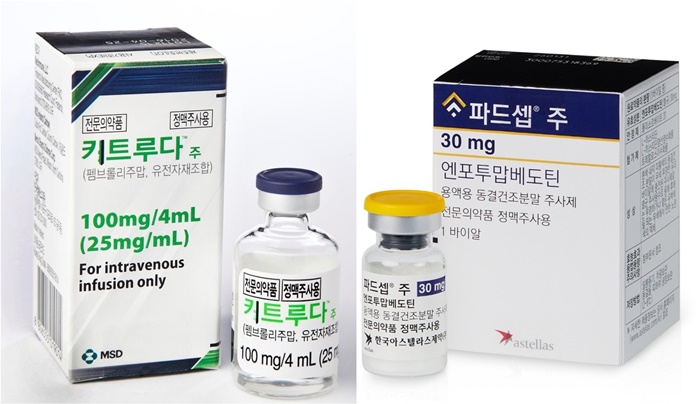
- 'Padcev Combination therapy' has been reported to have changed the urothelial cancer treatment paradigm after 30 years. After its launch in clinical practices in South Korea in the second half of last year, the government has initiated discussion for reimbursement of the therapy. Product photo of Keytruda and Padcev.According to the pharmaceutical industry on February 17, the Health Insurance Review and Assessment Service (HIRA) recently held the first Cancer Disease Review Committee (CDRC) for this year and discussed setting the reimbursement standards for the combination therapy containing Padcev (enfortumab, Astellas Pharma Korea) and Keytruda (pembrolizumab, MSD Korea). Padev was launched and became available for prescription in South Korea last year. It is an ADC anticancer agent for treating patients with metastatic urothelial carcinoma who failed previous treatments. In July 2024, indications were expanded as a first-line treatment in combination with Keytruda. Thus, Padcev is now an ADC anticancer agent approved for use in first-line to third-line treatments for metastatic urothelial carcinoma. Domestic approval was based on the EV-302 clinical study presented during the 2023 Congress of the European Society for Medical Oncology (ESMO Congress 2023). EV-302 is a randomized Phase 3 clinical study evaluating the effectiveness of Padcev+Keytruda combination therapy compared to platinum-based chemotherapy in 886 patients in 25 countries. Based on the study, at the median follow-up of 17.2 months, patients treated with Padcev combination therapy had a median overall survival (OS) of 31.5 months, extending the OS by approximately twofold compared to the platinum-based chemotherapy group and reducing death risk by 53%. The median progression-free survival (mPFS) of the combination therapy group was 12.5 months, and the mPFS of the platinum-based chemotherapy group was 6.3 months. The Padcev combination therapy extended the mPFS by approximately twofold. Based on this result, Astellas Pharma applied for reimbursement to the HIRA at the end of last year, and it has been considered for the first CDRC review for this year. However, the drug failed to pass the CDRC review after receiving the decision of 'reimbursement standards non-established.' Interestingly, Astellas Pharma had applied for reimbursement alone and its application was considered for the CDRC review. In the past, the review would have required applying for reimbursement with the Keytruda owner MSD. The policy has changed based on the global pharmaceutical companies' headquarters policy and the domestic‧foreign Fair Trade Act, and discussion with another pharmaceutical company can be considered 'price fixing.' As for Keytruda, which is used along with Padcev, MSD has not applied for reimbursement. It has been reported that MSD has applied for 17 indications, so the company may have been reluctant to file an additional one. However, the pharmaceutical industry believes that HIRA's approach toward combination therapies may have changed after the decision on the Padcev combination therapy. At the end of last year, HIRA announced the establishment of a review policy for reimbursement decisions on combination therapies. A pharmaceutical industry employee said who asked for anonymity said, "Last year, the CDRC review established a review policy for deciding on the reimbursement of combination therapies. However, the policy was limited to cases where a new drug is added to a previously reimbursed drug." He added, "The review of Padcev combination therapy indicates that an approach towards new drugs can be changed."
