
- LOGIN
- MemberShip
- 2026-06-22 09:57:42
- Opinion
- [Reporter's view] The National Assembly must restore
- by Lee, Jeong-Hwan Dec 17, 2024 05:51am
- On December 14, the National Assembly passed an impeachment motion against President Yoon Suk Yeol, causing the government to be partially paralyzed. The Ministry of Health and Welfare, the Special Presidential Committee on Healthcare Reform, and the National Bio Committee face significant disruptions in their ongoing policy initiatives. On Monday, December 16, following the weekend and holiday period after the impeachment decision, Minister of Health and Welfare Cho Kyoo-hong convened an emergency executive meeting at 9 a.m. Vice Minister Lee Ki-il, Second Vice Minister Park Minsoo, and department heads and directors of all key offices attended the meeting. Minister Cho Kyoo-hong directed the preparation of emergency medical response plans, respiratory disease management measures, and emergency healthcare services for the upcoming Korean New Year holiday. Cho also emphasized consistently and thoroughly implementing the recently announced regional·essential healthcare reinforcement strategies. Cho has been steadfastly emphasizing the MOHW's duties under Prime Minister Han Duck-soo, who is currently serving as acting president. Cho also faces unavoidable administrative disruptions. Minister Cho is himself under investigation as a suspect by the prosecution. The Special Presidential Committee on Healthcare Reform, led by Chairman Noh Yeon-hong, is facing increasing opposition from the medical community, creating uncertainty about its continued operation. Similarly, the National Bio Committee, where President Yoon Suk Yeol serves as chairman, is at risk of having its launch derailed. President Yoon Suk Yeol's duties were immediately suspended, and the Constitutional Court of Korea's impeachment trial was underway, resulting in political turmoil. The ruling People Power Party's leader, Han Dong-hoon, resigned voluntarily. In contrast, Lee Jae-myung, leader of the opposition Democratic Party, proposed the establishment of a National Stability Council for the ruling party. However, this suggestion has yet to gain traction. The impeachment vote has initiated the countdown for the Constitutional Court of Korea's ruling, with a final decision expected within 180 days and a new president to be elected within 60 days of the verdict. As the presidential office, government ministries, affiliated organizations, and the entire political landscape face chaos, the healthcare, pharmaceutical, and biotech industries are also encountering damages. The future of healthcare reforms, particularly those aimed at strengthening regional and essential medical services, is uncertain. The momentum for expanding medical school quotas has diminished. The pharmaceutical and biotech industries closely monitor the government's chaos, especially regarding how new regulatory·support policies, such as drug approvals·pricing, in 2025 will take shape. The remaining task is for the government and political parties to collaborate in restoring stability to the healthcare·biotech renewal policies, which have been left in chaos and now show the sings of ongoing conflict. Instead of focusing on battles between the opposing parties after the impeachment, the National Assembly must quickly secure a path forward for healthcare reforms critical to the nation's future. Furthermore, the National Assembly must identify and promote policies that support the pharmaceutical and biotech industries, providing the necessary legislative and government administrative support.
- Company
- SK Plasma will exclusively distribute Janssen’s Velcade
- by Nho, Byung Chul Dec 17, 2024 05:51am
- (From the left) Seungjoo Kim, CEO of SK Plasma, Christian Rodseth, Managing Director of Janssen Korea) SK Plasma, which specializes in plasma derivatives, has secured an additional rare disease treatment for its portfolio. SK Plasma (CEO: Seungjoo Kim) announced on the 16th that it had signed an exclusive domestic distribution agreement for the multiple myeloma and mantle cell lymphoma treatment Velcade inj (bortezomib triple complex) with Jassen Korea, Johnson & Johnson’s pharmaceutical division. Under the agreement, Janssen will manufacture and supply Velcade Inj, and SK Plasma will be responsible for its distribution and marketing in Korea. With this agreement, SK Plasma now owns a portfolio of leading blood cancer treatments, including Dacogen (myelodysplastic syndromes, acute myeloid leukemia) and Velcade (multiple myeloma, malignant lymphoma). “This agreement strengthens our oncology portfolio and enables us to supply a drug that has become a standard of care for multiple myeloma patients,” said Seungjoo Kim, CEO of SK Plasma. ”We will continue to develop and introduce various treatments for rare and incurable diseases to contribute to improving the quality of life for patients in Korea.” Meanwhile, SK Plasma signed an exclusive agreement with Janssen Korea in 2023 to market and sell Dacogen Inj (decitabine), a treatment for myelodysplastic syndromes and acute myeloid leukemia.
- Company
- Celltrion receives CHMP positive opinion for 4 biosimilars
- by Chon, Seung-Hyun Dec 17, 2024 05:51am
- Celltrion announced on the 16th that the. European Medicines Agency’s Committee for Medicinal Products for Human Use (CHMP) recommended marketing authorizations for its 4 biosimilar candidates. With the recommendations, Celltrion’s 4 biosimilar versions for Actemra, Eylea, Prolia, and Xgeva are expected to be approved in Europe. The biosimilars are named Avtozma, Eydenzelt, Stoboclo, and Osenvelt, respectively. Avtozma is a biosimilar version of the original Actemra, which is used to treat autoimmune diseases such as rheumatoid arthritis and giant cell arteritis. Celltrion’s biosimilar demonstrated bioequivalence and similarity to the original in a global Phase III clinical trial. The original Actemra posted global sales of approximately KRW 4 trillion last year. Eylea, the original version of Eydenzelt is used to treat ophthalmic conditions such as (wet) age-related macular degeneration (AMD), retinal vein occlusion macular edema, and diabetic macular edema. It generated global sales of about KRW 12 trillion last year. Stoboclo and Osenvelt are biosimilar versions of Prolia and Xgeva, respectively. Prolia and Xgeva are based on different doses and dosing intervals of the active ingredient denosumab. Prolia is approved for the treatment of osteoporosis and Xgeva is approved for the prevention of skeletal-related events in patients with bone metastases and the treatment of giant cell tumors of the bone. Together, Prolia and Xgeva generated KRW 8 trillion in sales last year. If Celltrion’s 4 biosimilars receive marketing authorization in Europe, Celltrion will be able to achieve its goal of securing 11 products in its portfolio by 2025. Celltrion currently has received approval or recommendation for approval for 11 biosimilars: Remsima, Remsima SC, Zymfentra, Yuflyma, SteQeyma, Avtozma, Herzuma, Truxima, Vegzelma, Omlyclo, Eydenzelt, Stoboclo, and Osenvelt. The global market size for all of the original products is nearly KRW 13.5 trillion. A Celltrion official said, “It is rare for the CHMP to recommend marketing authorization of 4 products from a single company at the same time, which became an opportunity for us to demonstrate our technology and development capabilities globally. We look forward to completing the remaining marketing authorization process and commercializing our products in Europe.”
- Company
- Keytruda and Vyloy to transform gastric cancer treatment
- by Moon, sung-ho Dec 17, 2024 05:51am
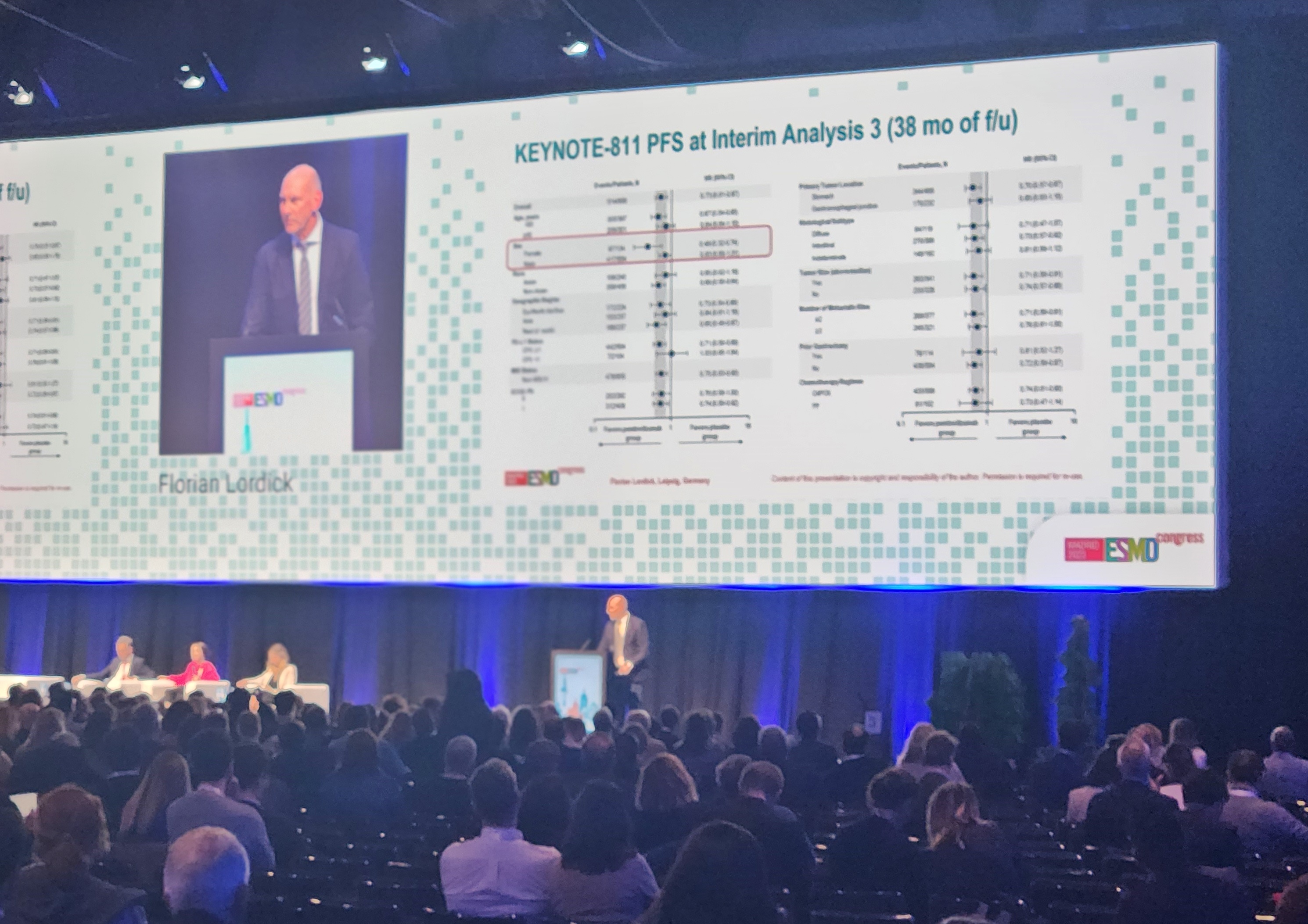
- Metastatic gastric cancer has long been labeled as a drug-barren area on site. Various clinical studies have been conducted to develop new therapies for the area, but most have been unsuccessful. This is due to the tumor's heterogeneity, which makes it difficult to prove the efficacy of treatments. However, the recent introduction of immuno-oncology drugs and targeted therapies has changed the treatment strategy in clinical practice. # The treatment paradigm for gastric cancer has now reached a state where the use of anticancer drugs is indispensable. However, due to obstacles in the domestic health insurance system, such as reimbursement and companion diagnostics, the use of these drugs in clinical practice is still limited. And pharmaceutical companies that are well aware of the situation have been scrambling to solve the problem. According to industry sources on the 13th, several drugs from global pharmaceutical companies have been approved in Korea for metastatic gastric cancer this year and are now available for clinical use. One representative drug is MSD Korea’s Keytruda (pembrolizumab). Keytruda was approved for the first-line treatment of metastatic HER2-positive gastric cancer, and in March this year, the indication was expanded to include HER2-negative gastric cancer. This makes Keytruda the first immuno-oncology option approved for both HER2-positive and HER2-negative gastric cancer. In the case of metastatic HER2-positive gastric cancer, the new indication was based on KEYNOTE-811, which was presented at the European Society for Medical Oncology’s ESMO Congress 2023. Specifically, after a median follow-up of 28.4 months, the Keytruda-trastuzumab-chemotherapy combination (10.0 months) reduced the risk of disease progression or death by 28% compared to trastuzumab-chemotherapy (8.1 months), resulting in a statistically significant improvement in PFS in the advanced HER2-positive gastric cancer ITT(intention to treat) population. The KEYNOTE-811 study, in particular, was expanded to a global clinical trial based on a trial led by Professor Sun Young Rha (Medical Oncology) at Yonsei Cancer Hospital. In addition, Keytruda was approved in March this year for the first-line treatment of HER2-negative gastric cancer, demonstrating clinical utility over chemotherapy regardless of the patient’s PD-L1 expression. Results from the KEYNOTE-859 trial, which became the basis of the drug’s approval for the indication, showed that at a median follow-up of 31 months, the median overall survival (OS) of the Keytruda-antineoplastic chemotherapy combination was 12.9 months, compared to 11.5 months with chemotherapy alone, and the risk of death was reduced by 22%. If Keytruda has changed the landscape of gastric cancer treatment as an immuno-oncology agent, Astellas' Vyloy (zolbetuximab) is the representative targeted therapy option. Vyloy is the first globally approved Claudin 18.2-targeted treatment, an immunoglobulin monoclonal antibody that binds to Claudin 18.2, a protein expressed and exposed in the stomach. Its approval in Korea allows Vyloy to be used in combination with fluoropyrimidine and platinum-based chemotherapy as a first-line treatment for patients with Claudin 18.2-positive, HER2-negative, unresectable locally advanced or metastatic gastric adenocarcinoma or gastro-oesophageal junction adenocarcinoma. The approval of Vyloy was based on two Phase 3 trials in patients with Claudin 18.2-positive and HER2-negative unresectable, locally advanced or metastatic gastric adenocarcinoma or gastro-oesophageal junction adenocarcinoma, the SPOTLIGHT and GLOW studies. In SPOTLIGHT, the median progression-free survival (PFS) in the Vyloy arm was 10.61 months, compared to 8.67 months in the control arm, reducing the risk of disease progression or death by approximately 25%. The secondary endpoint, median OS, was significantly higher in the Vyloy arm at 18.23 months versus 15.54 months in the placebo arm. Professor Sun Young Rha (Medical Oncology, Yonsei Cancer Hospital), Chairman of the Korean Cancer Association, said, “With an estimated prevalence of more than 100,000 patients with Stage IV gastric cancer in Korea, the approval of the first Claudin 18.2-targeted therapy will provide a breakthrough in the treatment of metastatic gastric cancer, an area that had limited options. In addition to expanding treatment options, the significant improvement in mOS compared to conventional chemotherapy, as Vyloy reduced the risk of disease progression or death by approximately 25%, is very encouraging in the treatment of metastatic gastric cancer due to its stagnant survival rate.” Keytruda’s expanded indication and the introduction of Vyloy have changed the treatment strategy for metastatic gastric cancer in Korea, but institutional obstacles have been obstructing its full use on-site. In the case of Keytruda, it has been difficult to cross the threshold of the Health Insurance Review and Assessment Service's Cancer Disease Deliberation Committee. It has applied for reimbursement for 17 indications but is being held up by the CDDC because it would require a significant investment in health insurance finances. As of August, the company has applied for insurance reimbursement benefits to the CDDC for a total of 17 indications, upon being granted marketing authorization for 33 indications in 17 cancers. After applying for reimbursement for 13 indications last year, the company added four more indications to the application this year, including MSI-H gastric cancer, MSI-H biliary tract cancer, HER2-positive gastric cancer, and HER2-negative gastric cancer. In addition, MSD Korea submitted a new reimbursement proposal in October to expand the reimbursement standard for 17 indications, including gastric cancer and is making every effort to set reimbursement standards this year. For reference, HIRA’s last CDDC meeting this year is scheduled for the 18th. However, it has been reported that there has not been a proper discussion made on the gastric cancer indication yet. If it fails to pass this year's CDDC review, Keytruda's application will enter its third year of deliberations. An MSD Korea official said, “Patients with gastric cancer, triple-negative breast cancer, and head and neck cancer, for which there are no current therapies available, are longing for the opportunity to be treated with Keytruda, which has demonstrated sufficient clinical utility. This reimbursement submission also includes the gastric cancer indication for which we applied for additional reimbursement expansion earlier this year. We hope it will be included in the final CDDC review.” Vyloy’s situation is different, but similar to Keytruda's. Companion diagnostics are required to use the drug, but this restriction is holding the drug’s use back. This is because HIRA is reportedly considering whether Roche Diagnostics' companion diagnostic test for Claudin 18.2, immunohistochemistry (IHC), should be evaluated as a new health technology in the reimbursement review process. If it is subject to a new health technology assessment, it would be difficult to utilize Vyloy in clinical practice during the review period, apart from its reimbursement. “If the companion diagnostic test method for Vyloy is subject to new health technology assessments, the introduction of the treatment in Korea may be delayed for up to a year,” said Rha. Targeted anticancer drugs and companion diagnostics inevitably go hand in hand, but the current system has structural limitations that do not support this, and patients are left to suffer the consequences. The KCA will continue to advocate for policy changes.”

- Policy
- Reimb of PE exemption drugs can be ex officio rejected
- by Lee, Tak-Sun Dec 16, 2024 05:53am
- In the future, drugs that sign refund-type risk-sharing agreements will be reviewed briefly by the Health Insurance Review and Assessment Service, focusing on changes, when a drug is reimbursed through the signing of the risk-sharing agreement more than 3 times. In addition, if a drug applies as a drug that can skip submission of pharmacoeconomic evaluation data but does not meet the requirements, such application can be rejected without committee deliberation. HIRA released a revision to the 'Detailed Evaluation Criteria for New Drugs and Other Drugs Subject to Negotiation' on the 12th that contains the changes above. The revision, which was finalized after deliberations by the Drug Reimbursement Evaluation Committee on the 5th, reflects improvements to the system for rewarding the innovation value of new drugs reported to the Health Insurance Policy Review Committee last year. HIRA has already revised the criteria once to reward the new drugs’ innovative value once in August. The new revision contains simplification of review for drugs that have signed 3 or more risk-sharing contracts. Specifically, it is possible to briefly review refund-type drugs, excluding multiple RSA-type drugs, starting from the evaluation related to the expiration of the second risk-sharing contract period (in the case the drug is signing the third or further risk-sharing contract), focusing on changes. There are also new requirements set to reject applications for ineligible PE exemption drugs. If an applicant applies for a determination that a drug falls under Article 6 (Drugs deemed essential for medical treatment) or Article 6.2 (Drugs that can waive the submission of pharmacoeconomic evaluation data) of the Regulations on Evaluation Criteria and Procedures for Eligibility for Medical Treatment Benefits, etc.’ HIRA stated that this addition was made to “clarify the processing criteria for drugs that are waived submitting pharmacoeconomic evaluation data for but fail to submit required data to improve work efficiency.”
- Company
- Soaring exchange rate causes pharma asset value to fluctuate
- by Kim, Jin-Gu Dec 16, 2024 05:53am
- The sharp rise in the won-dollar exchange rate in the aftermath of the impeachment and martial law has had a significant impact on the asset value of pharmaceutical and biotech companies. Companies with much foreign currency assets held in dollars have shown a significant increase in their asset value due to the high exchange rate, such as Samsung Biologics and SK Biopharm, which have a large share of overseas business. On the other hand, companies with large foreign currency liabilities held in dollars experienced a decrease in asset value due to the rise in the exchange rate. #SB 'High exchange rate' gains for firms with large dollar assets...Samsung Biologics’ asset value rises to KRW 112.9 billion when the exchange rate rises by 10% According to industry sources, the won-dollar exchange rate closed at KRW 1,432.80 on the Seoul foreign exchange market on the 14th, up 1.00 won from the previous trading day. The won-dollar exchange rate has recently remained above KRW 1430 in the aftermath of the declaration of emergency martial law and failed the impeachment vote. In Q3, the average won-dollar exchange rate was KRW 1,358.55. In the 3 months since it has risen to over KRW 1430, an increase of over 5%. Compared to last year, the increase is even greater. In Q4 last year, the average exchange rate was KRW 1321.24, which rose more than 8% in a year. Some analysts predict that if the current turmoil continues, the won-dollar exchange rate could reach KRW 1,500. Changes in the won-dollar exchange rate The rise in the exchange rate can have a modest impact on the asset value of pharma-bio companies. In particular, companies with a large proportion of overseas business are greatly affected by the exchange rate due to the assets and liabilities they hold in foreign currencies. If the company owns much foreign currency assets in dollars, the asset value will increase due to the rise in the exchange rate, and conversely, if there are many financial liabilities borrowed in dollars, the asset value will decrease. In its latest quarterly report, Samsung Biologics explained that every 10% rise in the won-dollar exchange rate increases its net income before corporate taxes by KRW 112.9 billion. Considering that the current KRW-dollar exchange rate has risen by about 5% compared to the average exchange rate in the third quarter, the time of the quarterly report, it is calculated that the recent rise in the exchange rate has increased the corporate’s asset value by about KRW 50 billion. In the case of SK Biopharmaceuticals, every 10% rise in the exchange rate increases the value of its assets by KRW 7.8 billion. Chong Kun Dang’s asset value increased by KRW 1 billion. The analysis is that companies that own more assets than liabilities held in dollars would show an increase in asset value. #SB Cashable assets of Samsung Biologics, Celltrion, Dong-A ST, increase due to exchange rate fluctuations The rise in exchange rates will especially affect the cash and cashable assets of major pharmaceutical and biotech companies. They have already increased their cash and cash equivalents by hundreds of millions of won to tens of billions of won in the third quarter due to the rise in the exchange rate. If the current high exchange rate continues to the fourth quarter, it is expected that the companies’ cash and cashable assets will increase even further. Samsung Biologics reported cash and cash equivalents of KRW 540.2 billion at the end of the third quarter, an increase of KRW 172.3 billion from the KRW 367.9 billion at the end of the second quarter. The increase in cash and cash equivalents was partly driven by a rise in the exchange rate. The company explained that the effect of foreign exchange rate fluctuations on cash and cash equivalents amounted to KRW 19.9 billion. Approximately 9% of the increase in cash and cash equivalents in the third quarter (KRW 172.3 billion) was attributable to foreign exchange rate changes. During the same period, Celltrion's cash and cash equivalents increased by KRW 408.1 billion, up from KRW 564.6 billion to 972.7 billion, of which KRW 4.1 billion was attributable to foreign exchange rate changes. Dong-A ST's cash and cash equivalents increased from KRW 212.8 billion to KRW 301.3 billion. Of this, the increase in cash and cash equivalents due to exchange rate fluctuations amounted to KRW 700 million. In the case of SK Biopharm, cash and cash equivalents increased from KRW 239.7 billion to KRW 266.0 billion, with the effect of exchange rate fluctuations amounting to nearly KRW 200 million. In the case of Chong Kun Dang, Hanmi Pharmaceutical, and Daewoong Pharmaceutical, the companies’ cash and cash equivalents decreased in the third quarter compared to the second quarter, but cash and cash equivalents ultimately increased due to the effect of exchange rate changes. Exchange rate changes partially offset the decrease in cash and cash equivalents. At Chong Kun Dang, cash and cash equivalents decreased from KRW 219.6 billion at the end of the second quarter to KRW 203.1 billion at the end of the third quarter. However, it increased by KRW 1.3 billion due to exchange rate changes. If the exchange rate had not risen, the decrease in cash and cash equivalents would have been even greater. Hanmi Pharmaceutical's cash and cash equivalents decreased from KRW 55 billion to KRW 48.2 billion. However, it increased by KRW 1.6 billion due to the effect of exchange rate fluctuations. Daewoong Pharmaceutical saw a decrease in cash and cash equivalents from KRW 111.5 billion to KRW 94.6 billion, with an increase of KRW 1.1 billion due to the effect of exchange rate changes. If the current high exchange rate continues, the effect of the exchange rate fluctuations is expected to contribute more significantly to the overall increase in cash and cash equivalents of corporations. At Yuhan Corp, cash and cash equivalents decreased from KRW 299.3 billion at the end of the second quarter to KRW 229.9 billion at the end of the third quarter, with a decrease of KRW 500 million in cash and cash equivalents due to exchange rate fluctuations over the same period. The decrease in cash and cash equivalents is attributed to the exchange rate rise, as the companies had more financial liabilities in dollars than financial assets.
- Policy
- NHIS to expand the special estimate case system in 2025
- by Lee, Tak-Sun Dec 16, 2024 05:52am
- The National Health Insurance Service (NHIS) (Chairman: Jung Ki Suck) has announced plans to expand the reimbursement criteria for special cases of new rare diseases, starting on January 1, 2025. The NHIS aims to enhance essential medical support for individuals who currently do not benefit from receiving healthcare, including patients with rare diseases. The NHIS' special estimate case system lowers the national health insurance partial co-payments, reducing the burden of co-payments to help alleviate the financial burden on patients with severe diseases, such as cancer and rare diseases. When this special estimate case system is applied, patients receive hospitalization·outpatient co-payment rates of 0-10%. The NHIS has been expanding the reimbursement criteria for special estimate cases of rare diseases by collaborating with the Korea Disease Control and Prevention Agency (KDCA) and consulting with academic organizations and experts, then proceeding with a rare disease management committee (Ministry of Health and Welfare, MOHW) and special estimate cases committee (NHIS) reviews·decisions. This year, the NHIS has expanded special estimate cases to 66 new rare diseases, including 'achalasia (K22.0).' Rare diseases to be covered by special estimate cases system taking effect on January 1, 2025, will be increased from 1248 to 1314 cases. Following the expansion, new patients with rare diseases will pay a co-payment corresponding to 10% of the medical fee for diseases registered under the special estimate cases system and side effects directly caused by those diseases. Approximately 14,000 individuals are expected to benefit from lowered medical fees. "The NHIS will continue to collaborate with the MOHW and KDCA to identify rare diseases with severe symptoms that incur high medical costs and requires long-term treatment, thereby enhancing essential healthcare security for vulnerable populations," Kim Nam-hoon, NHIS's senior director of reimbursement, stated.
- Company
- Daiichi Sankyo appoints Sunjin Lee to head Enhertu BU
- by Eo, Yun-Ho Dec 16, 2024 05:52am
- Sunjin Lee, head of Enhertu BU, Daiichi Sankyo Korea Daiichi Sankyo Korea has appointed Sunjin Lee (47), a former executive director of Takeda Pharmaceuticals Korea, as the new head of Daiichi Sankyo. According to industry sources, Daiichi Sankyo recently made the appointment. Lee will succeed Mr. Hyun-Joo Lee (48), who has left to head ZP Therapeutics Korea. After working at Baxter Korea and Boehringer Ingelheim Korea, Lee joined Takeda in 2017 as the Marketing Manager of Takeda's Hemophilia Business Unit, where she developed creative marketing strategies. At the company, Lee was recognized for her leadership skills, playing a pivotal role in improving access and awareness of Takeda's hemophilia business. Later, as the Launch & Digital Excellence Lead for the company’s Asia Pacific (APAC) region, she led product launches in the market and successfully executed projects, including providing vision and direction for the execution of digital transformation in APAC countries. Since 2022, Lee has led Takeda's Oncology Business Unit, where she has been responsible for promotional activities for anti-cancer drugs such as Zejula and Alunbrig. Meanwhile, Daiichi Sankyo's Oncology Business Unit, represented by the antibody drug conjugate (ADC) Enhertu, is an integrated business unit that involves the company’s licensing, drug pricing, and medical departments. Daiichi Sankyo seeks to become a global player in Oncology by 2025, and Enhertu is currently reimbursed in Korea.
- Policy
- HLB Pharma applies for reimb of 'Citrelin ODT' for SCD
- by Lee, Tak-Sun Dec 16, 2024 05:52am
- HLB Pharma HLB Pharma has reportedly applied to the Health Insurance Review and Assessment Service (HIRA) for reimbursement of 'Citrelin ODT,' a domestically distributed treatment for spinocerebellar degeneration. This product was approved in South Korea in 2015, but it has been distributed to the Korean market as a non-reimbursed drug. However, with the successful completion of its recent Phase 4 trial, involving Korean patients, the company may now attempt to obtain reimbursement for the drug. According to industry sources on December 16, the HIRA received an application for the reimbursement of Citrelin ODT and has begun its review. Citrelin ODT 5mg (taltirelin) received approval from the Ministry of Food and Drug Safety (MFDS) in Korea on February 6, 2015. It is orally administered twice daily after a meal to improve ataxia caused by spinocerebellar degeneration. Spinocerebellar degeneration (SCD), an inherited cerebellar disorder, is a degenerative disease affecting the cerebellum or spinal cord with an unknown cause. It accompanies degenerative symptoms, including ataxia, optic atrophy, and muscle spasm. Ataxia can lead to the loss of the capacity to control arm and leg muscles, causing gait and language dysfunction. It is reported to significantly hinder patients' quality of life. HLB has signed an exclusive agreement with Japan's Osaka Synthetic Chemical Laboratories (OSCL), the Citrelin ODT developer, and has been distributing the drug in South Korea. In 2017, the company attempted to obtain reimbursement. At the Drug Reimbursement Evaluation Committee (DREC) held in October 2017, a decision for re-evaluation was issued due to insufficient evidence for reimbursement approval, such as textbooks and guidelines. It was decided that the drug needed to be re-evaluated to see if it was necessary for medical use and meeting the reimbursement criteria when the company additionally submitted documents regarding the effectiveness of the drug. After that, the review held in January 2018 concluded that the drug is non-reimbursable due to insufficient evidence proving its clinical effectiveness and its costs being higher than that of other substitute drugs. Since the decision, the company has been focusing on proving the drug's clinical effectiveness by conducting a Phase 4 clinical trial involving Korean patients. Recent results from Phase 4 clinical trials were published in the 'Journal of Movement Disorder,' a SCI-grade international journal. The clinical trial involved a total of 160 study participants, 79 receiving the treatment drug and 81 receiving a control, randomly assigned. The results showed that the drug significantly reduced the K-SARA (Korean version of Scale for the Assessment and Rating of Ataxia), an objective evaluation index for ataxia, after 24 weeks of treatment. The company stated that they have confirmed this statistical significance. It is reported that Citrelin ODT is distributed at about KRW 12,000 per tablet. It costs about KRW 9 million annually. Confirming effectiveness in Korean patients is expected to impact reimbursement listing reviews for national health insurance positively. When the drug gets listed in the reimbursement list, patients will be able to afford the drug at a much cheaper price. Attention has been drawn to whether Citrelin ODT will be listed for reimbursement 10 years after it was approved in South Korea.
- Policy
- Otezla generics enter negotiations for reimb
- by Lee, Tak-Sun Dec 13, 2024 05:52am
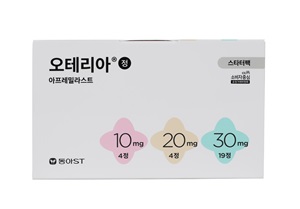
- Dong-A STGeneric to Otezla (apremilast, Amgen), which is used to treat psoriatic arthritis and psoriasis, is being considered for reimbursement negotiations with the National Health Insurance Service (NHIS). Attention has been drawn to whether a generic drug will be listed for reimbursement, the process in which a company with the original drug gave up. According to industry sources on December 11, the NHIS has recently included five products containing apremilast to the list of drugs for price negotiations. These medicines include 5 products: Dong-A ST's 'Otelia,' Daeowoong Pharmaceutical's 'Apsola,' Chong Kun Dang's 'Otebell,' Dongkoo Bio's 'Otemila,' and Hanlim Pharm's 'Psopre Tab.' Otezla received approval from the Ministry of Food and Drug Safety (MFDS) in South Korea in November 2017. However, the company withdrew from the Korean market due to difficulty listing the drug for reimbursement. Amgen voluntarily withdrew approval in June 2022. However, Otezla's sales have been skyrocketing in the overseas market. It recorded no.1 among oral psoriatic treatments in global sales last year. It is reported that Otezla recorded sales of US$3.984 billion (about KRW 5.5 trillion) last year worldwide. Recognizing Otezla's superior effectiveness and marketability, Korean pharmaceutical companies have been putting efforts into registering the drug in the reimbursement market ahead of the original drug. Pharmaceutical companies with generics successfully avoided two cases of active ingredient patents registered in South Korea. They have successfully overcome the patent challenge by signing an agreement with Amgen for the remaining usage patent. Based on these outcomes, they received approval from the MFDS in April. Generics have entered the market that the original drugs withdrew. For instance, Dong-A ST launched the Otelia tab in July as non-reimbursed. The Drug Reimbursement Evaluation Committee (DREC) review held in October ruled that medicines would be appropriate for reimbursement coverage if the company accepted the drug price below the evaluated amount. Analysis suggests that relevant pharmaceutical companies have accepted the drug price below the evaluated amount and proceeded with the negotiation phase with the NHIS. Because most companies tend to accept a drug price negotiation exemption criterion when they accept the drug price below the evaluated amount, they are likely to proceed with the negotiations for the expected claim amount. Then, they could conclude the negotiation early and be more likely to reach an agreement. Meanwhile, besides the current discussions for apremilast, the NHIS has started negotiating with the reimbursement expansion for Darzalex. Janssen, which owns Darzalex, is proceeding with getting reimbursement for DVTd therapy (Darzalex+bortezomib+thalidomide+dexamethasone) as a first-line treatment for multiple myeloma.
